- The paper systematically investigates how higher symmetries emerge in axion effective field theories through anomaly inflow mechanisms, setting strict energy scale constraints.
- The analysis uses prototypical axion-Maxwell and UV-completed models to quantify symmetry breaking and emergence ordering via defect operators and mixed anomalies.
- The study unifies infrared axion phenomena by linking non-invertible symmetry defects with topological couplings, guiding UV completion strategies.
Generalized Symmetries and Emergence in Axion Effective Field Theories
Overview and Motivation
This paper systematically examines the role of higher symmetries—specifically higher-group and non-invertible structures—in axion effective field theories (EFTs). The authors formulate and analyze parametric emergence constraints, which dictate the ordering of energy scales where various generalized symmetries manifest in axion EFTs. These constraints are devised from the anomaly structure in both abelian and non-abelian gauge sectors and are shown to be universally enforced via anomaly inflow mechanisms localized on topological defects such as axion strings and monopoles. This approach provides a symmetry-based organizational principle for infrared axion physics, and clarifies the connection between UV completion and effective anomaly data.
Higher Symmetries and Anomalies in Axion-Maxwell Theory
The axion-Maxwell system is used as a prototypical example due to its rich symmetry landscape encompassing higher-form (p-form), higher-group, and non-invertible symmetries. The action includes an axion coupled to a U(1) gauge field with a topological aF∧F interaction. In the absence of this coupling, the theory enjoys continuous axion-shift and winding symmetries as well as electric and magnetic 1-form symmetries, which are parametrized by conserved currents.
Upon introducing the axion-gauge coupling, the zero-form (axion shift) and electric 1-form symmetries are broken to their discrete, non-invertible counterparts, directly manifesting in the non-conservation of their associated currents. The authors classify defect operators implementing these symmetries and embed them in a framework with background gauge fields, extending the analysis to bulk-boundary relations and mixed 't Hooft anomalies.
Emergence constraints arise from the intertwined background gauge redundancies indicative of higher-group structure; a symmetry can only emerge in the IR if all symmetries responsible for its correlated background transformations have already emerged. Thus, the scale of emergence for one symmetry is bounded by those of others. The explicit inequalities for the axion-Maxwell theory are enforced by anomaly inflow mechanisms, which require axion strings, monopoles, and their higher-dimensional generalizations to host localized, charged zero modes, breaking the corresponding symmetries.
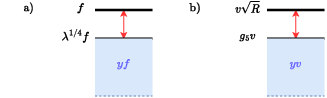
Figure 1: For the 3+1d KSVZ model, vacuum stability (yf≲λ1/4f) separates Eelectric∼yf and Ewinding∼f, enforcing emergence ordering whenever λ is perturbative.
UV Completions and Scale Hierarchies
The authors scrutinize two classes of perturbative UV completions: the 3+1d KSVZ axion model and a 4+1d Georgi-Glashow-type construction.
- KSVZ Model: The emergence scale of the electric symmetry is set by the mass of charged fermions mΨ∼yf, whereas the winding symmetry emergence scale is ambiguous but computed via fluctuations of the scalar field, yielding estimates of either Ewinding∼λ1/4f or Ewinding∼f. Here, vacuum stability requirements robustly enforce the energy ordering predicted by the emergence constraints, with scale separation arising from the loop-modified quartic terms and unitarity bounds.
- 5d Completion: A higher-dimensional axion setup leads to magnetic 2-form symmetry emergence scales computed via effective charge renormalization, as per Uehling-type corrections generalized to the 5d context. The unitarity bounds and vacuum stability once again guarantee the separation of relevant emergence scales in perturbative regimes.
Both cases demonstrate that emergence constraints are not just satisfied but typically overshoot, owing to parametric separation caused by perturbativity; however, the underlying mechanism is anomaly inflow, which enforces the constraints universally.

Figure 2: The worldvolume of a magnetic brane requires attachment to a TQFT on U(1)0; if the TQFT has a 't Hooft anomaly for global symmetry U(1)1, then U(1)2 is broken on the brane, consistent with inflow-induced charged modes.
Anomaly Inflow as Universal Enforcement
The paper identifies anomaly inflow as a UV-independent and robust mechanism underpinning all emergence constraints. Axion strings and monopoles inevitably acquire charged degrees of freedom on their worldvolumes, which directly break electric or center symmetries and generate axion potentials via loop effects. These phenomena are closely tied to the symmetry defect algebra: construction of non-invertible defects often requires half-gauging the relevant symmetry, and fusion of these defects results in the sum over invertible symmetry breaking defects.
The authors demonstrate that the inflow-induced symmetry breaking is precisely dictated by the structure of the symmetry defects, the associated TQFTs attached to brane worldvolumes, and the anomalies encoded in the bulk terms. Thus, the correspondence between higher symmetries and inflow is both qualitative (via symmetry breaking) and quantitative (via the emergence scale inequalities).
Generalizations: Axion Yang-Mills and Charged Matter
The analysis is extended to non-Abelian sectors, particularly axion-Yang-Mills theories with general global structures (e.g., U(1)3 or U(1)4), where the emergence constraints are modified by fractional instanton numbers and center symmetry properties. The existence of higher-group structures and non-invertible defects remains, now dependent on the representations of matter and the details of bundle global structure.
When charged matter is present, electric (or center) 1-form symmetries are explicitly violated, but higher-group structures continue to exist via replacement by flavor symmetries and quotient constructions. The constraints are then interpreted in terms of flavor symmetry emergence, and are again universally enforced via anomaly inflow.
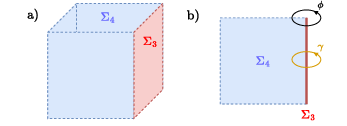
Figure 3: a) 0-form gauging of magnetic symmetry in 3+1d; b) 1-form gauging in 4+1d. Non-trivial linking/intersection between Wilson lines and symmetry surfaces results in non-invertible defect action and correlated symmetry breaking.
Theoretical Implications and Future Directions
This work provides a formal symmetry-based framework for organizing axion phenomenology, demonstrating that symmetry emergence constraints are encoded in the infrared anomaly structure and enforced by inflow onto topological defects regardless of UV completion. The analysis unifies a variety of infrared effects—axion potentials from monopole loops, charged zero modes on defects, and constraints on effective theory validity—under the umbrella of generalized symmetries.
Potential avenues for further exploration include applications to lower-dimensional models, extensions to more intricate global symmetry groups (such as those relevant in the Standard Model), and investigation of emergent symmetry constraints in grand unified theories and cosmological contexts. The connection between non-invertible defects, topological phases, and anomaly inflow suggests a fertile ground for future theoretical developments, particularly in mapping UV anomaly data to IR emergent phenomena.
Conclusion
The paper rigorously establishes that emergence constraints for generalized symmetries in axion EFTs follow from the structure of 't Hooft and ABJ anomalies and are universally saturated by anomaly inflow mechanisms onto topological defects. The symmetry-based perspective presented not only organizes a wide class of axion-driven infrared phenomena but also guides UV completion strategies and the interpretation of energy scale hierarchies in field theory. This paradigm is likely extensible to a broad variety of effective theories with topological couplings and rich symmetry structures, marking a significant advance in the symmetry-based organization of particle and condensed matter physics.

