- The paper demonstrates that spin and momentum decouple during quarkonium hadronization as rapid decoherence from soft gluonic fields quenches polarization.
- It employs the Lindblad formalism to relate fragmentation fraction z to observable suppression of angular parameters like λθ and λφ.
- The model reconciles NRQCD predictions with high-pT collider data, suggesting a paradigm shift in understanding quarkonium formation in jets.
Spin-Momentum Decoupling and Polarization Quenching in Quarkonium Hadronization
Introduction
The persistent discrepancy between Non-Relativistic QCD (NRQCD) predictions and observed heavy quarkonium polarizations at high transverse momentum (pT) in hadronic collisions has highlighted a critical shortcoming in the theoretical treatment of hadronization. The foundational assumption in NRQCD—that spin information survives hadronization due to a close coupling between the momentum and spin sectors—clashes with data from CDF, CMS, and ATLAS, which systematically report a largely unpolarized quarkonium state at high pT. The paper "Spin-Momentum Decoupling in Quarkonium Hadronization: Polarization Quenching via Environment-Induced Decoherence in Jets" (2604.11847) advances a paradigm shift, positing that the rapid decoherence induced by the stochastic chromo-electric environment inside jets severs the correlation between momentum and spin, leading to polarization quenching not accounted for by baseline perturbative QCD.
The core concept is that at pT≫2mQ≫ΛQCD, the quark-antiquark pair experiences immense kinematic inertia, safeguarding the hard production spectrum established by perturbative QCD. However, during color neutralization, the quarkonium is embedded in a bath of soft gluonic fields, whose color exchanges are energetically negligible relative to pT and cannot disrupt the macroscopic trajectory.
The approach constructs a parametric timescale separation: kinematical relaxation (τkin) scales with mQ/ΛQCD, while quantum spin decoherence (τdecoh) is inversely proportional to the local effective bath strength (Teff). This ordering, τdecoh≪τkin, ensures that the density matrix's off-diagonal spin elements are destroyed (decohered) long before any appreciable momentum relaxation.
Environment-Induced Decoherence: Theoretical Construction
The decohering environment is modeled as a stochastic thermal bath generated by the multiplicity of soft partons in jet fragmentation. Employing a horizon-inspired analogy, the effective string tension σeff(z) for a given fragmentation fraction pT0 grows as pT1. The associated effective temperature pT2 parameterizes the noise strength responsible for quantum decoherence.
This environment is incorporated into the Lindblad formalism for open quantum systems, with the reduced spin density matrix pT3 evolving under isotropic dissipators constructed from the pT4 operators. The formulation predicts a drive toward the maximally mixed state, with decoherence rates proportional to pT5. The Planck-like KMS-motivated transition rate imparts pT6-dependence to the polarization suppression.
Phenomenological Implications
Through convolution with the measured fragmentation function pT7, this framework naturally reproduces the observed unpolarized anomaly in inclusive pT8 measurements, obviating the need for ad hoc LDME fine-tuning. Notably, the mechanism predicts not only suppression of pT9, but also simultaneous attenuation of the azimuthal parameter pT≫2mQ≫ΛQCD0 and the frame-invariant pT≫2mQ≫ΛQCD1 as pT≫2mQ≫ΛQCD2 decreases. The recent CMS observation that most pT≫2mQ≫ΛQCD3 production occurs at pT≫2mQ≫ΛQCD4 places the majority of the yield deep in the decohered regime.
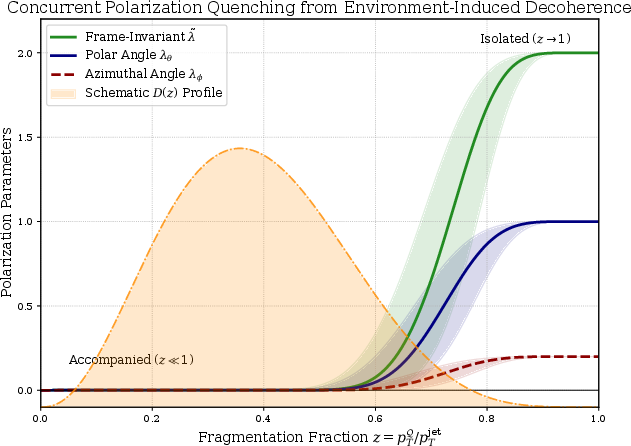
Figure 1: Theoretical prediction of the concurrent quenching of angular parameters (pT≫2mQ≫ΛQCD5) and the frame-invariant pT≫2mQ≫ΛQCD6 as a function of fragmentation fraction pT≫2mQ≫ΛQCD7; the main cross-section weight (schematically shown in orange) is captured in the maximally decohered region.
This formalism predicts that in kinematic bins with pT≫2mQ≫ΛQCD8, where the soft background is depleted, perturbative polarization should be observable. For the pT≫2mQ≫ΛQCD9 (bottomonium) system, larger pT0 leads to a higher threshold pT1 for recovery of polarization, in contrast to the pT2 (charmonium).
Theoretical and Practical Consequences
On the theoretical front, this paradigm imposes a re-evaluation of quarkonium hadronization as an inherently open-system process with rapid environmental decoherence, rather than as a closed-system evolution prescribed solely by NRQCD. The model's predictive power for pT3-dependence in polarization observables provides a new avenue for systematic experimental validation, especially in jet-resolved quarkonium measurements. Practically, this framework sets quantitative benchmarks: comparative studies across hadronic and pT4 environments, as well as systematic variation of jet pT5 and mass hierarchies, can be used to explicitly test the decoupling hypothesis.
Future Prospects
The model suggests several future directions: explicit incorporation of orbital angular momentum and spin-orbit coupling effects, derivation of the effective bath parameters from first-principles QCD, and application to other hadron species produced in jets. The formalism is extensible to multi-dimensional angular analyses and jet substructure observables, implying a path toward disentangling universal mechanisms of QCD decoherence.
Conclusion
This work synthesizes an open quantum system approach to resolve the long-standing quarkonium polarization anomaly in jet environments, rooted in the natural timescale hierarchy of high-energy QCD and formulated through a Lindblad master equation with a dynamically enhanced effective temperature. It posits and supports the decoupling of spin and momentum in hadronization, predicting pT6-dependent polarization quenching confirmed by modern collider data. This perspective lays a robust foundation for advancing both experimental analyses and theoretical treatments of spin in QCD jets.