An AI-based Detector Simulation and Reconstruction Model for the ALEPH Experiment at LEP
Published 12 Apr 2026 in physics.ins-det, hep-ex, and hep-ph | (2604.11834v1)
Abstract: We present the application of Parnassus, a generative model for full detector simulation and reconstruction, to the ALEPH detector at the Large Electron-Positron Collider (LEP). Training on simulated $e+e-$ to Z to qqbar events processed through the ALEPH detector simulation and reconstruction, we demonstrate that Parnassus faithfully reproduces the detector response at the event, jet, and particle levels. The clean $e+e-$ environment, free of pileup and characterized by simple event topologies, provides a well-controlled benchmark for evaluating the generative model's fidelity. Our results demonstrate that modern neural-network-based generative simulation approaches, developed primarily for LHC experiments, generalize naturally to historical collider experiments with distinct detector geometries and physics environments. This work shows that Parnassus can be applied beyond the LHC context and serves as an important tool for legacy data analysis where archival software tools are challenging to resurrect.
The paper introduces a transformer-based generative model (Parnassus) that generalizes AI simulation techniques from LHC to the ALEPH experiment.
It employs conditional flow-matching networks at both particle and event levels to faithfully reproduce key observables such as jet substructure and vertex information.
The results, with residuals at a few-percent level, showcase strong agreement with full simulation benchmarks and highlight potential for ML-driven data reuse in legacy HEP datasets.
AI-based Fast Detector Simulation and Reconstruction for ALEPH at LEP
Introduction
The paper "An AI-based Detector Simulation and Reconstruction Model for the ALEPH Experiment at LEP" (2604.11834) addresses the generalization of modern high-fidelity AI-based fast simulation and reconstruction techniques to the ALEPH experiment at the Large Electron-Positron Collider (LEP). The work leverages the Parnassus framework—a modular, neural-network-based generative approach originally designed for LHC-class detectors—and establishes its effectiveness when confronted with the different experimental environment and geometry of ALEPH.
The successful extension of Parnassus not only demonstrates the portability of advanced ML-driven simulation tools but provides vital infrastructure for reinterpreting and extending the scientific reach of legacy HEP datasets. A salient motivation is the absence of native fast-simulation tools for ALEPH, combined with limited availability of full simulation samples in the public domain.
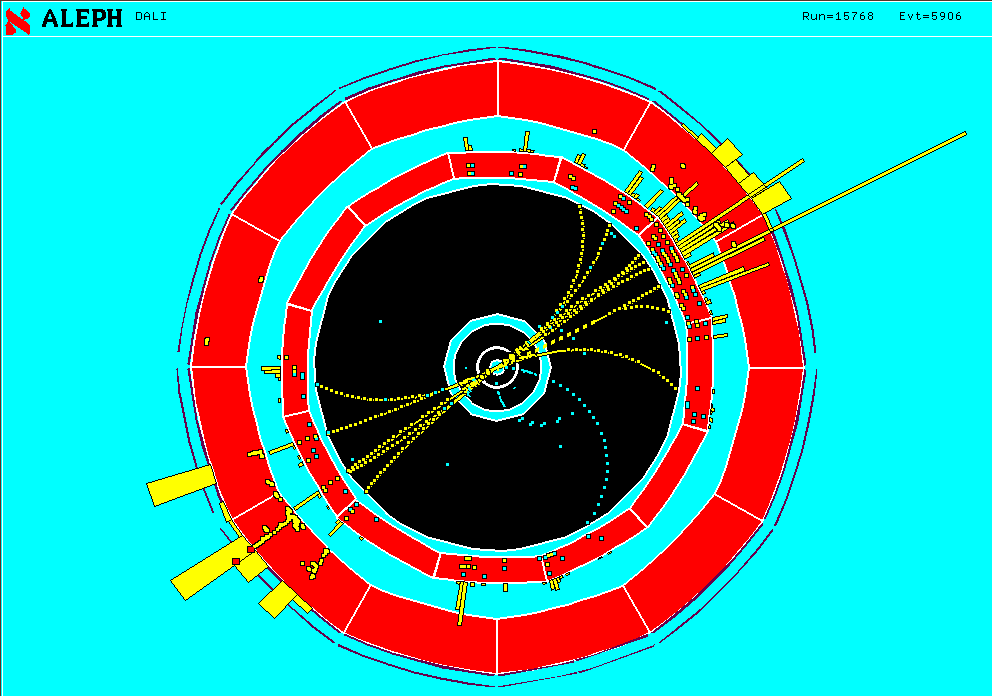
Figure 1: An event display of a collision in the ALEPH detector, illustrating the characteristic two-jet topology and detector geometry relevant to the LEP environment.
Dataset and Experimental Context
The training data comprises simulated e+e−→Z→qqˉ events at s≈91.2 GeV, processed through full ALEPH Geant3-based simulation and canonical reconstruction algorithms. ALEPH, with its time projection chamber, electromagnetic and hadronic calorimeters, and solenoidal 1.5 T field, was engineered for precise charged-particle tracking and nearly hermetic calorimetry. In contrast to pileup-rich, complex pp events at the LHC, LEP's clean e+e− collisions are essentially free of pileup and yield predominantly two-jet topologies, providing a controlled environment to scrutinize detector modeling at both coarse and granular levels.
The scale and curation of the ALEPH dataset—over one million usable events with stringent reconstruction and truth-matching requirements—enables statistically robust training, validation, and evaluation, with explicit separation to mitigate leakage.
Generative Simulation and Reconstruction Framework
Parnassus employs a conditional, flow-matching generative architecture with a transformer backbone, designed to capture correlations across reconstructed objects at both particle and event granularity. The approach includes:
Particle-level model: Conditional flow-matching network for variable-length sets of reconstructed particles, conditioned on global event features.
Event-level model: Flow-matching network that enforces consistency for aggregate event-level quantities.
Input representations encompass standard particle-flow features: pT, η, ϕ, mass, charge, and vertex position (vx, vy, vz). The networks are jointly optimized to learn the mapping from generator-level (truth) information to reconstructed (detector-level) observables, including the modeling of stochastic detector effects and multi-object correlations.
Fast-simulation proceeds by sampling from the particle-level model and refining with the event-level module, with jet finding applied post-generation using anti-s≈91.20, s≈91.21. Data/MC comparisons utilize both absolute quantities and normalized residuals.
Event-Level Performance
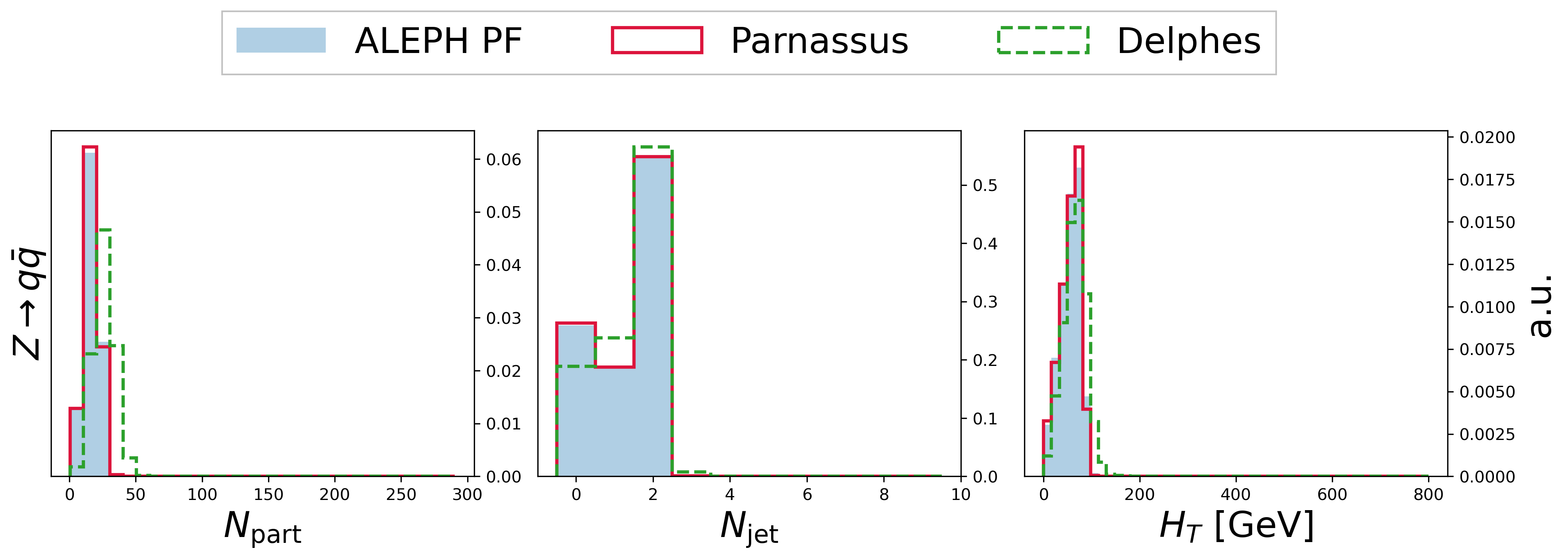
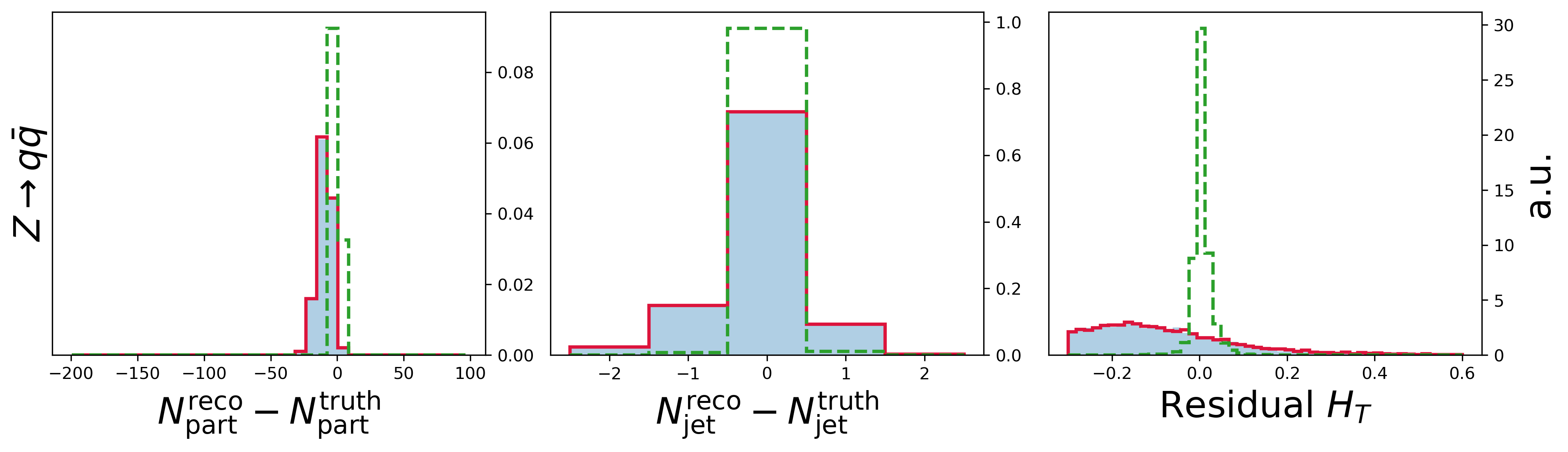
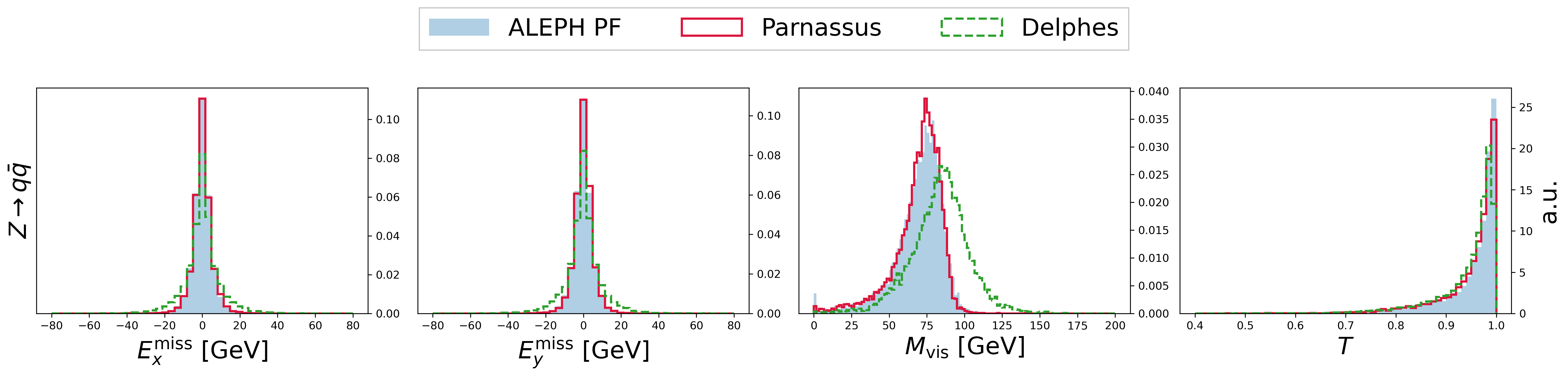
The fidelity of Parnassus at the event level is benchmarked against both ALEPH full simulation and the Delphes fast-simulation baseline. Key observables include reconstructed particle and jet multiplicities (s≈91.22, s≈91.23), missing transverse energy components (s≈91.24, s≈91.25), total scalar s≈91.26 sum (s≈91.27), visible mass (s≈91.28), and thrust (s≈91.29).
Figure 2: Event-level distributions comparing Parnassus, ALEPH full simulation, and Delphes; top: absolute distributions, bottom: normalized residuals.
Figure 3: Distributions of pp0, pp1, pp2, and thrust pp3 at the event level.
Numerical agreement is strong throughout, including:
Accurate reproduction of the broad, low-peaked pp4 and two-jet-dominated pp5 with correct population of higher-multiplicity outliers.
Symmetric, centered missing pp6 matching both core and tails.
Visible mass and thrust distributions are modelled well in terms of peak, width, and tail structure, critical for LEP Standard Model analyses.
Residuals are contained at the few-percent level, centered near zero across the full observable space, including the soft-activity regions.
Jet-Level and Substructure Validation
At the jet level, Parnassus provides a decisive improvement over Delphes in both kinematics and internal substructure.
Figure 4: Jet pp7, pp8, pp9, e+e−0, and e+e−1 distributions (top), with normalized residuals (bottom) for Parnassus, ALEPH full simulation, and Delphes.
The steeply falling e+e−2 spectra across two orders of magnitude, symmetric e+e−3, and uniform e+e−4 are modeled with high precision.
Substructure discriminants—e+e−5 (two-prongness) and e+e−6 (soft-gluon sensitivity)—demonstrate Parnassus's ability to encode subtle, IRC-unsafe details, with residuals consistent with statistical fluctuations and substantially better agreement than Delphes, especially in non-Gaussian tails.
Particle-Level Kinematics and Spatial Information
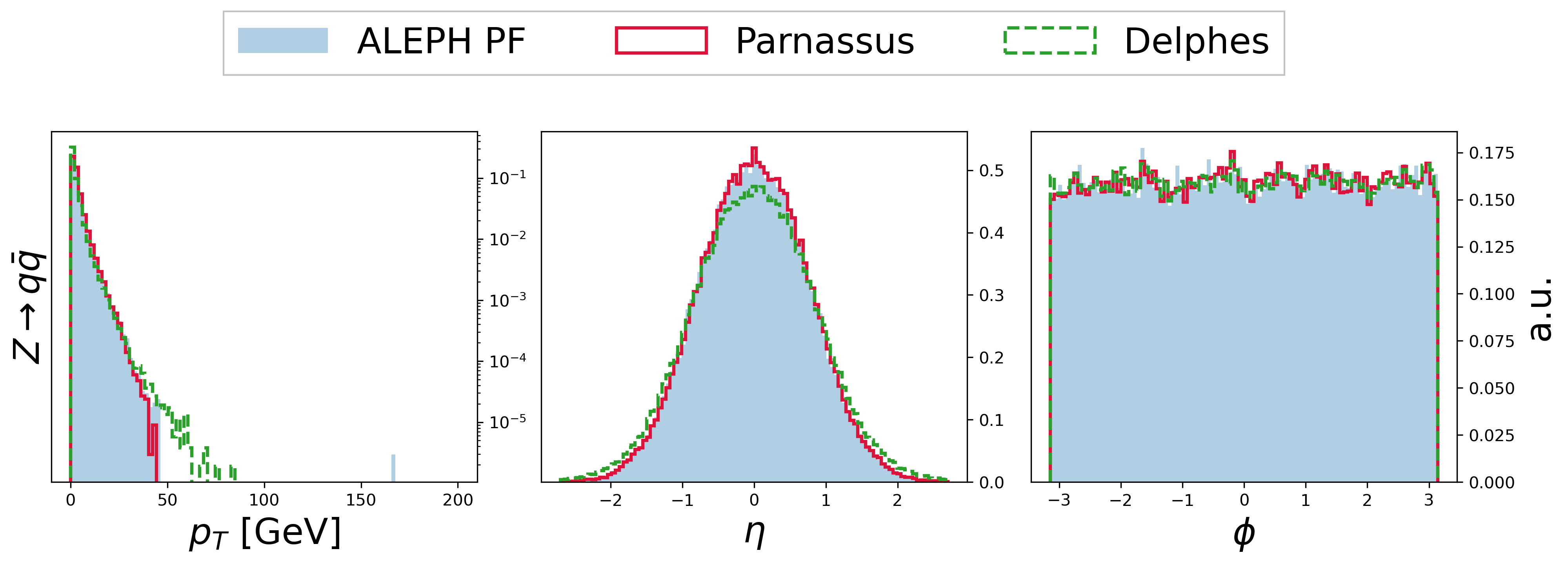
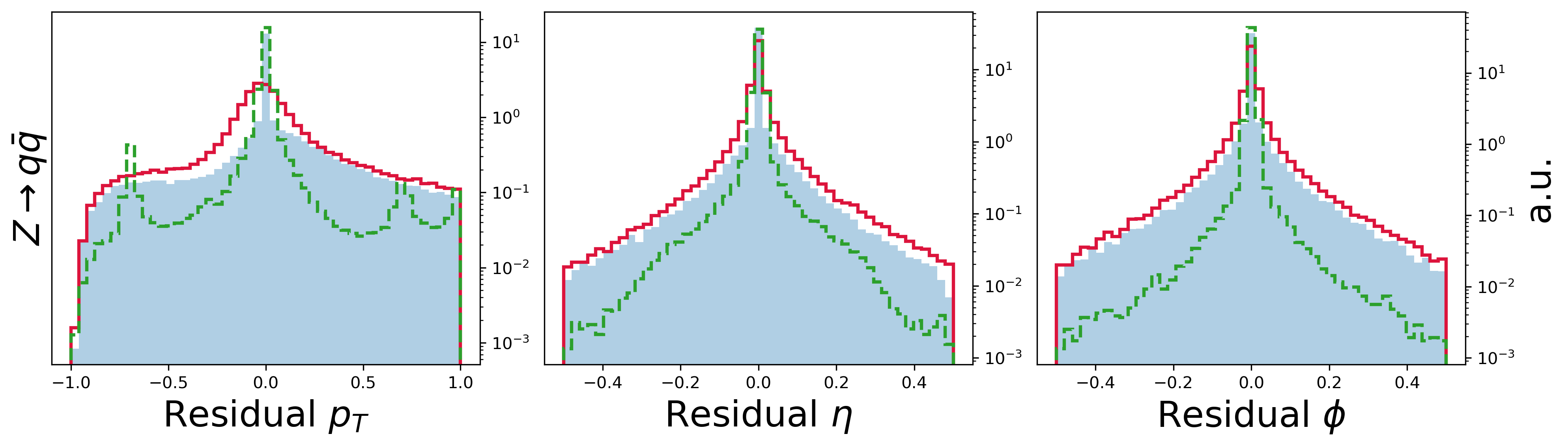
Analysis at the single-particle level exposes the model to the most stringent tests, spanning four orders of magnitude in e+e−7 and probing vertex displacement resolution.
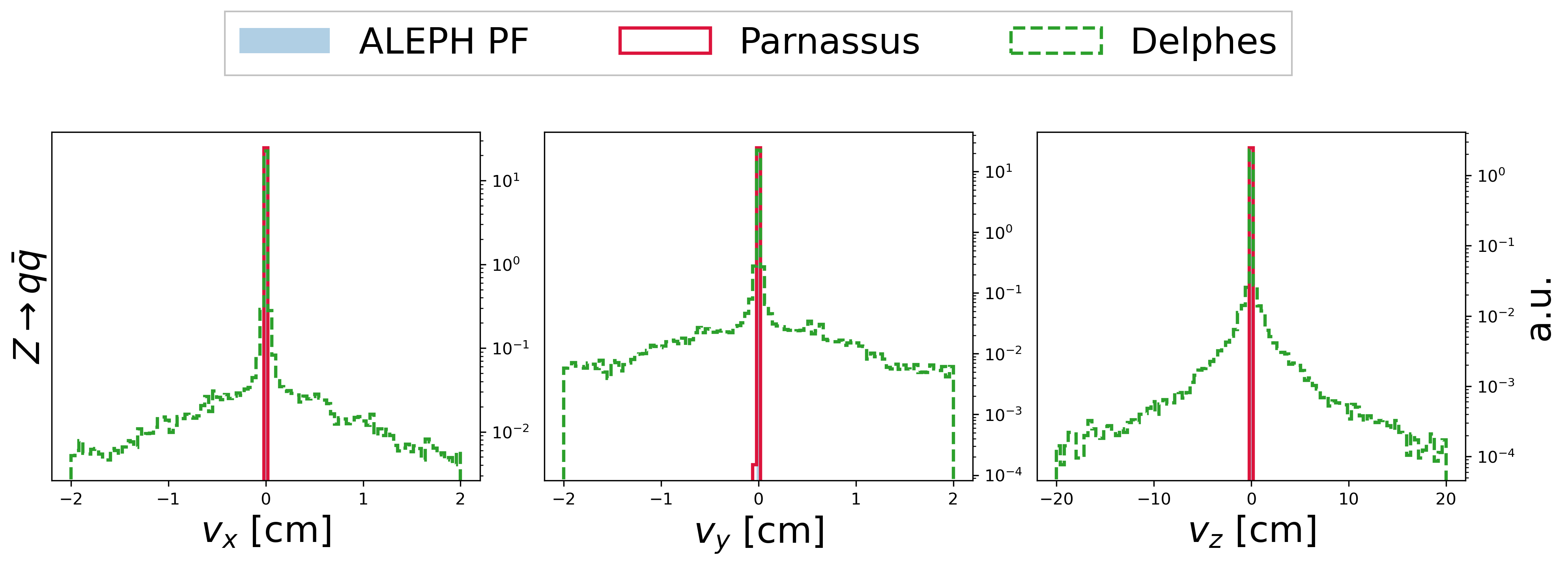
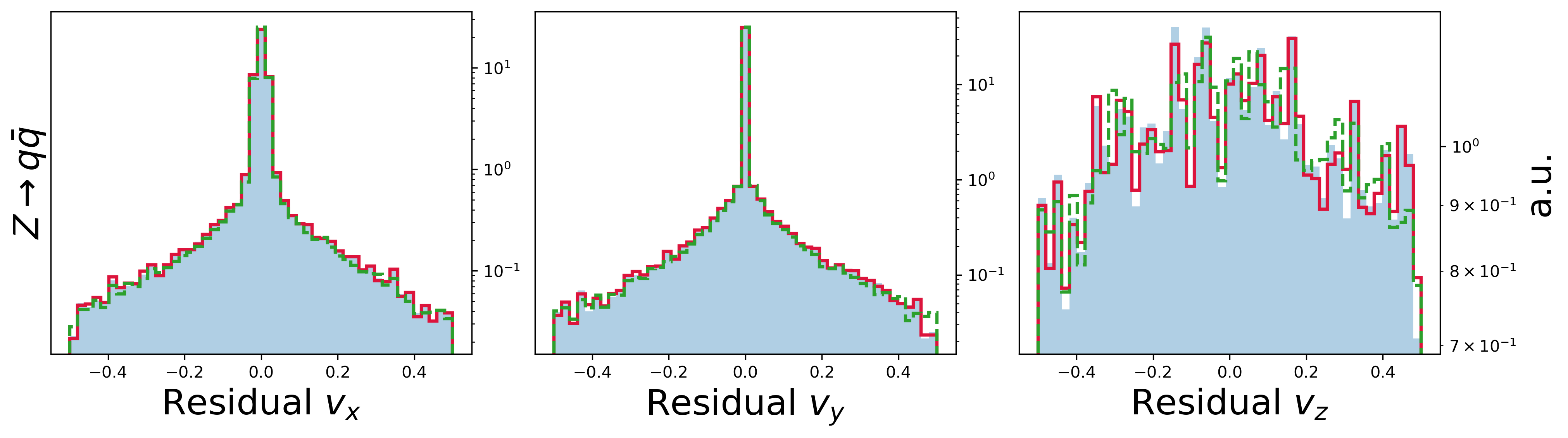
Figure 5: Particle-level e+e−8, e+e−9, pT0 distributions (top) and normalized residuals (bottom) versus ALEPH full simulation and Delphes.
Accurate modeling across both soft and hardpT4 regions; essential for LEP event shapes and QCD studies.
Vertex information, including sharp central peaks and extended pT5 spread, is faithfully recovered. Delphes fails to accurately model these key features, particularly secondary-vertex-sensitive distributions.
Residuals, while broader than for event-level observables due to dynamic range, remain unbiased in core regions and do not exhibit systematic failures.
Broader Implications and Future Outlook
The demonstration that a flow-based transformer generative model tuned on LHC data generalizes naturally to the LEP environment attests to the underlying flexibility of learned detector-response surrogates. This successfully establishes Parnassus as a viable tool for data preservation, reinterpretation, and future physics analyses on legacy (and future non-LHC) collider datasets, where full simulation infrastructure is inaccessible.
The results motivate further study of model extrapolation to low-statistics regions, interpretable uncertainty quantification, and integration with end-to-end differentiable detector design frameworks (Dorigo et al., 2022).
Conclusion
This work establishes that Parnassus, a flow-matching, transformer-based generative simulation and reconstruction framework, achieves high-fidelity modeling of the ALEPH detector response across event, jet, and particle levels. The model outperforms classical fast-simulation baselines in both kinematic and spatial variables, confirming the portability and robustness of AI-based simulation pipelines across disparate experimental geometries and environments. These advances provide concrete tools for unlocking precision physics and BSM searches in legacy datasets and inform the design and reuse of ML-driven simulation infrastructure for future experiments.