- The paper determines that differential extinction, rather than stellar rotation, is the principal driver of the broad main sequence and eMSTO features in NGC 1647.
- Spectroscopic analysis using ROTFIT and archival UVES spectra provided precise measurements of T_eff, log g, [Fe/H], and radial velocity, enhancing cluster parameter estimates.
- Integrating Gaia astrometry, LAMOST spectra, and TESS photometry, the study robustly constrains the cluster's age at approximately 203 Myr with supporting lithium and gyrochronological diagnostics.
NGC 1647: Comprehensive Spectroscopic and Photometric Characterization of a Young Open Cluster
Introduction
The paper "NGC 1647: A young open cluster with a broad main sequence observed with LAMOST" (2604.11765) presents an extensive analysis of the open cluster NGC 1647 using a large set of medium-resolution LAMOST MRS spectra and Gaia astrometric and photometric data. The central objective is to refine cluster properties—age, metallicity, kinematics, differential extinction—and to diagnose the origin and nature of its broad main sequence and extended main-sequence turn-off (eMSTO) features.
Sample Selection and Observational Data
The authors amalgamate three recently compiled catalogs utilizing Gaia data and clustering algorithms, focusing on a ‘golden sample’ of 610 high-probability members. A total of 159 candidate members with reliable LAMOST MRS spectra were analyzed, supplemented by archival UVES spectra for three bright MS stars critical for constraining cluster age and eMSTO morphology. Photometric time-series data from TESS were employed for rotational period analysis, with 637 members possessing high-quality light curves.
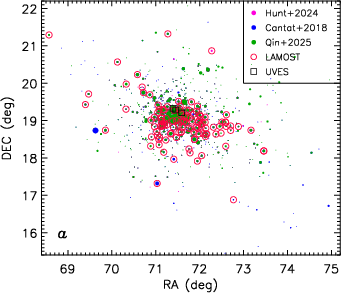
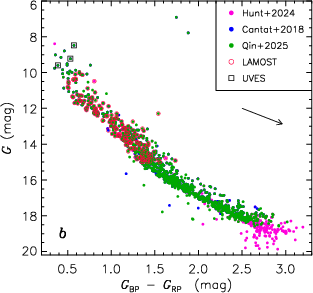
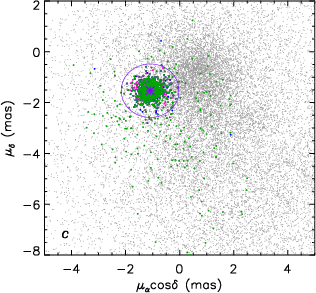
Figure 1: Spatial distribution, CMD, and proper motion space for NGC 1647 members; LAMOST targets are highlighted.
Spectroscopic Analysis: Methodology and Parameter Extraction
The ROTFIT code was used to derive effective temperature (Teff), surface gravity (logg), metallicity ([Fe/H]), radial velocity (Vr), and projected rotational velocity (vsini), leveraging ELODIE templates for ‘cool’ stars (Teff≤7000\,K) and BT-Settl synthetic spectra for hotter stars. Mean atmospheric parameters were computed by variance-weighted aggregation across the blue and red arms, with cross-arm comparisons serving as empirical error diagnostics.
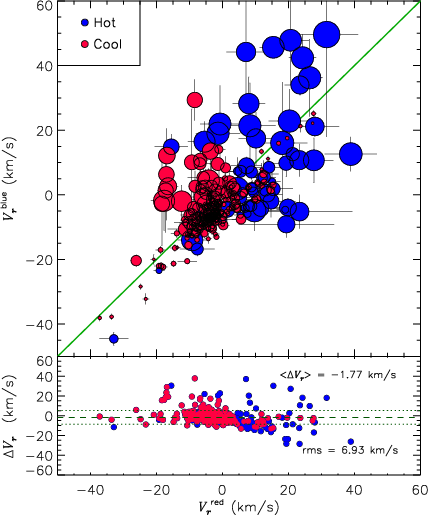
Figure 2: Comparative analysis of Vr from blue and red arms; fast rotators yield increased scatter.
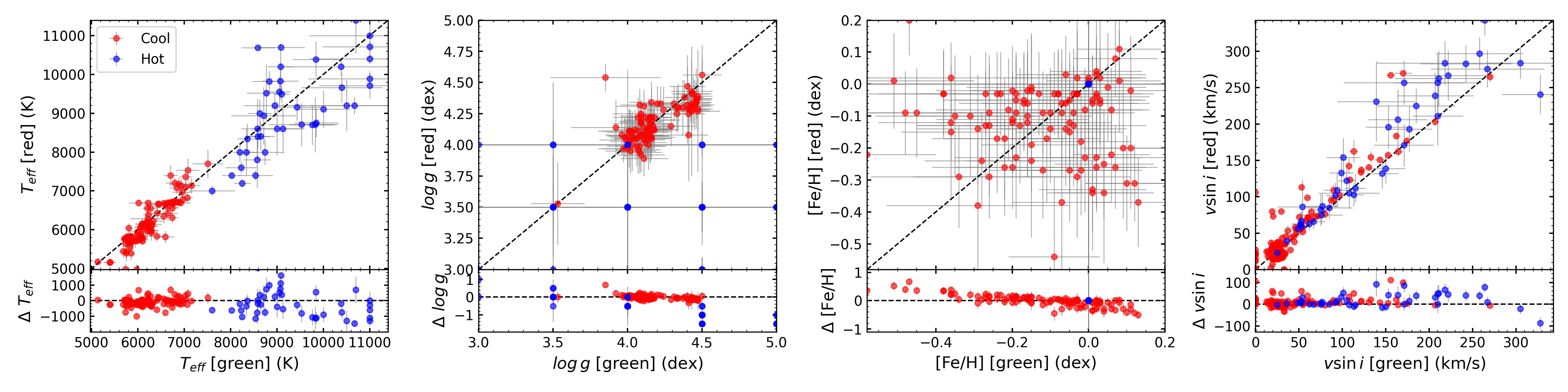
Figure 3: Cross-arm consistency for Teff, logg, [Fe/H], and Gaia0; hot stars show elevated dispersion.
Archival UVES spectra of hot, bright MS stars were analyzed via LTE spectral synthesis, constraining parameters primarily through Balmer line profiles. Metallicities were fixed due to rapid rotation-induced line broadening.
Cluster Kinematics
The radial velocity distribution, derived from weighted means per source, yields a symmetric peak at Gaia1\,km\,sGaia2 with a dispersion of 1.6\,km\,sGaia3. Fast rotators (Gaia4\,km\,sGaia5) exhibit a flatter, scattered Gaia6 histogram, but the mean kinematic parameters are robust to inclusion/exclusion of such objects.
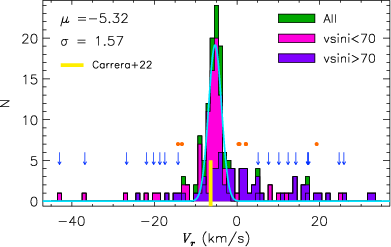
Figure 4: Radial velocity distribution for NGC 1647 members, resolved by rotation class; slow rotators define the cluster mean.
A non-negligible fraction present significant RV variability, flagged as ‘RVvar’, consistent with prevalent binarity or pulsational activity.
Cluster metallicity is well-constrained: [Fe/H]Gaia7 dex (weighted mean), with Gaussian fitting confirming a slightly sub-solar value and agreeing with prior determinations based on the giants.
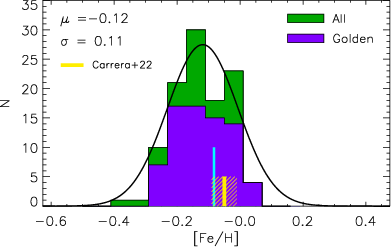
Figure 5: [Fe/H] distribution for cool stars, with sub-solar peak, and literature comparison for giants.
Extinction and Differential Reddening
SED fitting combining multi-band photometry and spectral parameters reveals substantial differential reddening: Gaia8 mag, spatially correlated with dust columns as traced by IRAS 100 Gaia9m maps. There is a clear correspondence between Teff0 and CMD color offset from the MS envelope, empirically confirming differential extinction as the dominant driver of the broad MS.
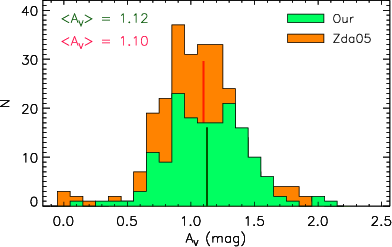
Figure 6: Extinction distribution for studied stars; broad range and agreement with literature.
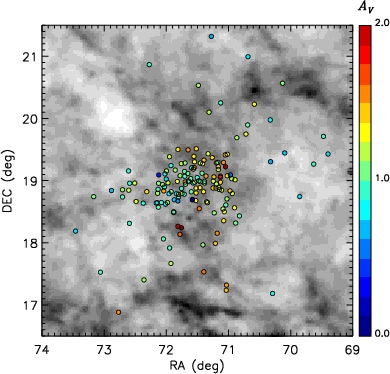
Figure 7: Spatial distribution overlaid on dust emission, revealing extinction gradients across cluster.
Age Diagnostics: HR Diagram, Lithium, and Rotation
The HR diagram, incorporating intrinsic luminosity and temperature, demonstrates that the MS locus alone yields limited age constraint. The positions of two giants and bright MS stars anchor an age window of 150–200 Myr, consistent with lithium depletion modeling.
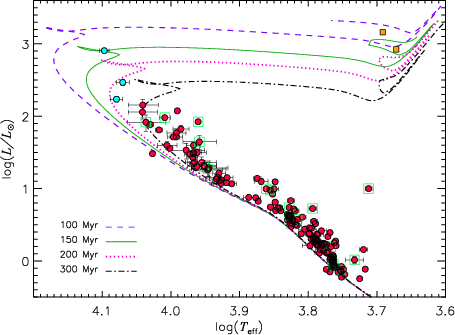
Figure 8: HR diagram overlaying PARSEC isochrones; giants and bright MS stars constrain cluster age.
Net HTeff1 emission and lithium equivalent widths were measured for late-type stars after photospheric subtraction. The lithium depletion pattern fitted by EAGLES yields an age of Teff2 Myr, confirming isohrone and gyrochronological estimates.
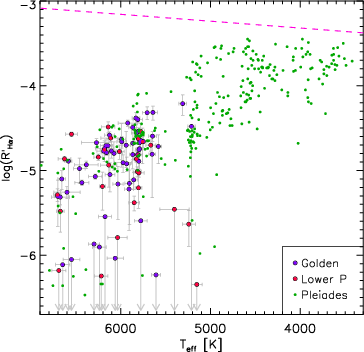
Figure 9: HTeff3 luminosity ratio versus Teff4; NGC 1647 chromospheric activity aligns with Pleiades locus.
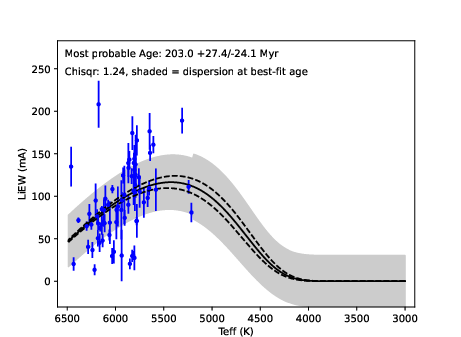
Figure 10: Li depletion fit yields cluster age of Teff5 Myr.
Rotation periods, extracted from TESS photometry via Lomb–Scargle and mapped to dereddened color indices, position NGC 1647 between the Pleiades (125 Myr) and NGC 3532 (300 Myr) in rotational evolution sequence.
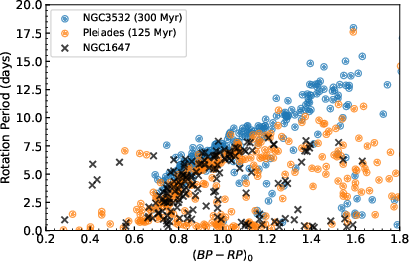
Figure 11: Rotation period–color diagram; NGC 1647 bridges Pleiades and NGC 3532 sequences.
Origin of Broad Main Sequence and eMSTO
Analysis reveals negligible correlation between color offset and Teff6 (Teff7). In contrast, extinction correlates strongly with color shift (Teff8), substantiated by both present analysis and previous photometric extinction maps (Teff9). The data robustly attribute the eMSTO and broad MS to differential extinction, counter to rotationally-induced variants considered dominant in Magellanic Cloud clusters.
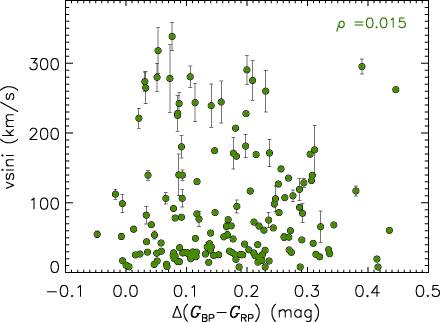
Figure 12: logg0 versus CMD color shift; absence of correlation.
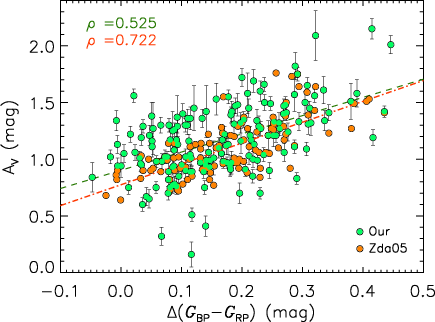
Figure 13: logg1 versus CMD color shift; strong positive correlation indicates extinction-driven spread.
Conclusion
This study delivers a comprehensive spectroscopic and photometric characterization of NGC 1647, leveraging the largest LAMOST-based sample to date. The refined astrometric, kinematic, and chemical parameters provide robust anchor points for cluster evolutionary modeling. Strong numerical results include precise constraints on [Fe/H], logg2, and an internally consistent age from CMD, lithium, and gyrochronology (logg3 Myr). The assertion that differential extinction, rather than stellar rotation, is the principal mechanism engendering CMD broadening and eMSTO in NGC 1647 is supported by direct correlations and stands in contradiction to prevailing rotational explanations for the phenomenon in other clusters. Practically, these results serve as benchmarks for the calibration of stellar models and the interpretation of open cluster CMD morphology in the context of Galactic structure and evolution.
Future developments may entail deeper spectroscopic coverage for cooler, fainter members to further probe lithium depletion and chromospheric activity regimes, refinement of extinction maps, and utilization of high-resolution spectroscopy for binary population and kinematic substructure analysis. The methodology and findings solidify NGC 1647 as a key reference cluster in studies of stellar evolution under heterogeneous interstellar environments.