Geometry-controlled magnon-polariton excitations in a bilayer planar cavity
Published 13 Apr 2026 in cond-mat.mes-hall | (2604.11690v1)
Abstract: Planar cavity magnonics has been developed predominantly for a single magnetic film, leaving the role of multiple magnetic layers in a cavity-scattering framework with spatial resolution largely unexplored. In this study, we introduce a bilayer planar cavity in which two magnetic films are embedded inside the same microwave cavity and interact through the cavity field and their relative placement within the standing-wave pattern. First, we derive a full two-film scattering theory in the macrospin limit and recover the exact zero-gap half-thickness limit to benchmark it against the known one-film planar result. This formulation reveals that the bilayer does not simply strengthen the magnon-photon interaction by adding magnetic material but instead enables position-dependent control of the collective bright channel. Antinode-compatible placements enhance effective coupling, whereas node-compatible placements suppress it. We then show that weak symmetry breaking between the two films transfers the finite cavity weight to a mode that is dark in the symmetric limit, producing an additional spectroscopic branch without immediately destroying the main avoided crossing. To extend the analysis beyond the macrospin regime, we formulate a reduced multimode bilayer theory for $J\neq 0$, where odd standing-spin-wave families reorganize into family-resolved bright and dark bilayer channels. Our results show that bilayer planar cavities are a minimal but versatile setting for controlling the collective magnon-polariton structure through geometry, symmetry, and exchange-driven mode hierarchy.
The paper develops an exact scattering theory for a bilayer planar cavity to capture geometry-driven magnon-polariton coupling, validated against the single-film limit.
It demonstrates that spatial placement of magnetic films modulates coupling, yielding a √2 enhancement at antinodes and suppression at nodes in the bright mode.
The work extends to exchange-induced multimode regimes, showing selective hybridization and dark-mode activation that offer tunable control for quantum and classical devices.
Geometry-Controlled Magnon-Polariton Excitations in a Bilayer Planar Cavity
Introduction
The structure, manipulation, and hybridization of spin waves in magnetic cavities underpin a growing domain that interfaces quantum information and microwave technology. This paper, "Geometry-controlled magnon-polariton excitations in a bilayer planar cavity" (2604.11690), develops a systematic and controlled scattering theory for a planar cavity hosting two magnetic films, allowing rigorous study of geometry- and symmetry-dependent coupling effects that go well beyond simple volume-driven enhancements. The developed formalism is benchmarked against the one-film analytic standard and subsequently extended to the standing-wave, exchange-coupled regime, elucidating cavity-induced collective phenomena in both the symmetric (bright) and asymmetric (dark-branch activated) cases.
Planar Bilayer Model and Formalism
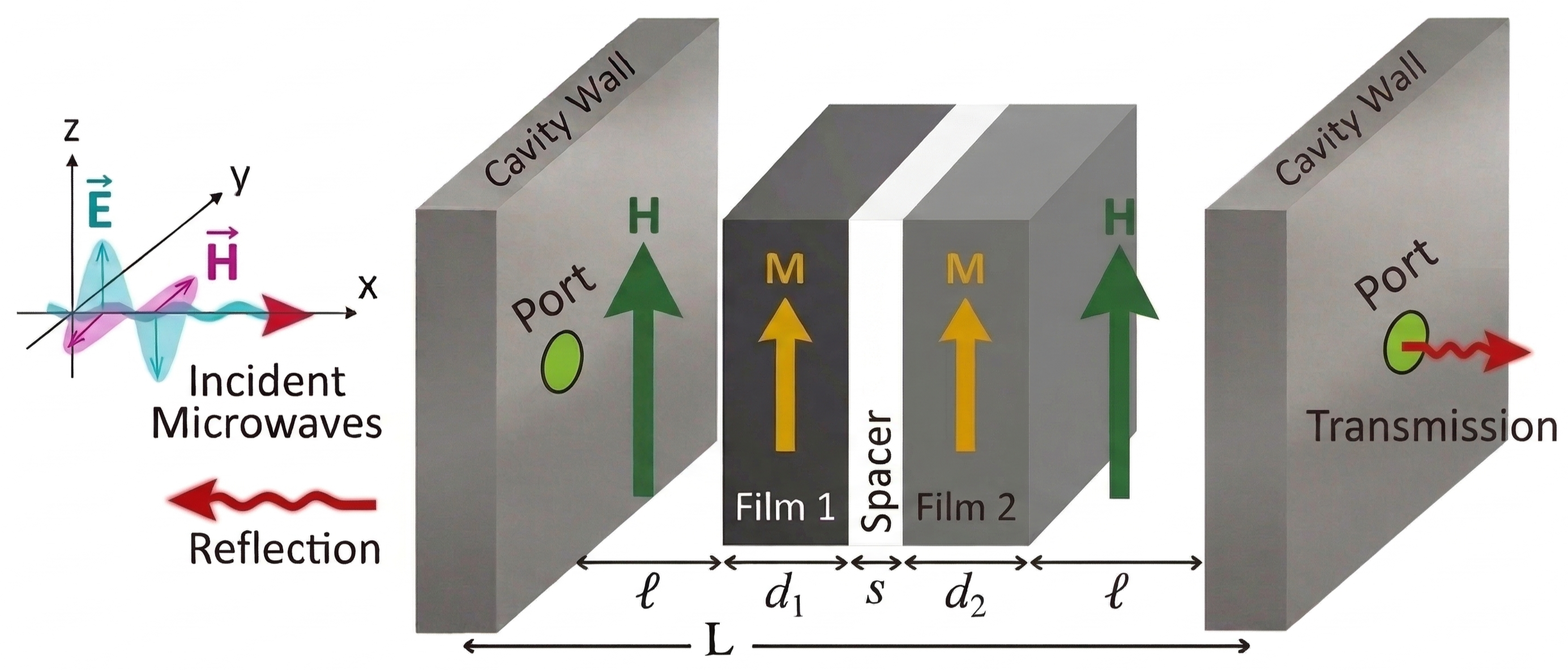
The geometry consists of two magnetic films of generally distinct thicknesses and spacing embedded in a one-dimensional planar microwave cavity, with cavity walls parametrized by their opacity and explicit inclusion of all dielectric spacers. The formalism generalizes the macrospin scattering theory of Cao et al. for a single magnetic film [Cao2015ExchangeMagnonPolaritons] to a seven-region bilayer scenario, retaining exact algebraic control: the transmission and reflection at each layer and interface are derived, and the transfer-matrix formulation guarantees global unitarity and consistent reduction to the monolayer limit.
Figure 1: Double magnetic film in a planar electromagnetic cavity.
Spatial placement of the two films relative to the standing-wave structure of the cavity is fully preserved, enabling direct analysis of mode overlap and symmetry. The theory guarantees that the special case of two adjacent identical films is mathematically indistinguishable from a single thicker film—the foundational limiting benchmark for any legitimate multi-film treatment.
Validation and Recovery of the Single-Film Limit
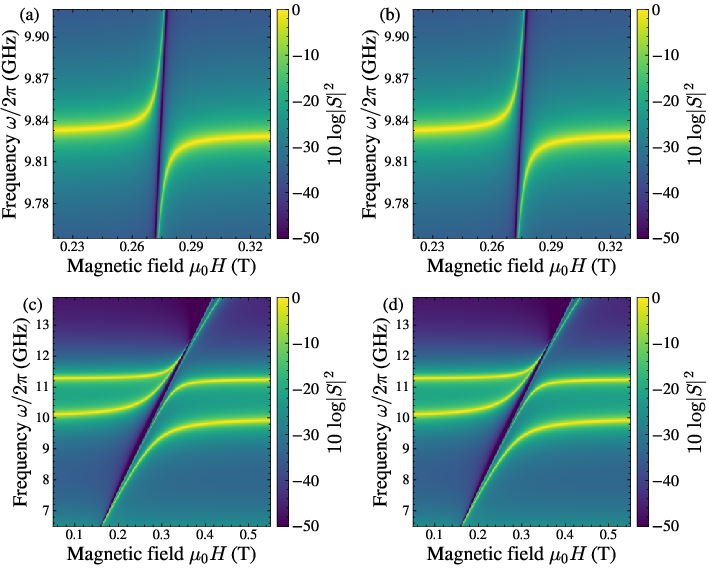
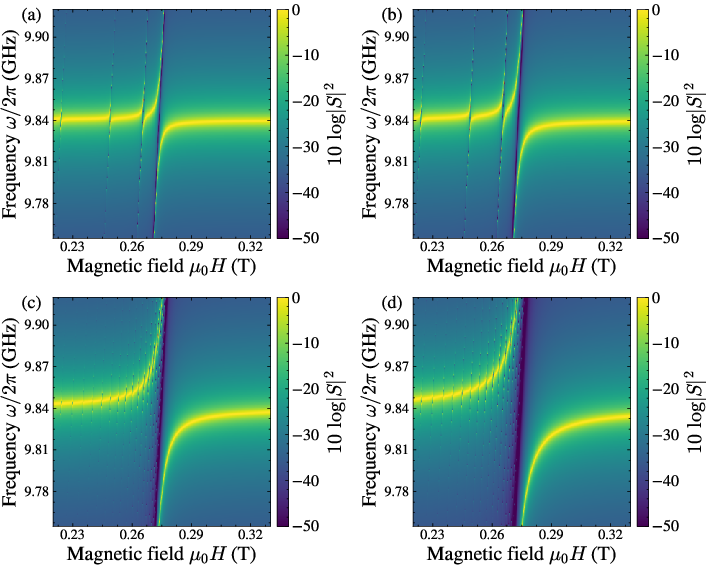
The authors validate the formalism by numerically demonstrating exact agreement between the two-film result for adjacent half-thickness layers and the canonical single-film planar cavity spectrum in both thin and thick-film regimes, confirming that cavity loading, wall transparency, and inhomogeneous field effects are carried over without alteration or arbitrary fitting.
Figure 2: Validation of the bilayer scattering theory against the single-film planar-cavity benchmark for a thinner film d=5μm.
This consistency anchors all subsequent results: the planar-cavity enhancement, suppression, and activation phenomena are strictly geometric and collective, not artifacts of formal construction.
Geometry-Controlled Bright-Channel Enhancement
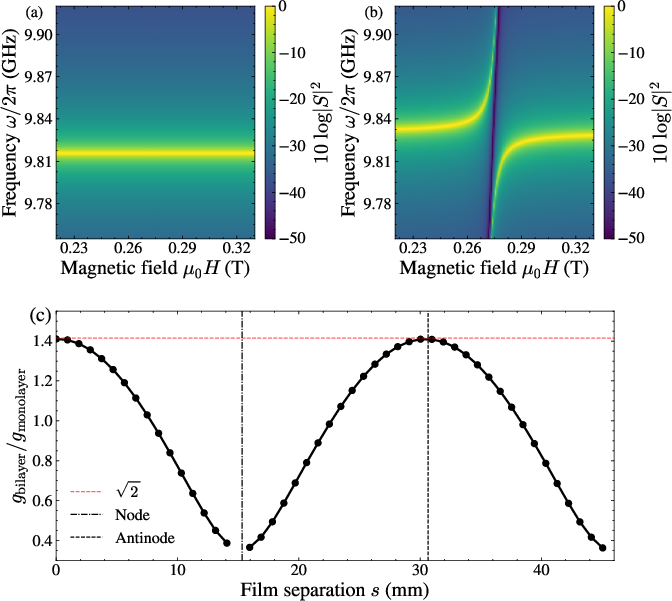
In the symmetric bilayer configuration (d1=d2), the effective coupling strength depends sensitively on where the two film centers sample the internal standing-wave pattern of the cavity. Placement near cavity antinodes enhances the collective bright mode, yielding the expected 2 enhancement in coupling, while placement at nodes suppresses hybridization even with equivalent combined thickness.
Figure 3: Normalized transmission spectra of the symmetric bilayer as a function of inter-film separation; enhancement and suppression correspond to antinode and node placements, respectively.
Analysis of the effective coupling (via cavity transmission line cuts or direct fit to polariton splitting) reveals sharply peaked enhancement windows that directly correspond to antinode-compatible placements and minima at node-compatible placements, confirming that spatial control is essential for collective mode engineering. This demonstrates that in planar cavity magnonics, coupling enhancement is not merely additive with respect to material volume; rather, geometric control of the mode overlap is a tunable and crucial degree of freedom.
Symmetry Breaking and Activation of Dark Channels
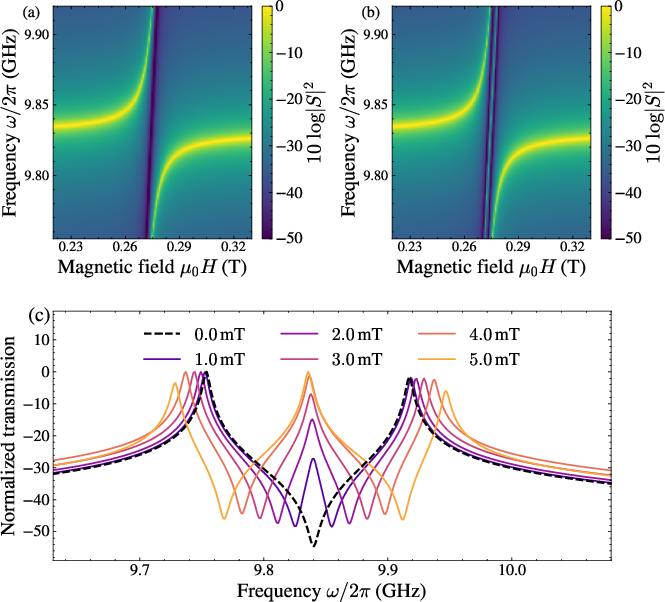
Deliberate small asymmetry between the two films (e.g., a controlled detuning of local field) leads to the appearance of an additional weakly visible transmission branch between the main bright polariton branches. This dark-derived mode is strictly invisible in the symmetric limit due to destructive interference, but, upon symmetry breaking, acquires cavity weight—evidence of bright–dark mode mixing.
Figure 4: Bilayer cavity transmission maps showing bright-branch splitting and emergence of a dark-derived branch under controlled field asymmetry.
The analysis demonstrates that, while the main bright-polariton splitting remains robust, the dark branch’s cavity visibility can be dialed in without structural modification, realizing a spectroscopic analogue to strong-to-weak collective mode population transfer, as previously conjectured in multi-magnet systems [Zhang2015DarkModes]. The strong persistence of the bright channel with weak asymmetry permits exploitation of this effect for switching and tunable hybridization regimes.
Extension to Exchange-Driven Multimode Regime (J=0)
The theory is extended to include exchange-induced standing-spin-wave modes using a reduced multimode cavity theory, retaining all essential spatial and symmetry features. Each magnetic film supports a ladder of odd standing spin-wave resonances. For each odd mode, the bilayer forms collective bright and dark states; symmetry breaking activates dark branches for every family, not just the FMR mode.
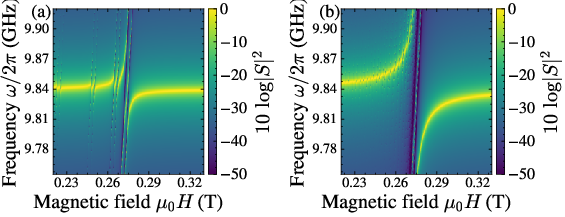
Figure 5: Standing-spin-wave transmission maps for single-film and symmetric bilayer configurations in the exchange regime.
Figure 6: Asymmetric bilayer spectra, illustrating dark-branch activation for standing spin-wave modes under field asymmetry.
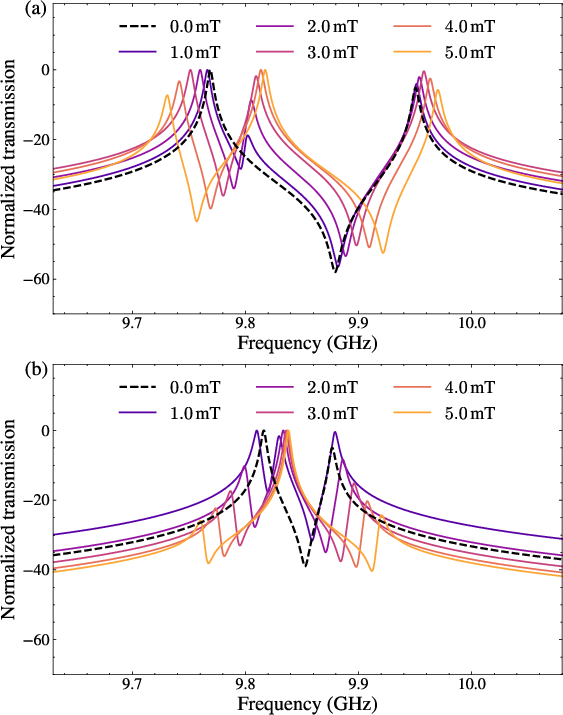
The authors show that multimode hybridization produces pronounced anticrossings for both p=1 and p=3 odd families in the symmetric case; when asymmetry is introduced, weak dark-derived branches become appreciable, with family-resolved sensitivity. Higher spin-wave families (e.g., p=3) exhibit greater responsiveness to symmetry breaking due to their reduced intrinsic hybridization, facilitating selective dark-mode access.
Figure 7: Family-resolved resonance-field line cuts showing progressive dark-branch activation in p=1 and p=3 standing-spin-wave channels for increasing asymmetry.
Implications and Future Prospects
This work elevates planar bilayer cavity magnonics from a simple volume-doubling scenario to a fully geometric, symmetry-tunable platform for engineering magnon-photon collective hybridization. The results have concrete implications:
Spectroscopic Control: Placement and field tuning allow individual control over bright enhancement and dark-mode activation without reconfiguring the cavity, enabling in situ experiments with fixed-device geometry.
Family-Selective Engineering: In the presence of exchange, higher-order standing-spin-wave modes can be addressed and manipulated selectively, which informs design of multi-frequency, mode-multiplexed quantum or classical devices.
Exactness and Reliability: The full-scattering, transfer-matrix-based theory permits rigorous prediction for arbitrary planar geometries, essential for device optimization and systematic exploration of non-additive, collective effects.
Foundation for Multi-Magnetics: As planar cavities and magnonic systems are generalized to multilayers and more complex cavity environments (e.g., multimode or non-Hermitian structures), the presented framework offers a reproducible and extendable baseline, with built-in validation against known limits.
Long-term, the presented results invite construction of full exact exchange-coupled solvers that treat both magnetic and electromagnetic degrees of freedom on equal footing, as well as experimental realization of geometry-tunable bilayer cavity architectures for coherent magnonics, cavity QED, and hybrid quantum technologies.
Conclusion
The developed bilayer planar cavity scattering theory provides a mathematically exact and physically controlled platform for geometry-controlled magnon-polariton engineering. It validates and extends the canonical single-film model, revealing that both strong collective enhancement and tunable dark-mode activation are governed by spatial symmetry and cavity geometry—not simply by increased magnetic volume. The reduced multimode extension into the exchange regime demonstrates that collective effects persist and diversify at the level of each standing-spin-wave family. These findings establish the bilayer planar cavity as a minimal but versatile architecture for spatial, collective, and symmetry-dependent engineering of hybrid magnon-photon excitations, with direct implications for tunable quantum and classical coherent information platforms.
“Emergent Mind helps me see which AI papers have caught fire online.”
Philip
Creator, AI Explained on YouTube
Sign up for free to explore the frontiers of research
Discover trending papers, chat with arXiv, and track the latest research shaping the future of science and technology.Discover trending papers, chat with arXiv, and more.