- The paper presents the AmBox system that directly connects edge sensors to a permissioned blockchain, ensuring tamper-evident recording of environmental data.
- The paper demonstrates robust data resilience with local buffering and BLE-driven synchronization, maintaining integrity even during connectivity disruptions.
- The paper shows practical deployment via dual Node-Mote architectures that achieve energy efficiency and compliance with traceability standards.
AmBox: Device-to-Blockchain Ambient Sensing for Food Traceability
System Architecture and Design Principles
AmBox is a modular, device-to-blockchain system engineered specifically for the secure and verifiable recording of environmental data—namely temperature, humidity, and atmospheric pressure—within agri-food supply chains. The architecture is predicated on the direct interaction between edge sensors and a permissioned blockchain (Hyperledger Fabric), explicitly circumventing dependence on centralized middleware or untrusted intermediaries. The core topology comprises AmBox Nodes (Raspberry Pi-based) and lightweight AmBox Motes (ESP32-based), facilitating single- and multi-device deployments adaptable to heterogeneous logistics scenarios.
The end-to-end pipeline encompasses three decoupled layers: the Sensing Layer (distributed environmental data acquisition), Data Processing and Storage Layer (local aggregation, cryptographic signing, and buffering), and the Blockchain Integration Layer (atomic, auditable, and tamper-evident data submission to Fabric via smart contracts).
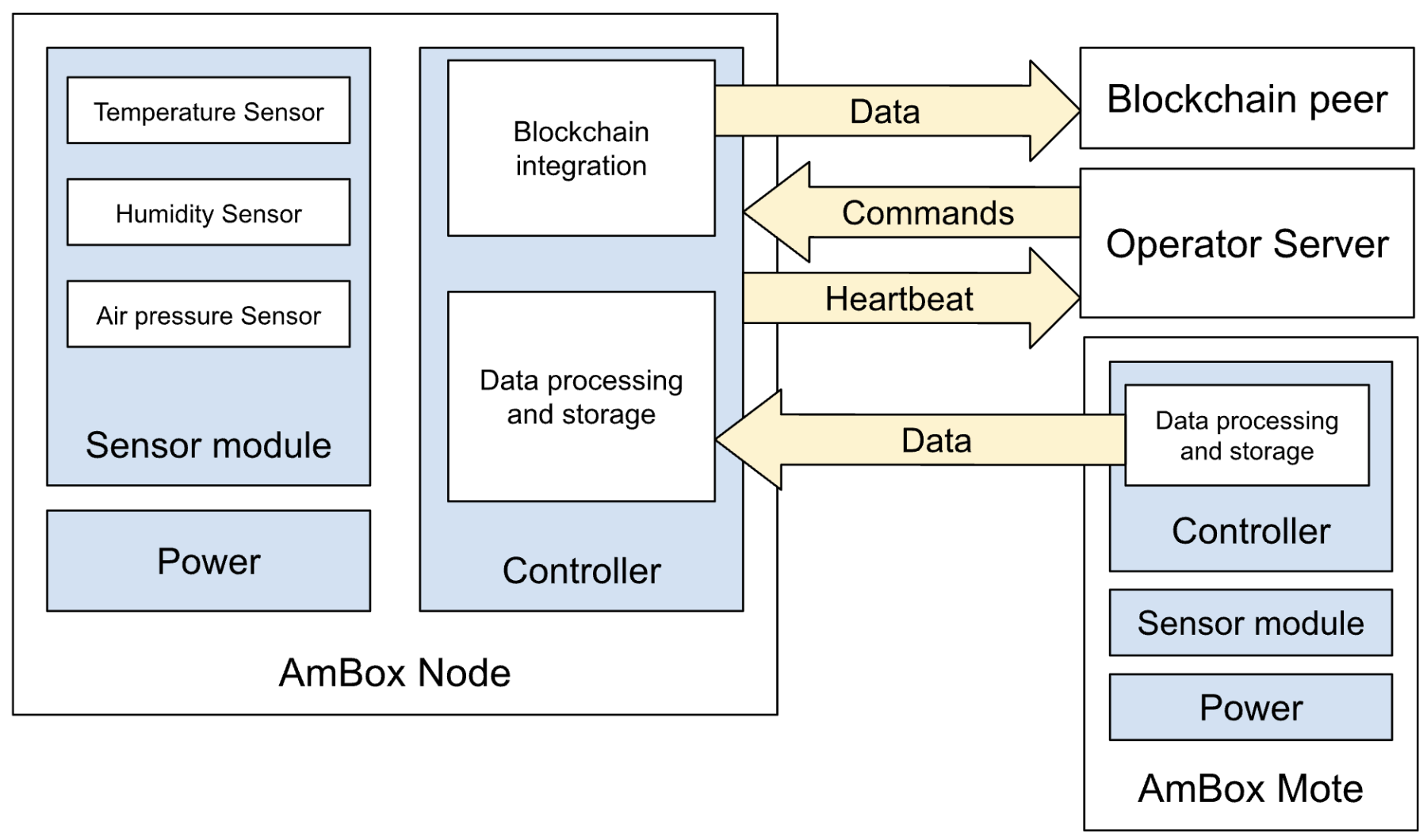
Figure 1: AmBox system architecture delineating distinct sensing, processing, and blockchain integration layers for modular deployment.
AmBox supports operational resilience via robust local buffering and deferred upload, ensuring no data loss during intermittent connectivity. All environmental records are digitized, formatted as JSON, and signed using RSA-SHA256, creating cryptographically verifiable, non-repudiable events stored immutably on-chain.
Deployment Flexibility: Node and Mote Interplay
The architecture supports both standalone Node deployments, suitable for smaller logistics nodes or static infrastructure, and hierarchical Node-Mote networks. The latter enables spatially granular environment monitoring and enhanced coverage, with Nodes acting as BLE-connected aggregators for multiple energy-optimized Motes.
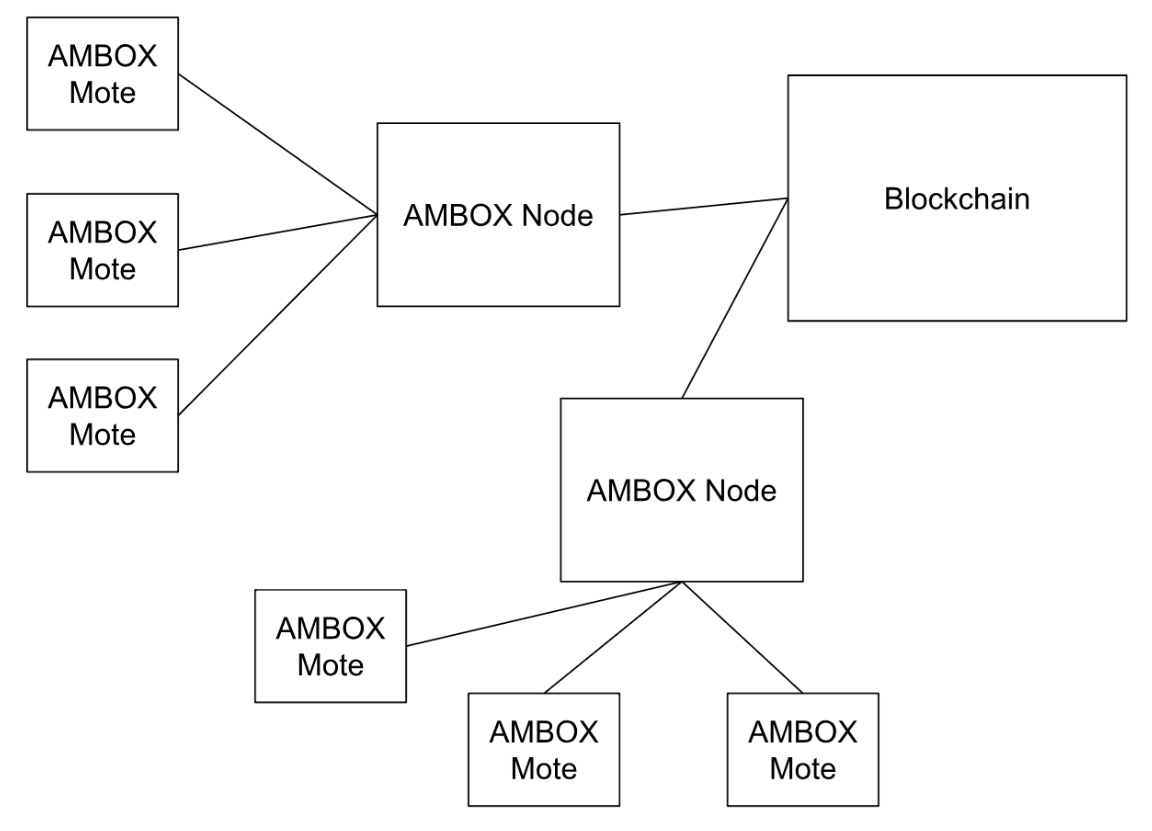
Figure 2: Illustration of multi-device deployment demonstrating Node and Mote interaction, addressing coverage and redundancy in logistics environments.
Synchronization between Mote buffers and Node aggregation is event-driven over BLE with auto-reconnection logic, allowing uninterrupted ambient sensing—even under lossy link conditions or device mobility.
Lifecycle and Communication Protocols
AmBox introduces a fine-grained device lifecycle—spanning configuration, operational monitoring, data transmission, and decommissioning—enforced via programmable state transitions. Nodes emit periodic heartbeat messages to the Operator Server, enabling remote auditability and fleet management.
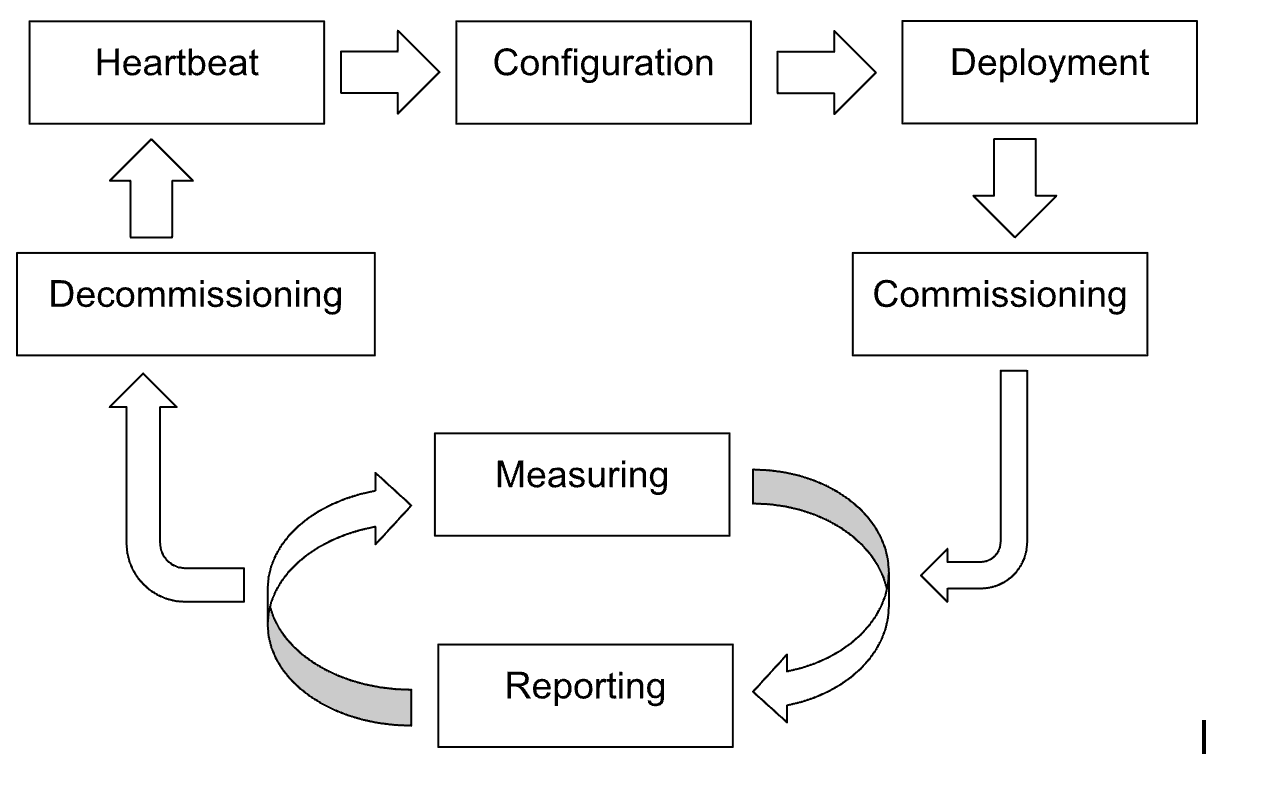
Figure 3: AmBox lifecycle, highlighting state transitions from configuration through to decommissioning and subsequent health monitoring.
Device configuration, blockchain endpoint provisioning, and data collection policies are orchestrated over HTTPS/RESTful APIs, while interaction with Hyperledger Fabric is realized via gRPC channels with mutual TLS authentication. The system applies mutex-based serialization to maintain idempotency and coherence during concurrent sensor data submission.
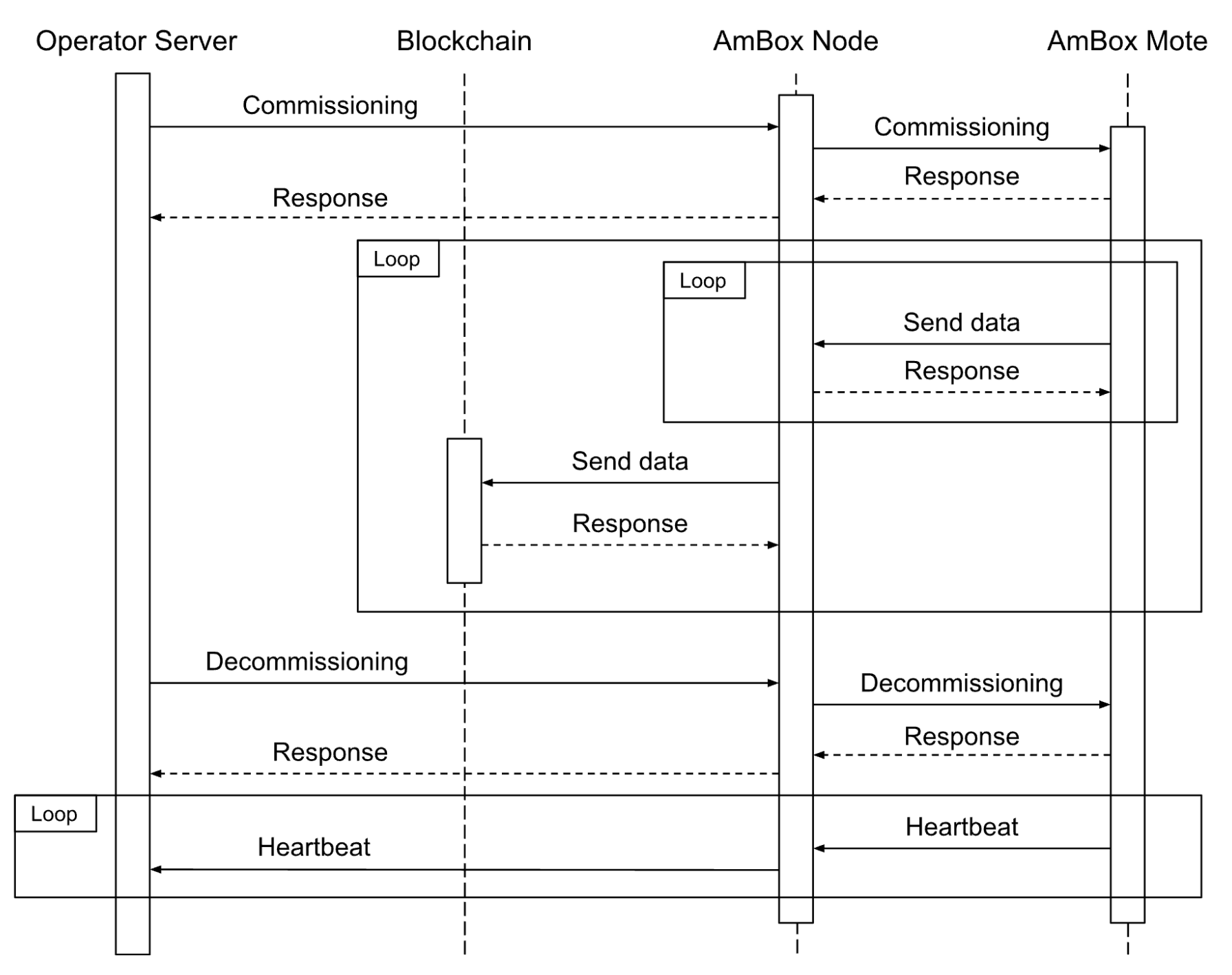
Figure 4: Sequence of communications among Operator Server, Nodes, Motes, and Blockchain, detailing configuration, monitoring, and data flow.
Quantitative evaluation reveals several salient properties:
- Connectivity Resilience: Both single and multi-device topologies collect, buffer, and synchronize all records despite Wi-Fi/BLE disruptions up to one hour, with zero data loss or order inversion.
- Data Integrity: Manual tampering with buffered data invariably leads to on-chain signature verification failures and event rejection, empirically validating strong integrity guarantees.
- Latency: Node-to-blockchain round-trip times average 148 ms (local Fabric) and 628 ms (remote), while Mote-to-Node BLE latencies remain sub-50 ms under typical link conditions.
- Sensor Fidelity: Mote-based measurements closely track calibrated reference sensors in extended (5-hour) experiments, whereas Node-board sensors display systematic thermal drift, indicating CPU-induced bias.
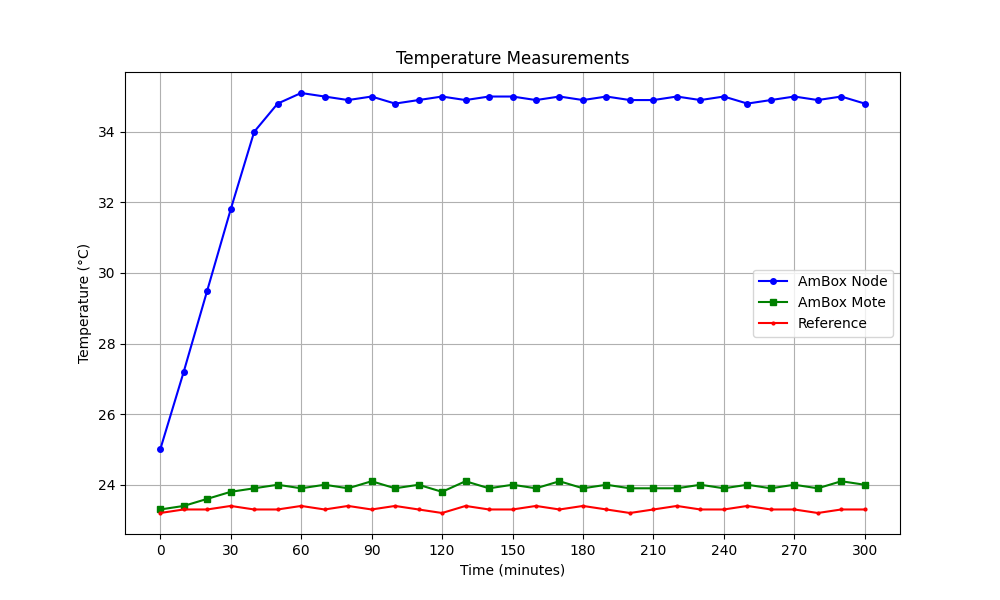
Figure 5: Comparative temperature profiles from Node, Mote, and reference sensors over a 5-hour operating window.
- Energy Profile: Under one-minute sampling and ten-minute batch upload policies, Nodes sustain 13 hours and Motes 51 hours of operation on 10,000 mAh batteries, exceeding minimal field requirements.
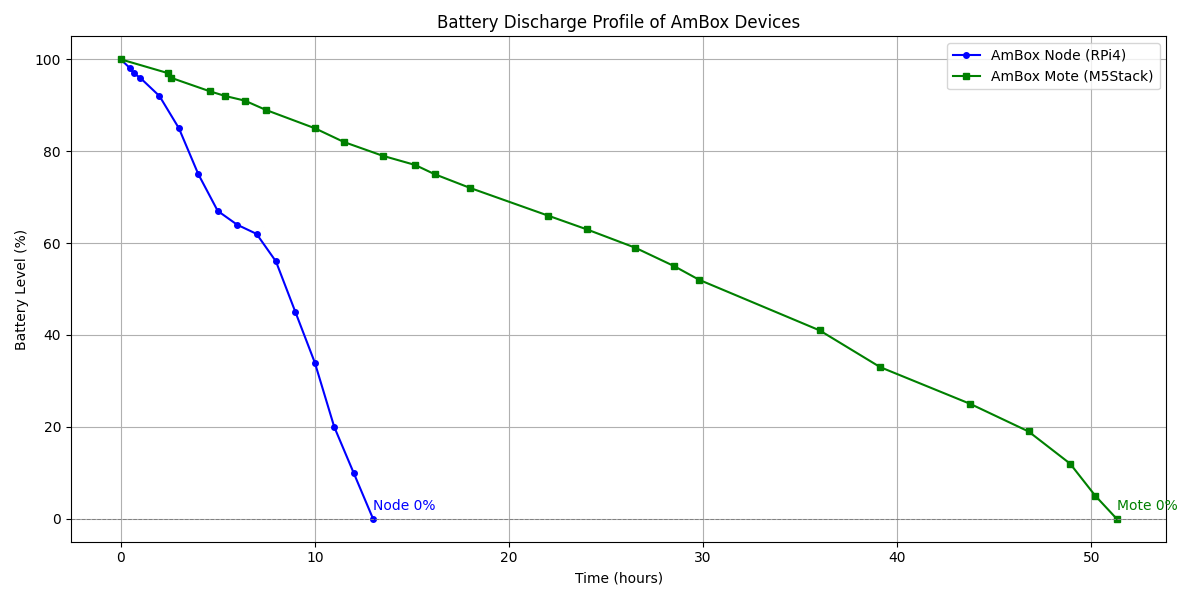
Figure 6: Battery discharge trajectories of Node (Raspberry Pi) and Mote (ESP32), highlighting hardware-induced efficiency differentials.
A four-hour real-case deployment in transportation with induced Wi-Fi outage reaffirmed robustness: all buffered records uploaded sequentially post-reconnection, and battery drawdown was moderate (remaining capacity ≈69%).
Theoretical and Practical Implications
AmBox demonstrates the feasibility of auditable, peer-verified environmental records for food traceability without requiring centralized, cloud-based relay oracles, directly addressing the multi-stakeholder, trust-fragmented nature of agrifood supply chains. By abstracting sensor interaction and enforcing cryptographic signatures prior to blockchain reporting, AmBox provides strong non-repudiation and end-to-end integrity even in adversarial connectivity states. These characteristics are essential for regulatory compliance, liability demarcation, and cross-enterprise provenance in perishable logistics.
The data model is harmonized with GS1/EPCIS standards, facilitating future interoperability with existing enterprise resource planning and supply chain management systems. The use of permissioned Fabric blockchain (with PoA) provides operational efficiency and privacy-preserving, access-controlled data audit—superior to public chain implementations in enterprise consortia [androulaki2018hyperledger].
Security Considerations and Future Directions
While signature-based tamper evidence is empirically robust, advanced threats such as key compromise, replay attacks, and targeted DoS were not addressed and represent critical vectors for future mitigation. Further enhancements should prioritize hardware-based root-of-trust primitives (e.g., TPM integration), sensor placement algorithms to decouple from heat sources, and adaptive duty-cycling to extend operational envelope. Integration with decentralized identifiers and advanced off-chain analytics is anticipated for further supply chain digitalization.
Conclusion
AmBox introduces a practical, low-cost framework for decentralized, device-to-blockchain ambient sensing with demonstrable guarantees in data integrity, operational resilience, and deployment scalability for agri-food traceability. Its dual hardware topology, cryptographic anchoring, and permissioned blockchain integration make it immediately applicable to current and next-generation supply chain digitization initiatives. The demonstrated performance profile suggests AmBox is well-positioned for adaptation and augmentation as supply chain transparency and regulatory requirements become more stringent.
Reference:
"AmBox: Device-to-Blockchain Ambient Sensing for Food Traceability" (2604.11681)