- The paper introduces the Borsuk number for graphs, extending the classical geometric problem to discrete and continuous settings.
- It proves NP-completeness for deciding partition thresholds and establishes sharp upper bounds using monotone and tree structures.
- The study offers practical algorithms and structural insights, with implications for network design and social network analysis.
The Borsuk Number of a Graph: A Technical Overview
This paper introduces the Borsuk number within the context of graphs, extending the classical geometric Borsuk problem to both abstract and geometric graphs. The Borsuk problem traditionally asks for the minimal number of subsets of strictly smaller diameter required to partition a bounded set in Rd. The current work transfers this notion to graphs, distinguishing two natural variants: the discrete (where only vertices are considered and partitions are induced via edge deletions) and the continuous (where graphs are treated as 1-dimensional simplicial complexes and partitions arise from line cuts).
The discrete Borsuk number, b(G), for a connected abstract graph G, is the minimal number of subgraphs of smaller diameter obtained through edge deletion. The continuous Borsuk number, b(G), parallels this in the geometric setting, but partitions are defined via sequential insertions of lines (and associated connecting segments) in the plane that inductively split the graph.
Discrete and Continuous Borsuk Numbers: Definitions and Properties
Discrete Variant
For discrete graphs, the operation of deleting edges is standard. Classical graph parameters immediately connect: for instance, paths and even cycles have Borsuk number two, odd cycles have Borsuk number three, and the star graph on k+1 vertices attains b(G)=k. The behavior can be linear in n for certain families, e.g., maximal outerplanar graphs and stars.
Continuous Variant
In continuous geometric graphs, partitioning is via linear cuts that, with associated maximal segments, ensure that each partition remains connected. The Borsuk number in this setting, b(G), is the minimum k such that the graph can be partitioned into k connected geometric subgraphs of strictly smaller diameter. The geometric setting introduces new phenomena, such as the possibility that diameter may increase after an edge insertion, especially when considering all points on an edge rather than merely vertices.
A foundational result establishes an upper bound: any continuous geometric graph with b(G)0 vertices satisfies b(G)1, via a construction using vertical line sweeps at vertices.
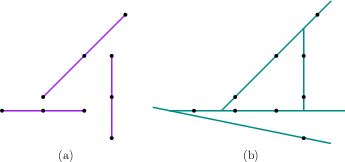
Figure 2: Optimal coverings for b(G)2 points using three disjoint segments and four guillotine cuts; each guillotine cut or segment successively partitions the plane, mirroring the permitted continuous cuts for the Borsuk problem in geometric graphs.
Complexity Results
A central contribution is the NP-completeness result for deciding, in both settings, whether the Borsuk number is less than a given threshold. In the discrete case, the problem reduces to the minimum clique cover problem. In the continuous case, the reduction is to the covering of points by guillotine cuts (an NP-complete variant of the point-line cover problem), exploiting the combinatorial structure of recursive partitions Figure 1.
This complexity-theoretic analysis situates the Borsuk number decisively among hard partitioning parameters in both discrete and geometric graph settings.
Upper Bounds in the Continuous (Monotone) Case
The core technical development addresses upper bounds on b(G)3 for monotone geometric graphs—graphs embedded so that the intersection with any line perpendicular to a given direction is a point or segment. Key to this analysis are the diametral sets, defined as the union of all shortest paths between diametral pairs (pairs at diameter distance), and their combinatorics.
Lemma results show that there are only b(G)4 possible diametral sets, and the number of disjoint diametral sets, b(G)5, directly bounds the Borsuk number: any b(G)6-monotone geometric graph with at most b(G)7 disjoint diametral sets satisfies b(G)8.
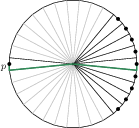
Figure 4: The wheel graph on 33 vertices attains the upper bound predicted by the analysis for monotone graphs, realizing b(G)9 for one disjoint diametral set.
In the monotone setting, associated partitioning functions (G0 and G1, giving the diameters of upper/lower subgraphs as a sweep line advances) are monotonic, and even continuous in convex cases. This structural control is critical for the precise upper bounds.
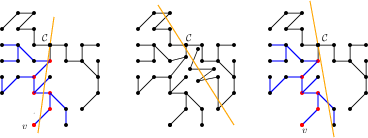
Figure 6: Visualization of the subtree and the set G2 used in the tree algorithm; this set governs which lines may induce correct diameter-reducing partitions for tree centroids.
The Structure and Algorithmics of Borsuk Numbers in Trees
A key theoretical dichotomy emerges for trees:
- Discrete Tree Case: The Borsuk number is linear in the degree of the central vertex (or in special cases, two), and can be computed in linear time.
- Continuous Tree Case: G3 for any geometric tree, a constant upper bound independent of G4, achieved via careful analysis of diametral paths and the action of lines intersecting the tree near its center.
A quadratic time algorithm is presented for computing the Borsuk number of a continuous tree: by classifying possible combinatorial types of cuts at the center (using double wedges; Figure 7), the algorithm checks, for each partition, whether diametrically opposite points in the original graph are now strictly closer in their respective partitions. This analysis crucially leverages the geometry induced by the embedding.
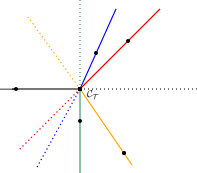
Figure 8: Double wedges generated by the angular order around the center G5 play a role in identifying all combinatorially distinct cut types through the tree center.
Disjoint Diametral Sets and Planarity Constraints
The paper provides an in-depth combinatorial analysis of when two diametral sets (collections of points and shortest paths between diametral pairs) can be disjoint, with the notable conclusion that in planar embeddings, such sets cannot have all four diametral points on the same face—else the underlying structure would violate planarity Figure 9.
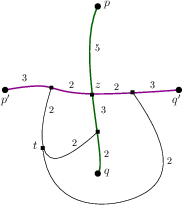
Figure 10: The graph structure for two disjoint diametral sets; the square points form a bipartite subgraph G6, witnessing necessary conditions on face embeddings for disjoint diametral sets.
Conclusion
This work rigorously formulates and analyzes the Borsuk number for both discrete and continuous graphs, linking it to classical graph invariants, partitioning problems, and computational complexity. The major theoretical contributions include NP-completeness results, sharp upper bounds for monotone and tree-like graphs, and algorithmic strategies foundational for future work. The implications extend to network design and social network analysis, as understanding how structural cuts interact with diameter affords both theoretical insight and practical optimization.
The characterization of diametral sets in geometric graphs remains a rich direction, especially for ascertaining whether constant bounds exist for broader classes of plane geometric graphs or for refining efficient algorithms for determining the Borsuk number in specific families.

