- The paper presents a closed-form analytical characterization of the cumulative log-likelihood ratio method for detecting subtle anomalies in linear Gaussian systems.
- It quantifies detection error rates using a Fisher information metric and assesses the impact of temporal correlation on effective sample size.
- It demonstrates practical applications in an inverted double pendulum and observer design, highlighting trade-offs between innovation variance and anomaly detectability.
Detectability of Subtle Anomalies in Dynamical Systems via Log-Likelihood Ratio
Introduction
The identification of subtle system anomalies in industrial and safety-critical systems demands detection mechanisms with quantified sensitivity and reliability. "Detectability of Subtle Anomalies in Dynamical Systems via Log-Likelihood Ratio" (2604.11631) rigorously analyzes the statistical performance of cumulative log-likelihood ratio (LLR) methods for anomaly detection in linear Gaussian dynamical systems. The work provides closed-form analytical characterizations of detection error rates, establishes connections to Fisher information, and demonstrates implications for both anomaly detection and observer design.
The detection paradigm centers on discrete-time linear systems with additive, zero-mean Gaussian process and measurement noise, modeled as
xk+1=Axk+wk,yk=Cxk+vk
with wk∼N(0,Q), vk∼N(0,R). The actual system differs from the nominal model Π∗ by small parametric deviations. These deviations are parameterized by weights γ, so that the real system is a linear combination of the nominal model and deviation directions.
Detection is formalized as model discrimination between hypothesized systems Πα and Πβ, with the cumulative log-likelihood ratio (LLR) statistic employed to decide which hypothesis better explains an observed measurement sequence. For hypotheses characterized by deviations α and β,
L({yk}k=1N∣α,β)=21(Nlog∣Σα∣∣Σβ∣+k=1∑Nyk⊤(Σβ−1−Σα−1)yk)
where wk∼N(0,Q)0, wk∼N(0,Q)1 are the implied steady-state output covariances.
Statistical Characterization of the LLR and Analytical Bounds
By leveraging the asymptotic normality of the LLR, the mean and variance of the test statistic can be computed in closed form under both the null and alternative system hypotheses. The key theoretical contribution is the quadratic approximation for the distribution's mean and variance as functions of the deviation parameters and a Fisher information-weighted metric wk∼N(0,Q)2, where
wk∼N(0,Q)3
resulting in
wk∼N(0,Q)4
where wk∼N(0,Q)5 is the true deviation. The expression directly yields the error probability for the LLR-based test, quantifying the exponential decay of false positive rates as a function of information content and the number of observations.
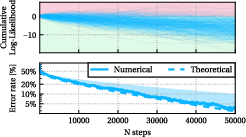
Figure 1: 2000 Monte-Carlo sample paths of the cumulative log-likelihood ratio for the stabilized inverted double pendulum; lower panel shows empirical and theoretical error rates with shaded confidence bounds.
This analytical quantification enables evaluating the minimal number of measurements required for a prescribed detection confidence, explicitly reveals the influence of deviation directionality and magnitude, and allows practical deployment through data-driven or model-based estimation of wk∼N(0,Q)6.
Effects of Temporal Correlation and Adjusted Detection Thresholds
While the analytical derivations take i.i.d. measurements as their starting point, the work carefully addresses the colored nature of measurement noise in dynamical systems. Through detailed analysis, it is shown that temporal correlation inflates the variance of the LLR, reducing effective sample size and slowing convergence of error rates. The authors develop a heuristic correction, where the effective standard deviation is adjusted according to the largest closed-loop eigenvalue, yielding adjusted theoretical bounds.
Practical Application: Double Pendulum and Observer Design
The efficacy and implications of the proposed methodology are demonstrated in two salient case studies:
- Deviation Detection in an Inverted Double Pendulum: Multiple subtle fault modes (friction and process noise increases) are defined. The metric wk∼N(0,Q)7 is computed, quantifying which deviations are intrinsically more detectable and highlighting nontrivial interactions (off-diagonal entries) where distinct faults produce highly correlated changes in the measurement covariance, complicating discrimination.
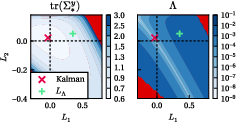
Figure 2: Contour maps of wk∼N(0,Q)8 and the Fisher information metric wk∼N(0,Q)9 for different observer gains, delineating the detectability/accuracy trade-off and regions of instability.
- Observer Gain Selection for Enhanced Detectability: The LLR detectability metric is used as a performance functional for observer design. It is demonstrated that the classical Kalman filter generally does not maximize anomaly detectability; indeed, there is a tension between minimizing innovation variance (Kalman criterion) and maximizing the Fisher information (detection criterion). By sweeping observer gains, the authors show maximized detectability and innovation variance are reached by distinct gain settings.
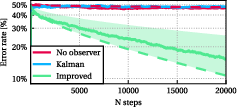
Figure 3: Experimental and theoretical error rates for three observer strategies (no observer, Kalman, and Fisher-optimal), demonstrating the theoretical predictions and highlighting observer impact on detection sensitivity.
Implications and Future Directions
The closed-form characterization of LLR-based anomaly detection sensitivity enables:
- Formal detectability assessment for any hypothesized deviation class, providing guarantees on minimal detectable effect sizes and sample complexity.
- Quantitative, insight-driven observer design not limited by the traditional minimum-variance framework.
- Systematic trade-off analysis between observer-induced decorrelation (beneficial for standard inference assumptions, but potentially detrimental to deviation distinguishability) and detectability.
From a theoretical perspective, the explicit connection to Fisher information and the covariance structure of the measurement process strengthens the bridge between statistical decision theory, control, and fault diagnosis. Practically, the results facilitate data-driven calibration of detection thresholds in industrial settings and motivate new frameworks for adaptive observer reconfiguration where detectability is dynamically optimized.
Potential future extensions involve generalizing the approach to non-autonomous systems, addressing input-dependent settings, and scaling up observer design for large-scale or distributed architectures.
Conclusion
This work establishes a rigorous analytical framework for anomaly detectability in stochastic dynamical systems using the cumulative log-likelihood ratio. The provided methodology delivers actionable, theoretically justified guarantees on detection performance and facilitates observer and system architecture co-design for enhanced anomaly sensitivity. This contributes a foundational toolset for robust, quantifiable anomaly detection in engineered systems.

