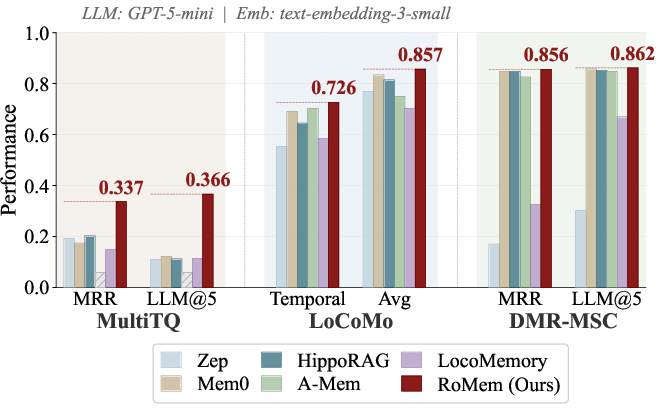
- The paper introduces continuous phase rotation combined with a semantic speed gate to resolve temporal conflicts in knowledge graphs.
- It employs zero-shot interpolation and dual-stream retrieval to overcome the limitations of discrete temporal models.
- Empirical results demonstrate state-of-the-art performance on temporal and static benchmarks, ensuring reliable, append-only memory retrieval.
Continuous Phase Rotation for Temporal Knowledge Graphs: An Expert Synthesis of RoMem
Motivation: Temporal Reasoning in Structured Memory Systems
Graph-based knowledge representations have become indispensable in AI systems designed for long-horizon reasoning, agentic memory, and retrieval-augmented generation. Yet, structured memory architectures face crucial limitations in modeling temporal dynamics. Conventional approaches treat time as discrete metadata—either using recency sorting, destructive overwriting, or expensive LLM arbitration at ingestion. This introduces the “static-dynamic dilemma”: persistent facts like “(Obama, born_in, Hawaii)” risk being unfairly buried by recent but transient changes (such as fresh “president_of” relations), or conflicting facts remain unresolved for lack of principled temporal arbitration.
RoMem directly addresses this dilemma by internalizing time as a continuous operator within the knowledge graph embedding. The theoretical and empirical analysis demonstrates that this inductive bias enables robust temporal conflict resolution, maintains full retrieval performance on non-temporal slots, and generalizes across relation types and domains without manual annotation.
RoMem Architecture: Continuous Geometric Time and Volatility-Aware Rotation
RoMem’s core mechanism combines continuous phase rotation in complex vector space with a pretrained semantic gate that encodes relation volatility. Unlike discrete temporal models (e.g., TeRo, ChronoR) that rely on timestamp lookup tables and are brittle to interpolation or extrapolation, RoMem’s phase shift operator is a smooth, functional mapping from real-valued timestamps—supporting zero-shot predictions for unobserved time points. All entities and relations are embedded in Cd, with functional rotation governed by:
θr(τ)=s⋅αr⋅τ⋅ω
Here, s is a learnable time scale, ω is an inverse frequency vector, and the critical innovation is αr, the semantic speed gate. This gate is predicted from the text embedding of each relation via a lightweight MLP and maps automatically to high values for dynamic predicates (“president_of”, “consult”) and low values for stable predicates (“born_in”, “species”).
Upon fact ingestion, memory remains strictly append-only; no fact is overwritten or deleted. Temporal arbitration is deferred to query time, when geometric shadowing ensures that, for any given query timestamp, only the phase-aligned facts are retrieved with high confidence.
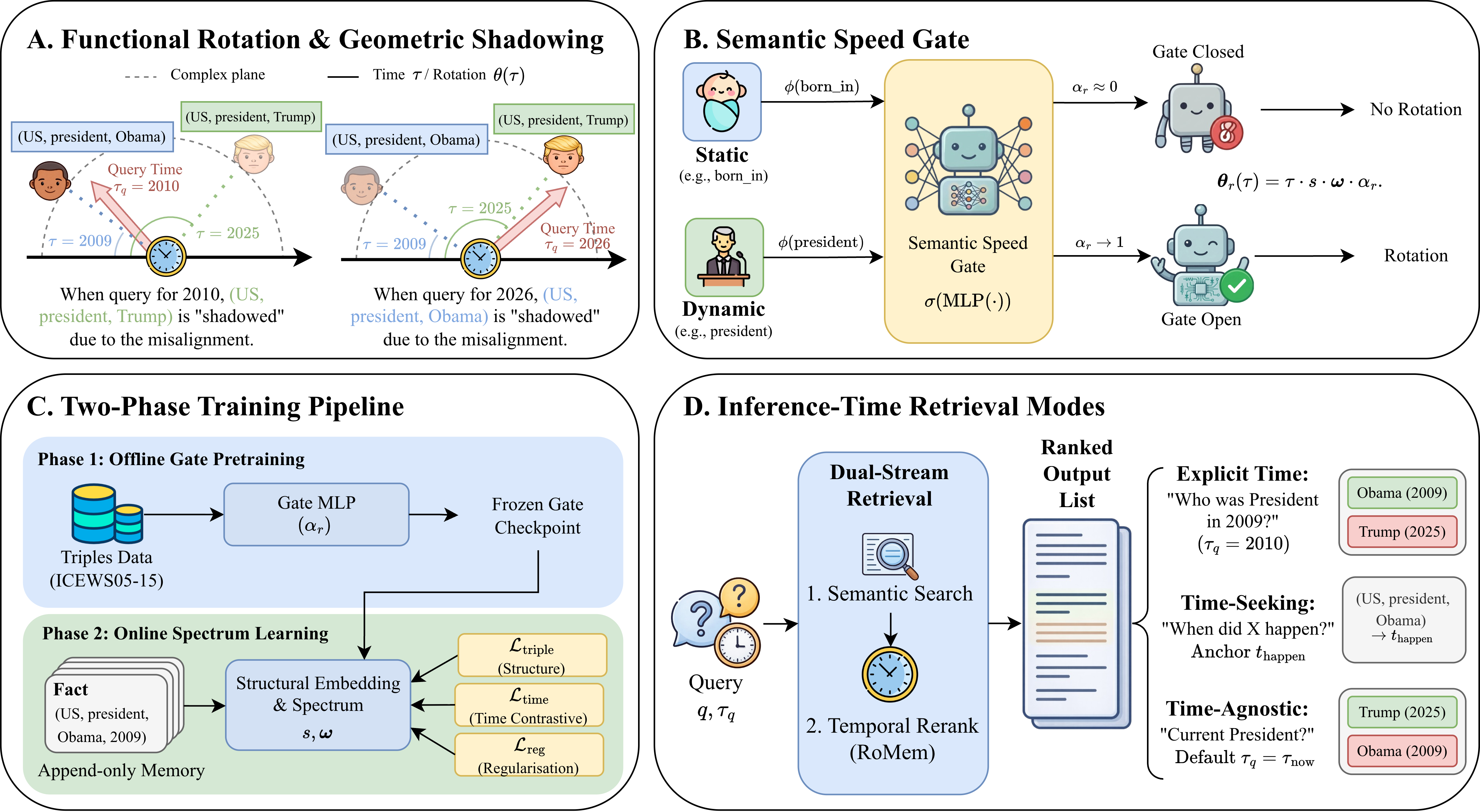
Figure 1: RoMem’s architecture flows from functional phase rotation, through volatility estimation by the semantic speed gate, to two-phase training and inference-time geometric conflict resolution.
Theoretical Properties: Temporal Conflict Resolution via Geometric Shadowing
Modeling time as continuous rotation ensures robust interpolation and conflict arbitration. When two or more facts compete for a slot over time, each is rotated in phase, and only the temporally appropriate fact aligns with the query’s phase. This geometric mechanism guarantees a unique crossover point in the score dynamics, where the new fact overtakes the obsolete one as the preferred answer (formally proved for sufficient frequency bounds).
The gate αr acts as a temporal clutch: for static relations, rotation is suppressed (αr≈0), so facts never fall out of phase and are immune to recency burying. For highly dynamic relations, rapid phase rotation ensures outdated facts quickly become geometrically misaligned and uncompetitive at retrieval.
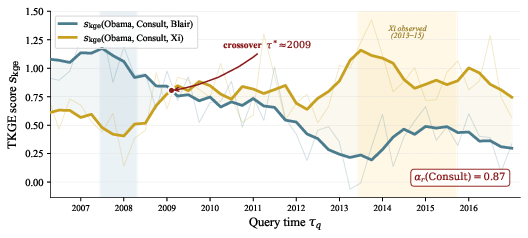
Figure 2: Temporal score traces (e.g., for “(Obama, consult, ?)”) demonstrate how geometric shadowing causes the obsolete fact (Blair) to be overtaken and suppressed by the fresh fact (Xi), with the crossover point governed by the learned volatility.
Empirical Results: Temporal Reasoning, Generalization, and Static Memory Preservation
RoMem demonstrates strong and robust performance drivers across multiple benchmarks:
Mechanistic Analysis and Ablation
Detailed ablations confirm that each architectural element is necessary:
- Continuous phase rotation enables zero-shot temporal interpolation in scoring, eliminating the blind spots inherent in discrete models.
- Semantic speed gate pretraining is essential for robust volatility learning, especially when sparse data would otherwise cause gate collapse or improper temporal discrimination.
- Dual-stream retrieval and multiplicative score gating allow RoMem to amplify only semantically plausible facts, avoiding spurious temporal boosting.
Qualitative analysis of the score traces further aligns with theoretical predictions: the shadowing phenomenon is robust even in the presence of high-frequency noise or entity-sharing among slots.
Implications and Future Directions
By eliminating the dependence on discrete timestamp metadata, destructive updates, and costly LLM arbitration, RoMem represents a shift towards purely geometric, inductive, and maintainable temporal modeling in agentic memory. The approach is strictly append-only, supporting verifiable and auditable memory while relieving the LLM of burdensome context disambiguation.
Practical implications include:
- Modular Integration: RoMem is a drop-in module for any knowledge graph-based or hierarchical structured memory component, providing standard scoring APIs.
- Continual Learning and Retrieval: Guarantees of backward-compatible memory and phase-locked knowledge resolve major usability issues for updating facts in long-lived agents.
- Zero-Shot Generalization: Semantic volatility estimation enables temporal modeling on unseen predicates or domains—crucial for open-world financial, biomedical, or scientific discovery applications.
- Theoretical Foundation: The framework motivates further research into continuous group-theoretical operators, structured functional gates, and their downstream integration with language, vision, or multi-modal data representations.
Potential extensions include leveraging multi-modal information for volatility signals, incorporating more structured calendars or periodicities, and adaptation for lifelong/continual learning settings with drift.
Conclusion
RoMem presents a principled temporal knowledge graph module using continuous phase rotation and a data-driven volatility gate, achieving unambiguous temporal conflict resolution, precise retrieval under arbitrary temporal queries, and robust generalization. The append-only, geometric inductive bias avoids pitfalls of metadata or symbolic update machinery, addressing persistent challenges in agentic memory and temporal KG reasoning. The model’s demonstrated transferability and strong performance across benchmarks highlight its immediate utility and serve as a foundation for future advances in temporal reasoning in artificial agents.
Citation: "Time is Not a Label: Continuous Phase Rotation for Temporal Knowledge Graphs and Agentic Memory" (2604.11544)