- The paper demonstrates that for sufficiently small s, minimizers stick completely to the obstacle in the designated region and diverge to −∞ elsewhere.
- The paper establishes the equivalence between a functional variational formulation and a geometric s-fractional perimeter approach in the obstacle context.
- The paper employs precise geometric constructions and monotonicity formulas to quantify the asymptotic behavior of the nonlocal mean curvature as s approaches zero.
Asymptotics as s↘0 of the Nonlocal Nonparametric Plateau Problem with Obstacles
Introduction and Motivation
This study analyzes the behavior of solutions to nonlocal nonparametric Plateau problems with obstacles in the singular regime as the fractional parameter s↘0. The framework extends classical minimal surfaces into the nonlocal field by employing the s-fractional perimeter, considering subgraph sets associated to functions as generalized surfaces. The focus is on domains modeled as unbounded cylinders and the interplay between boundary data, obstacles, and stickiness phenomena that are emergent in this nonlocal setting for small s.
Historically, investigations such as [DSVnmsstick20, BucurLombardini] revealed the phenomenon of "stickiness" for nonlocal minimal surfaces: for small s, minimizers may adhere entirely to the obstacle or boundary, a property absent in the local regime. While classical minimal surfaces are governed by regularity and continuity across boundaries, their nonlocal counterparts depart from these behaviors, especially as s→0, where nonlocality amplifies the influence of data at infinity.
Functional and Geometric Frameworks
The paper constructs two equivalent formulations for the obstacle Plateau problem: a functional setting based on a variational minimal graph functional, and a geometric setting based on s-fractional perimeter minimization among subgraphs in unbounded cylinders. A key contribution is the demonstration of equivalence between these frameworks, extending results previously established by [CozziLombardini].
Within both settings, the obstacle is represented by a function ψ defined on an open subset A⊂Ω, while the exterior data φ prescribes values outside the domain. The main variational problem seeks a function s↘00 such that its subgraph both minimizes the s↘01-fractional perimeter and lies above the obstacle on s↘02, coinciding with s↘03 outside s↘04.
The functional's strict convexity, regularization properties, and connections to s↘05 spaces are established, providing fundamental existence, uniqueness, and a priori estimates for solutions. The Euler-Lagrange equations for solutions are obtained in both weak and strong forms. Boundedness and truncation properties are proved, ensuring the problem is well-posed in highly nonlocal settings.
Main Results: Complete Stickiness and Asymptotics
Stickiness for Small s↘06
The central finding is that for sufficient smallness of s↘07, the solution to the obstacle problem "sticks" completely to the obstacle in s↘08, and diverges to s↘09 elsewhere in s0 whenever the exterior data is not large at infinity. This phenomenon is characterized using the set function s1, a renormalized integral that quantifies the influence of the exterior data at infinity.
Specifically, if s2, then for any obstacle s3 and open set s4, given large enough s5 and sufficiently small s6, any solution s7 satisfies:
This result is robust with respect to the size and regularity of the obstacle and domain, highlighting the intrinsic nonlocal effect underlying stickiness. Notably, the threshold s5 does not depend on the geometry of the domain or the value of the obstacle, but rather on the concentration of the exterior datum at infinity.
Mechanism of Stickiness
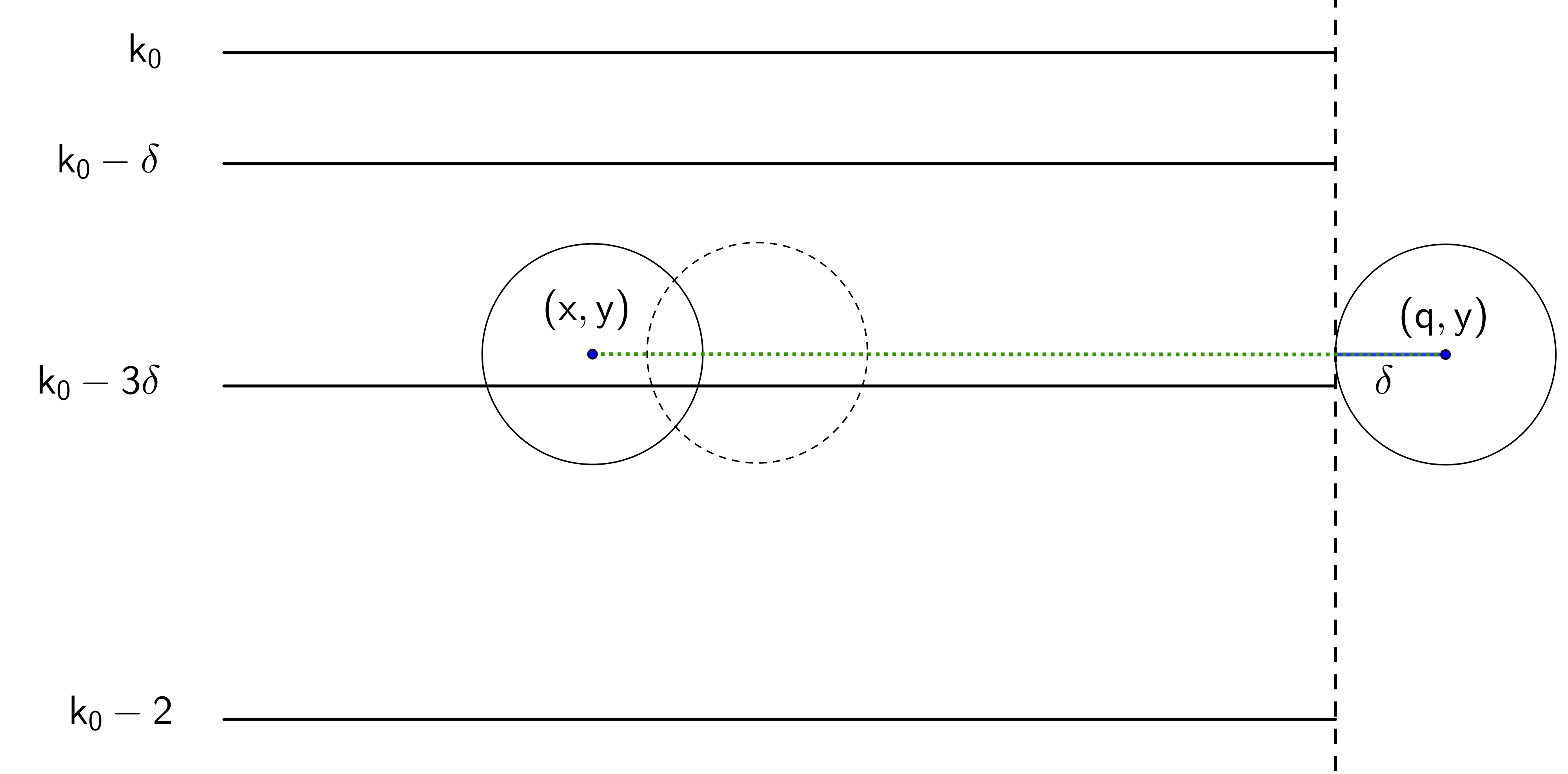
The proof employs careful geometric constructions using exterior tangent balls and monotonicity formulas for the s6-fractional mean curvature. As s7, data at infinity dominate, encoded through the set function s8. For exterior data not "completely surrounding" the domain (i.e., s9), minimization of s0-perimeter leads to the internal set becoming empty, i.e., the minimizer adheres to the obstacle or diverges. This is visualized through sliding tangent balls making contact with the boundary or obstacle, causing discontinuous transitions in the graph.
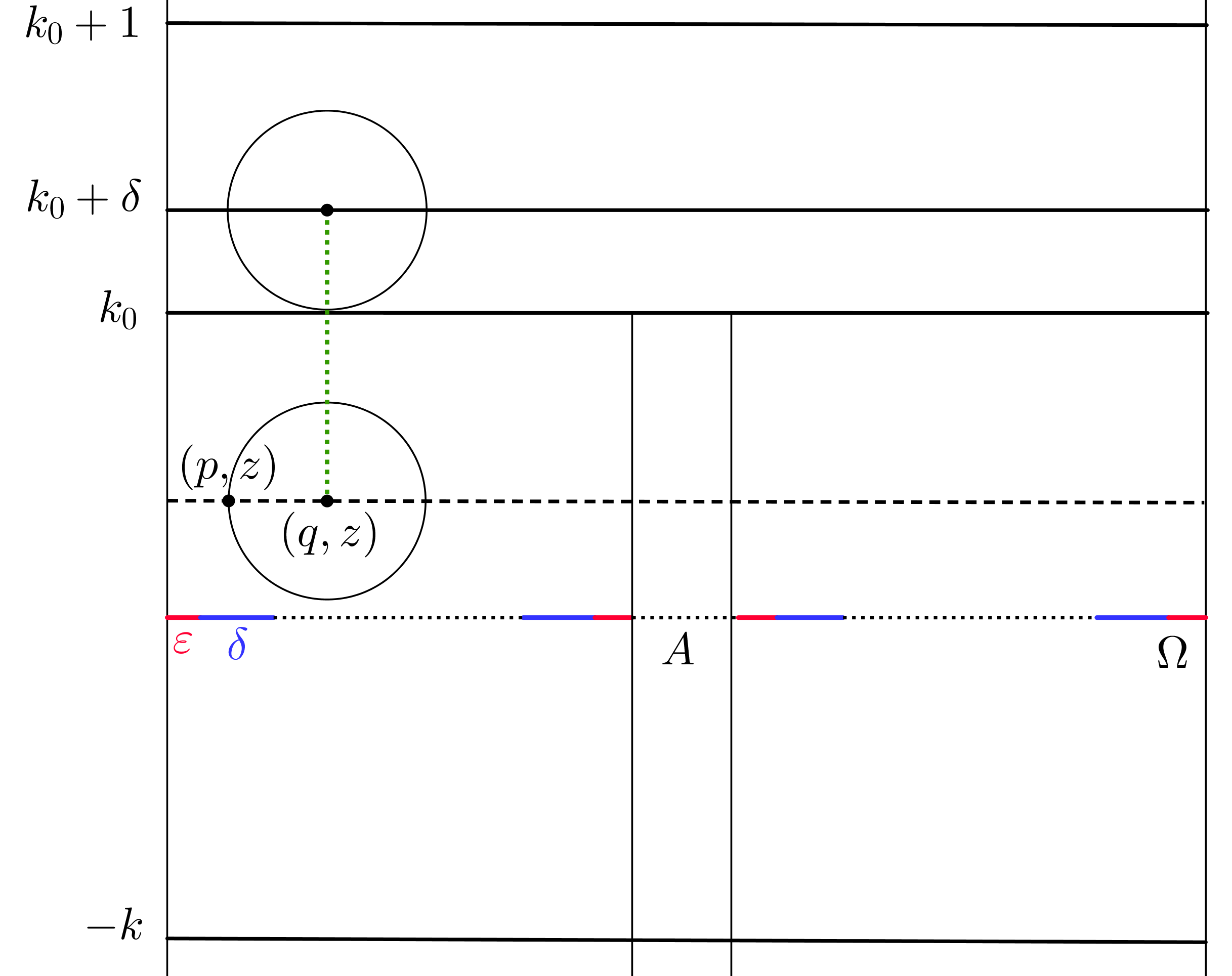
Figure 2: The construction to empty s1.
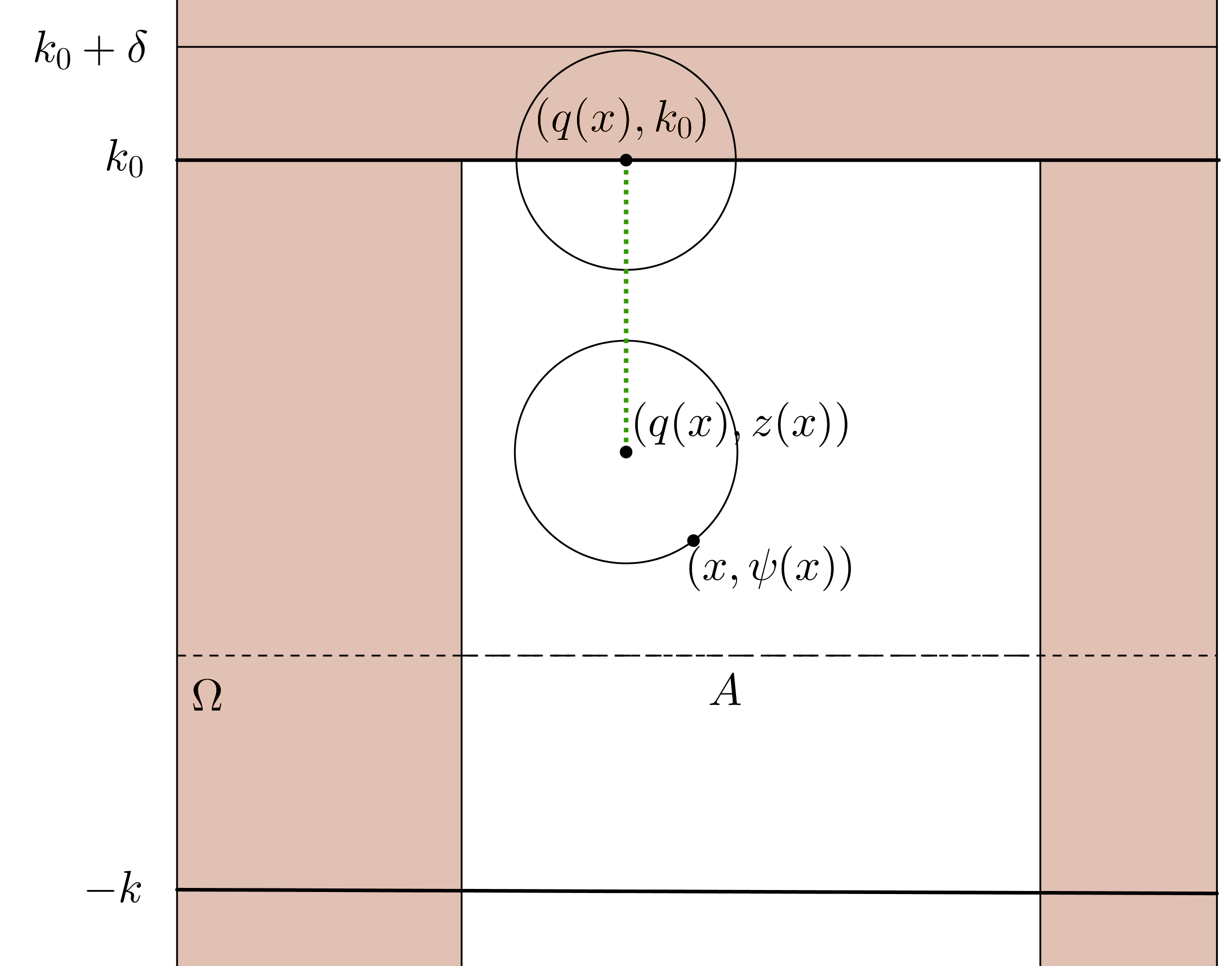
Figure 3: The construction to empty s2.
Contrasting Regimes and Failure of Continuity
A dichotomy emerges: if the exterior data's tail is small (s3), the minimizer "sticks" entirely to the obstacle; if the tail is large (s4), the minimizer prefers to avoid the obstacle entirely. As a consequence, continuity fails both across the boundary of the domain and across the obstacle for small s5, regardless of the regularity of the obstacle or the external datum—in stark contrast to classical minimal graphs. The same effect occurs even for vanishingly small obstacles: the stickiness phenomenon is not mitigated by scaling the obstacle height.
Technical Contributions
The paper develops new technical results to:
- Quantify the asymptotic behavior of the s6-fractional mean curvature as s7, linking it with the set function s8.
- Prove existence, uniqueness, and boundedness of solutions without demanding regularity of the obstacle or the external datum.
- Construct smooth domains over cylinders to overcome difficulties associated with boundaries with corners, supporting the geometric analysis.
Implications and Future Directions
These results signal profound differences between local and nonlocal geometric variational problems.
- From a practical standpoint, they suggest that nonlocal minimal surface models used in interface phenomena, phase-field models, or image processing may exhibit abrupt phase transitions (stickiness to obstacles) for highly nonlocal interactions, independent of obstacle geometry or smoothness.
- Theoretically, the findings emphasize the failure of continuity and regularity typical of local minimal graphs, marking a fundamental limitation for nonlocal geometric flows and PDEs as s9.
- The analysis necessitates novel tools relying on nonlocal mean curvature asymptotics, tail integrals, and fine geometric constructions—pointing to future research into the interplay between nonlocality, data at infinity, and obstacle problems.
Conclusion
The paper rigorously demonstrates the complete stickiness phenomenon for nonlocal minimal graphs in the obstacle problem as s→00 under mild asymptotic assumptions on the exterior data. The equivalence of geometric and functional formulations is established, and quantitative a priori estimates are derived. The asymptotic regime reveals failure of regularity and continuity across both the domain boundary and obstacle—a stark contrast with local theory—providing new perspectives and challenges for analysis and applications involving nonlocal geometric variational problems.