A generalization of Reifenberg's theorem in R^N for flat cones
Abstract: In this paper we prove that if a closed set in RN is close to a cone over a simplicial complex at each point and at each scale, then it is locally bi-Hölder equivalent to such a cone. This generalizes Reifenberg's Topological Disk Theorem in 1960 and G. David, T. De Pauw and T. Toro's result in 2008.
- Almost volume cone implies almost metric cone for annuluses centered at a compact set in $RCD(K, N)$-spaces (2021)
- Cone and paraboloid points of arbitrary subsets of Euclidean space (2021)
- Regularity of minimal surfaces near quadratic cones (2019)
- The singular set of minimal surfaces near polyhedral cones (2017)
- Tangent cones and $C^1$ regularity of definable sets (2017)
- On the Geometry of Rectifiable Sets with Carleson and Poincaré-type Conditions (2015)
- A controlled local-global theorem for simplicial complexes (2013)
- Approximation of a Reifenberg-flat set by a smooth surface (2012)
- Ricci Bounds for Euclidean and Spherical Cones (revised/extended version) (2011)
- Tangent cones and regularity of real hypersurfaces (2010)
Summary
- The paper introduces a generalization of Reifenberg's theorem by parameterizing closed sets in R^N as approximations of flat cones over simplicial complexes.
- It develops a hierarchical, recursive method to construct local bi-Hölder homeomorphisms with explicit quantitative distortion and displacement estimates.
- The framework unifies previous Reifenberg-type results, extending applications to geometric measure theory and regularity analyses in minimal surfaces and elliptic PDEs.
Generalization of Reifenberg's Theorem for Flat Cones in RN
This paper "A generalization of Reifenberg's theorem in RN for flat cones" (2604.11418) proposes a broad extension of Reifenberg's topological disk theorem to a large class of closed sets which resemble cones over simplicial complexes at all locations and scales in RN. The results unify and generalize classical Reifenberg-type regularity theorems and recent bi-Hölder parametrizations for singular sets, laying a comprehensive foundation for the description and analysis of sets approximable by multifaceted conical geometries.
Background and Motivation
The classical Reifenberg theorem characterizes closed sets quantitatively close (in Hausdorff sense) to n-planes in RN at every point and scale, ensuring that the set is homeomorphic via a bi-Hölder mapping to a standard n-disk. Efforts since have divided between more quantitative rectifiability measures (using Jones' β-numbers, e.g., [NV17]) and generalization to sets modeled on more singular geometries—particularly minimal cones. Previous results in this latter direction include parametrizations in R3 for sets modeled on classical minimal cones (planes, Y, and T sets) [DDT08], and frameworks for tangent set stratification in singular measure theory [BL15], but parameterizations for higher and more general cone types remained open.
This work addresses the classification and characterization problem for arbitrary cones over finite simplicial complexes and their products with Euclidean factors, thus subsuming all previously considered models, and yielding a complete regularity and parametrization theory for this large geometric setting.
Statement of Main Results
The principal contribution is a parametrization theorem for closed sets RN0 that, at every point RN1 and scale RN2, can be approximated (to accuracy RN3) by an element RN4 from a prescribed finite family (up to isometries) RN5 of "model" cones of some type RN6 (RN7). Each such set is locally bi-Hölder homeomorphic (via a controlled, canonical mapping RN8) to a corresponding cone, with optimal uniform estimates on both the map and the approximation.
Structure of Model Cones
These "types" are defined inductively as products of an RN9-dimensional cone over a simplicial complex and RN0, equipped with a nonflatness condition to prevent reducible or degenerate geometries (e.g., planes arising as unions of co-planar faces). Model cones admit a natural hierarchy of spines RN1, corresponding to the union of faces of dimension RN2, and every type is stratified accordingly.
Main Parametrization Theorem
Let RN3 be a finite collection (modulo isometry) of such models. If RN4 admits at every RN5, RN6 an approximant RN7 (the iterated blow-up closure of RN8) such that the normalized Hausdorff distance RN9, then there exist n0 and a homeomorphism n1 such that n2 is bi-Hölder on n3, parameterizes n4 locally, and satisfies explicit quantitative bounds:
- For all n5,
n6
- n7 (pointwise displacement)
- n8
This theorem implies that n9 is locally bi-Hölder equivalent (with dimension and geometry specified by the type) to a model cone, for arbitrarily small approximation error.
Inductive Construction and Stratification
A core methodological advance of this work is the systematic, inductive treatment of the parameterization—built recursively on the stratification of the model cone and of RN0 itself.
Figure 1
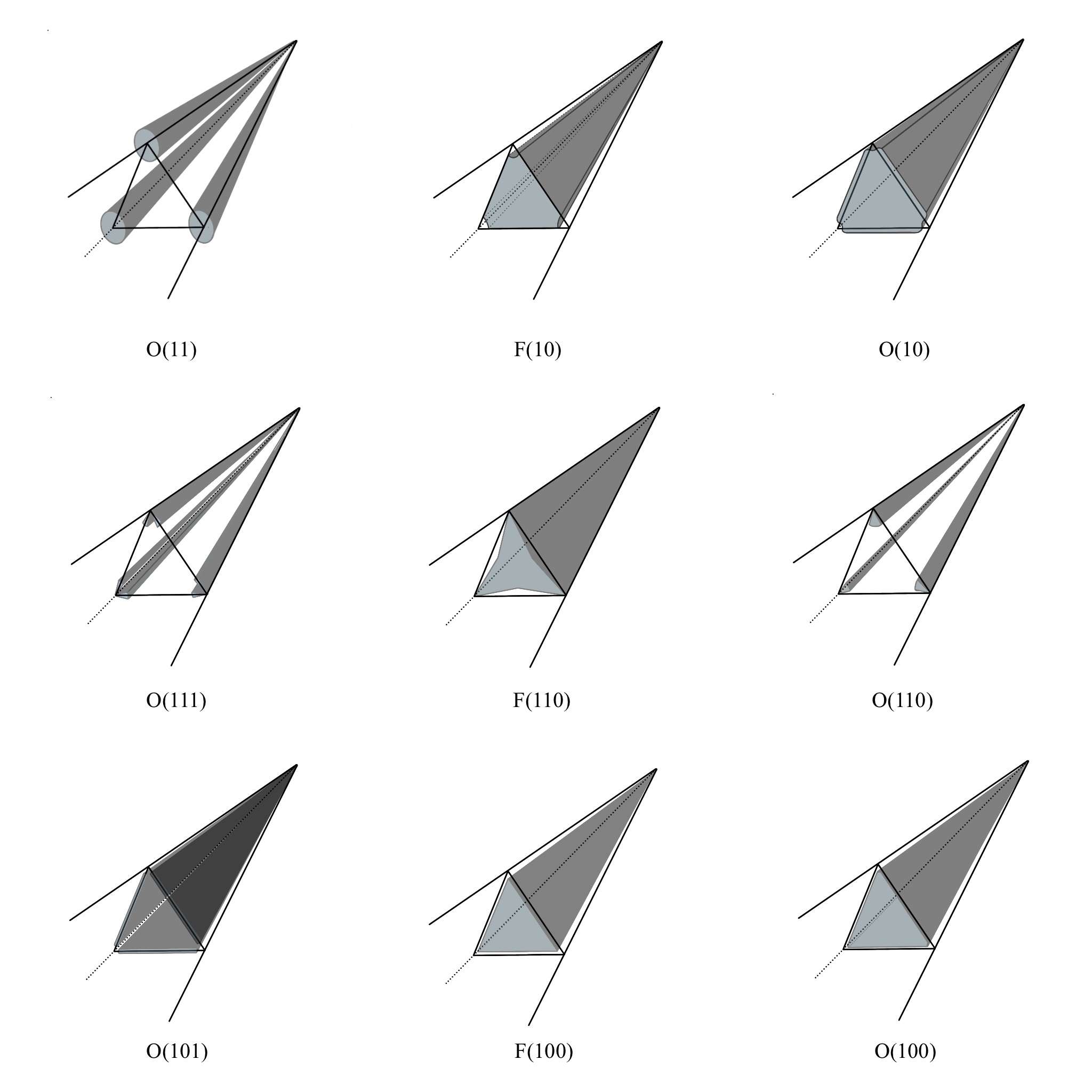
Figure 2: Hierarchical decomposition of spines and their surrounding neighborhoods for a 3-cone, visualizing open neighborhoods (RN1) associated to binary words which classify the region relative to spines of various dimensions.
Each cone and its spines are organized so that, at each scale, the set is partitioned into regions modeled on neighborhoods of different spine dimensions. Open sets RN2 parameterized by binary words encode the relative position to these spines, supporting a recursive partition of unity and map construction. This hierarchical approach circumvents the need for an enumeration of local geometries—an issue in previous literature when only finitely many cases were known.
Stepwise Parametrization
The map RN3 is defined on each stratum of the spine as a limit of homeomorphisms RN4 (with RN5), each RN6 deforms RN7 by an explicit, localized motion controlled by the partition of unity. Inside conical regions between spines, the map is constructed as the (piecewise) orthogonal projection onto the "nearest" spine, and is extended across strata using a tree-structured extension procedure (as shown in Figure 2).
At each step, regularity, injectivity, and consistency conditions across intersections of neighborhoods and spines are maintained with quantitative control.
Structural Lemmas and Stratification Properties
The argument establishes:
- Existence and uniqueness of type for nonflat cones (Ambiguity is precluded by the nonflatness condition; see Proposition 2.7 and associated remark).
- Complete stratification of any set close to models into layers RN8 consisting of those points whose small-scale type is RN9 (Proposition 3.7).
- Stability of strata and cones under blow-ups; closure and containment relations analogous to polyhedral skeleta.
- Quantitative separation of branches and nontrivial lower bounds for distances across different cone types.
- For each n0, n1 is locally close to an n2-plane in the sense of the original Reifenberg theorem, except possibly in small neighborhoods of lower strata.
Figure 2
Figure 2: Regions around the base point n3 of a 3-cone. Solid lines and colored branches represent 1/2/3-dimensional spines; gray zones illustrate conical open sets n4 and their complements n5, supporting the local parameterization and inductive extension.
Numerical and Theoretical Strength
The main theorem yields uniform constants of regularity, and the construction explicitly produces the bi-Hölder map n6. Quantitative bounds on distortion, displacement, branching separation (controlled by n7), and layer transitions (n8) are central to the construction.
This framework subsumes all previously known Reifenberg and De Pauw-David-Toro-type parameterizations: for n9-planes, for minimal cones in lower dimensions, and for products of these with Euclidean factors. The approach is also fully constructive, avoiding non-quantitative global arguments.
Implications and Future Development
Practical implications include:
- Applicability to geometric measure theory problems involving rectifiability and parameterization near singularities, such as analysis of minimal surfaces, free boundary problems, or zero sets of analytic functions where tangent cones are not necessarily smooth.
- The establishment of a complete local classification of geometric types for sets approximable by cones over simplicial complexes, which can be translated directly to questions of regularity for solutions to elliptic PDEs or for limiting objects in geometric flows.
Theoretical ramifications:
- Provides a unifying formalism for blow-up analysis and singular set stratification, in line with the tangent measure and β0-number approaches for quantitative rectifiability.
- The recursive, tree-based local cover and map extension method is likely to be adaptable to more general stratified and singular settings, including possibly to non-Euclidean or metric spaces with cone-type tangent structures.
Future directions may include:
- Quantitative versions (in measure or density) via the adaptation of Jones' β1-numbers and higher order geometry, bridging toward analytic regularity (see [NV17], [ENV19]).
- Extension toward an analogue in Riemannian or metric space settings, or in the presence of further singularities.
Conclusion
This paper provides a sharp and highly general parametrization theorem for sets close to arbitrary cones over finite simplicial complexes in β2. The new hierarchical, stratified, and inductive techniques bridge the gap between classical Reifenberg theory and modern singular blow-up analysis, providing a canonical description of the geometry of multi-scale, multi-type singular sets. The explicit, constructive nature of the parametrization and the general model class set a new standard for regularity theorems in geometric analysis and geometric measure theory.
References:
- [NV17] Naber, A.; Valtorta, D.: Rectifiable-Reifenberg and the Regularity of Stationary and Minimizing Harmonic Maps, Annals of Mathematics (2017).
- [DDT08] David, G.; De Pauw, T.; Toro, T.: A generalization of Reifenberg’s theorem in β3 for sets close to minimal cones, Annales de l'Institut Fourier, 58(6):1971–2068, 2008.
- [BL15] Badger, M.; Lewis, S.: Local set approximation: Geometry and measure, Transactions of the AMS, 2015.
Paper to Video (Beta)
No one has generated a video about this paper yet.
Whiteboard
No one has generated a whiteboard explanation for this paper yet.
Paper Prompts
Sign up for free to create and run prompts on this paper using GPT-5.
Top Community Prompts
Open Problems
We haven't generated a list of open problems mentioned in this paper yet.
Continue Learning
- How does the bi-Hölder parametrization method improve upon classical Reifenberg approaches?
- What are the key challenges in extending the theorem to higher-dimensional flat cones?
- How do the hierarchical and inductive techniques contribute to managing singularities within the set?
- In what ways can the quantitative bounds on distortion and displacement be applied in geometric measure theory?
- Find recent papers about singular set stratification in geometric measure theory.
Collections
Sign up for free to add this paper to one or more collections.