- The paper presents its main contribution by integrating agent-based herding dynamics into a growth model to capture unidirectional technology diffusion in CEE economies.
- It calibrates a nonlinear model using OECD TFP data, revealing clear convergence trajectories toward the German technological frontier.
- The empirical analysis projects future TFP levels up to 2050, highlighting heterogeneous diffusion rates and policy implications for economic catch-up.
A Herding-Based Model of Technological Transfer and Economic Convergence: Analytical and Empirical Perspectives
Introduction
This essay provides a technical analysis of the herding-based endogenous technology diffusion framework developed in "A Herding-Based Model of Technological Transfer and Economic Convergence: Evidence from Central and Eastern Europe" (2604.11413). The authors extend standard macroeconomic growth models by introducing agent-based dynamics for technological transfer, with particular application to the convergence of Central and Eastern European (CEE) economies. The following sections review the theoretical construction, empirical methodology, primary results, and implications of this modeling approach.
Theoretical Model: Micro-Foundations of Technology Adoption
The model extends the classical Solow-type aggregate production structure:
Y=AL1−αKα
by endogenizing the total factor productivity (TFP) term, A, through diffusion from the technological frontier, instead of rendering it as an exogenous or purely innovation-driven process.
The core theoretical innovation is the micro-founded adoption process, formulated via herding dynamics akin to Kirman's model. Agents (interpreted as innovators) choose between adoption and non-adoption states. Transitions are captured through state-dependent intensities reflecting both individual and peer (herding) effects, but unlike typical models, only forward (adoption) transitions are allowed, consistent with unidirectional technology accumulation.
This leads to a deterministic nonlinear ordinary differential equation for the share of adopters x(t):
dtdx=(1−x)(σ+hx)
which, together with initial and boundary conditions, yields an explicit solution for the trajectory of aggregate technological productivity, formulated analytically as:
A(t)=Ame(−Am−A0Amht)+A0(1−e(−Am−A0Amht))AmA0
where A0 is initial TFP, Am is the maximum attainable TFP ("frontier"), and h parameterizes the convergence rate.
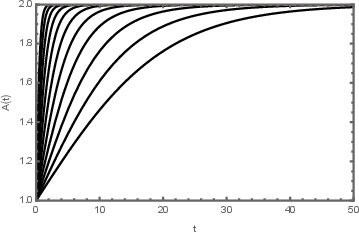
Figure 1: Visualization of technological productivity model solution for varying convergence rates h.
The authors further generalize Am to account for ongoing frontier advancements, adopting an exponential growth specification, which leads to a dynamic, logistic-type convergence model towards a moving target.
Empirical Application: CEE Convergence and Model Calibration
For empirical validation, the authors use OECD cross-country panel data on TFP for Germany (as the reference advanced economy) and eleven CEE countries. Total factor productivity is measured in PPP-adjusted dollars per hour worked, aligning with international comparative standards.
The study visualizes the historical convergence trajectory between CEE countries and Germany, noting the heterogeneity and episodic acceleration associated with EU accession and broader global economic integration.
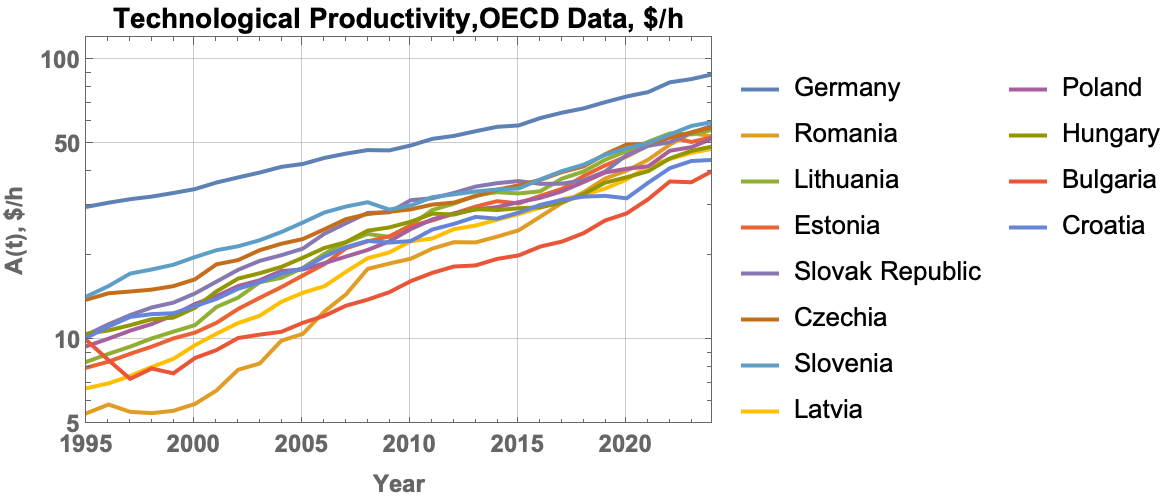
Figure 2: OECD TFP trajectories for Germany and select CEE countries, demonstrating observable convergence over the past decades.
Parameter estimation proceeds by first fitting the exponential growth of the frontier (Germany) and then calibrating the catch-up dynamics for each CEE country via nonlinear least-squares (Levenberg–Marquardt algorithm). The two key country-specific parameters are:
- A0: initial technological productivity
- A1: effective diffusion rate (pace of convergence)
Goodness-of-fit is assessed both visually and via forecast projections for years 2030 and 2050.
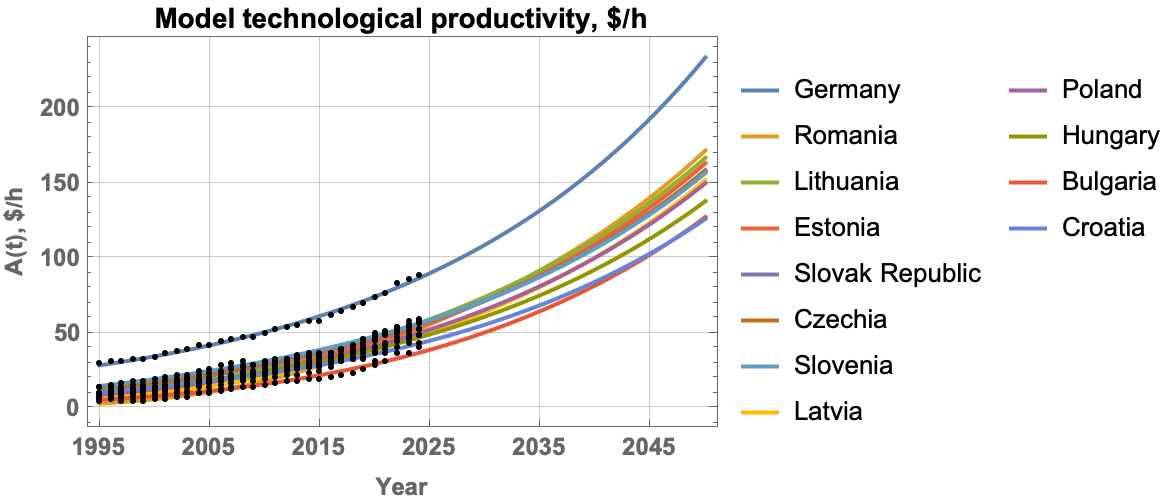
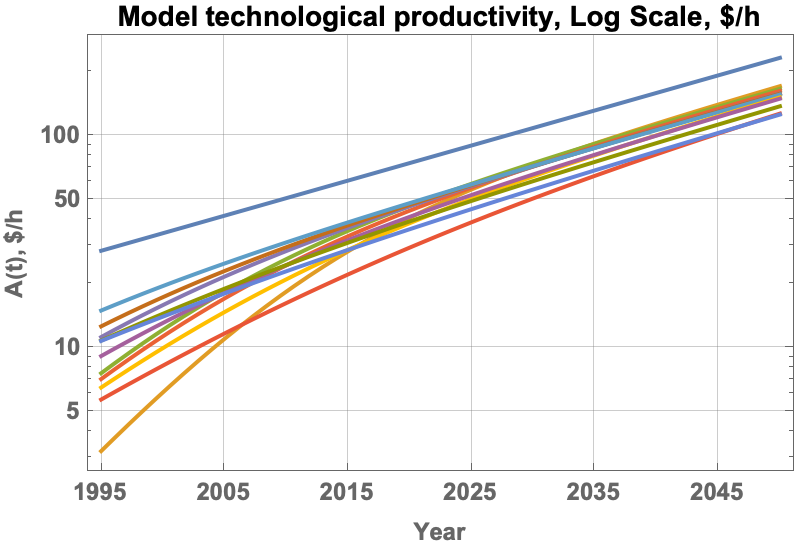
Figure 3: Fitting the dynamic convergence model to CEE country TFP data; left: linear, right: log scale.
Principal Results and Key Numerical Findings
The main empirical findings highlight:
- All CEE economies examined exhibit clear TFP convergence trajectories toward the German frontier, with country ordering in long-run productivity almost perfectly coinciding with the estimated diffusion rate A2.
- Projected TFP levels for 2050 suggest substantial catch-up is likely for the most dynamic countries (e.g. Romania, Lithuania, Estonia), while others remain at lower relative TFP, despite the upward trajectory.
- The model retains parsimony, capturing essential convergence patterns with a minimal parameterization and offering closed-form solutions for future projections under different frontier scenarios (Germany, US).
Importantly, this herding-based model leads to an explicit and tractable mapping from micro-level peer effects to macro-level convergence speeds, which is not a feature of canonical Solow/Swan or standard endogenous growth frameworks.
Discussion: Theoretical Implications and Model Limitations
This work demonstrates the feasibility and empirical credibility of embedding agent-based herding dynamics within aggregate growth theory. The micro-foundation provides insight into how peer interactions at the agent level—representing competitive or imitation-based diffusion—aggregate into measurable differences in national convergence rates.
Nevertheless, several limitations should be underscored:
- The model does not explicitly account for country-specific institutional, sectoral, or policy heterogeneity; all such variation is effectively subsumed in the estimated A3 parameter.
- The assumption of a homogeneous, unidimensional adoption channel omits multi-channel, multi-sector diffusion, inter-sectoral linkages, and strategic policy interventions.
- The reliance on a single moving frontier (Germany or US) as the reference benchmark may affect estimated convergence and future projections; yet, robustness checks with different frontiers only moderately change country ordering.
Practical Relevance and Prospects for Extension
On the practical side, the framework provides a basis for medium- and long-term projections of labor productivity (hence, potential GDP) across converging economies, subject to the caveats associated with model simplicity and exogenous shocks. This is valuable for policy planning, international projections, and as a parsimonious baseline for more complex multi-factor models.
For future theoretical development, possible directions include:
- Incorporation of structured agent heterogeneity to accommodate network effects, sectoral adoption gradients, or institutional differences.
- Extension to endogenize policy and financial market channels (private debt, investment, openness) directly within the diffusion rate, linking with findings that private credit is an empirically vital growth factor (Kolinets et al., 5 Oct 2025).
- Integration with open-economy and multi-frontier frameworks to reflect the complexity of real-world global technology exchange.
Conclusion
The paper presents a rigorous herding-based analytical framework for modeling international technology diffusion and economic convergence. By bridging agent-based and macro-level approaches, it illuminates the structural underpinnings of convergence speeds and the persistent divergence in realized TFP in Central and Eastern Europe. Despite its parsimony, the model robustly captures core features of the empirical data and offers explicit, interpretable parameters for cross-country comparison and long-run forecasting. Future work that relaxes homogeneity or adds financial and institutional channels would further enhance the explanatory and policy relevance of this modeling paradigm.

