- The paper demonstrates that imposing global invariant structure significantly reduces negative eigenvalue frequency and projective-invariance drift in CY metric learning.
- The framework decouples geometry generation from model variation, enabling controlled benchmarking of local, globally invariant, and symmetry-aware model architectures.
- Results indicate that while symmetry-aware methods show promise, globally invariant models currently offer superior stability and robustness in hard quartic regimes.
GlobalCY I: Controlled Benchmarking of Globally Defined and Symmetry-Aware Neural Kähler Potentials
Introduction and Problem Motivation
The computation of explicit Ricci-flat Kähler metrics on Calabi–Yau (CY) manifolds is central in complex differential geometry and string theory compactifications. Traditional approaches give existence but not a constructive expression for these metrics. Numerical and, recently, machine learning methods have been deployed to develop approximations for these metrics, mostly by learning the Kähler potential correction ϕ in the ansatz g=gFS+∂∂ˉϕ, with gFS the pullback Fubini–Study metric. The key scientific problem is that prevailing local-input neural models can achieve low training loss but fail geometric fidelity diagnostics, especially in singular regimes such as the Cefalù quartic cases. Instability manifests as negative eigenvalues, poor behavior under projective rescaling, or drift in globally invariant quantities. Thus, learning strategies must impose explicit geometric architecture—globality and symmetry-awareness—rather than relying on the optimizer to recover these properties implicitly.
Software Architecture and Experimental Protocol
GlobalCY is a JAX-native scientific ML framework built for this purpose, composed of several pipeline layers. GeoCYData provides the geometry and protocol substrate, exporting quartic-family data bundles with local, global, and symmetry-aware feature perspectives, together with canonical case identifiers and seed presets. GlobalCY consumes these, instantiates three model classes (LocalPhiMLP, GlobalInvariantPhi, and SymmetryAwareGlobalPhi), constructs the full Hermitian metric via autodiff, and evaluates each under a suite of geometric diagnostics. The design separates geometry generation from model variation, enabling controlled, artifact-driven benchmarking.
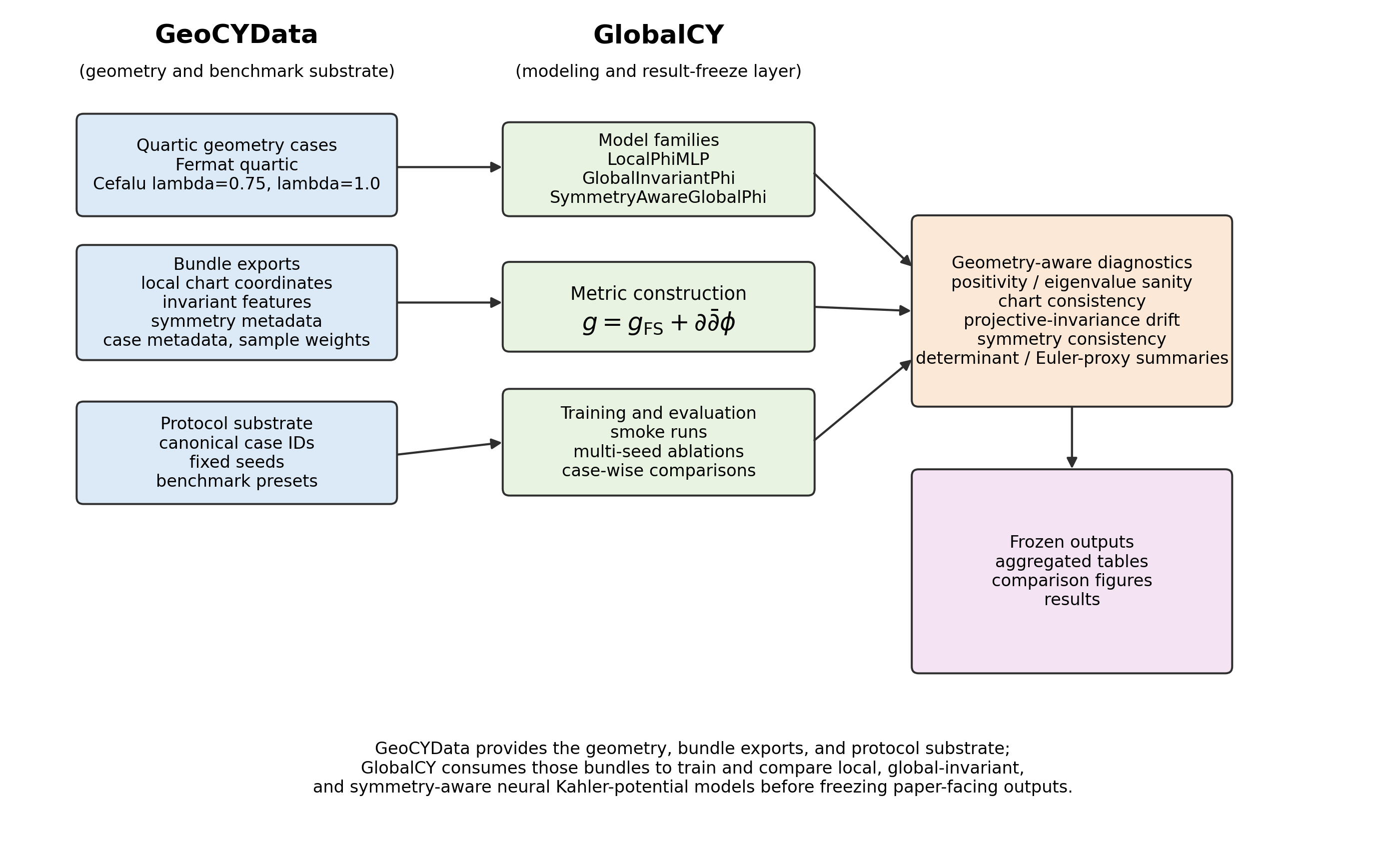
Figure 1: Overall workflow separating geometric data, invariant/symmetry-aware views, model architecture variation, and metric/diagnostic layers within the GlobalCY stack.
Each model class operates on identical benchmark bundles, with the architectural variable isolated: LocalPhiMLP (chart-local input MLPs), GlobalInvariantPhi (input on projective-invariant feature sets), and SymmetryAwareGlobalPhi (invariant inputs plus explicit symmetry-orbit information). The framework supports multi-seed ablations, case-wise aggregation, and reproducible pipeline freezing for results.
Geometry, Models, and Diagnostics
The chosen testbed is the Cefalù quartic family, specifically at λ=0.75,1.0—regimes exhibiting significant geometric fragility and prior evidence for architectural effects. GeoCYData bundles provide feature representations for both local patches and globally invariant tensors, with model export from each, followed by metric construction and rigorous diagnostics.
The geometry-aware diagnostic suite includes:
- Negative-eigenvalue fraction: frequency of metric negativity
- Minimum eigenvalue: spectral lower tail
- Projective-invariance drift: global structure preservation
- Chart consistency: overlap stability
- Symmetry consistency: behavior under intrinsic automorphisms (when available)
- Auxiliary: determinant mean, Euler proxy, training loss, runtime
The principal interpretive focus is on negative-eigenvalue frequency and projective-invariance drift as robust signatures of geometric fidelity.
Results
The controlled benchmark (across fixed seeds 7, 11, 19) provides clear evidence of the effect of architectural choices. The globally invariant model outperforms both the local-input and symmetry-aware (current implementation) model families on the principal diagnostics at both λ=0.75 and λ=1.0.
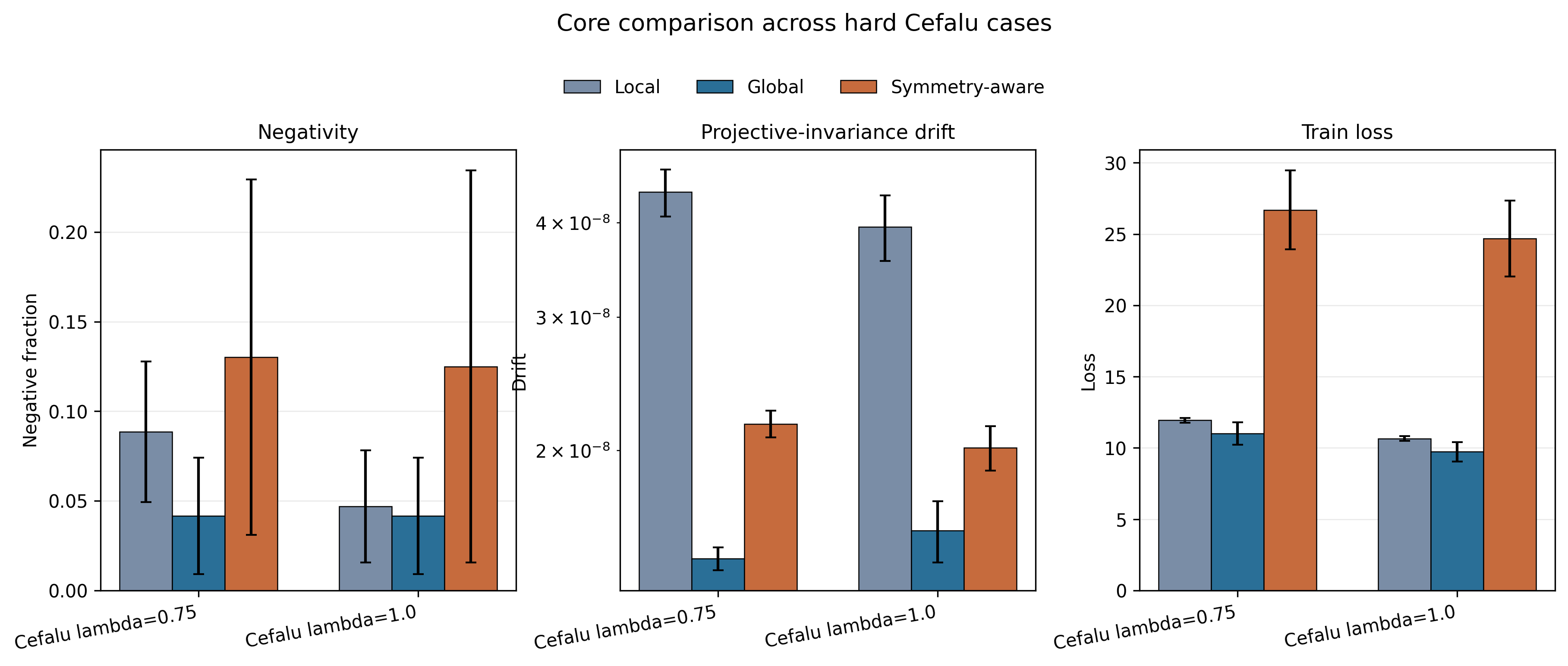
Figure 2: Per-family mean performance (negative-eigenvalue frequency, projective-invariance drift, training loss) across the two hard Cefalù quartic cases. Error bars reflect cross-seed variation. The globally invariant model is uniformly strongest overall.
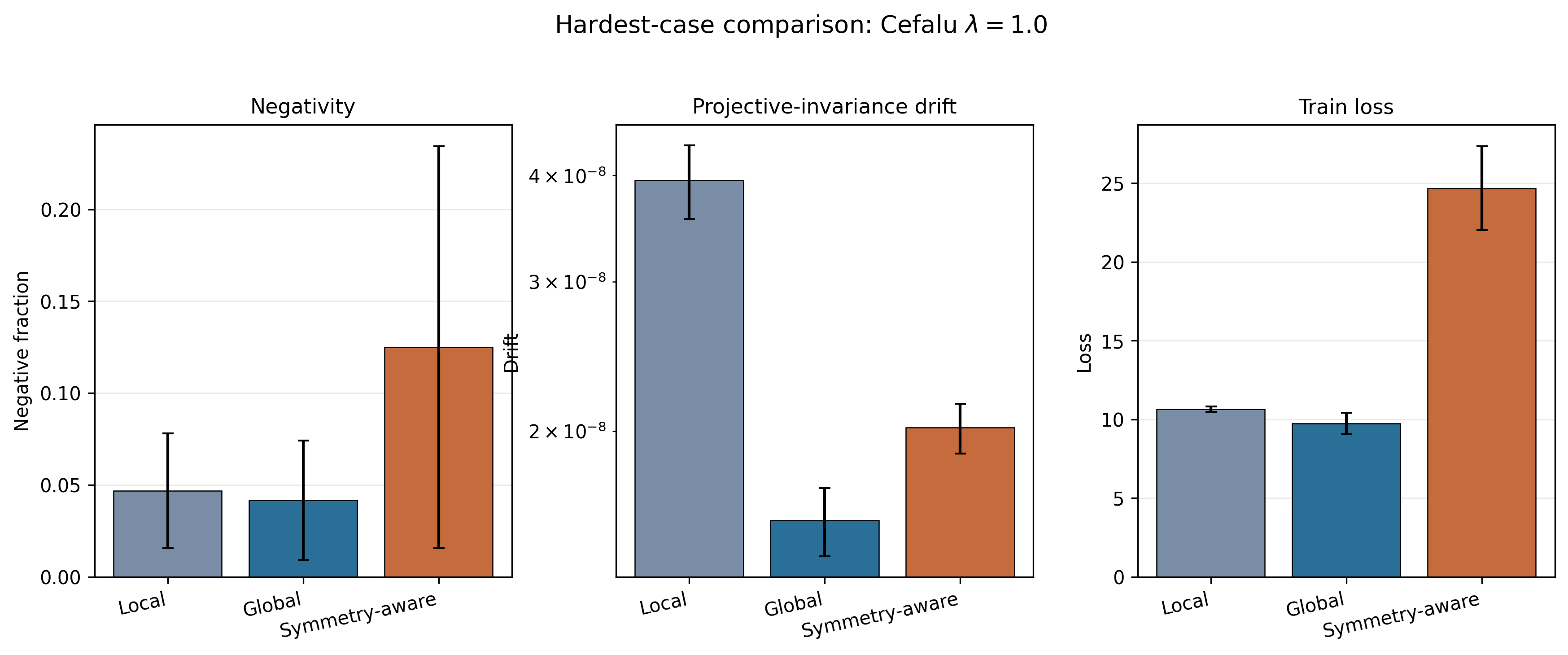
Figure 3: Detailed ablation at λ=1.0. The globally invariant model continues to achieve the lowest projective-invariance drift and training loss, but the margin over local-input models on negativity is reduced.
Quantitatively, at λ=0.75:
- GlobalInvariantPhi lowers mean negative-eigenvalue rate from 0.0885 (local) to 0.0417, and drift from 4.39×10⁻⁸ to 1.44×10⁻⁸.
- The symmetry-aware model marginally improves drift but has higher negativity and greater inter-seed variance, indicating insufficient robustness at this development stage.
At g=gFS+∂∂ˉϕ0 (harder regime):
- Performance separation narrows, but the globally invariant architecture still provides lower negativity and drift.
- Symmetry-aware gains remain limited and less stable.
Across all experiments, chart consistency and Euler/determinant proxies are not discriminative, confirming the diagnostic value lies in geometry-sensitive measures.
Interpretation, Limitations, and Implications
The primary takeaway is that imposing global invariant structure is a scientifically consequential architectural constraint for learned CY metrics—performance gains on instability and drift diagnostics are visible under controlled, reproducible settings and not explainable by overfitting or randomness. Symmetry-awareness, while theoretically promising, does not yet surpass global invariance when implemented only nominally; richer group-theoretic or equivariant representations are likely necessary for further improvement.
The study is deliberately limited in scope: only two hard quartic cases, controlled seeds, and a lightweight, though geometry-aware, diagnostic layer. It is not a comprehensive solution to the Ricci-flat learning challenge, nor does it address full moduli spaces or deeply singular behaviors. The LocalPhiMLP baseline retains best minimum eigenvalue mean on both cases, underlining that architectural gains are not universal across all metrics.
Practically, these results signify that future high-fidelity machine-learned CY metrics for string theory compactification, physics-facing observable computations, or symbolic distillation pipelines should build on globally invariant, and eventually symmetry-adapted, model architectures. The separation into geometry (GeoCYData) and model layers (GlobalCY) provides a reusable experimental backbone for modular, extensible scientific development.
Conclusion
GlobalCY establishes, for the first time in a rigorous, artifact-driven protocol, that global invariant structure is an essential ingredient in geometry-first neural metric learning for CY hypersurfaces, with performance benefits evident in the most robust geometric diagnostics on hard quartic testbeds. The results align with, but extend, prior evidence for architecture-driven gains, and set the stage for subsequent work: group-equivariant modeling, symbolic distillation, generalization across moduli spaces, and integration into full-string-theory-inspired calculation stacks.
Reference: "GlobalCY I: A JAX Framework for Globally Defined and Symmetry-Aware Neural Kähler Potentials" (2604.11404)