- The paper establishes sharp upper and lower bounds for ex(n, Bₜ), pinpointing the threshold for excluding multiple C₄'s sharing an edge.
- It employs probabilistic blow-up constructions and intricate double-counting methods to obtain improved constants, especially for t=2.
- The results extend to bipartite settings and generalize to Cartesian products with arbitrary trees, offering insights for extremal graph constructions.
The Turán Number of the Cartesian Product of a Star and an Edge
Introduction
This paper investigates the Turán number for the Cartesian product of a star St with t edges and an edge K2, denoted as Bt=St□K2, equivalently the graph consisting of t copies of C4 sharing a single edge (see Figure 1 below). Determining Turán numbers—maximum sizes of graphs avoiding a given subgraph—remains a central problem in extremal combinatorics, especially in the bipartite case, where the problem is notably challenging. The main contributions of this work are sharp upper and lower bounds for ex(n,Bt) (and its bipartite variant exbip(n,Bt)), explicit determination of leading constants for small t (notably t=2), and generalizations to Cartesian products of t0 with arbitrary trees.
(Figure 1)
Figure 1: The graph t1. The graph is comprised of t2 copies of t3 sharing a single edge.
Turán Numbers for t4: Upper and Lower Bounds
The main theorem establishes that for any t5 and sufficiently large t6,
t7
The lower bound, based on random and blow-up constructions from t8-free graphs, matches the upper bound in order of magnitude,
t9
with a more complex expression for even K20. As K21, this shows K22 is the window for the rescaled limit K23.
Improved Coefficients for K24
For K25, sharper analysis gives
K26
The upper bound comes via intricate double-counting and star-decomposition arguments leveraging exclusion of special structures, and it is improved further from the standard K27 to K28. The lower bound is achieved by randomized blow-ups maximizing edge count while precluding K29.
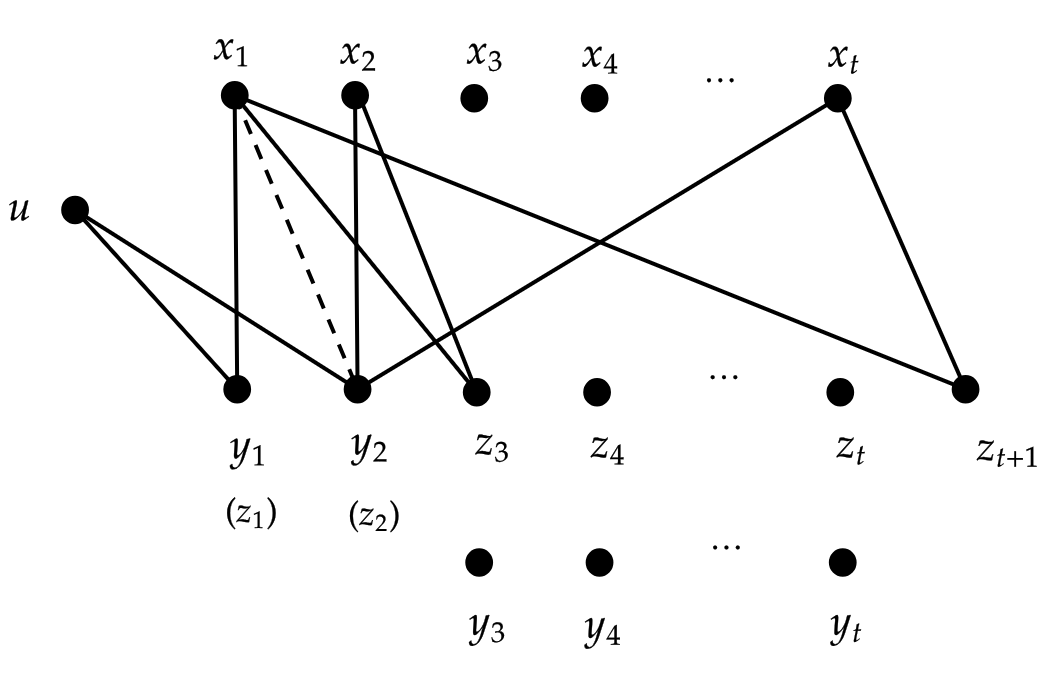
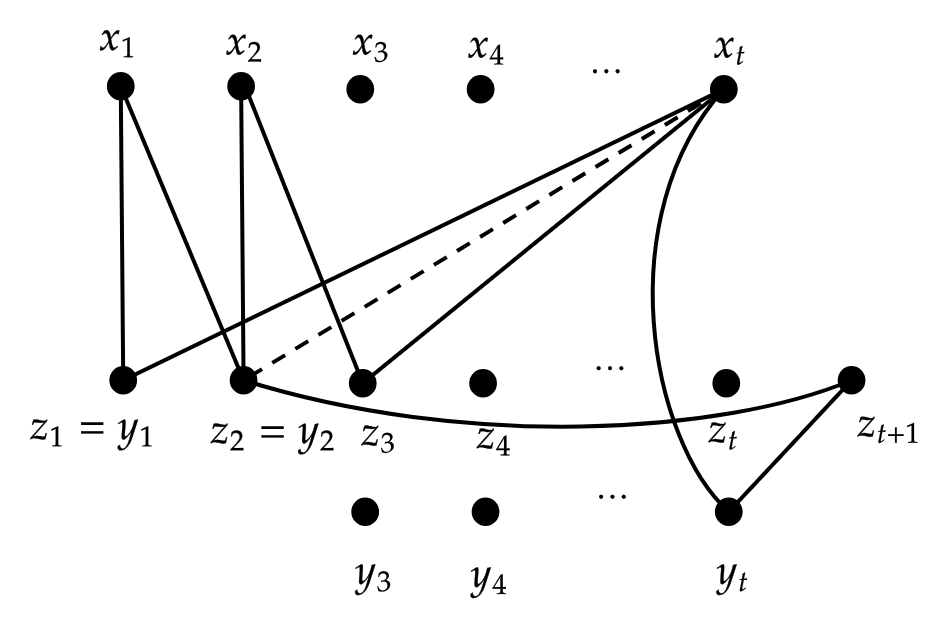
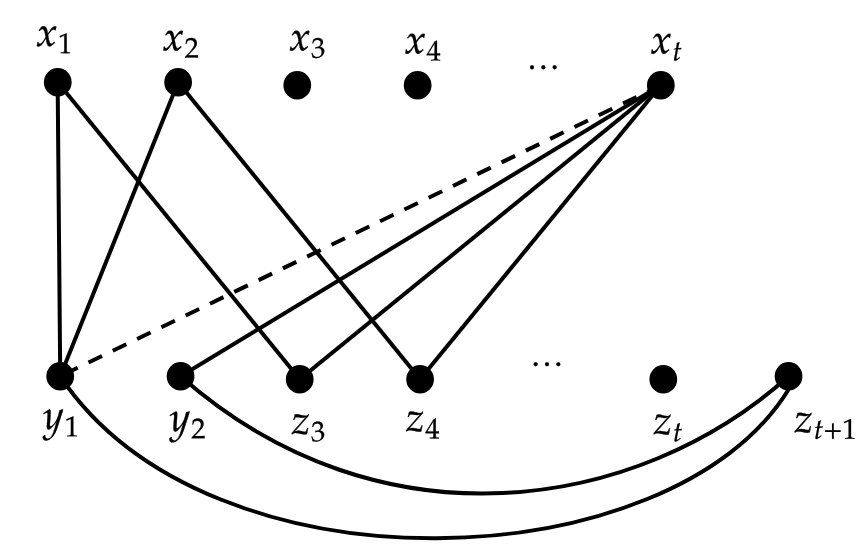
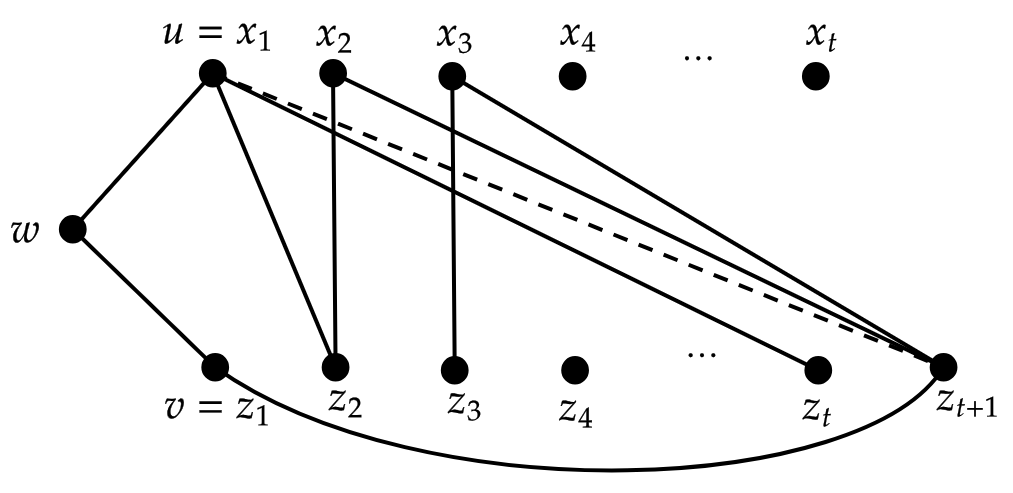
Figure 2: The red edge represents the edge shared by Bt=St□K20 copies of Bt=St□K21.
Bipartite Turán Numbers and Generalizations
The bipartite Turán number Bt=St□K22 is analyzed via similar methods but reflects tighter constraints:
Bt=St□K23
For the case Bt=St□K24, the result is further refined:
Bt=St□K25
This uses an adaptive deletion process and careful bounding of the number of forbidden configurations using degree distributions and codegree constraints.
A general theorem extends the upper bound to all trees Bt=St□K26 with Bt=St□K27 edges:
Bt=St□K28
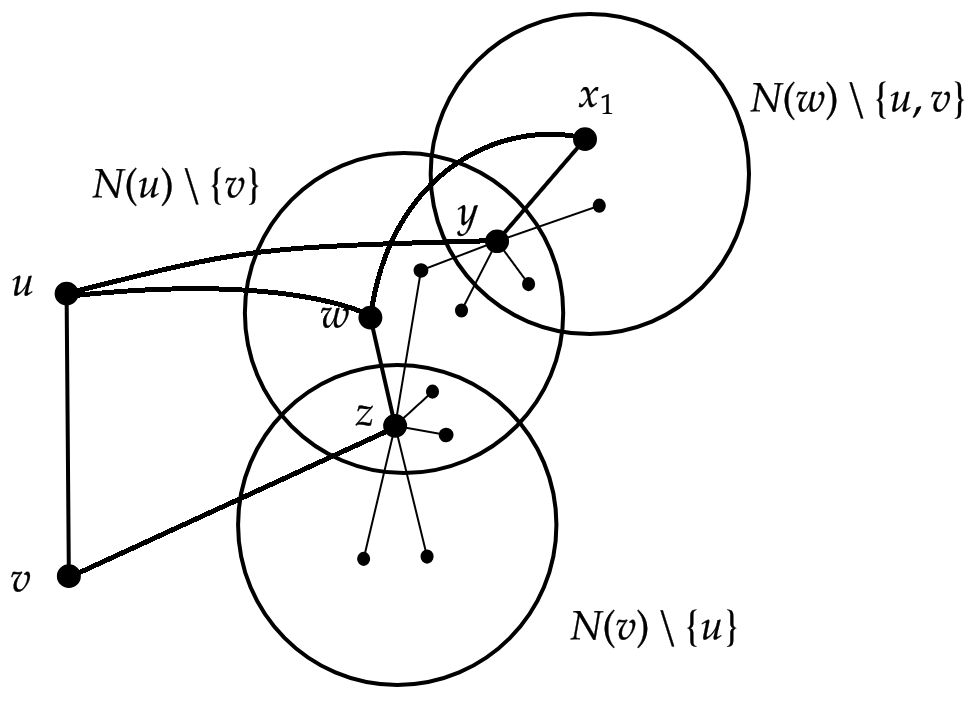
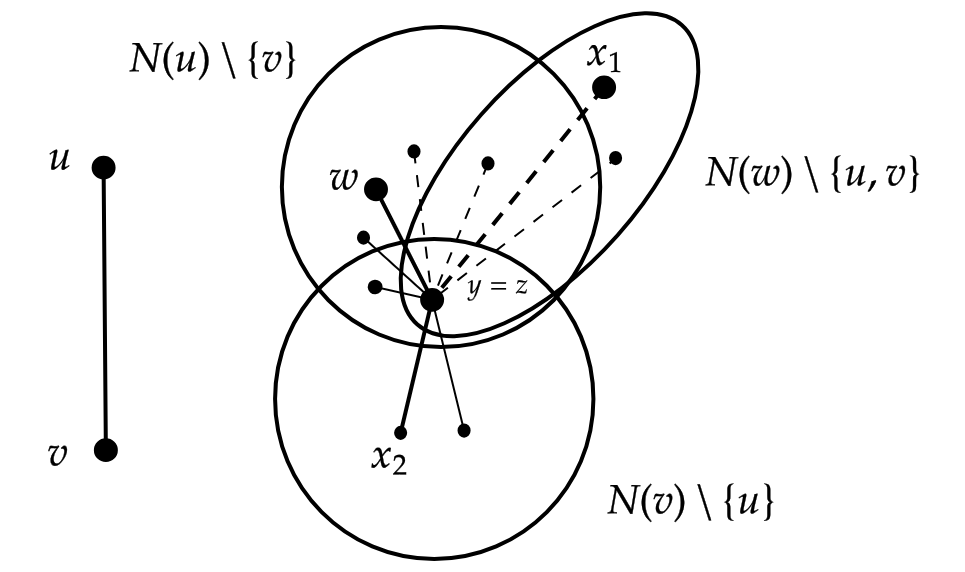
Figure 3: For each Bt=St□K29, if t0 and t1, a forbidden t2-configuration is found via the neighborhoods (star structure is violated).
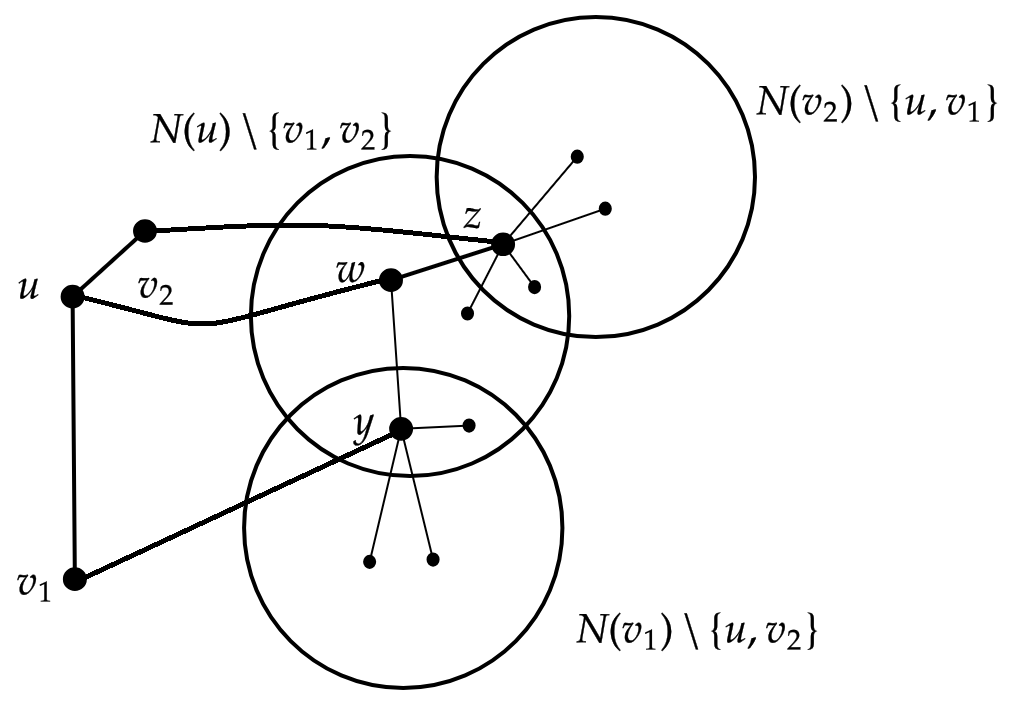
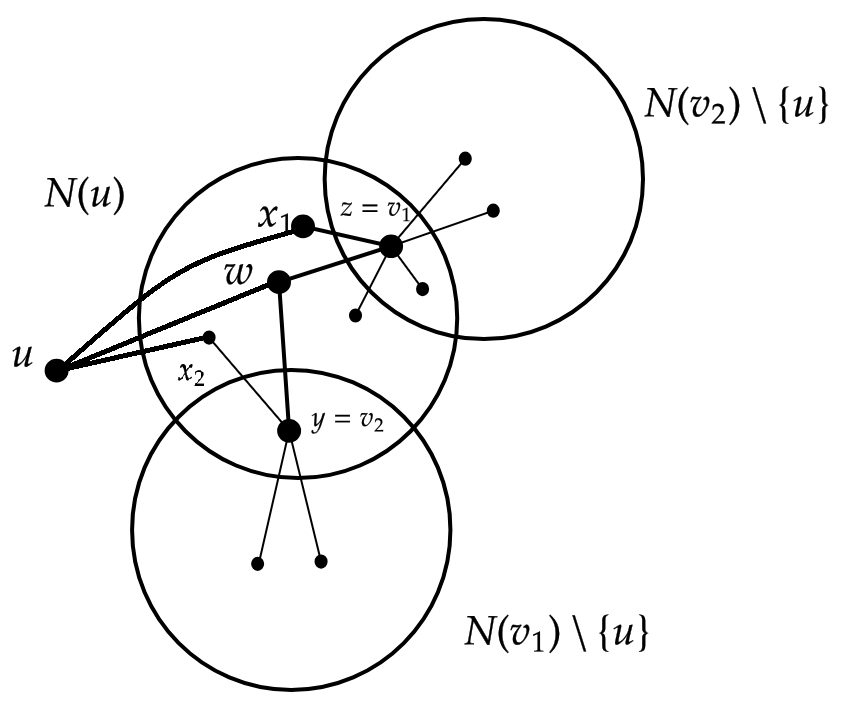
Figure 4: For t3, if t4, then a t5 can be constructed; no such overlap can occur in a t6-free graph.
Structural and Methodological Insights
A central theme is counting copies of t7 in the host graph via various projections (e.g., fixing a “good” set of size t8 with large common neighborhood) and using intricate double-counting strategies. Forbidding t9-configurations imposes rigid structural limits that are exploited via extremal combinatorial arguments, such as bounding the number of stars or matchings in associated auxiliary graphs.
The approach uses:
- Blow-up construction: Enlarging C40-free graphs by substituting each vertex with an independent set, maximizing edge count while preserving C41-freeness.
- Auxiliary graphs: Constructing graphs (e.g., C42 induced by pairs of neighborhoods) whose matching size or star-structure is tightly controlled due to C43 exclusion.
- Decomposition by degree: Deletion patterns based on low-degree vertices to reduce analysis to graphs with "large minimum degree", followed by analytic optimization over C44.
- Probabilistic tools: Lower bounds leveraging randomized partitions, optimizing over blow-up parameters.
Theoretical and Practical Implications
On the theoretical side, these results precisely quantify the extremal threshold for the exclusion of multiple C45's joined along a common edge. The approach provides an explicit route to determining leading constants in the C46 regime for a wide class of bipartite, even structured, graphs, extending earlier work from simple cycles and grids to star-propagated Cartesian products.
The results improve previously best-known constants in several key cases and establish, for the first time, exact asymptotics up to multiplicative constants for the bipartite Turán number of C47 and general C48. From a practical viewpoint, these bounds govern the extremal behavior of large, sparse bipartite graphs with prescribed forbidden substructures—relevant, for example, in design of extremal graph instances for network coding, pseudorandomness, and information theory.
Directions for Further Research
This work opens several questions for further investigation. Potential directions include:
- Extending the methodology to more general graphs of the form C49 for arbitrary ex(n,Bt)0.
- Tightening the constants or giving exact bounds for more specific ex(n,Bt)1, especially in the small and moderate regime.
- Investigating stability: characterizing extremal graphs realizing these numbers.
- Studying analogous problems in directed graphs or hypergraphs.
- Exploring applications in computational extremal graph theory, such as faster detection algorithms or extremal certificate construction.
Conclusion
This paper provides a comprehensive determination of Turán numbers for the Cartesian product ex(n,Bt)2, giving matching upper and lower bounds up to tight constants and refining these constants in special cases. The analysis robustly generalizes to bipartite settings and to ex(n,Bt)3 for trees ex(n,Bt)4. The combination of probabilistic, combinatorial, and analytic tools yields an advanced framework for extremal problems concerning blow-ups and products of bipartite graphs, and establishes new benchmarks in this domain.
[The Turán number of the Cartesian product of a star and an edge, (2604.11366)]