- The paper demonstrates that a signal-aware conditional diffusion model improves predictive accuracy by reducing mean absolute error by up to 60% compared to conventional surrogates.
- It employs a PCA-based full-dimensional field representation and a U-Net-like architecture adapted for unstructured wing mesh data to overcome limitations of pointwise loss functions.
- The method provides built-in reliability diagnostics via diffusion-induced spread measures, effectively highlighting challenging flow regions such as shocks and hinge lines.
Signal-Aware Conditional Diffusion Surrogates for Transonic Wing Pressure Prediction
Introduction
The paper presents a conditional denoising diffusion probabilistic model (DDPM) tailored for high-fidelity prediction of surface pressure distributions over the NASA Common Research Model (CRM) wing in transonic regimes. This work directly addresses key challenges arising in traditional ML surrogates for computational fluid dynamics (CFD), such as the smoothing of crucial nonlinear flow features (e.g., shocks) by regressors trained with pointwise losses. The authors propose a signal-aware training objective combined with a PCA-based full-dimensional representation, leveraging the generative flexibility of diffusion models to improve both predictive accuracy and qualitative reliability assessment for complex aerodynamic fields.
Background and Methodology
The DDPM framework operates in a PCA modal space, using the full set of principal components as a reversible linear coordinate transformation, thereby circumventing the lossy truncation typical of reduced-order modeling. The generative network adopts a U-Net-like architecture, reinterpreted using fully-connected layers due to the unstructured point-cloud topology of the CRM wing mesh. Condition vectors—comprising Mach number, angle of attack, and four control surface deflections—are used to achieve conditional generation.
A central methodological contribution is the signal-aware training objective. Rather than matching the added noise in the standard DDPM loss, the objective minimizes reconstruction error in signal space after propagating noise through the forward diffusion process. This leads to a timestep-weighted loss function, giving higher emphasis to regions and phases with larger impact on reconstructed signal structure, specifically targeting improvement in shock regions and other pressure discontinuities.
The framework is benchmarked against a standard MLP regressor and a hybrid autoencoder plus Gaussian process regression (AE+GPR) surrogate baseline, as well as an internally controlled DDPM variant (DDPM-N) using the unmodified loss.
Dataset and Flight Envelope
The methodology is validated on a CFD-generated dataset of the NASA-CRM, utilizing RANS simulations with the Spalart-Allmaras turbulence model. The dataset encapsulates variations across six design parameters: Mach number (M), angle of attack (α), inboard and outboard aileron deflections, elevator, and horizontal tailplane. The surface mesh contains 139,374 points, with PCA reducing field representation to 105 components—equal to the training sample rank.
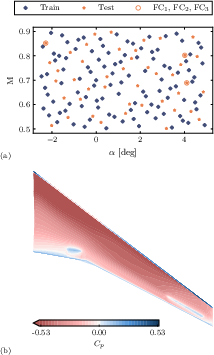
Figure 1: Flight envelope for the NASA-CRM wing and a representative upper surface Cp field, highlighting the high-gradient and shock-rich regions addressed by the surrogate.
Results and Analysis
Reconstruction Fidelity and Error Distribution
The signal-aware DDPM (DDPM-S) demonstrates a significant reduction in mean absolute error (MAE), yielding a 48% lower MAE compared to the MLP baseline and 60% lower than AE+GPR. The improvement is particularly concentrated in physically critical regions:
- Shock fronts
- Suction peaks at the leading edge
- Control surface hinge lines
Notably, the standard DDPM (DDPM-N) underperforms DDPM-S and exhibits failure to recover complex upper-surface topology in challenging regimes, highlighting the necessity of the proposed signal-aware weighting.
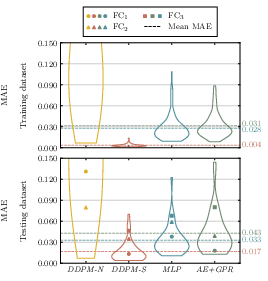
Figure 2: MAE distribution across all models and datasets, with visualization cases indicated. DDPM-S consistently achieves the lowest errors.
Field-Structure Preservation
Chordwise and spanwise Cp reconstructions reveal DDPM-S preserves gradient sharpness and discontinuity alignment, minimizing the smearing effect inherent to pointwise losses (typical in deterministic surrogates). Error contours clearly localize the residual deviations to regions of strong flow nonlinearities, while baseline models tend to diffuse errors more broadly.
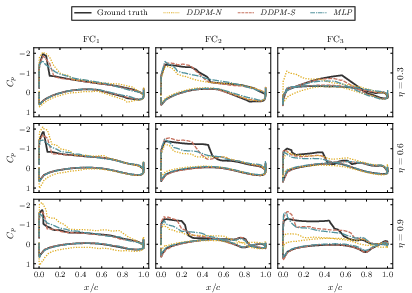
Figure 3: Chordwise Cp distributions comparing actual, DDPM-S, and baseline surrogate predictions at multiple spanwise stations, demonstrating superior fidelity of DDPM-S, especially near shocks and suction peaks.
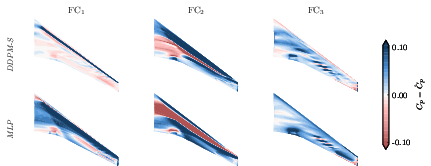
Figure 4: Error distribution on the upper surface wing, visualizing local error reductions provided by DDPM-S compared to MLP.
Conditioning-Space Error Topology
Maximum errors cluster at the high-Mach, high-angle-of-attack boundary of the designed envelope, coinciding with regions where shocks and flow separation are strongest. Embedding dimension allocation within the network reflects this, prioritizing Mach and AoA over control surface deflections.
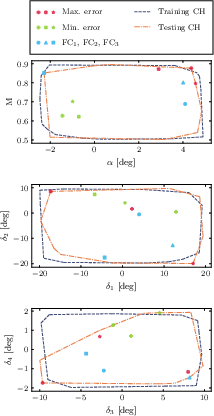
Figure 5: Visualization of high- and low-error flight condition cases in design parameter subspaces, showing physically meaningful error localization.
Diffusion-Induced Variability and Reliability Diagnostics
The stochasticity of the DDPM is analyzed via repeated conditional sampling. Convergence analysis demonstrates that for ensembles of N≥50—well beyond typical deployment—the mean and spread of predictions stabilize, with ensemble means closely approximating reference truths and a bounded spatial deviation (mean σ(N)≈0.005).
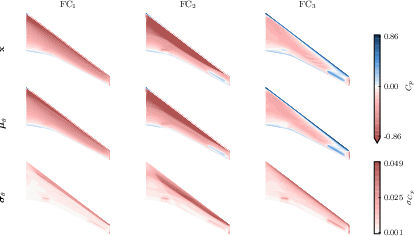
Crucially, diffusion spread aligns with physically and numerically challenging flow regions:
Two diagnostic indices are introduced: the Local Reliability Index (LRI) and the Global Reliability Index (GRI). LRI curves show a monotonic increase with the spread fraction ω, confirming that high-variance regions correlate with elevated surrogate errors. At the global level, GRI demonstrates high linear correlation (ρ=0.889) with the MAE across flight conditions, validating DDPM spread as an effective qualitative error predictor, in contrast to ensemble variance from deterministic MLPs—which exhibits much lower correlation and limited reliability information.
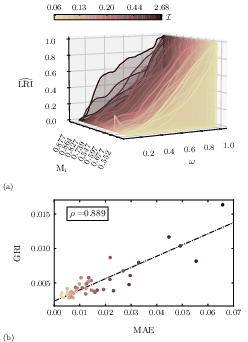
Figure 7: (a) LRI profiles as a function of mesh fraction ω, colored by Mach number; (b) GRI versus MAE, showing strong linear correlation ρ=0.889.
Implications and Future Directions
This work establishes signal-aware conditional diffusion surrogates as robust, self-aware alternatives for high-dimensional aerodynamic field prediction in CFD workflows. The approach aggregates multiple advancements:
- PCA-based lossless field parameterization enables efficient learning on unstructured meshes with limited data.
- The signal-aware loss offers systematic improvement in regions critical for performance quantification, such as shock and hinge lines.
- Built-in stochasticity is leveraged not for formal uncertainty quantification, but as a practical reliability diagnostic, pinpointing challenging regions for surrogate deployment or active data enrichment.
- The framework is fully scalable for six-dimensional design problems and unstructured 3D geometry, comparing favorably to more computationally intensive graph-based or operator-learning alternatives.
Theoretical implications are clear: diffusion models, conditioned on physically meaningful parameters and equipped with loss functions reflecting application-specific priorities, address core limitations of traditional ML regressors for nonlinear physical system surrogacy. In practice, such surrogates promise to dramatically accelerate parametric CFD analyses and optimization under real-world, resource-constrained scenarios.
Anticipated developments involve generalization to more complex full-aircraft configurations, extension to other physical quantities (e.g., wall shear stress), and iterative integration with active learning pipelines where the reliability metrics serve as error indicators for guided database refinement.
Conclusion
This study demonstrates that signal-aware conditional DDPMs, operating in a lossless modal space, simultaneously deliver best-in-class reconstruction accuracy for transonic wing pressure prediction and embed an interpretable, physically aligned reliability signal via their sampling spread. The approach corrects for the key weaknesses of deterministic surrogates—gradient smoothing and black-box uncertainty—establishing conditional diffusion as state-of-the-art for three-dimensional, high-gradient aerodynamic field regression and diagnostic error estimation.