- The paper introduces a framework that leverages coarse prior AoA statistics to select an optimal plate orientation, reducing mechanical control overhead.
- It employs Fisher Information Matrix analysis and a MAP estimator to enhance multi-path AoA estimation accuracy with just two linear scans.
- Simulation results in mmWave urban scenarios demonstrate near single-path RMSE performance, outperforming traditional exhaustive scanning techniques.
Prior-Guided Control of Movable Antennas for Reduced-Complexity Agile Multi-Path Sensing
Problem Context and Motivation
The extraction of multi-path geometric attributes, especially AoAs, is central to the vision of 6G, where radio signals are leveraged for both communication and high-resolution sensing. Traditional MA-based frameworks exploit a single mechanically-actuated antenna traversing a plate to form a synthetic spatial aperture, enabling high angular resolution and the separation of paths even with closely spaced AoAs. However, exhaustive MA scanning incurs prohibitive control overhead and latency, constraining their suitability for agile and time-critical sensing scenarios. The present work addresses these limitations by incorporating coarse prior AoA statistics—readily extractable from environmental knowledge, digital twins, or multimodal models—which have been underutilized in the design of agile MA-based sensing.
The considered configuration consists of a transmitter with a rigid antenna and a receiver with a single mechanically-actuated MA mounted on a movable plate. The 3D orientation of the plate is controlled by Euler angles (α,β,γ), and upon orientation, the MA executes two linear scans along the (rotated) X and Z axes. The system simultaneously observes L NLoS propagation paths, each parametrized by (θℓ(0),ϕℓ(0))—their elevation and azimuth AoAs referenced to the environment. The physical configuration and geometrical relationships are schematically illustrated in (Figure 1).
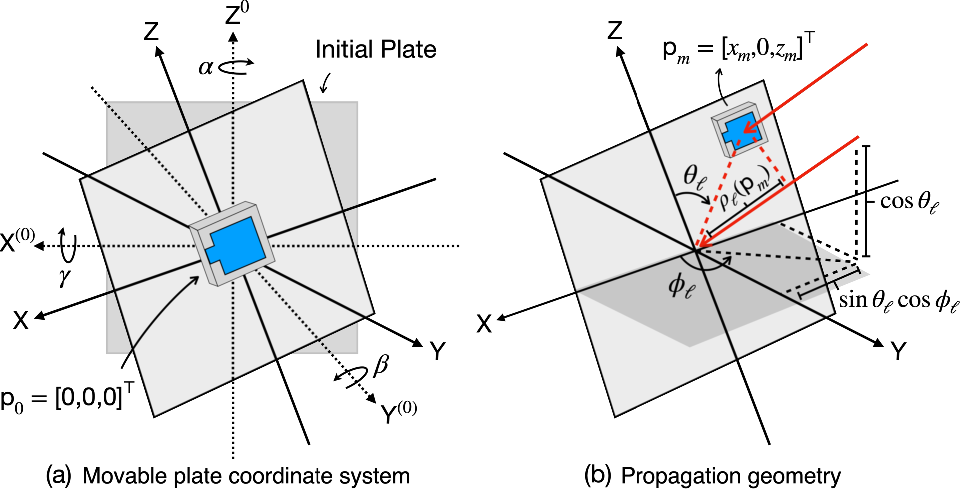
Figure 1: The geometries of the movable plate and MA, showing the coordinate system before and after plate orientation and the resulting propagation path geometry.
The OFDM-based signal model accounts for frequency diversity across K subcarriers. The total channel response at each scan location, incorporating MA position and plate orientation, captures the projection of the path vectors onto the scan trajectories. The resulting received vector comprises contributions from all paths, modulated by per-path delays and projections.
The core innovation is the single-shot orientation selection of the movable plate prior to sensing. Recognizing that the cost of actuation dominates, optimal orientation must maximize both the visibility and separability of all paths over the ensuing two linear scans. Fisher Information Matrix (FIM) analysis reveals that the off-diagonal blocks, capturing path cross-talk, are minimized when the projected distances between paths—and thus their induced phase differences—are maximized over both scan axes. The precise dependence of FIM block structure on plate orientation and prior AoA distribution is analytically derived.
To formalize orientation optimization, the expected separation between projected path components, taking into account prior statistics (mean/variance for each path's AoA), provides the objective. The order-reversal constraint is introduced: stochastic overlap between projected path distributions must not exceed small thresholds (ϵ(1),ϵ(2)). This is depicted in (Figure 2), which contrasts overlapping versus ϵ-separated projections.
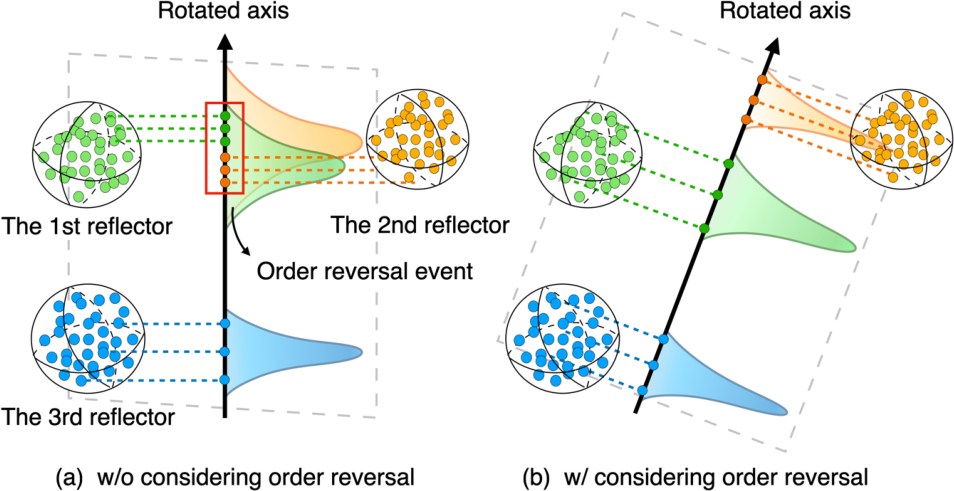
Figure 2: Graphical example of the impact of the order-reversal constraint, ensuring robust path separability under uncertainty.
Additionally, front-side incidence constraints ensure that all targeted paths intersect the physically feasible side of the plate with high probability. All constraints are explicitly relaxed to sufficient conditions via the Cantelli bound, enabling efficient non-convex optimization using SQP.
The result is a strategy where, for given a priori (possibly weak) AoA statistics, a single plate orientation is selected to optimize spatial coverage and minimal crosstalk, fundamentally reducing mechanical control cost.
Two-Scan MAP-Based Multi-Path AoA Estimation
After orientation, the MA performs two linear scans: one along the X-axis and one along the Z-axis of the rotated plate. For each scan, a MUSIC-based estimator extracts the dominant spatial frequency parameters (SFPs), which are functions of AoA components. This phase yields two unordered sets of parameters, X0 and X1, which must be optimally paired to the underlying physical paths.
To resolve pairing, a MAP estimator is constructed. It combines (i) the likelihood of the received signals under trial pairings (via the projected steering vectors for each (X2, X3) hypothesis) and (ii) the prior probability of the underlying physical AoAs (from side information). This pairing is solved by maximizing a joint objective over all possible permutations. The estimator thus fuses environmental knowledge and signal structure, and the implementation details ensure computational feasibility for moderate X4.
Simulation Results
The framework is validated via Monte Carlo simulations representative of mmWave urban environments, with AoA priors reflecting real-world geographic layouts (cf. Table 1 in the paper). Results are reported as joint AoA RMSE across all paths, comparing the proposed method to non-rotated and non-prior benchmarks.
Figure 3 presents the RMSE versus SNR for the main approaches. The proposed MAP-based method with orientation control consistently outperforms both the non-rotated variant and competitive greedy pursuit baselines (SOMP-based), with RMSE approaching that of the single-path limit at high SNR.
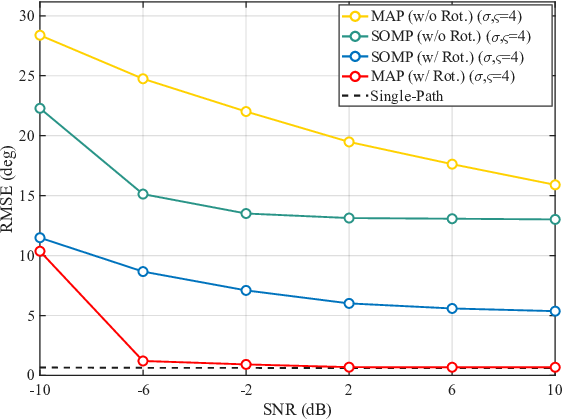
Figure 3: Joint AoA RMSE versus SNR, showing the superiority of the proposed method in leveraging orientation and prior statistics.
Figure 4 evaluates robustness to prior quality, sweeping the standard deviation of AoA priors. The performance of the proposed strategy remains substantially improved compared to all baselines even as priors become uninformative, highlighting the significant resilience the framework attains by rigorous constraint enforcement and MAP fusion.
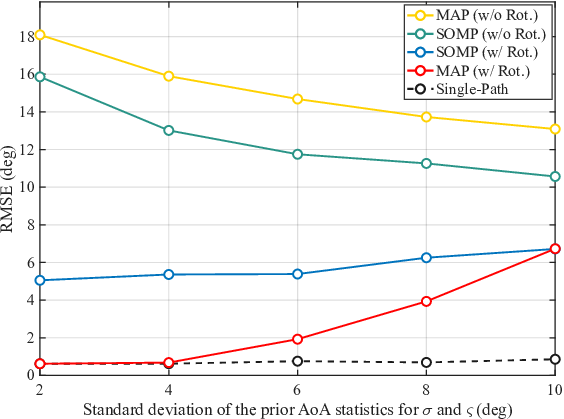
Figure 4: Joint AoA RMSE as a function of AoA prior standard deviation, demonstrating robust performance even under weak side information.
Implications and Future Directions
The key contribution is a significant reduction in the sensing latency and control overhead of MA-based multi-path resolution, achieved by integrating ambient knowledge in a Fisher-optimal, constraint-driven orientation design, paired with statistical signal processing for joint estimation. The proposed architecture aligns with the dual-functional philosophy of 6G networks, harmonizing communication and sensing with minimal resource cost.
Practically, the approach is applicable to agile automotive, localization, and SLAM applications where channel geometry evolves dynamically and exhaustive environmental scanning is infeasible. Furthermore, the design framework generalizes to cases where partial environmental knowledge (from digital twins or large multimodal models) can reliably inform real-time sensing control, and it naturally extends to ToA and full geometric estimation.
Theoretically, the paper advances the integration of side information into array geometry adaptation, motivates new stochastic control constraints supporting robust allocation, and impacts array processing under realistic actuation restrictions. Likely future work includes joint AoA-ToA multi-modal fusion, continuous-time optimal scan trajectory design, and broader expansions to distributed multi-agent or multi-MA networks.
Conclusion
This work establishes a prior-guided agile MA sensing framework that enables high-accuracy, low-latency multi-path AoA estimation with minimal control actuation. By combining weak prior statistics, Fisher-efficient orientation selection, and constraint-enforced pairing, the resulting method achieves near-single-path benchmark accuracy using just two linear scans, outperforming existing exhaustive or greedy alternatives and setting a new standard for practical, high-resolution radio-based sensing in 6G systems (2604.11227).

