- The paper introduces an architectural framework for adaptive digital nudging that integrates behavioral modeling, LLM-driven reasoning, and built-in ethical guardrails.
- It employs a three-layer pipeline—data capture, user modeling, and nudge intelligence—validated through empirical studies with experts and end-users.
- The system demonstrates cross-domain applicability by structurally enforcing ethics and fairness to ensure regulatory compliance and enhanced personalization.
Designing Adaptive Digital Nudging Systems with LLM-Driven Reasoning
Introduction
This paper provides a comprehensive architectural framework for the design of adaptive, ethically compliant digital nudging systems leveraging LLM-driven cognitive reasoning. Addressing architectural limitations in current digital nudge systems, the authors systematically translate behavioral science theory—explicitly incorporating ethical guardrails and multidimensional user modeling—into structurally enforceable software requirements. The framework integrates sequential and cross-cutting architectural concerns, validated through empirical studies both with software architects and end users. Distinctively, the architecture operationalizes the role of LLMs for nuanced, context-sensitive reasoning within adaptive interventions, while treating ethical compliance as a non-negotiable structural property.
Behavioral Foundations and Literature Synthesis
The work initiates with a literature review synthesizing nudging strategies, quality attributes, and user profiling dimensions into architectural requirements. The review operationalizes behavioral theory—incorporating dual-process models (System 1 & System 2), the Transtheoretical Model of behavior change, and cognitive load factors—as core user modeling dimensions. The identification of 68 nudging strategies and 11 quality attributes establishes the taxonomic and metric foundation for intervention logic.
Three major behavioral profiling dimensions are emphasized:
- Cognitive mode (System 1 vs. System 2),
- Behavioral stage (cf. Transtheoretical Model),
- Attention capacity.
These ground the architecture's capacity for phenomenological adaptation, supporting coordinated multi-dimensional intervention delivery.
Architectural Design: Structure, Decisions, and Enforcement
The architectural framework comprises three sequential core layers—Data Capture, User Modeling, Nudge Intelligence—and two cross-cutting modules—Adaptation and Evaluation. This pipeline guarantees causal consistency and traceability required by both auditing and explainability.
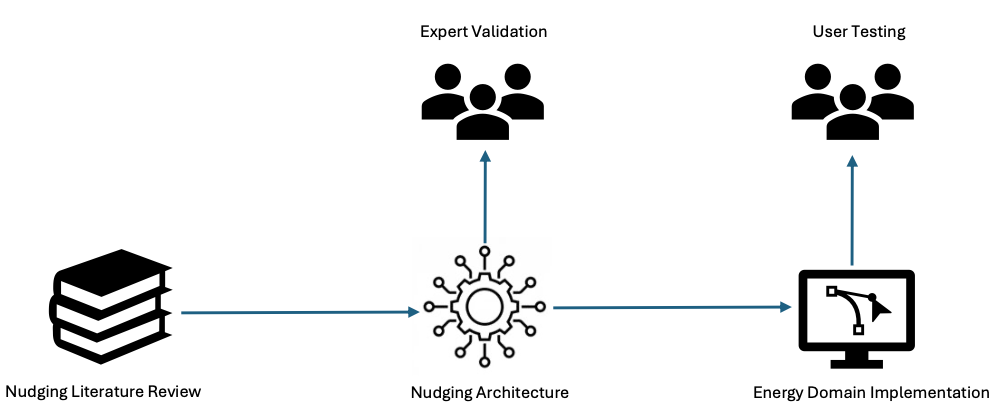
Figure 1: An overview of the research methodology structuring the requirements engineering, architectural design, validation, and instantiation.
Data Capture Layer acquires context and behavioral signals (device, interaction, affective state).
User Modeling Layer fuses signals for probabilistic classification along cognitive, behavioral, and attentional dimensions, using LLM-driven reasoning for robust semantic interpretation of ambiguous or weak signals.
Nudge Intelligence Layer encompasses a constraint satisfaction-based Strategy Optimizer, an LLM-based Nudge Generator, and Backend-Driven UI Adaptation: the backend controls UI adaptation parameters for the frontend in response to attention and cognitive profiles.
Evaluation Module incorporates separate Ethics Compliance and Fairness Monitor submodules as side-mounted interceptors of all generated interventions, ensuring structural enforcement of regulatory constraints (GDPR, DSA, EU AI Act), bias mitigation, and explainability before any output is delivered.
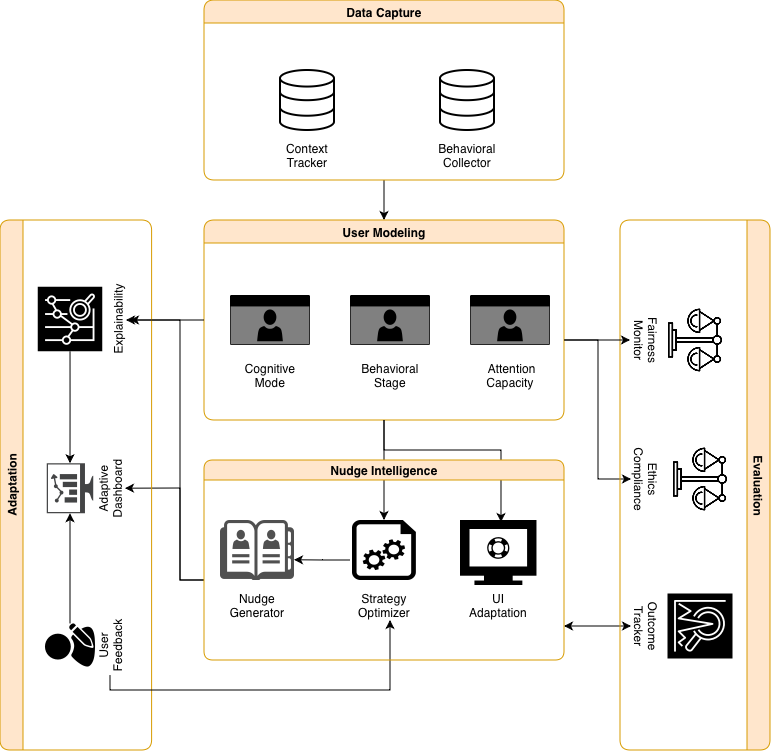
Figure 2: Layered architectural decomposition for adaptive digital nudging; side-mounted evaluation modules enforce ethics and fairness as non-negotiable system properties.
Key architectural decisions are explicitly documented, including rejection of event-driven and blackboard paradigms in favor of sequential pipelines, and the externalization of ethical and fairness enforcement (as interceptors), which assures non-bypassable compliance and simplified evidencing for regulatory audit.
LLMs are strategically utilized for all non-trivial behavioral classification tasks. While providing greater expressivity and context understanding, this introduces stochasticity, for which operational mitigations such as low-temperature decoding and audit trails are incorporated. The architecture's explicit separation between behavioral reasoning and ethical validation is highly rated by expert architects for testability, evolvability, and compliance audit readiness.
Validation: Architect Evaluation and Domain Transferability
Empirical evaluation involved 13 professional software architects with adaptation system expertise. Closed-format surveys indicate strong agreement with architectural requirement satisfaction (mean across requirements M=4.62, SD=0.12). UI Adaptation is most highly rated (M=4.85), while explainability emerges as a relative weakness (M=4.38), both in expert and end-user evaluations. Qualitative analysis underscores the preference for structural separation of ethics from intervention generation; operational risks associated with LLM non-determinism are flagged as requiring downstream controls.
Domain transferability assessment: all participants recognize the architecture’s applicability beyond residential energy (e.g., healthcare, finance). This is attributed to the clear modularization of profiling, intervention, and cross-cutting evaluation, each parameterizable for new application verticals.
Implementation: LLM-Driven Adaptive Nudging in Energy Sustainability
The architecture is instantiated in a residential energy management context, operationalizing a full-stack system with a Python backend (OpenAI LLM APIs) and React/TypeScript frontend. User interaction, behavioral, and affective signals are collected and processed as per the architecture.
Backend LLM modules perform:
- Session-wise user modeling (cognitive mode, behavioral stage, attention capacity classification),
- Strategy optimization via constraint-satisfaction prompting from the implemented taxonomy,
- Nudge content generation with embedded regulatory/ethical/fairness guardrails in all prompts.
UI adaptation is realized by dynamically adjusting information density and visualization on the frontend in accordance with backend-determined cognitive/attentional state.
Evaluation with 15 end-users demonstrates:
- High perceived adaptive nudge quality (M=4.73),
- Positive emotional impact (using FaceAPI-based pre/post happiness classification ΔM=0.00033),
- Reliable end-to-end system performance with no pipeline failures,
- Consistent mapping between classified user dimensions and intervention/UX adaptation,
- Adequate transparency, though with scope for further explainability enhancements.
The system demonstrates the feasibility of integrating LLM reasoning with explicit, structurally embedded architectural controls for ethics and fairness, achieving multi-dimensional adaptation without sacrificing auditability or regulatory compliance.
Implications and Future Directions
The architecture reconceptualizes digital nudging from an implementation concern to a discipline grounded in explicit architectural patterns with strong behavioral and ethical provenance. Structural enforcement of fairness, transparency, and compliance circumvents the limitations of post-hoc validation. LLM-driven multidimensional reasoning enables nuanced adaptation but introduces non-determinism and explainability trade-offs that must be addressed at the architecture level.
Theoretical implications: The framework offers a reusable model for embedding behavioral theory primitives as enforceable architectural requirements, integrating ethics and quality attributes at the core rather than peripherally.
Practical implications: The documented architectural patterns (separation of concerns, LLM-powered modular adaptation, interceptor-based ethics/fairness enforcement) are directly translatable to verticals requiring both high personalization and hard ethical guarantees.
Future research focuses on (1) cross-domain empirical validation (healthcare, finance, e-commerce), (2) longitudinal studies for sustained effect measurement and habituation dynamics, and (3) advanced explainability mechanisms for tracing and justifying system adaptations and rejected alternatives.
Conclusion
The proposed architecture sets a formal, traceable, and transferable foundation for adaptive digital nudging systems, structurally bridging behavioral science and software engineering. Through the fusion of LLM-driven adaptive intervention logic and systematic architectural enforcement of ethical guardrails, the framework assures effective, individually tailored, and accountable digital nudging. The empirical evidence confirms both feasibility and positive user reception. The architectural patterns established herein provide a reference model for domains wherein adaptive intervention and regulatory compliance must be simultaneously advanced.

