- The paper introduces AeroSense, a state-to-flow paradigm that predicts future airspace flows directly from granular, physics-aware aircraft state data.
- It employs variable-cardinality input handling, masked self-attention, and permutation-invariant summation pooling to effectively model inter-aircraft dependencies.
- Quantitative results and ablation studies show significant performance gains over classical time-series models, with reduced MAE and enhanced interpretability.
Situation-Aware State Modeling for Air Traffic Flow Prediction: An Expert Analysis
Introduction and Motivation
Air traffic flow prediction in terminal airspace (TA) presents critical operational challenges, especially as the domain shifts toward high-resolution, data-driven airspace management. The prevailing paradigm in the literature frames this as a macroscopic, time-series forecasting task, relying on the aggregation of aircraft trajectories into flow sequences before feeding the result into statistical or DL-based models. This macroscopic approach suffers inherent misalignment: it ignores variable aircraft cardinality, discards physical and kinematic state cues, and circumvents the fundamental physical reality that airspace state is an unordered, dynamic set of microscopic aircraft states.
AeroSense addresses this mismatch with a direct state-to-flow paradigm, where future airspace-level flows are predicted directly from instantaneous aircraft-level states, leveraging the granular kinematic, control intent, and relational information. The core technical contributions encompass a situation-aware set representation of the airspace and an architecture tailored for variable-cardinality sets employing masked self-attention and decoupled prediction heads for TA subregions.
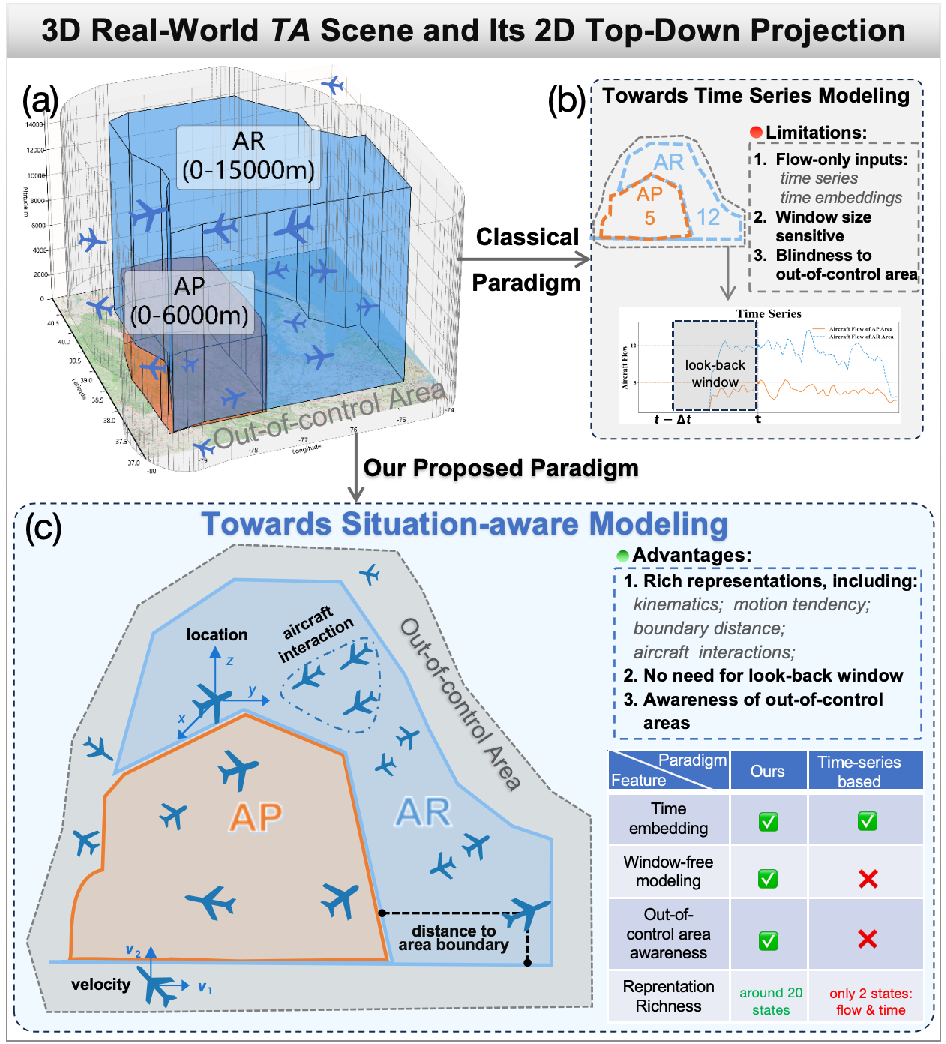
Figure 1: Paradigm comparison for air traffic flow prediction, highlighting the shift from time series-based aggregation to direct state-to-flow mapping in AeroSense.
Situation-Aware State Representation
The situation-aware state encoding is fundamental to AeroSense’s predictive advantage. Each aircraft is represented by an 18-dimensional feature vector comprising:
- Location state: 3D geographic coordinates.
- Kinematic state: instantaneous ground speed, heading, and vertical speed.
- Control intent: pilot-set airspeed and altitude via flight management system.
- Boundary interactions: signed distance to region boundaries; cosine similarity between velocity vector and center-of-region vector, operationalized as approach/divergence factors.
- Temporal context: cyclical hour/minute embeddings.
A key methodological choice is the explicit injection of relational physics (boundary proximity, convergence/divergence factors, inclusion indicators) as inductive biases, aligning the input manifold with operational domain priors. These features are not only more expressive but provide key explanatory power, as ablation studies demonstrate significant deterioration when omitted.
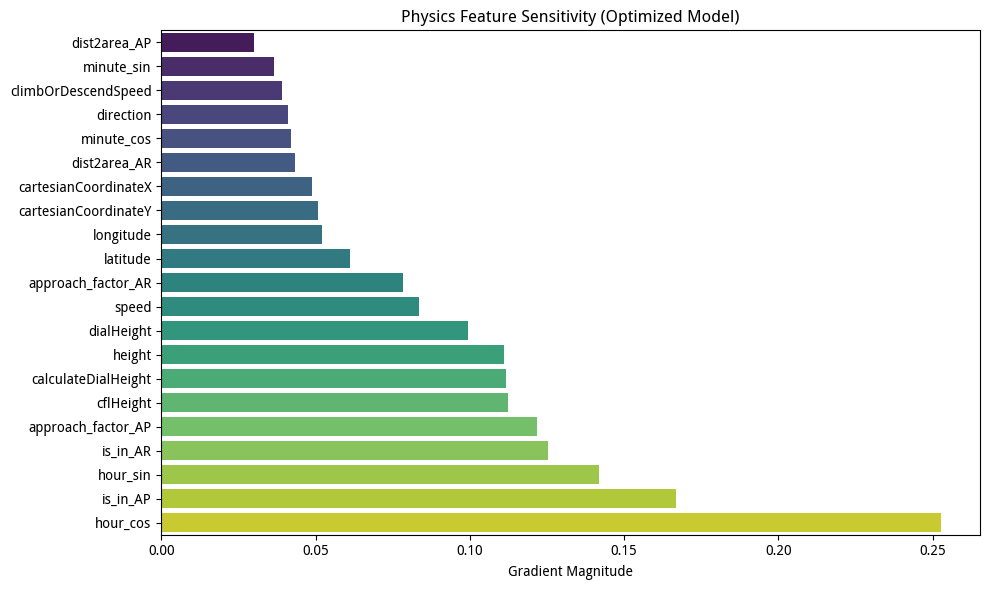
Figure 2: State importance display, with approach factor and area inclusion indicator identified as most critical to predictive performance.
AeroSense Architecture
AeroSense is designed for variable-cardinality set input, operationalized via fixed-size zero-padded input containers that mask irrelevant elements during computation. Each aircraft state is first projected into a shared latent space via an MLP. Multi-head self-attention, enhanced with masking, is then deployed to capture inter-aircraft dependencies intrinsic to flow evolution. This masked attention ensures that only active (non-padded) aircraft contribute to interaction modeling.
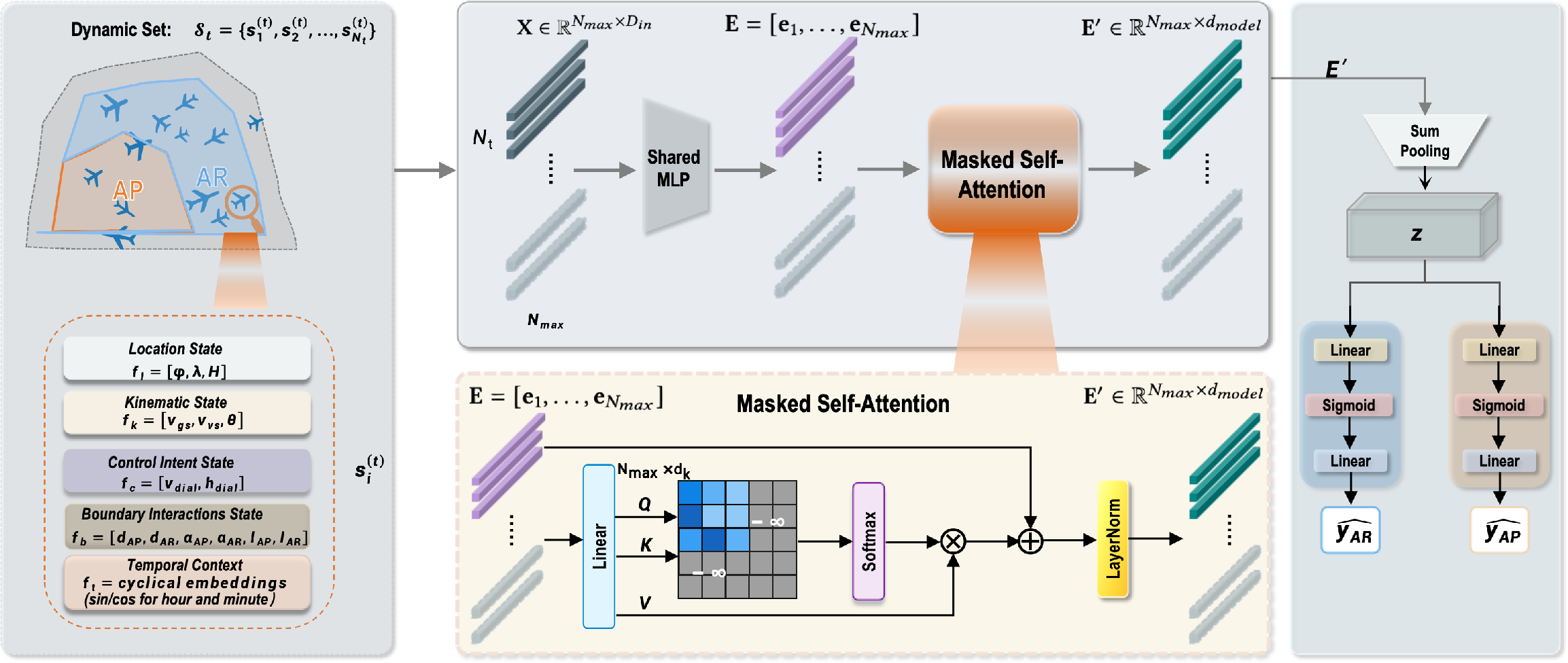
Figure 3: Overview of the AeroSense architecture, detailing the end-to-end state-to-flow inference pipeline, from situation-aware state extraction to decoupled flow prediction.
The global airspace context is distilled via permutation-invariant summation pooling, a design choice grounded in the extensive nature of flow: unlike mean or max pooling, summation strictly retains the cumulative nature of aircraft-induced flow, as demonstrated by sharp performance degradation with alternative aggregation operators. Finally, two decoupled MLP heads model AP (approach) and AR (area control region) flows independently, reflecting their heterogeneous, partially orthogonal evolutionary dynamics.
Quantitative Results and Ablation Analysis
AeroSense establishes SOTA performance with statistically robust gains across all standard metrics (MAE, RMSE, R2) relative to SOTA time-series approaches including TimesNet, Autoformer, and Fedformer. In the critical AR region, AeroSense outperforms TimesNet with MAE reduced by 22.7% (2.100 vs.\ 2.718) and RMSE by 22.1% (2.806 vs.\ 3.602); R2 achieves 0.984, approaching the error floor of labeling noise.
Ablation studies corroborate the importance of each module. Removing boundary/intercept states, kinematic features, or task decoupling yields 5–10% MAE increases. Summation pooling is critical; replacing it with mean or max operators results in AR MAE increases exceeding 75%. The performance impact of masking and multi-head self-attention is also significant, enabling the model to filter irrelevant (padded) elements and effectively concentrate predictive mass on flow-driving agents.
Multi-Objective Temporal Robustness
Dayparting analysis reveals that AeroSense is robust not only in average-case performance but also maintains low error across daily traffic volatility regimes. In contrast to time-series models whose performance deteriorates sharply during morning/evening peaks, AeroSense maintains Pareto-optimal error (MAE) envelopes throughout all intervals, underscoring its capacity to anticipate traffic surges from instantaneous airspace state rather than lagging historical trends.
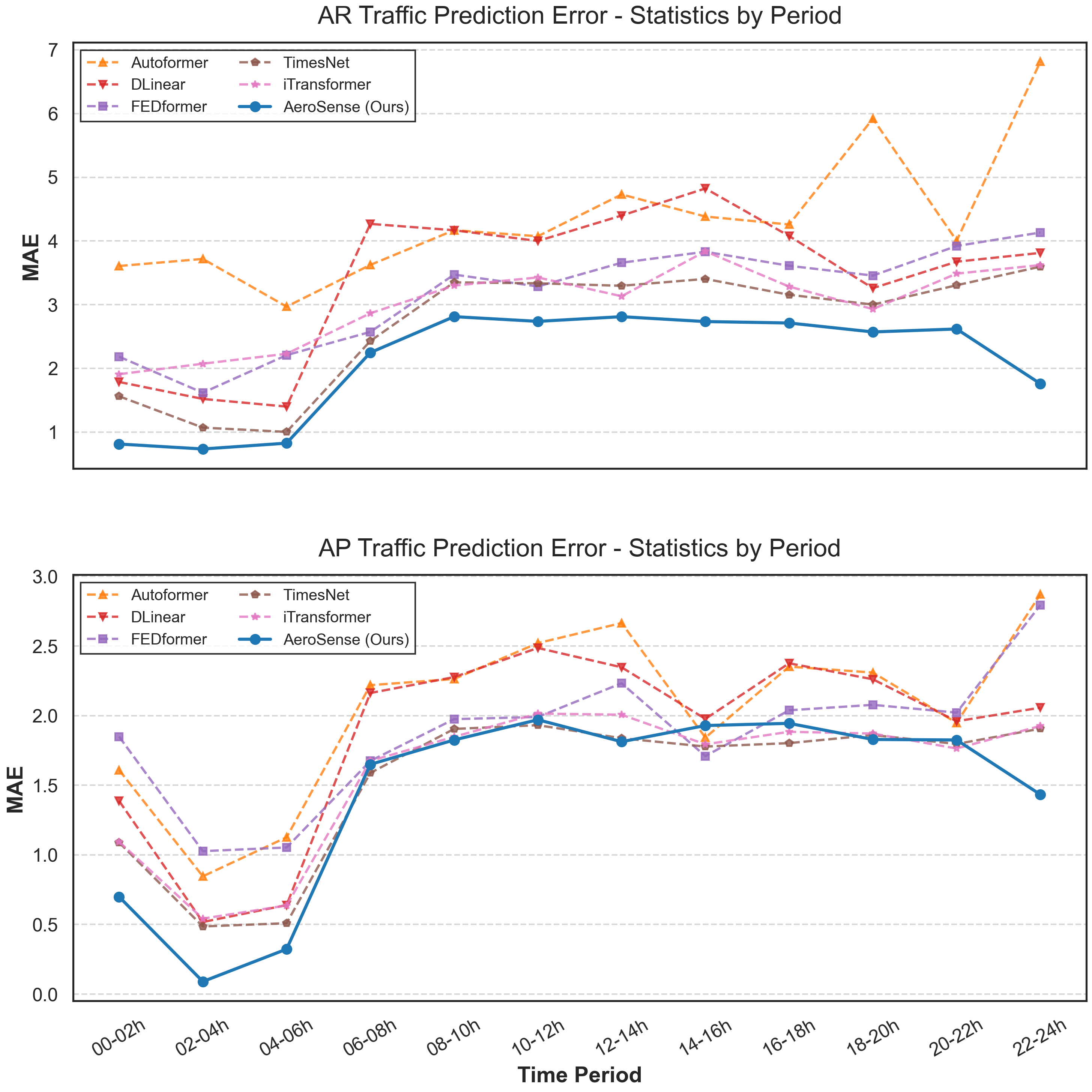
Figure 4: Temporal distribution of prediction error (MAE) over 24 hours; AeroSense dominates baselines across all intervals, excelling during peak congestion periods.
Interpretability and Task-Conditioned Attention
Inspection of attention maps and aircraft-level influence visualizations demonstrates that AeroSense’s masked self-attention mechanism produces physically interpretable task-conditioned relevance profiles. For identical situations, the attention mechanism emphasizes distinct aircraft for AP vs. AR prediction, attending more heavily to flow-driving agents while suppressing irrelevant or overflight traffic. The inter-aircraft attention matrix is non-uniform and non-symmetric, signifying that contextual influence is both selective and directional.
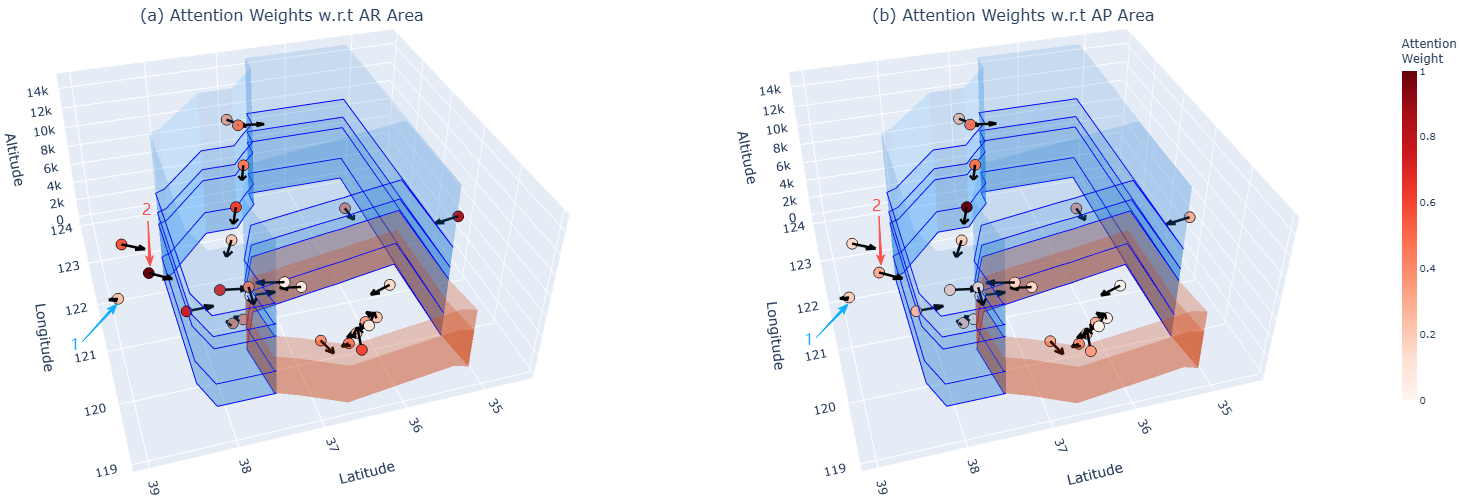
Figure 5: Visualization of situation-aware representation; darker nodes indicate higher predicted relevance for regional flow, with clear task-dependent adaptation.
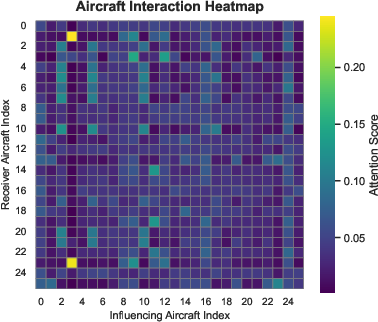
Figure 6: Inter-Aircraft Attention Matrix; highlights the heterogeneity and selectivity of the learned interaction structure across the aircraft set.
Implications and Future Directions
The state-to-flow modeling paradigm exemplified by AeroSense delivers a new operational envelope for flow prediction in dynamic, high-density TAs. The methodological advances—variable-cardinality set handling, relational feature injection, permutation-invariant aggregation—are transferable to other domains characterized by interacting agent sets, such as maritime traffic, UAV swarms, and crowd flow modeling. Practically, this enhances ATM responsiveness during surge and disturbance scenarios, providing controllers with predictive tools that are both more accurate and physically interpretable.
Several avenues remain open. The extension of direct state-to-flow modeling to incorporate uncertainty quantification, probabilistic multi-horizon anticipation, or hybrid integration with explicit controller intervention modeling could further operationalize the approach. Additionally, exploring self-supervised or transfer learning objectives leveraging raw trajectory data across multiple airspaces may yield more generalizable models.
Conclusion
AeroSense represents a foundational shift for TA flow prediction, experimentally validating that situation-aware, physics-augmented, variable-cardinality models significantly outperform classical time-series paradigms. This modeling framework realigns predictive learning with the physical reality of the airspace, producing models that achieve both superior accuracy and interpretable structure-function mappings. The technical architecture and empirical findings provide a blueprint for future research in agent-based flow prediction tasks involving unordered, dynamic sets and nonlinear interaction topologies.
Reference: "From Time Series to State: Situation-Aware Modeling for Air Traffic Flow Prediction" (2604.11198)