- The paper demonstrates an autoregressive flow matching framework that improves short-term prediction and uncertainty quantification over traditional models.
- It integrates multimodal stimulus features with historical BOLD responses using a recurrent encoder and neural ODE parameterization.
- Empirical results on fMRI data show significant performance gains, approaching noise ceilings and highlighting potential for neurotechnological applications.
Probabilistic Prediction of Neural Dynamics via Autoregressive Flow Matching
Introduction
This paper introduces a generative modeling framework for probabilistic, short-term forecasting of neural dynamics, with a focus on parcel-wise BOLD activity in naturalistic fMRI datasets. The core methodological contribution is the adaptation of autoregressive flow matching (AFM)—originally developed for general time series modeling—to the neural dynamics prediction problem. The AFM framework explicitly incorporates both stimulus features and historical BOLD responses, addressing the limitations of stimulus-only and deterministic encoding models by enabling principled uncertainty quantification and leveraging rich temporal dependencies. The framework is empirically validated on the Algonauts project 2025 challenge dataset, revealing significant gains in predictive performance and uncertainty calibration relative to both general linear model (GLM) and standard (non-autoregressive) flow matching (SFM) baselines.
Autoregressive Flow Matching Framework
Autoregressive flow matching constructs a probabilistic path between a simple base distribution p0—typically standard Gaussian—and a target conditional distribution p1 representing future BOLD activity. This path is realized as a flow of probability densities, learned by regressing a neural velocity field to an analytically known optimal vector field via conditional flow matching objectives. Unlike standard flow matching, AFM factorizes the conditional distribution over the multi-step prediction horizon into an autoregressive product of one-step transition distributions, thus allowing adaptive history-aware generation and aligned with the temporal structure of fMRI data. The model is implemented with a recurrent encoder (GRU) for sequence context, neural ODE parameterization for the flow, and a linear decoder for BOLD readout.
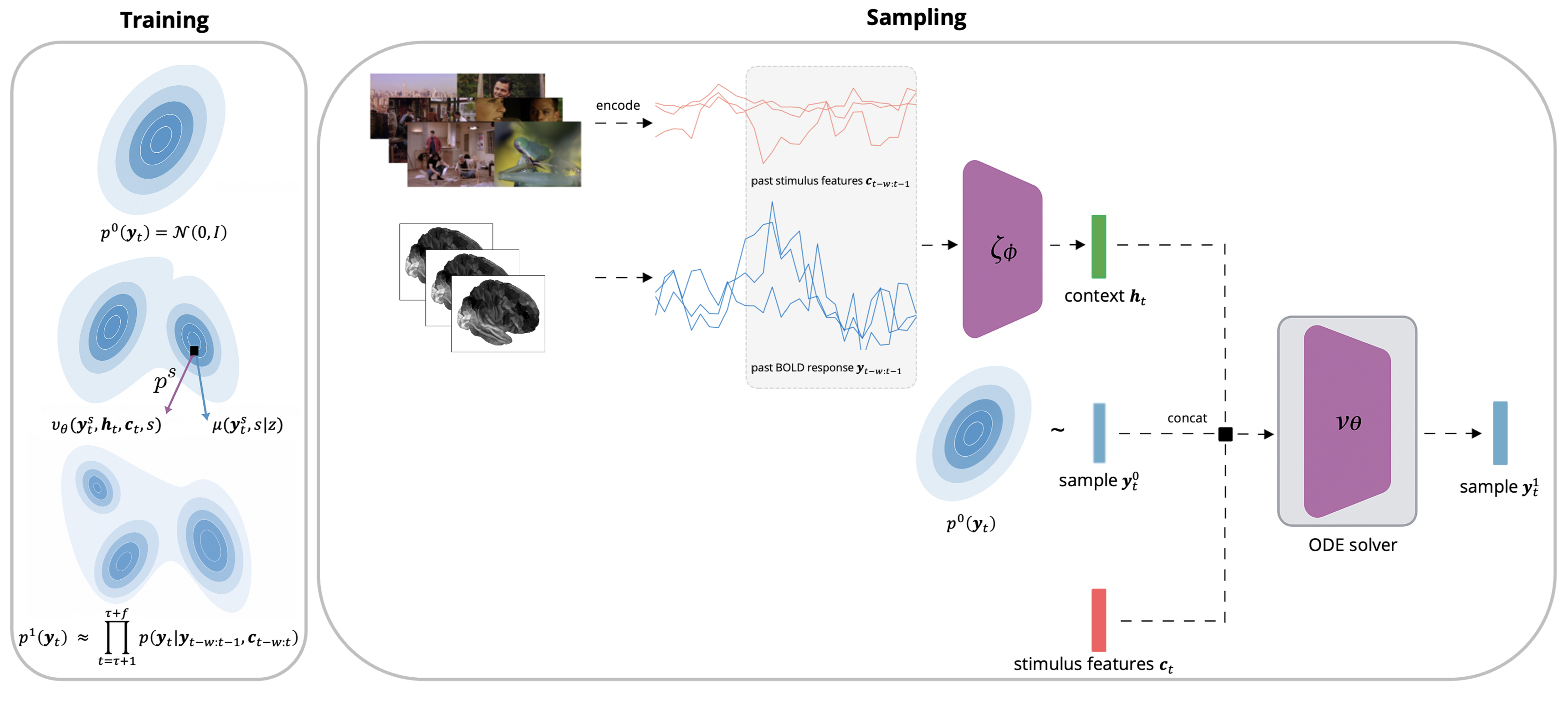
Figure 1: Overview of the autoregressive flow matching framework, showing training via regression of a neural vector field and autoregressive, ODE-based sampling for prediction.
This autoregressive decomposition allows the model to enforce temporal continuity in sampled BOLD trajectories, in contrast to the standard approach of jointly modeling the future segment.
Experimental Setup
The framework is evaluated on the Algonauts project 2025 challenge dataset, which provides extensive fMRI data (four subjects) collected during complex, naturalistic audiovisual stimuli (Friends S1–S6 and Movie10). Inputs to the AFM are multimodal: visual (Slow R50 feature extractor), auditory (MFCCs), and linguistic (BERT embeddings), integrated within a temporal context window. Individual subject models are trained for 10 s (8 TRs) horizons using a rolling window approach. Predictive performance is quantified using noise-ceiling–adjusted Pearson’s r, and uncertainty is assessed with continuous ranked probability score (CRPS). Baselines include the standard GLM encoding approach and SFM (same architecture, single-step prediction).
AFM yields substantial and statistically significant improvements over both baselines. The mean test correlation (r∗) for AFM is 0.465, representing a 79% gain over GLM (0.260) and 11% over SFM (0.420). While SFM attains higher train-set scores, its larger generalization gap reflects overfit, whereas AFM exhibits more robust validation. Notably, the performance approaches the estimated noise ceiling (mean r ≈ 0.588), indicating the approach is capturing much of the explainable signal given fMRI noise constraints.
Widespread gains are observed across cortical parcels: AFM shows significant improvement in mean correlations throughout the cortex, with the largest relative increases in somatomotor and frontoparietal networks. The model outperforms SFM in a majority of parcels and shows especially consistent advantages with longer historical context and shorter prediction horizons.
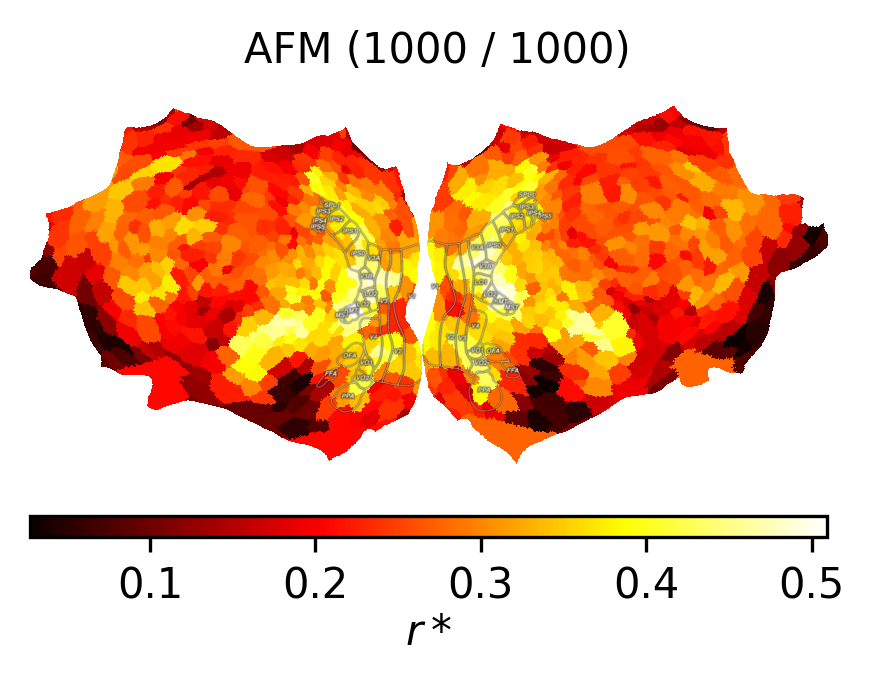
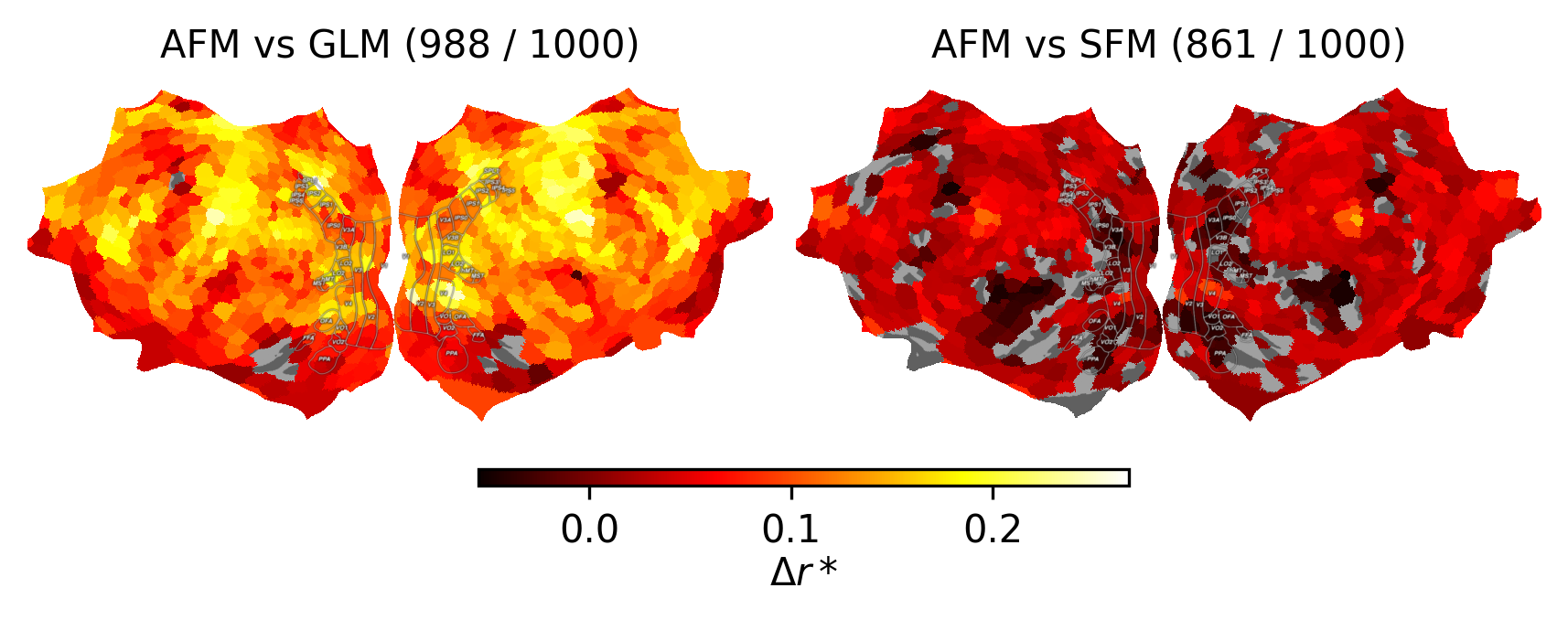
Figure 2: Flatmap visualizations of AFM prediction (mean correlation) and performance differences with GLM and SFM, indicating widespread and significant gains.
Spatial and Network-Level Analysis
The spatial performance analysis confirms that AFM achieves high correlation coefficients throughout the cortex, with only modest regional variability and most parcels significantly predicted. At the level of canonical functional brain networks (Yeo et al. 2011), AFM delivers consistent, significant improvements over both baselines in all networks except the limbic system, paralleling its lower intrinsic predictability.
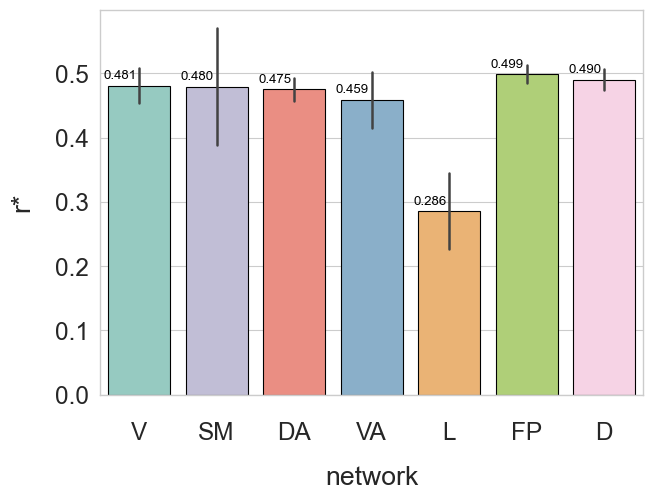
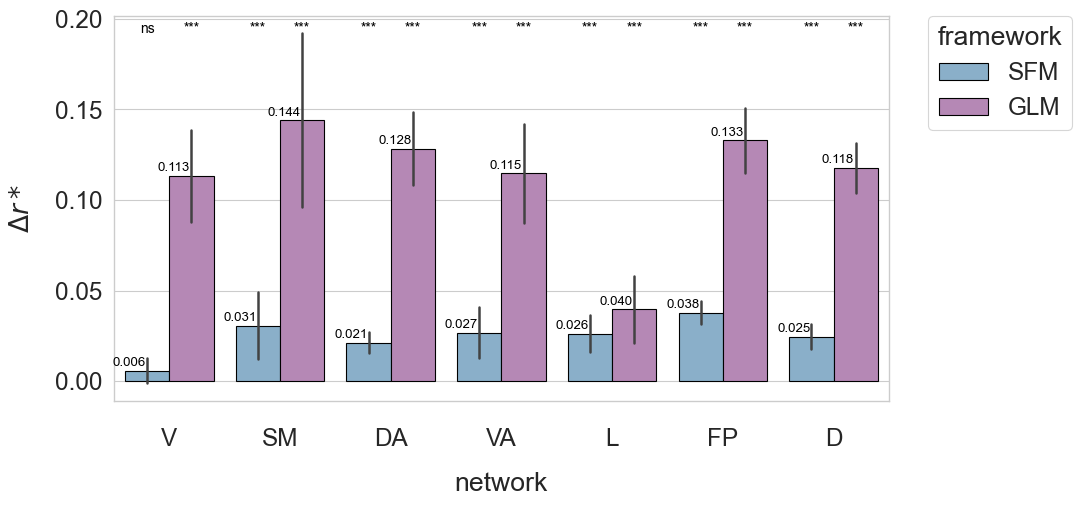
Figure 3: AFM predictive performance and gains across functional brain networks show widespread and robust improvements over baselines.
Uncertainty Quantification
AFM provides improved predictive uncertainty estimation relative to SFM, as measured by marginally lower CRPS scores across all subjects. This suggests that explicit temporal modeling via AFM yields not only higher point accuracy but also more calibrated predictive distributions, a critical property for closed-loop neuroscience and clinical applications.
Ablation Studies
Ablation analyses clarify the mechanisms behind observed performance gains:
- Context Window: Increasing the temporal history available to the model strongly enhances AFM performance but produces only minor improvements for SFM. The benefit becomes pronounced for context windows exceeding 15 s, underscoring the necessity of leveraging historical neural information.
- Prediction Horizon: Both models degrade as the forecast window extends, but AFM’s advantage is maximal at short horizons.
- Input Modalities: Excluding past BOLD context dramatically reduces performance, nearly collapsing both FM models to GLM-level results. Thus, conditioning on past neural dynamics is the dominant driver of forecasting accuracy.
Implications and Future Directions
The main theoretical significance is the demonstration that explicit history-aware, autoregressive generative modeling substantially outperforms stimulus-only or non-autoregressive methods for short-term neural forecasting. These findings challenge the common restriction to stimulus-only encoders in fMRI modeling and motivate broader adoption of context-sensitive approaches, particularly for downstream neurotechnology (e.g., closed-loop brain-computer interfaces, model-based control). The ability to generate distributional forecasts and quantify uncertainty positions AFM as a candidate foundation for safety-critical or adaptive neurostimulation settings.
The practical applicability is moderated by the prominence of noise in BOLD signals; while AFM approaches the modality-imposed predictability ceiling, further progress may depend on better measurements (e.g., higher SNR or temporal resolution) or more expressive models (e.g., advanced encoders, continuous-time formulations). Notably, performance gains from autoregressive modeling are constrained to short-term horizons and sufficient historical context, with diminishing returns for long-term extrapolation due to error accumulation.
A key methodological avenue for future research is the incorporation of stochastic neural ODEs for continuous-time, uncertainty-aware neural system modeling, as well as systematic evaluation across subjects, stimuli, and acquisition modalities.
Conclusion
The paper establishes autoregressive flow matching as an effective, uncertainty-aware, history-driven framework for short-term prediction of neural trajectories in high-dimensional, naturalistic fMRI datasets. Incorporating past BOLD dynamics is the principal contributor to accuracy; the explicit autoregressive, flow-based architecture delivers robust gains in both predictive fit and uncertainty calibration relative to state-of-the-art non-autoregressive and encoding baselines. These results indicate a methodological shift is warranted for neural dynamic modeling—emphasizing historical context and generative uncertainty—in both basic neuroscience and downstream translational applications.