- The paper introduces a full compression pipeline integrating model pruning, quantization, and Huffman encoding to achieve over 10x reduction in communication overhead.
- It presents an analytical evaluation linking compression-induced errors with minimal accuracy loss (around 2% drop) in federated learning scenarios.
- The approach reduces client computation cost by less than 30% and cuts global training time by over 60% on low-bandwidth connections, promoting green AI.
Full Compression Pipeline for Communication-Efficient Green Federated Learning
Introduction
The paper "A Full Compression Pipeline for Green Federated Learning in Communication-Constrained Environments" (2604.11146) presents a comprehensive framework integrating model pruning, quantization, and Huffman encoding in a single pipeline to optimize federated learning (FL) under tight communication resource constraints. The work systematically addresses communication overheads, computational complexity, and the accuracy-efficiency tradeoff while adhering to sustainable AI principles. The Full Compression Pipeline (FCP) is deployed and analyzed across different data and model settings, accompanied by thorough runtime and cost modeling.
Motivation and Context
Communication overhead is a fundamental bottleneck in FL deployments, especially over lossy, bandwidth-limited channels typical in wireless and edge environments. While decentralized learning preserves privacy, it exacerbates model update size and frequency, limiting system scalability and environmental sustainability. Previous approaches generally targeted compression in isolation, lacked unified end-to-end implementations, and seldom offered analytical bounds for the communication/accuracy tradeoff or system-wide computational impact.
This work advances the state of the art by combining three compression methods—unstructured magnitude pruning, codebook-based post-training quantization, and Huffman entropy coding—into a unified per-layer, client-executed pipeline, with analytical modeling and holistic system cost evaluation.
Full Compression Pipeline Architecture
The FCP executes three complementary steps sequentially during each client model update before transmission:
- Pruning: Unstructured, magnitude-based pruning removes a global fraction γ of the smallest weights, yielding maximal sparsity with minimal impact on accuracy.
- Quantization: Remaining weights are clustered into k centroids via layer-wise k-means, replacing individual values with shared codebook entries, reducing bitwidth adaptively.
- Huffman Encoding: Quantized values and index differences are entropy-encoded using empirical distributions, resulting in variable-length binary codes with near-minimal redundancy. Indices are encoded via difference representation to efficiently capture sparsity structure.
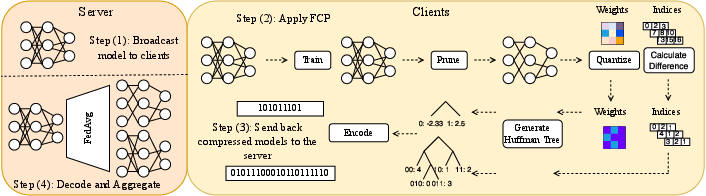
Figure 1: The end-to-end FCP, sequentially combining pruning, quantization, and Huffman encoding for minimization of uplink communication load.
This ordering maximizes compression synergy; pruning sparsifies, quantization exploits reduced weight diversity, and Huffman encoding adapts automatically to symbol frequencies. Compression is only applied upstream (client-to-server) to preserve downstream model integrity.
Analytical Evaluation: Compression, Loss, and Complexity
Communication Compression Ratio
Let N be the number of model parameters and b the baseline bitwidth. For pruning rate γ and quantization with k=2q clusters:
- Initial transmission cost: B0=Nb
- After pruning + quantization: Bpq=(1−γ)Nlog2k
- After Huffman encoding (final): Weighted sum over symbol code lengths for values and indices, with codebook and overhead terms negligible for large N.
The FCP achieves compression ratios exceeding 10x—for instance, with k0 and k1: the model size reduces from 3177 kB to 274 kB for ResNet-12.
Compression-Induced Accuracy Loss
Model update errors due to pruning and quantization manifest as an additive, generally biased noise k2. The paper rigorously bounds this additive error's variance and traces its impact through FedAvg during aggregation. Experimental results show, for typical settings (e.g., k3, k4), accuracy drop is contained to around 2%—a favorable tradeoff for up to 11x reduction in update size, especially under IID data. Worst-case degradation increases under high heterogeneity (non-IID partitions), particularly on CIFAR-10, but remains modest for federated-friendly datasets like FEMNIST.
Computation Overhead
The introduction of the FCP does not significantly alter per-round complexity:
- Pruning, quantization, and Huffman coding are k5 (assuming k6, k7 are constants).
- Added compression cost at the client is always dominated by the cost of local training.
- Server overhead is dominated by decompression but sharply lower due to reduced data volume.
Simulation shows client computation cost increases by <30%, while server-side overhead drops by an order of magnitude as compression increases, yielding end-to-end global training speedups up to 3x on bandwidth-constrained links.
Empirical Results
- CIFAR-10 (IID and non-IID), ResNet-12 (780K params); FEMNIST (IID and non-IID).
- The FCP maintains test accuracy above 80% (baseline 80.7% on IID CIFAR-10) for k8, k9.
- For FEMNIST, accuracy remains above 87% even at high compression, reflecting the robustness of the approach on more homogeneous data.
Impact on System Metrics
- Training Rounds: Minimal increase in convergence time (k0 metric) under compression; virtually no effect on FEMNIST, 10–20% slower on CIFAR-10.
- Global Training Time: On low-bandwidth (Bluetooth class, 2 Mbps), total wall-clock training time is cut by over 60%; savings are less pronounced on high-bandwidth LTE links but compression remains beneficial for device/server load.
Practical and Theoretical Implications
This work demonstrates that layered deep compression, when properly tuned and integrated, can transform FL into a genuinely scalable and environmentally efficient paradigm. The holistically-modeled cost analysis and practical parameter guidelines support deployment by network operators, mobile platforms, and IoT system designers. Importantly, the architecture and evaluation framework permit further extension—e.g., adaptive or learned compression, or combining with energy-sensitive scheduling policies.
The theoretical framework provides a bridge between model-level compression artifacts and system-level learning guarantees, enabling future research to incorporate stochastic optimization, device heterogeneity, and robust aggregation. The simplicity and modularity of the pipeline align with PyTorch/Flower-based FL stacks, facilitating immediate adoption.
Conclusion
The paper provides a rigorous, unified, and practically validated compression pipeline for FL in constrained environments. By merging pruning, quantization, and Huffman encoding with full cost and loss analysis, it establishes an actionable recipe for green AI deployment, enabling substantial communication savings with negligible impact on model performance in most tasks. The framework is extensible and aligns with the goals of sustainable, scalable federated training.
Further research may incorporate task-adaptive compression schemes, fine-grained layer selection, aggregation robustness under massive model sparsity, and integration with secure aggregation protocols to maximize the impact of FCP on future FL systems.