- The paper introduces Hyper-FEOD, employing sparse hypergraph cross-modal fusion and a fine-grained mixture-of-experts to enhance frame-event detection.
- It reduces computational complexity by focusing on motion-critical tokens and efficiently modeling high-order dependencies across modalities.
- Experimental results on the DSEC benchmark show a significant +7.7 mAP improvement with only 13.4M parameters and 10ms inference latency.
Sparse Hypergraph-Enhanced Frame-Event Object Detection with Fine-Grained MoE
Introduction and Problem Significance
This paper introduces Hyper-FEOD, a computationally efficient and high-performance framework for frame-event object detection that unifies RGB frames and event streams through sparse hypergraph-based feature fusion and fine-grained expert modeling (2604.11140). Traditional FEOD systems either rely on dense pairwise attention for cross-modal interaction or neglect modality-aware feature enhancement, resulting in high computational cost or incomplete exploitation of complementary cues. Hyper-FEOD addresses these deficiencies by focusing computation on motion-critical regions and adaptively refining modality-specific features.
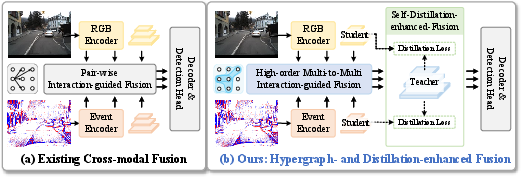
Figure 1: Hyper-FEOD restricts high-order non-local dependency modeling to sparse motion-critical tokens while adaptively refining region-aware features via a novel mixture-of-experts strategy.
Hyper-FEOD Architecture
Hyper-FEOD takes paired RGB images and event streams as input, employing a dual-stream encoder to extract modality-specific features. The centerpiece is the Sparse Hypergraph-enhanced Cross-Modal Fusion (S-HCF) module, which utilizes event-guided sparsity to select motion-salient tokens for high-order non-local interaction using hypergraph computation. This enables efficient modeling of complex dependencies across modalities with substantially lower computational complexity compared to dense attention.
Post-fusion, a Fine-Grained Mixture of Experts (FG-MoE) module is introduced. Unlike conventional MoE, this module employs specialized hypergraph-based experts for different image regions, combined with pixel-level spatial gating. This structure allows adaptive routing of features to region-specific experts (boundary, texture, background), facilitating precise region-wise refinement and stable feature distribution.
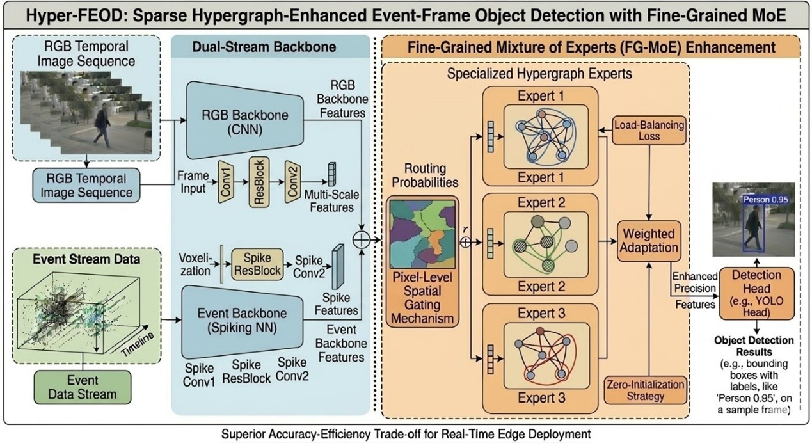
Figure 2: Workflow of Hyper-FEOD, highlighting two-stream encoding, event-guided sparse cross-modal fusion (S-HCF), and fine-grained mixture-of-experts (FG-MoE) for region-adaptive feature enhancement.
Sparse Hypergraph Cross-Modal Fusion
Conventional cross-modal attention is fundamentally limited to low-order pairwise interactions. S-HCF transcends this by constructing hyperedges that aggregate and distribute information across both intra- and inter-modal tokens, derived from global adaptive pooling and optimized using fuzzy C-means clustering. The process comprises:
- Cross-modal Hyperedges Construct (CHC): Spatially structured hyperedges are generated from each modality and concatenated, then refined iteratively to encode discriminative latent correlations.
- Adaptive Hypergraph Attention (AHA): Feature aggregation and dissemination operate bidirectionally between tokens and hyperedges, implemented with a multi-head mechanism to diversify relational modeling.
The computation is focused exclusively on motion-critical tokens suggested by sparse event cues, which sharply reduces the combinatorial explosion typical in dense hypergraph frameworks.
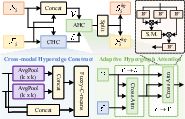
Figure 3: Detailed structure of S-HCF, showing the construction of cross-modal hyperedges and bidirectional high-order message passing.
Fine-Grained Mixture-of-Experts (FG-MoE) Enhancement
FG-MoE adopts a unique, fine-grained strategy compared to traditional expert models. Each region (object boundary, texture, background) is adaptively routed to a dedicated hypergraph expert using a spatial gating mechanism. Training employs both load-balancing and zero-initialization regularization, ensuring stable optimization without distribution shift from the pretrained backbone. Furthermore, a dual-branch self-feature distillation mechanism is integrated, which uses the stronger fused features as targets to supervise the unimodal branches. This mutually reinforces both frame and event representations, optimizing cross-modal information transfer in a cost-free manner (i.e., no additional inference overhead).
Experimental Evaluation
Hyper-FEOD demonstrates substantial advances on three large-scale RGB-event object detection datasets, achieving state-of-the-art accuracy with minimal model size and latency. Notably, on the DSEC benchmark, Hyper-FEOD surpasses the FAOD baseline by +7.7 mAP with a parameter budget of only 13.4M and an inference latency of 10ms. Ablation studies confirm the complementary contribution of S-HCF (high-order sparse modeling) and FG-MoE (region-specialized adaptive enhancement). The effectiveness of bilateral self-distillation is substantiated, with unilateral distillation resulting in limited gains due to introduced modality imbalance.
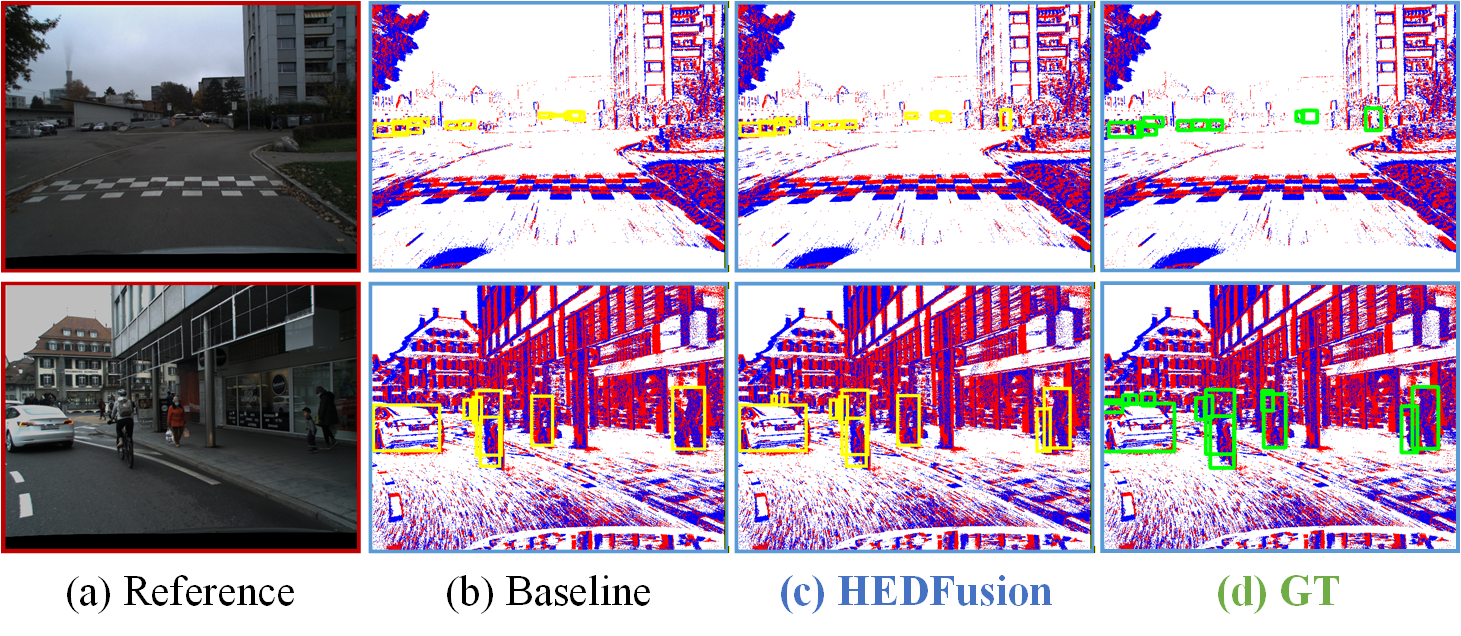
Figure 4: Qualitative comparison on DSEC—Hyper-FEOD achieves more complete detection under challenging scenarios, reducing miss rates compared to a strong baseline.
Theoretical and Practical Implications
The sparse event-guided hypergraph paradigm sets a new computational standard for cross-modal aggregation—enabling non-local high-order dependency capture at a fraction of the complexity of conventional frameworks. This design is amenable to real-time edge deployment, facilitating robust detection under high dynamic range and rapid scene motion. The region-aware FG-MoE module highlights the efficacy of combining MoE routing with hypergraph relational priors, suggesting potential for broader application in region-adaptive perception tasks.
The bilateral self-distillation mechanism implies further theoretical synergy between cross-modal fusion and unimodal feature learning, where quality of fusion provides a learning signal that stabilizes and enhances backbone feature extractors.
Future Directions
Future work should extend the sparse hypergraph mechanism to temporal modeling, further capturing dynamic spatiotemporal correlations inherent in event-based data. Exploring end-to-end differentiable hyperedge construction, higher-level abstraction for expert specialization, and more structured balancing in multi-expert routing could further enhance model robustness and efficiency.
Conclusion
Hyper-FEOD advances the state-of-the-art in FEOD by integrating event-guided sparse high-order modeling and fine-grained expert enhancement, validated by strong empirical results and efficiency. The method presents a compelling direction for efficient, adaptive multi-modal perception under challenging, dynamic vision conditions.
(2604.11140)

