- The paper shows that choosing a transition density near 2ρ₀ in hybrid EoS models introduces significant systematic errors in neutron star observables.
- It demonstrates that lowering the transition density towards ρ₀ diminishes model spread, bringing predictions closer to current observational uncertainties.
- The study emphasizes treating the transition density as a free parameter in Bayesian analyses to achieve a model-agnostic equation-of-state mapping.
Sensitivity of Neutron Star Observables to Transition Density in Hybrid Equation-of-State Models
Introduction
The equation of state (EoS) for ultradense matter inside neutron stars (NSs) is central to understanding the connection between nuclear microphysics and macroscopic astrophysical observables. While theoretical and experimental constraints anchor the EoS near the nuclear saturation density ρ0, the high-density regime is uncertain due to the emergence of exotic degrees of freedom and nonperturbative QCD effects. Hybrid EoS constructions, which match a nucleonic EoS below a transition density ρtr to an agnostic high-density extension (typically parameterized by the speed of sound), are widely used to incorporate phase transitions or rapid stiffening/softening associated with new phases. However, it is commonly assumed that choosing ρtr≈2ρ0 sufficiently minimizes model dependence in NS observables. This paper rigorously assesses this assumption and quantifies the residual systematic error introduced by the matching procedure itself (2604.11046).
Methodology and EoS Construction
The hybrid EoS is constructed by matching four distinct nucleonic models (Taylor, n/3-expansion, Skyrme, and relativistic mean-field (RMF)), all characterized by identical nuclear matter parameters (NMPs), to a common high-density speed-of-sound (CS) parameterization at varying transition densities: ρtr=ρ0,1.5ρ0,2ρ0. For ρ>ρtr, the EoS is generated using a flexible CS ansatz that maintains thermodynamic stability, causality, and approaches the conformal limit at asymptotic densities.
Matching is enforced by continuity of cs2 and its first derivative, which uniquely determines the extension's coefficients and thus imprints sensitivity from the low-density sector into the high-density EoS and resulting NS macroscopic properties.
Analysis of Model Dependence and Results
Model Spread Near and Above Saturation
While all four nucleonic models yield consistent chemical potentials near ρ0, significant divergence emerges as the density is increased Figure 1.
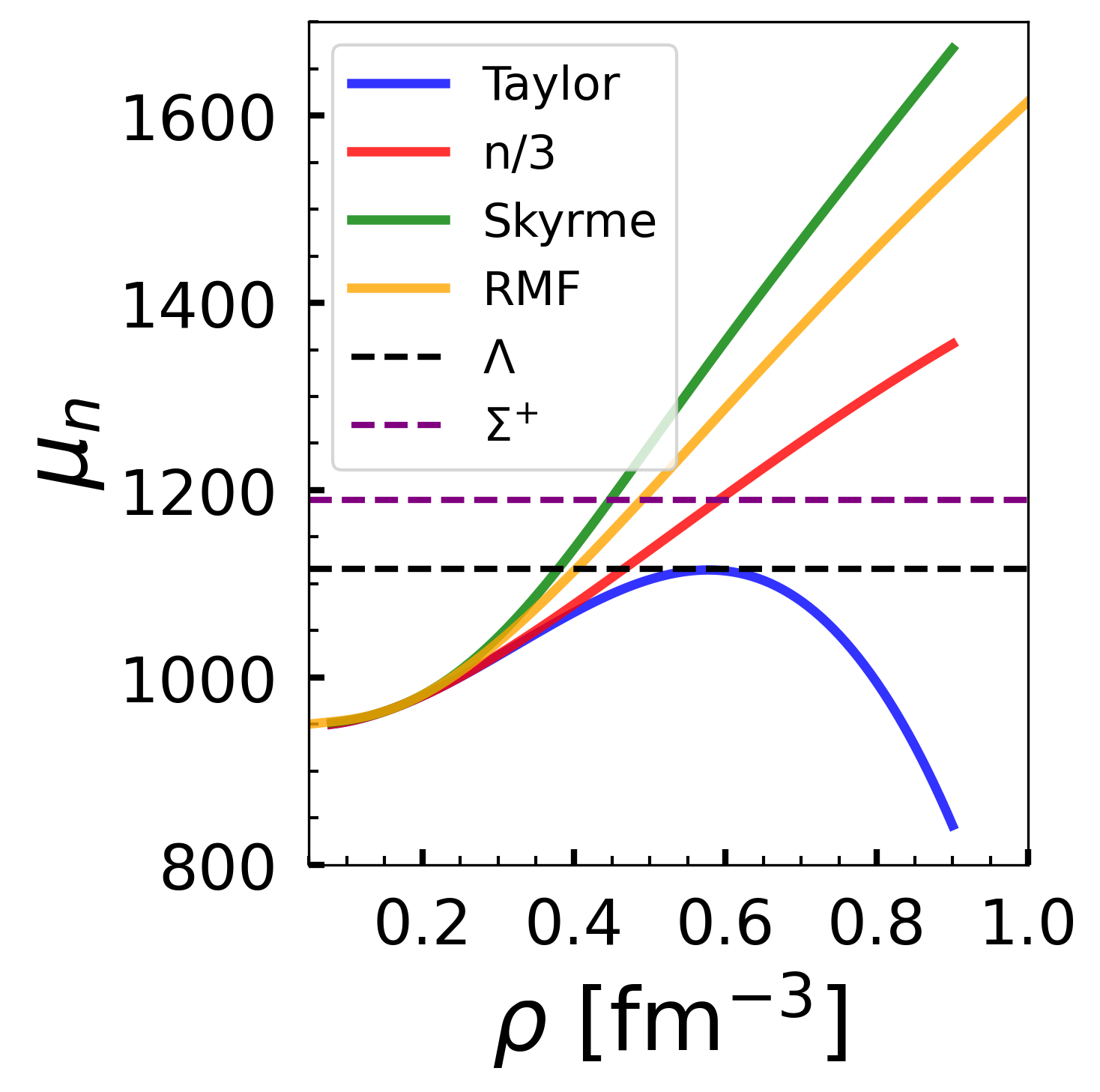
Figure 1: Baryon chemical potential as a function of density for the four nucleonic EoSs with identical NMPs. Deviations increase above ρ0 and impact the matching procedure and NS observables.
The spread among models at the matching point irreducibly propagates into the CS extension, even for fixed high-density parameters.
Impact of Transition Density on NS Observables
The influence of ρtr on the EoS, squared sound speed, and principal NS observables (mass, radius, and tidal deformability) is quantified in Figure 2.
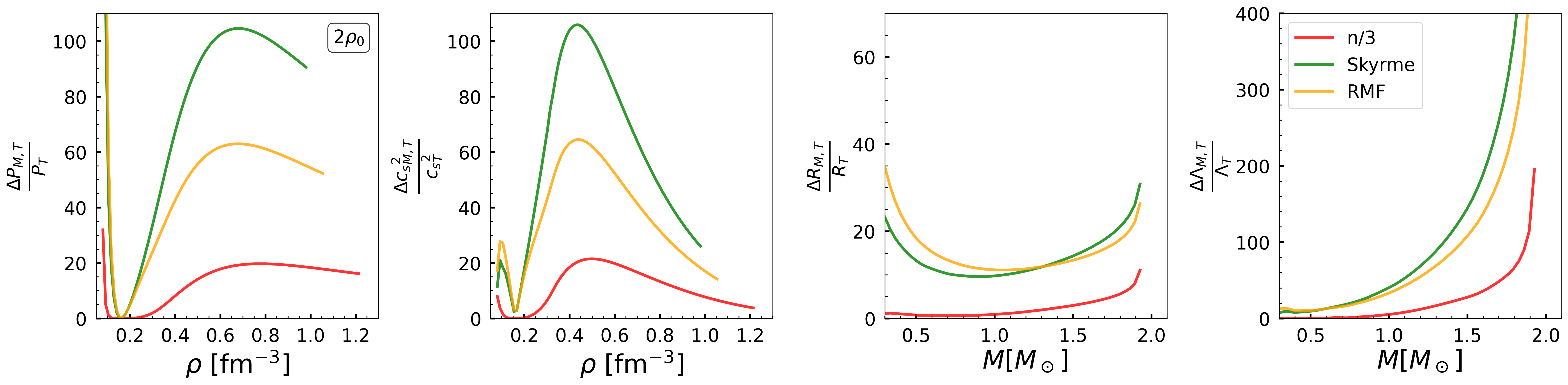
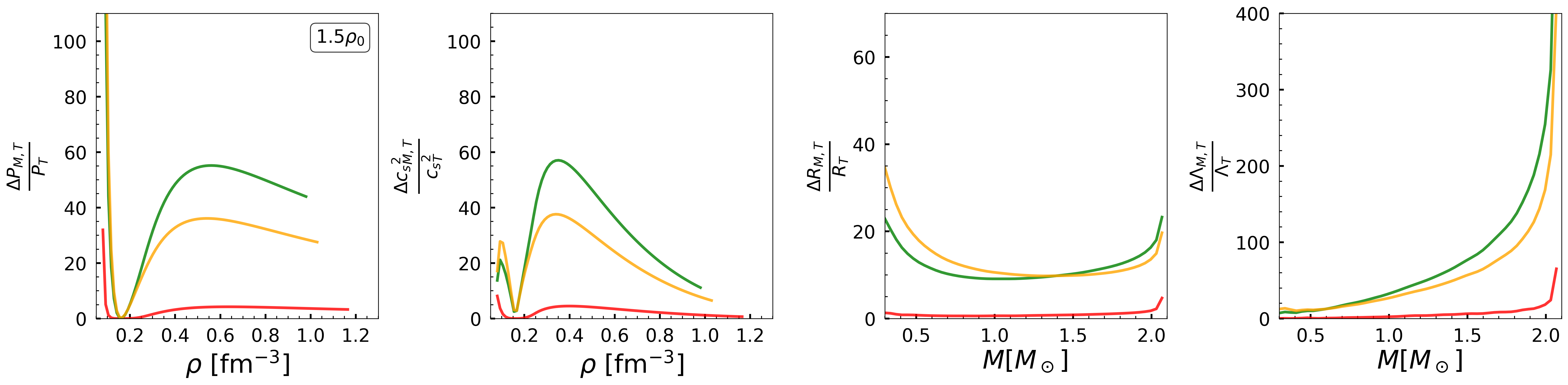
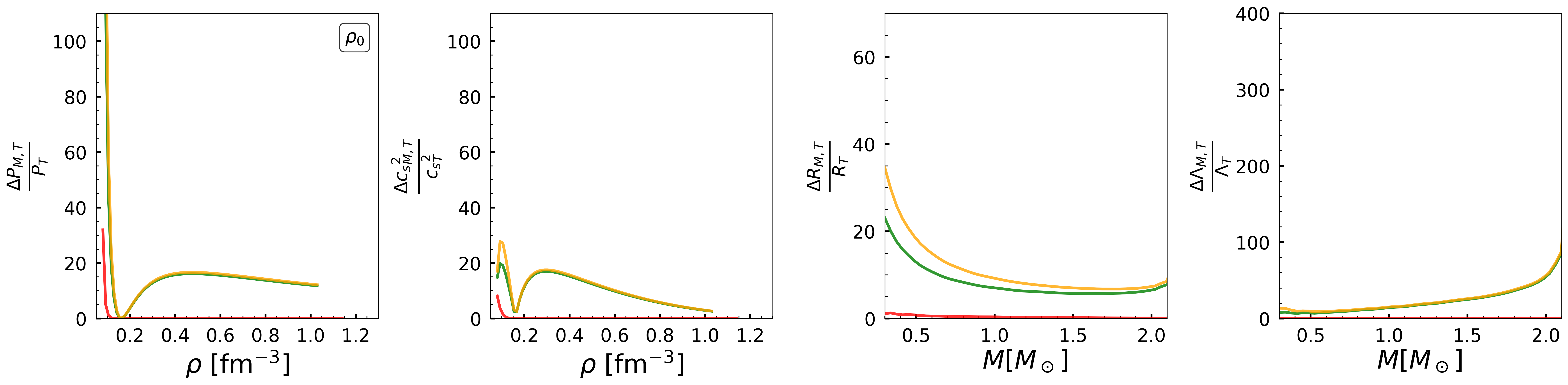
Figure 2: Equation of state and neutron star observables for different ρtr0 values and nucleonic input. Lowering ρtr1 systematically reduces the spread in pressure, radius, and tidal deformability.
For the widely used choice ρtr2, the spread in radius (ρtr3) and tidal deformability (ρtr4) at ρtr5 exceeds current observational uncertainties by roughly ρtr6 and ρtr7, respectively. The deviations manifest despite fixed NMPs due to functional form dependence in the low-density region, and they remain well above the measurement capabilities of both gravitational wave and X-ray observations.
Upon lowering ρtr8, the discrepancy diminishes: at ρtr9 the model spread becomes comparable to, or below, existing error bars (ρtr≈2ρ00 for ρtr≈2ρ01 and ρtr≈2ρ02 for ρtr≈2ρ03), indicating that model dependence can only be safely neglected for matching densities sufficiently close to the nuclear saturation point.
The corresponding sensitivity to ρtr≈2ρ04 is further isolated by fixing the nucleonic EoS and varying the matching density Figure 3.
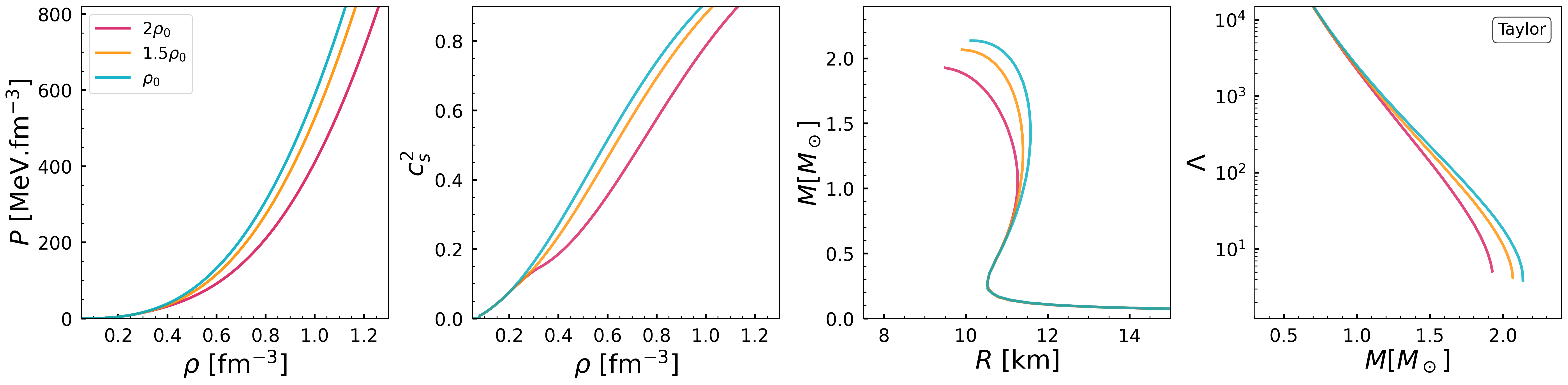
Figure 3: Neutron star and EoS properties for a fixed nucleonic input and varying ρtr≈2ρ05. NS observables grow systematically as matching occurs at lower densities, reflecting earlier onset of CS stiffening.
Lowering ρtr≈2ρ06 moves the inception of the stiffer speed-of-sound extension to lower density, yielding larger radii, higher maximal masses, and increased deformabilities. The magnitude of these changes is non-negligible and fully attributable to the matching algorithm.
The results for alternative NMP sets (Appendix, Figures 4 & 5) confirm the qualitative robustness of the conclusions.
Theoretical Implications
The study demonstrates that the procedure of hybrid EoS matching introduces a source of systematic error that can dominate over current and near-future observational uncertainties unless ρtr≈2ρ07 is placed at or below ρtr≈2ρ08. The high-density extension cannot be regarded as model-agnostic unless the matching is performed near the region where theory and experiment most tightly constrain the EoS. The often-assumed notion that ρtr≈2ρ09 is "safe" is not supported; the model dependence at this point exceeds observational precision and is therefore relevant for inference.
Additionally, the study reveals that constraints on the speed-of-sound profile from observational data are inherently conditioned on the chosen transition density, with matching discontinuities and pressure offsets entangling low- and high-density EoS features.
Implications for Bayesian Inference and Future Directions
These findings have immediate applications for statistical inference frameworks and NS EoS parameter estimation using multimessenger observations. In Bayesian analyses employing hybrid EoS families, systematic variation and marginalization over n/30 are mandatory: fixing or assuming a default transition density is not justifiable unless justified by robust microphysical input.
The results also suggest that any search for model-independent NS observables (quantities robust against low-density EoS freedom) remains challenging if the matching is not performed at densities very close to n/31. Conversely, the quantitative decoupling observed for n/32 at or below n/33 provides a rigorous criterion for building model-agnostic EoS parametrizations for use in statistical analyses.
Additionally, the propagation of matching uncertainties may be relevant for efforts to extract QCD signatures (e.g., identifying strong phase transitions) from macroscopic NS properties.
Conclusion
This work rigorously demonstrates that the standard hybrid construction for neutron star EoSs retains significant model dependence in key macroscopic observables when the hadronic-to-CS transition is set at n/34. Only by lowering n/35 to near the nuclear saturation point is the spread among models reduced below current uncertainty floors. Therefore, the choice of transition density constitutes an explicit, non-negligible source of systematic error in hybrid EoS frameworks. All future empirical inference and EoS mapping efforts must either treat n/36 as a free parameter or restrict matching to densities where microscopic constraints are the most robust. This conclusion is supported across diverse nucleonic models and CS parametrizations, and it has direct implications for the interpretation of NS multimessenger observations and high-density QCD phenomenology.

