- The paper demonstrates that a multi-phased, structured workflow significantly enhances prompt diversity and requirement transparency in T2I design.
- It introduces a modular pipeline that includes requirement structuring, element-level exploration, and compositional synthesis, validated with professional user studies.
- The study highlights trade-offs between efficiency and integration, advocating for adaptive, human-AI co-creative systems.
Multi-Phased, Compositional Prompt-Based Design: An Expert Analysis of "Brief2Design"
Introduction
"Brief2Design: A Multi-phased, Compositional Approach to Prompt-based Graphic Design" (2604.11019) formulates a structured, T2I-driven methodology for bridging ambiguous client briefs and concrete visual collateral. Addressing the limitations of monolithic, conversational T2I workflows, the paper contextualizes design as a process of iterative requirement analysis, element-level exploration, and compositional synthesis, and presents both qualitative and quantitative empirical validation with professional designers. The system is analyzed as an instantiation of best practices in creative support systems, co-creative AI, and human-in-the-loop prompt engineering.
System Design and Workflow Decomposition
Requirement Structuring
Central to Brief2Design is a modular pipeline that aligns with observed professional workflows: first, ambiguous natural-language briefs are parsed into structured requirement cards spanning deliverable formats, business context, target audience, constraints, and other facets. This explicit externalization supports both requirement clarification and gap identification, operationalized via LLM-based extractors and recommenders.
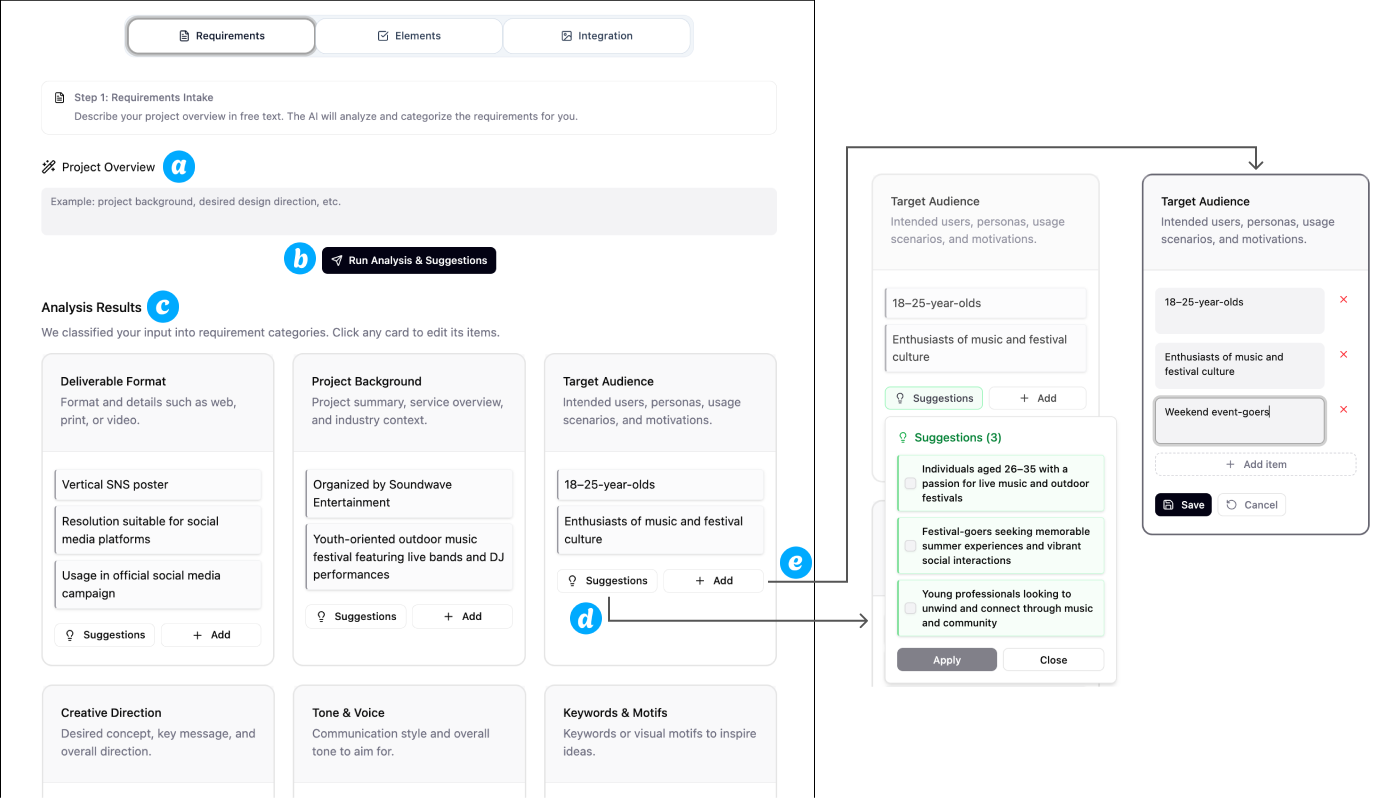
Figure 1: Step 1: Automatic structuring of a free-form brief into categorical requirement cards and field-specific recommendations.
Element-Level Exploration
The requirement schema feeds an element recommender/visualizer subsystem, generating previewable candidates for core design primitives (objects, backgrounds, text, typography, composition). Each generated card adheres to type-specific enhancement templates, enforcing both high-level coherence and type-local diversity; users can iteratively edit, delete, and regenerate individual elements with immediate visual feedback.
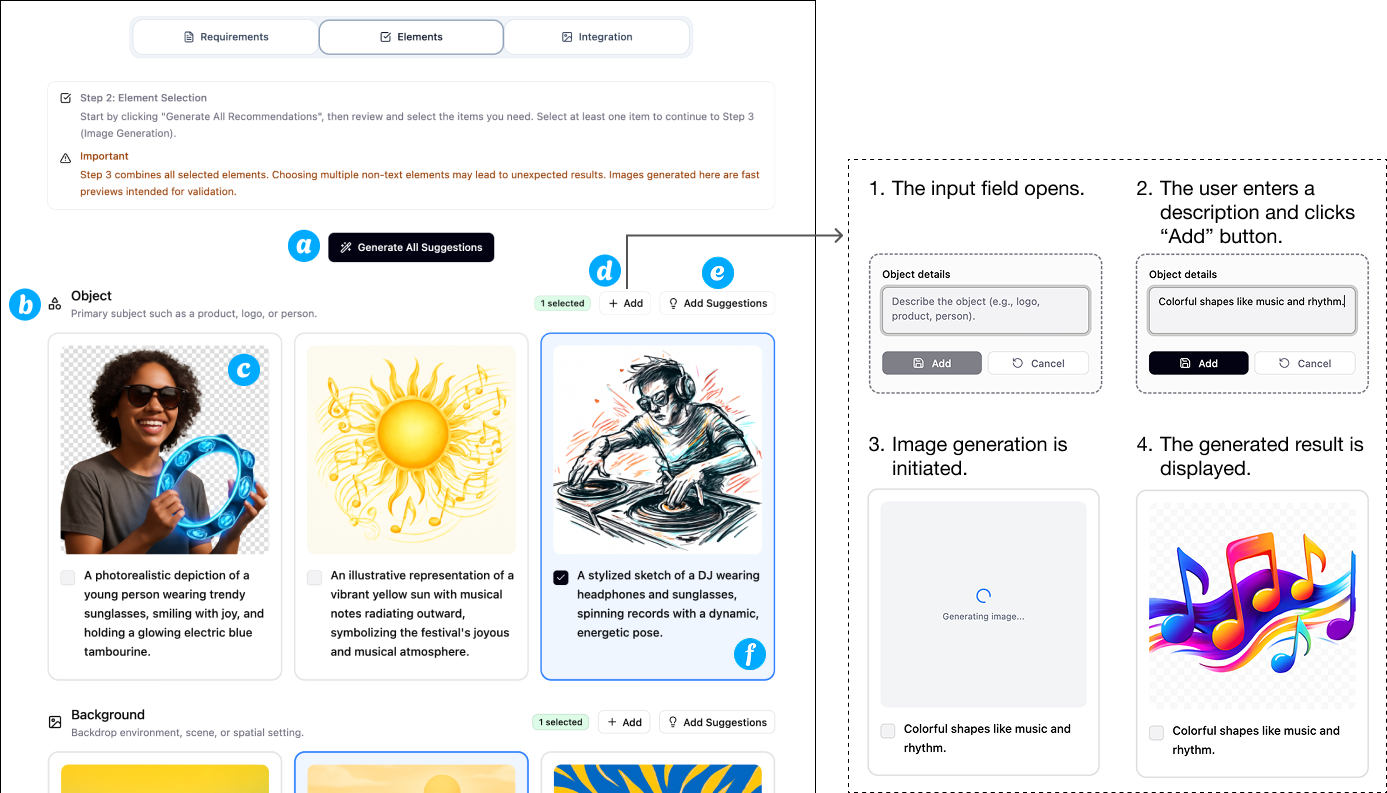
Figure 2: Step 2: Visualization and customization of type-specific element cards; inline editing and iterative preview generation per card.
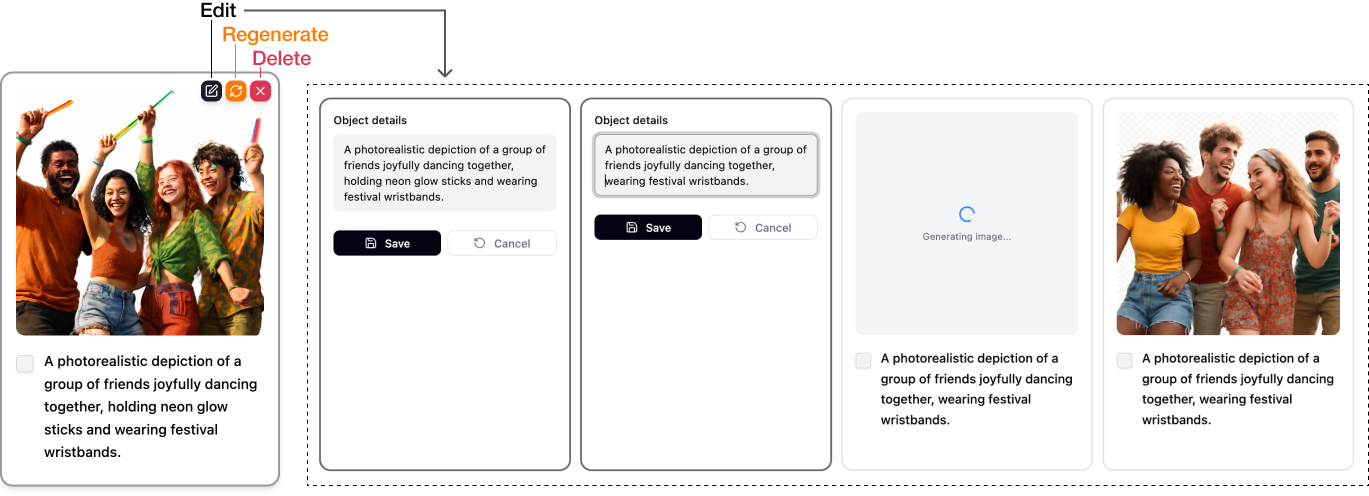
Figure 3: Card-level interaction: edit, delete, or regenerate element prompts with direct updating of previews.
Coherent Integration and Synthesis
Selected elements are aggregated through a composition-first design integrator which maintains explicit spatial roles and constraints. The integration process is hierarchical (background → text → typography → objects), uses compositional numerics for strict spatial fidelity, and outputs a single prompt for the final T2I generation call. Users can further explore variations by reconfiguring card selections or reviewing history.
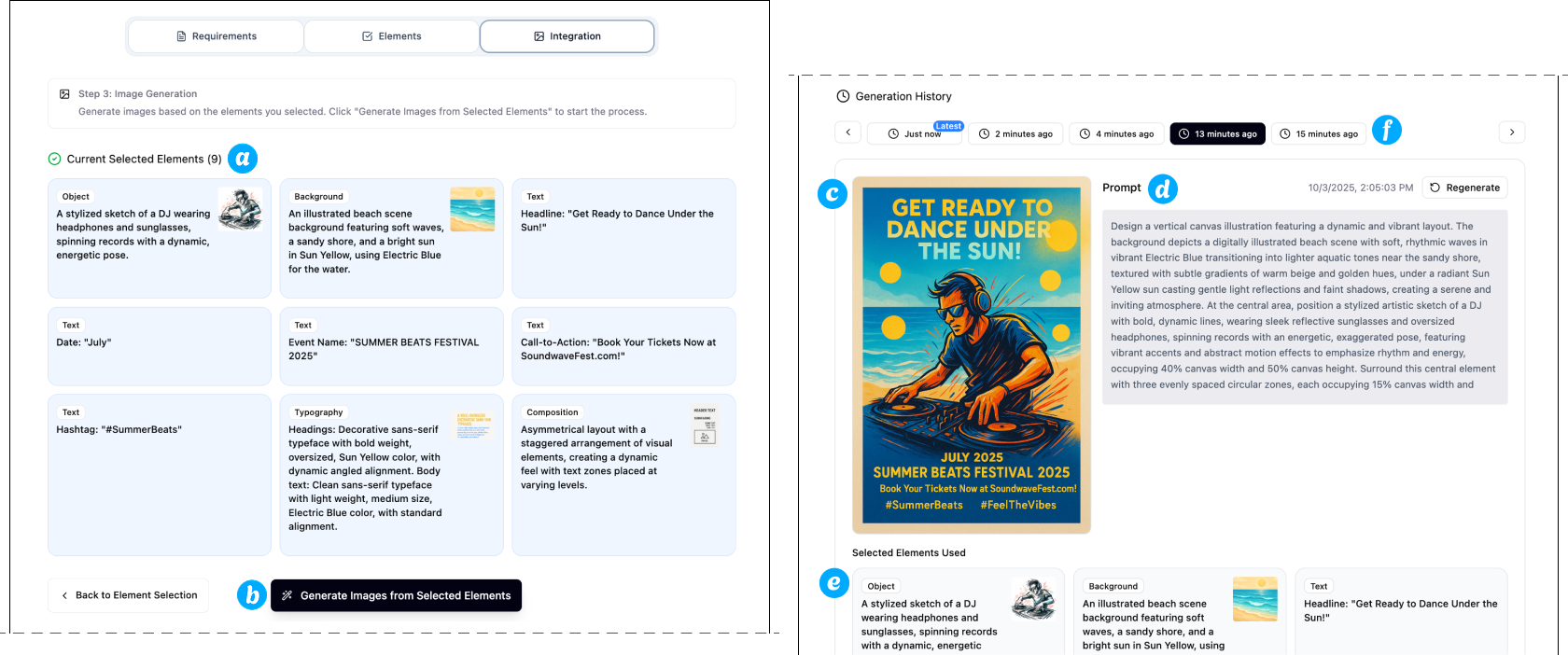
Figure 4: Step 3: Synthesis of selected elements into a cohesive design; visualization of integrated prompt, source elements, and variation history.
Baseline and Experimental Methodology
A baseline emulating ChatGPT-style conversational design was constructed for comparative user studies. Both systems share foundational model layers (GPT-4o for LLM, gpt-image-1 for image generation), ensuring experimental validity. Tasks reflected real-world client scenarios with both highly constrained and open-ended requirements. Metrics evaluated include task completion rate, generation frequency, CSI (Creativity Support Index), image/prompt diversity, and feature usefulness.
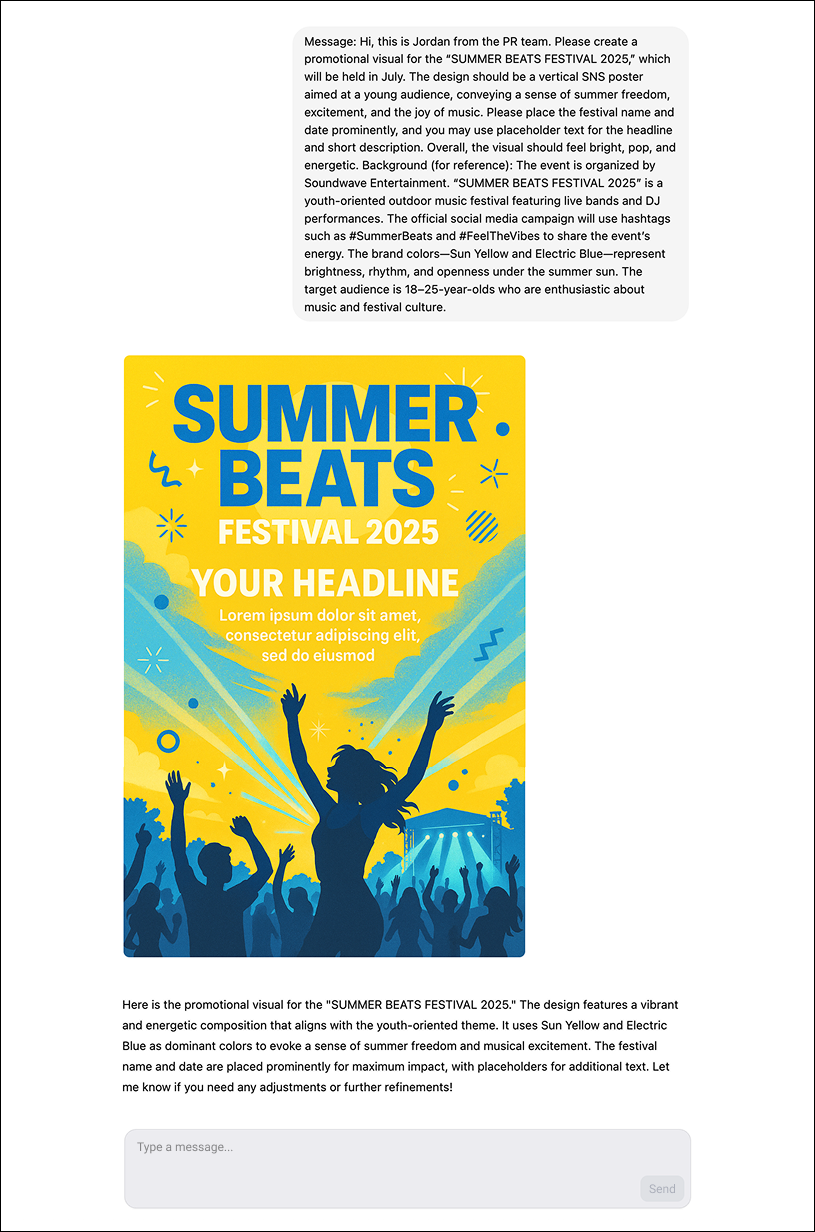
Figure 5: The baseline system: conventional chat-based, end-to-end image generation via unconstrained prompt-engineering.
Empirical Findings
Workflow Efficiency and Diversity
Prompt diversity metrics show that Brief2Design significantly enhances prompt-level exploration under lower-freedom constraints, and maintains competitive diversity in high-freedom regimes, all while yielding comparable image diversity to conversational baselines. Notably, the structured workflow incurs longer per-design generation times and somewhat lower completion rates, reflecting genuine cognitive/exploratory overheads in the requirement structuring and element selection stages.
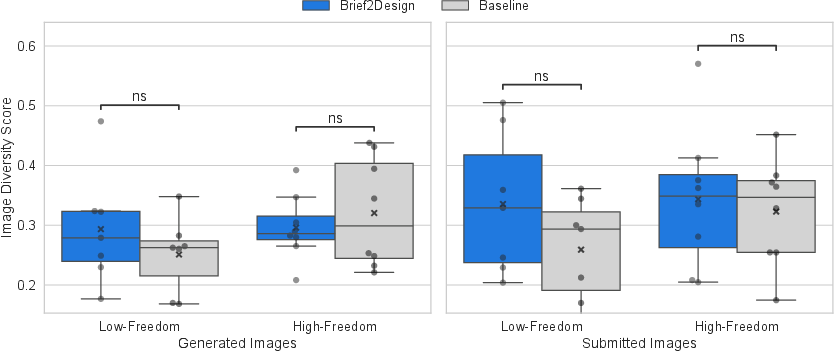
Figure 6: Comparison of image-level diversity across systems and constraint regimes; differences not statistically significant.
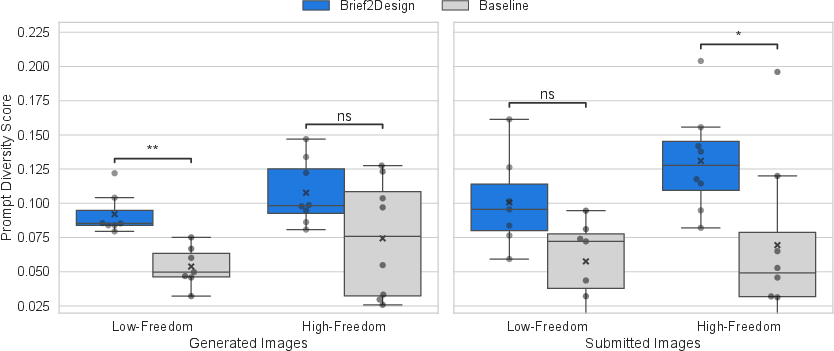
Figure 7: Prompt-level diversity is consistently higher in Brief2Design, particularly in low-freedom scenarios (p<0.05 or lower).
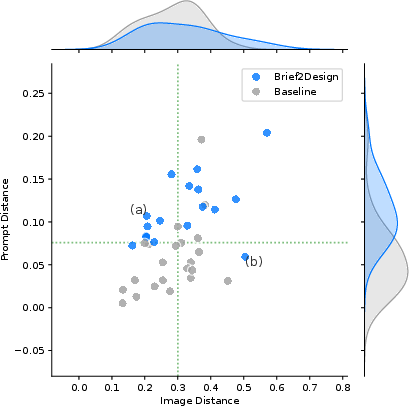


Figure 8: Illustration: high prompt diversity does not always equate to high image diversity, emphasizing the importance of compositional metrics.
User Experience and Feature Ratings
Creativity support as measured by CSI does not differ significantly between systems; however, granular ratings indicate that requirement extraction, requirement recommendation, and the overall staged workflow are perceived as highly valuable by professionals. Evaluation of composition and integration features reveals a pronounced component-versus-holistic gap—isolated element previews provide less actionable feedback for context-dependent facets such as layout and typography.
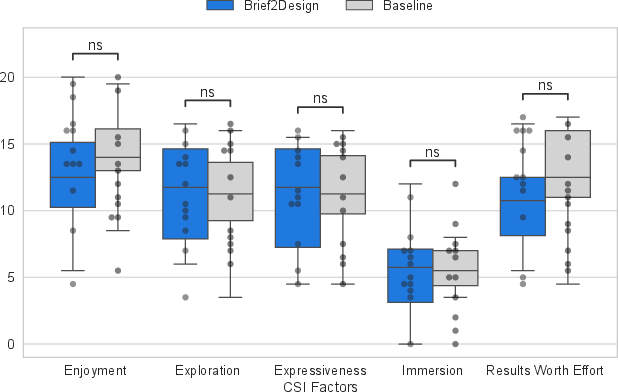
Figure 9: CSI results: no significant advantages for either workflow across enjoyment, exploration, expressiveness, immersion, or effort factors.
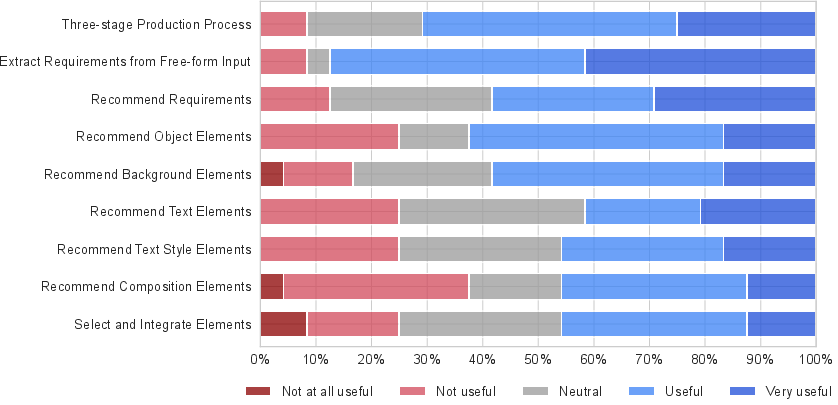
Figure 10: Feature utility: requirement extraction and stage-based guidance are rated highest by participants.
Analysis of Compositional and Cognitive Aspects
The system enables explicit and systematic design space exploration, mitigates early design fixation by avoiding overexposure to "polished" full outputs, and supports remixing of design primitives. Nevertheless, integration friction emerges when recombining disparate elements—user feedback highlights the need for higher fidelity in preview-generation and more sophisticated context-awareness, especially for holistic coherence.
Theoretical and Practical Implications
Compositional Prompt Engineering
Brief2Design demonstrates that prompt compositionality and explicit grounding directly scale the diversity of exploration, offering a reproducible mechanism to disentangle prompt semantics from image feature diversity. The divergence between prompt-based and perceptual similarity underscores current similarity metrics' insufficiency for capturing layout and structure—a limitation with direct implications for T2I system evaluation and design.
Human-AI Co-Creation Dynamics
The staged design paradigm, while academically principled, requires adaptation by practitioners accustomed to iterative, blockwise refinement. These findings reinforce the necessity for configurable, user-adaptive workflows that blend structured and free-form creative interaction, and point toward the development of more flexible, hybrid creative pipelines that bridge requirement scaffolding with non-linear refinement.
Limitations and Future Directions
The current study's sample is limited to in-house professional designers and short-burst tasks, limiting ecological validity for long-term, unconstrained, or cross-organizational creative workflows. Moreover, single-image-per-generation restrictions and reliance on LLM-driven preview fidelity expose failure modes in integration and context-dependent element evaluation. Advancements in real-time feedback, higher-fidelity compositional T2I, and adaptive workflow architectures are necessary to realize the system's full potential.
Conclusion
Brief2Design substantiates the practical utility of a structured, compositional, and multi-phased workflow for AI-assisted graphic design. Explicit requirement externalization and card-based element-level exploration concretely improve prompt diversity and requirement transparency at the cost of decreased efficiency and integration friction, especially under time/resource constraints. High user valuation of requirement structuring validates the need for robust AI-driven scaffolding tools in professional practice. Future research should address adaptive workflow flexibility, richer compositional metrics, and improved element integration to further reconcile AI agency with human creative workflows.