- The paper introduces malleable prompting by reifying user preferences as interactive widgets, enabling precise and modular control over LLM outputs.
- It employs a training-free modular decoding method that modulates token probabilities based on attribute-specific weights, leading to enhanced output precision.
- Empirical evaluations demonstrate that the widget-enabled system significantly improves target preference realization and user-perceived controllability.
Introduction
The increasing reliance on LLMs for content generation tasks foregrounds the limitations of purely natural language (NL) prompting, particularly in expressing and iteratively tuning subjective user preferences such as tone, style, focus, and formatting. While NL offers open-ended expressiveness, it imposes significant “gulfs of execution and evaluation”—users struggle both to precisely articulate nuanced preferences and to map changes in prompts to output effects. "From Words to Widgets for Controllable LLM Generation" (2604.10925) proposes Malleable Prompting, an interaction paradigm wherein preference expressions in prompts are systematically reified as GUI widgets (sliders, toggles, dropdowns, steppers), enabling users to parameterize, configure, and directly control output characteristics.
This approach is grounded in a new decoding method that modulates token probabilities according to attribute-level preference weights, offering real-time, modular control and post-hoc attribution. Empirical evaluation demonstrates significant gains in precision, transparency, and user-perceived controllability over conventional NL prompting.
From Natural Language to Malleable Interfaces
Malleable Prompting systematically transforms prompts into a dual structure: immutable task specification and modular, attribute-bound preferences. The preference space is formalized around prevalent dimensions—Format, Tone, Audience, Length, and Content Constraints—mapped to manipulable control types (categorical, numeric, binary, continuous).
The workflow is instantiated in an interactive system where users:
- Enrich prompts with system-suggested preferences,
- Parse expressions into corresponding controls,
- Manually or automatically bind spans to widgets,
- Steer generation by adjusting widget values,
- Attribute output spans to specific widgets,
- Track iteration history with structured visualizations.
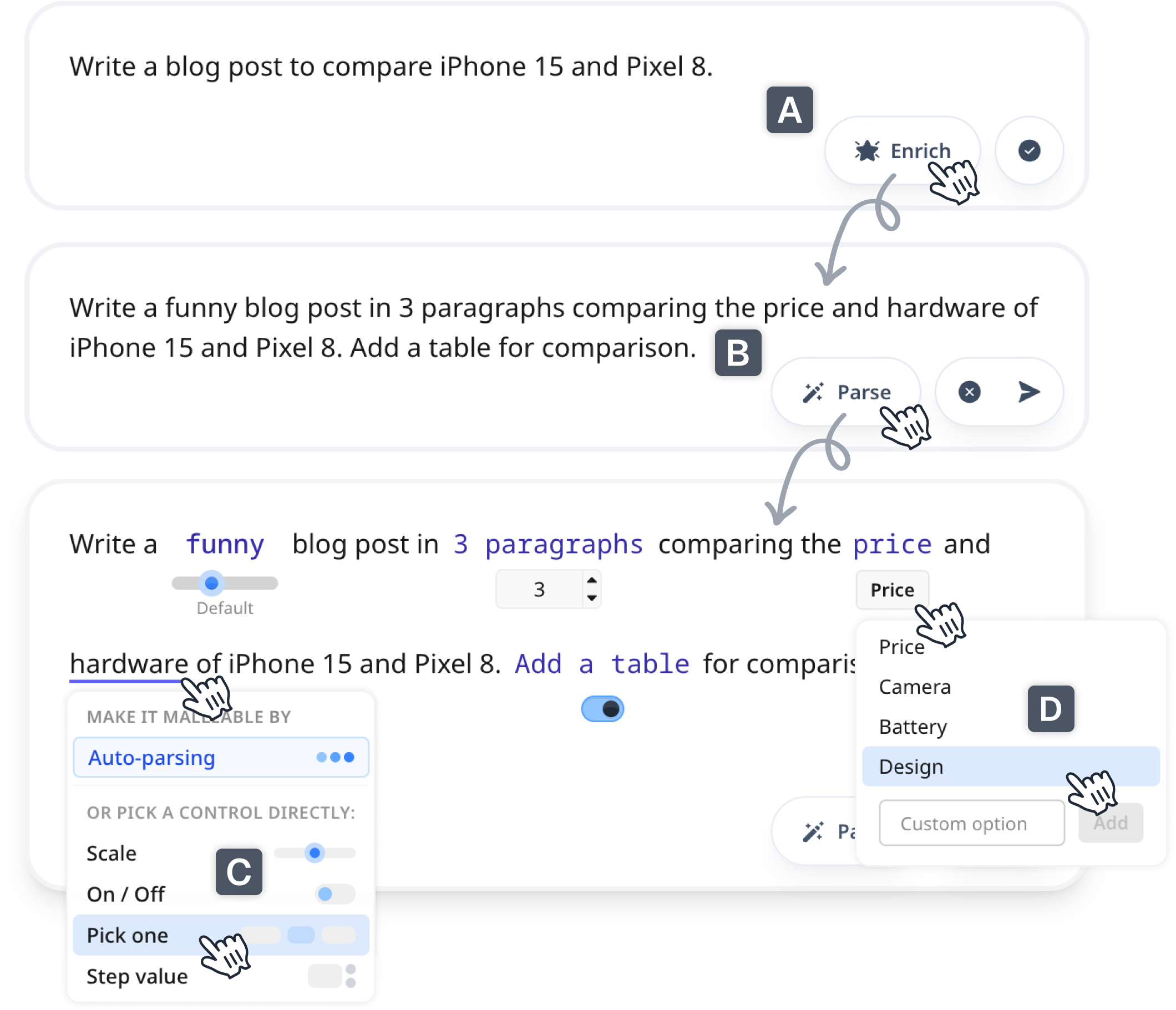
Figure 1: The Malleable Prompting interface enables users to enrich prompts with system-suggested preferences, parse and reify preference expressions as widgets, and rapidly configure output characteristics by manipulating controls.
This malleability enables both granular forward configuration (steering execution) and post-hoc evaluation (attribution and version comparison).
Technical Framework: Modular Decoding and Attribution
The central technical contribution is a training-free, inference-time method for real-time preference control. The system modularizes prompts by extracting controllable attributes (via LLM-based parsing), splitting user input into a base specification and a set of attribute-value pairs. Each attribute is handled according to type:
- Categorical/numeric: Value substitution within the prompt.
- Binary/continuous: Token-probability modulation during decoding using attribute-specific control weights.
Concretely, during each decoding step, the influence Fa,P0(xi) of attribute a on token xi is measured by the log-probability difference when including versus omitting a. The user-selected strength λa further scales this modulation, enabling direct manipulation of attribute realization from none (λa=0) through amplified (λa>1) values.
Aggregate modulation over all controls ensures that interaction with one attribute does not occlude inspection of others—any subset of preferences can be isolated or combined. Categorical attributes are handled by targeted string replacement, while continuous controls are mapped to steered probability vectors.
Post-hoc attribution is achieved by computing Shapley-value-inspired marginal effects: for each token, the increase or decrease in probability when omitting each attribute reveals localized control influence. For discrete attributes, direct string matching reliably links prompt edits to verbatim output segments.
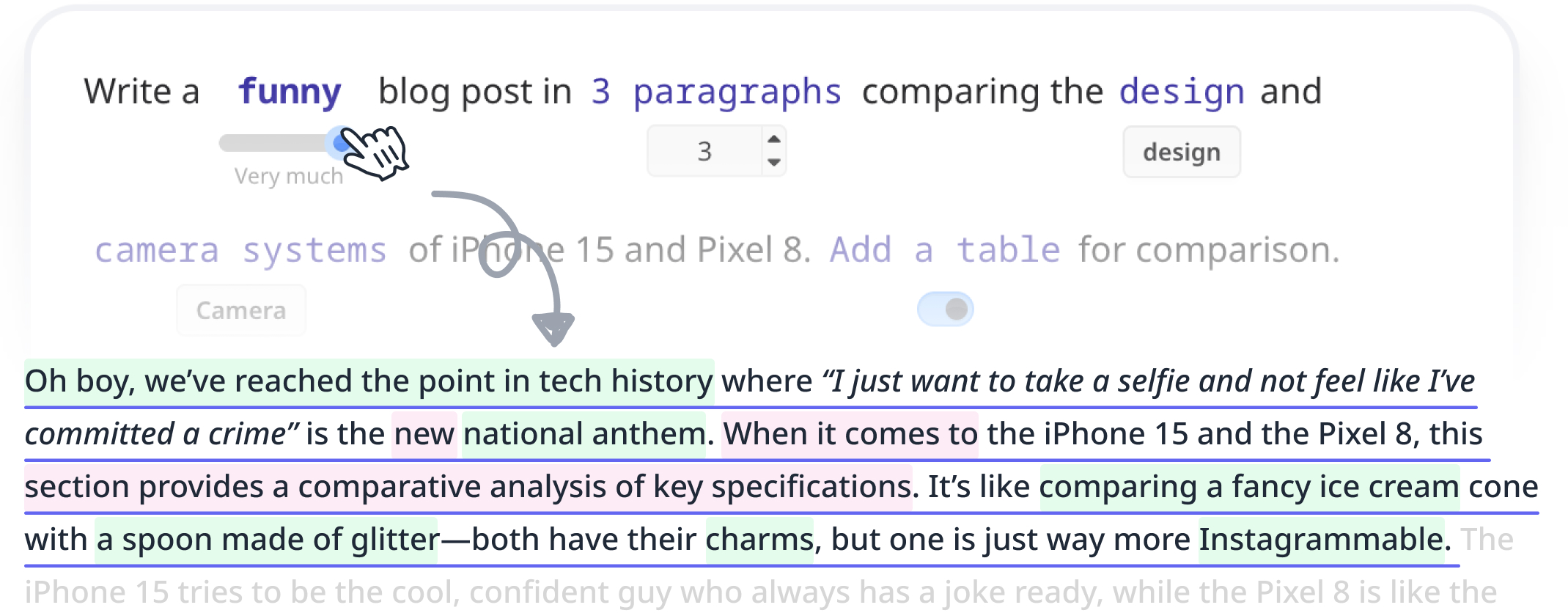
Figure 2: Widget attribution visualization shows how control adjustments map to affected output spans—underlining, color-coding, and overlay indicate the influence direction and degree per token.
Interaction Affordances and Iterative Control
The system supports emergence and evolution of user preferences, addressing under-specified or shifting requirements typical in open-ended content creation. Users can discover suggested attributes through prompt enrichment, add novel constraints on demand, and manipulate the parameter space via GUI elements mapped to the preference taxonomy.
Widget creation and adjustment patterns are found to be strongly type-categorized: sliders are dominant for tone/style attributes, toggles for binary constraints, dropdowns for audience roles or categories, and steppers for structural/length variations.
Crucially, the version graph enables non-linear exploration of prompt-output states, supporting branching, reverting, and comparative evaluation not possible with standard chat-history interfaces.
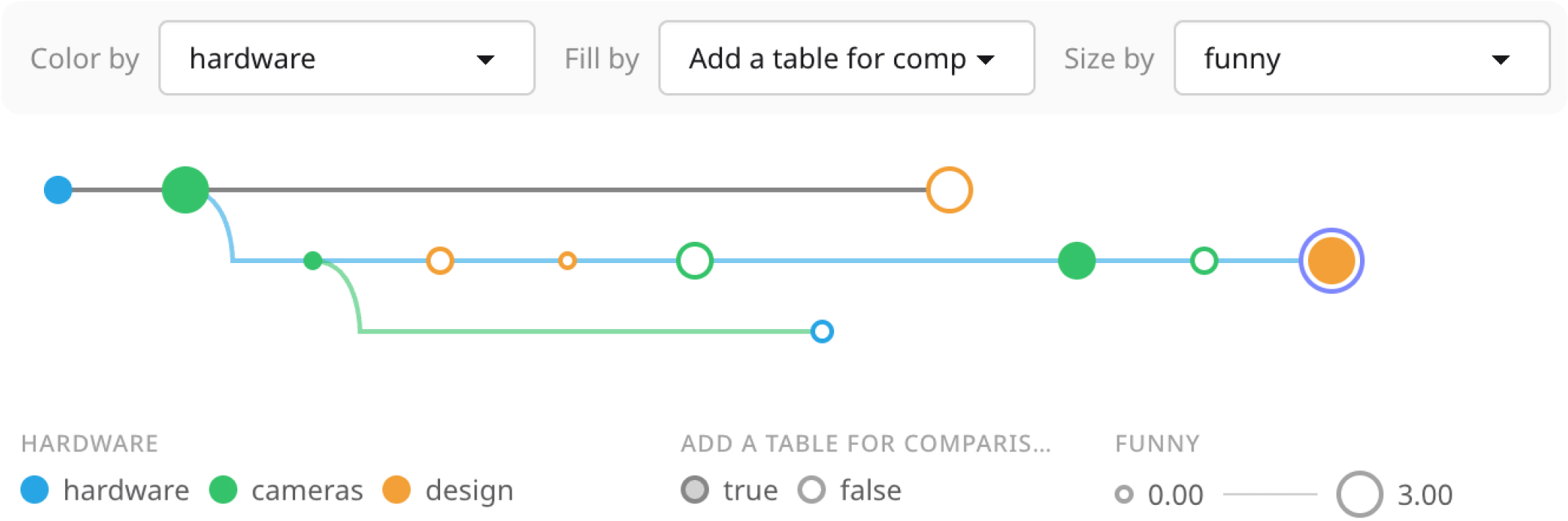
Figure 3: Node-link visualization organizes prompt-output iterations by configuration state, not chronology, supporting systematic evaluation of branched and reverted alternatives.
User Study: Quantitative and Qualitative Findings
In a within-subjects user study (N=12), Malleable Prompting was compared against NL-only prompting on controlled Jeopardy-style writing tasks and open-ended exploration.
Qualitative analysis revealed emerging user mental models that allocate sliders to ordinal attributes, dropdowns to categorical dimensions, and toggles to Boolean constraints. NL prompting is preferred for simple, well-specified tasks, while the malleable system excels for compositional, style-rich, or exploratory generation. Users leveraged enrichment for preference discovery, and systematically calibrated sliders to establish boundaries before fine-tuning intermediate values.
Implications, Limitations, and Future Directions
The research articulates clear design consequences: malleable widgets efficiently bridge the gulfs of execution (by enabling direct configuration of latent or emergent preferences) and evaluation (by attributing and organizing outputs around configuration state). The modular decoding technique is extensible to broader agentic workflows, code generation, and prompt template libraries with parametric controls.
Shortcomings include computational overhead due to multi-pass decoding, small sample size, focus on constrained writing genres, and the potential for template anchoring/homogenization effects.
Several lines for extension are explicit:
- Adaptive surfacing of widget complexity tied to task demands,
- Expansion of the preference taxonomy for new domains,
- Reverse widget inference via selection in output (for backward mapping from output fixes to controllable parameters),
- Longitudinal analysis of scalability as preference spaces and widget sets grow.
Conclusion
Malleable Prompting establishes parameterized, widget-driven control as a robust solution to the expressive and evaluative limitations of NL-only LLM prompting. The modular decoding approach delivers precise, real-time steering of arbitrary preference dimensions and explicit attribution of output spans to user-configured controls. Empirical evidence strongly supports its value on both performance and user experience axes. This paradigm has clear implications for the design of next-generation LLM authoring interfaces—blending the flexibility of language with the deterministic manipulation of GUIs to support iterative, transparent, and fine-grained collaborative generation.
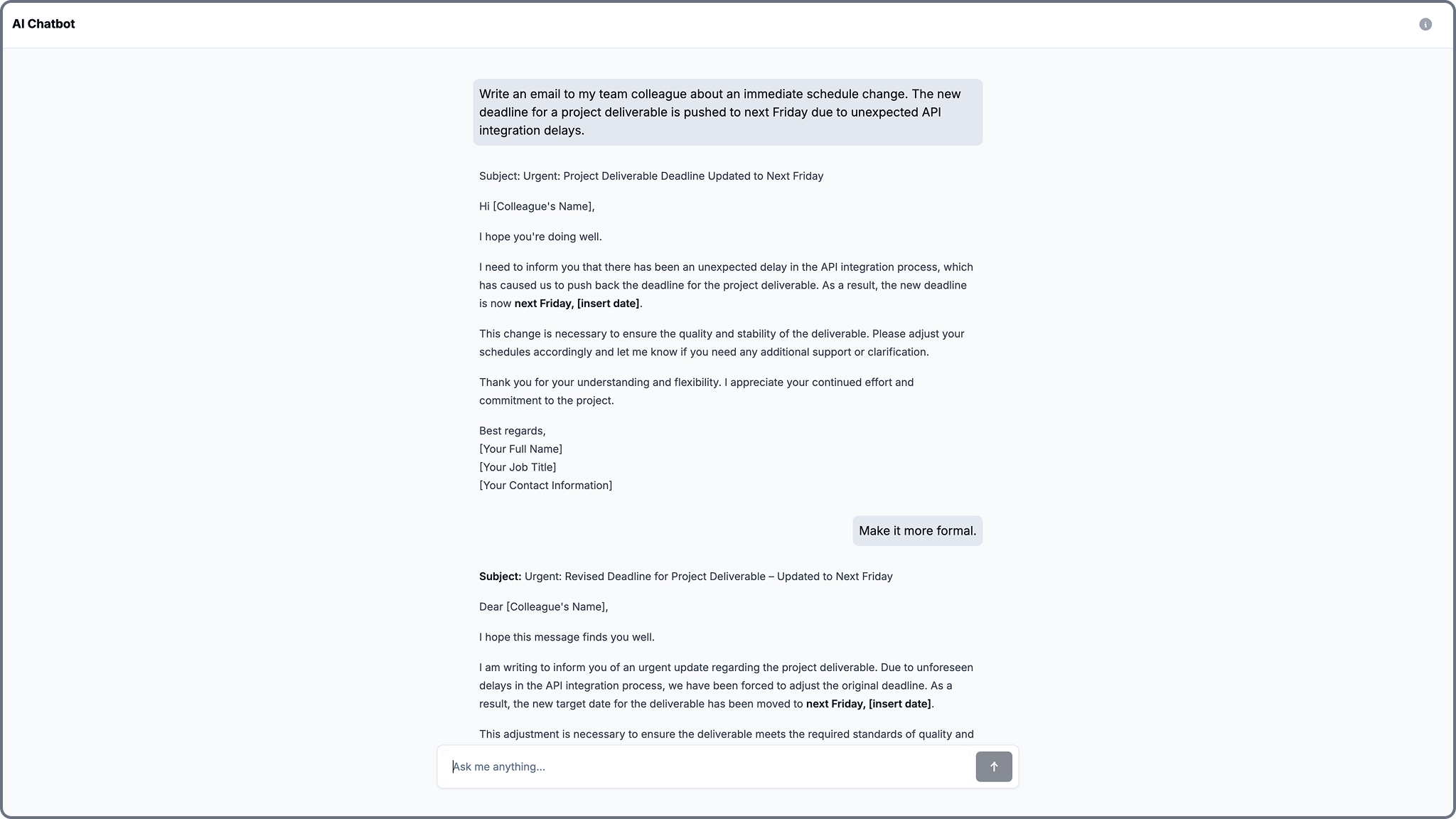
Figure 5: Example of the baseline interface for standard chat-based NL prompting, used as the comparison condition in the empirical study.
