Learning Preferences from Conjoint Data: A Structural Deep Learning Approach
Published 12 Apr 2026 in stat.ME and econ.EM | (2604.10845v1)
Abstract: Conjoint experiments randomize multidimensional profiles, offering a powerful design for recovering structural preference parameters -- including marginal rates of substitution, willingness to pay, and the distribution of preferences across a population. Yet the dominant approach in political science has focused on nonparametric causal estimands that do not leverage this potential. We propose a structural approach that embeds a deep neural network within a random utility logit model, allowing preference parameters to vary as a fully flexible function of respondent characteristics. The neural network addresses the concern that a parametric specification may not capture the true data generating process, while double/debiased machine learning provides valid inference on average preference parameters. We apply our method to three prominent conjoint studies and find rich preference heterogeneity masked by reduced-form averages: a near-zero gender effect coexists with 83% preferring female candidates, opposition to undemocratic behavior is near-universal but varies sharply in intensity, and progressive tax preferences cut across every partisan subgroup.
The paper presents a novel structural deep learning approach that integrates DNNs with random utility models to nonparametrically estimate individual preference heterogeneity.
It employs double/debiased machine learning to ensure valid, √N‐consistent inference on average and subgroup-specific marginal utilities and trade-offs.
Empirical applications reveal that the method outperforms traditional models by accurately identifying distributional features and counterfactual choice probabilities in complex conjoint experiments.
Structural Deep Learning for Conjoint Analysis: Methodology, Empirical Findings, and Implications
Introduction
The paper "Learning Preferences from Conjoint Data: A Structural Deep Learning Approach" (2604.10845) introduces a novel method that integrates deep neural networks (DNNs) with a random utility discrete choice model for the analysis of conjoint experimental data. The core contribution is a fully nonparametric estimator for individual-level preference heterogeneity, which leverages double/debiased machine learning (DML) for valid inference on average and subgroup quantities. The approach addresses longstanding obstacles in political methodology related to identifying structural preference parameters—such as marginal rates of substitution (MRS), willingness to pay (WTP), and the distributional features of preferences—while mitigating the risk of misspecification associated with parametric utility models.
Structural DNN Utility Model
The methodological framework comprises a random utility model with utility linear in attribute levels, but with respondent-level marginal utilities that are a flexible, high-capacity function of observable characteristics. The structural model is characterized as follows:
Each profile is encoded as a p-dimensional attribute vector.
Respondent utilities are modeled as Uijt=Xijt⊤β(Zi)+εijt, where β(Zi) is an unrestricted (via DNN) mapping from respondent characteristics to preferences, and εijt are independent Gumbel errors.
The forced-choice probability for a binary profile comparison is given by the multinomial logit model, preserving identification of structural quantities.
The main estimands enabled by this model include:
Average and subgroup-specific marginal utilities (θk)
Individual-level preference vectors
Distributional features such as polarization (the fraction of respondents favoring or opposing an attribute)
Marginal rates of substitution between attributes
Attribute-level importance shares in respondent utility decomposition
Compensating differentials for policy trades
Counterfactual choice probabilities for arbitrary profile contrasts
Estimation Strategy and Inference
The estimation pipeline employs a DNN to flexibly, nonparametrically learn the mapping from respondent features into their preference parameters, subject to architectural constraints that enforce meaningful utility structure. DML cross-fitting is used to debias average parameter estimation, providing confidence intervals robust to first-stage overfitting. The influence-function-based correction ensures N-consistent inference for averages, even as the first-stage DNN estimator converges at slower rates.
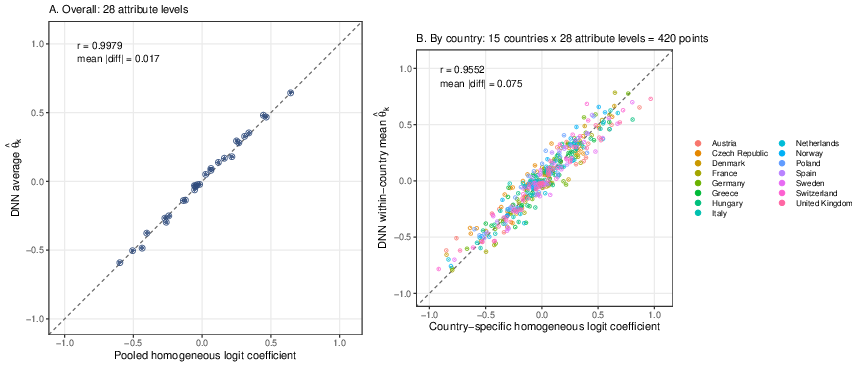
Figure 1: Validation of DNN-recovered averages against reduced-form homogeneous logit estimates on the \citet{bansak2023amce} immigration conjoint, demonstrating nearly perfect correspondence.
Crucially, when the logit model is correctly specified, the DNN's population-level estimates nest the popular average marginal component effect (AMCE) as a special case; this is validated both analytically and empirically (Figure 1).
Empirical Applications
Candidate Preference Heterogeneity
The approach is applied to the candidate-choice conjoint of Saha & Weeks (2022), involving multi-attribute candidate profiles. The structural DNN uncovers significant heterogeneity:
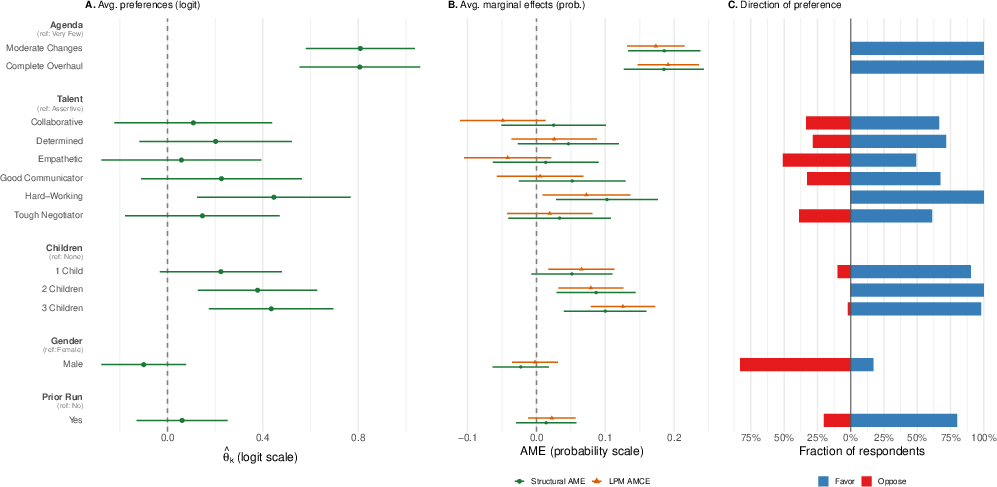
The average effect for candidate gender (female vs. male) is close to zero, but 83% of respondents prefer female candidates—a striking instance of polarization masked by classical averages.
Figure 2: Average preference parameters and shares favoring each attribute in Saha & Weeks (2022). The gender effect demonstrates near consensus hidden by a zero mean.
For the "Empathetic" attribute, the average is also near zero, but the population is almost evenly split—49% favor, 51% oppose—corresponding to a sharp partisan divide.
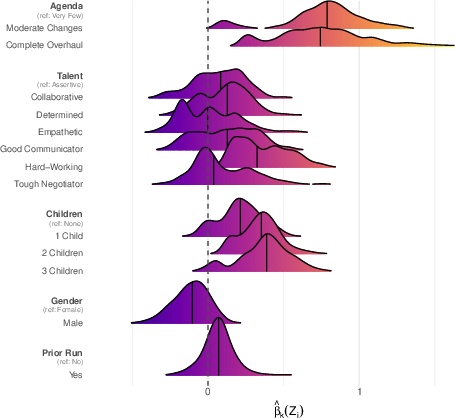
Figure 3: Ridgeline densities of individual-level preference estimates reveal intensity and direction of heterogeneity across all attributes.
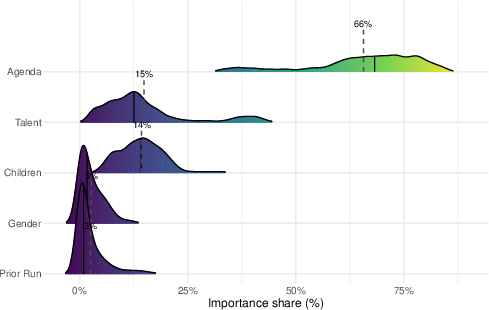
Policy agenda dominates attribute importance, with a mean share of 66% in respondent utility, and gender contributing a negligible share despite a strong directionality in preference.
Figure 4: Distribution of attribute importance shares illustrates domination of policy agenda and the broad individual-level heterogeneity.
Democratic Principles vs. Partisanship
Reanalysis of Graham & Svolik's (2020) conjoint experimental data challenges inferential claims regarding democratic accountability:
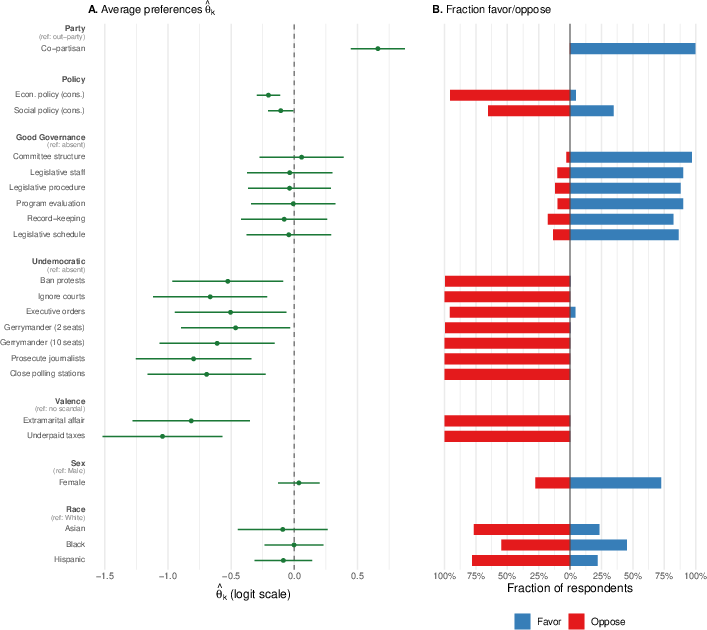
Nearly all respondents penalize undemocratic actions (e.g., gerrymandering, prosecuting journalists), which is hidden when only averages or dichotomous threshold-based metrics are reported.
Figure 5: DNN-based average marginal effects and directionality for democracy attributes in Graham & Svolik (2020).
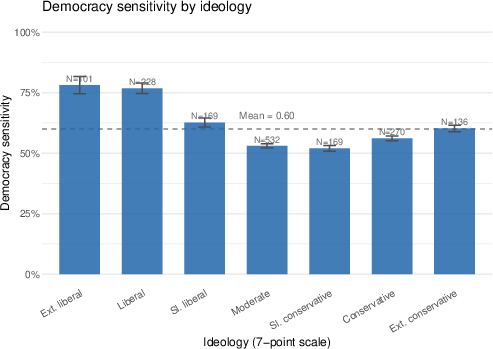
However, the magnitude of these preferences varies, with cross-ideological differences in willingness to trade off democratic principles for partisan benefit.
Figure 6: Democracy sensitivity is highest at ideological poles and lowest among moderates, indicating a U-shaped pattern for intensity of democratic concern.
The inferred MRS indicates that voters, depending on ideology, are willing to trade 66% to 93% of their co-partisan benefit to avoid an undemocratic action—a quantification unreachable by standard AMCE approaches.
Tax Policy Preferences
Application to Ballard-Rosa et al.’s (2017) tax preference conjoint yields a direct mapping of individual tax schedules:
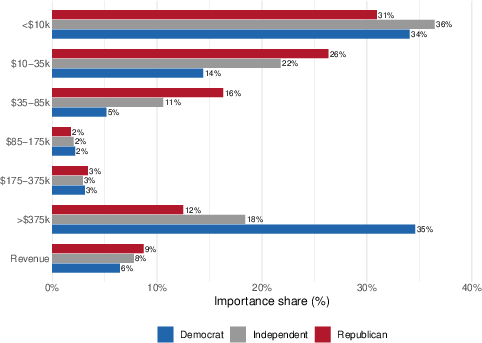
Nearly all Americans exhibit progressive revealed preferences, including 99.7% of Republicans, even though inter-party gaps persist in the weight assigned to top income brackets.
Figure 7: Variance decomposition by party uncovers that Democrats allocate much greater weight to tax rates on the rich, while Republicans focus on lower and middle brackets.
The distribution of individual attribute weights and slope of revealed tax progressivity correlates positively (r = 0.43) with self-reported ideal rates collected independently, providing external validation.
Theoretical and Practical Implications
Structural Recoverability of Heterogeneity
By embedding the flexible neural architecture within the discrete choice model, the paper achieves recoverability of functionals that are structurally non-identifiable via reduced-form AMCE, such as MRS, polarization, and counterfactual majority preferences. The DNN-based estimator formalizes "lean structure"—preserving identification of structural parameters while minimizing parametric risk.
Diagnostics and Misspecification
Discrepancies between structural DML-based average marginal effects and nonparametric AMCEs serve as functional misspecification diagnostics; close correspondence validates the structural model, while divergence warns of latent violations (e.g., attribute interactions, non-compensatory decision rules).
Requirements for Design and Power
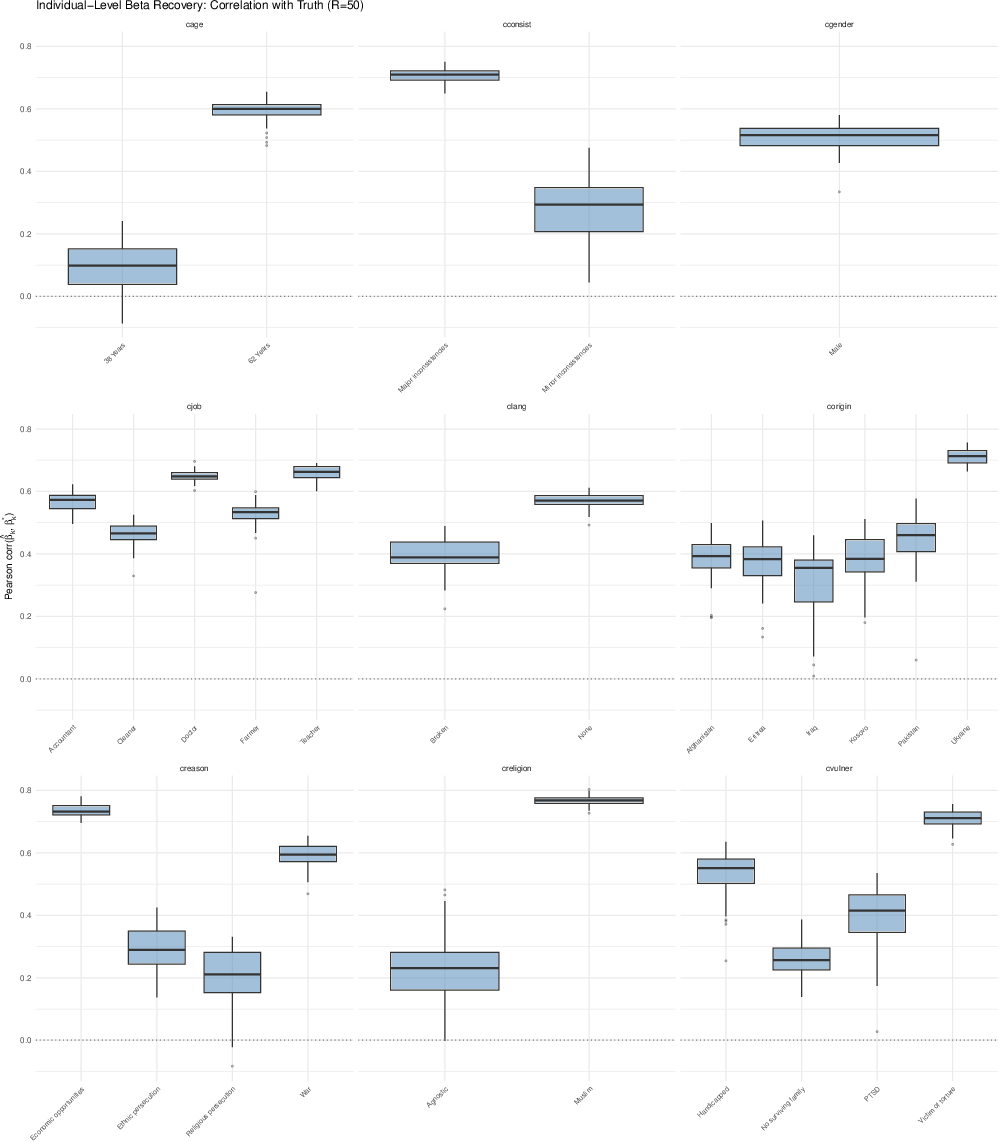
Monte Carlo simulations in the supplement reveal that accurate individual-level inference depends primarily on total observation count (N×T), with $8,000$–$10,000$ tasks required for reliable respondent-specific parameter recovery. The method outperforms random-coefficient logit and Bayesian HLM in recovering heterogeneity robustly under high-dimensional covariates, with precise inference for averaged effects even in moderate sample regimes.
Figure 8: Distribution of individual-level preference correlation across Monte Carlo replications documents the gain in recovery versus benchmark models.
Future Directions
Extensions include the incorporation of latent respondent-level random coefficients to address unobserved heterogeneity, explicit modeling of scale heterogeneity, and architectural augmentation for systematic attribute interactions. Development of formal inference methods for nonlinear and distributional functionals of structural parameters (e.g., the distribution of MRS or of importance shares) remains an open theoretical area.
Conclusion
This work establishes a rigorous, valid, and practical framework for recovering the full structure of preference heterogeneity from conjoint experiments. By combining experimental randomization, nonparametric respondent-feature mappings, and double/debiased machine learning, the method bridges the gap between flexible design-based inference and the need for structural quantities inherent to core questions in political economy, marketing, and policy analysis. The empirical demonstrations highlight both the dangers of relying solely on population averages and the analytic power gained by recovering the distributional and cross-attribute features of individual preferences. The sconjoint R package operationalizes this pipeline for immediate applied use.
“Emergent Mind helps me see which AI papers have caught fire online.”
Philip
Creator, AI Explained on YouTube
Sign up for free to explore the frontiers of research
Discover trending papers, chat with arXiv, and track the latest research shaping the future of science and technology.Discover trending papers, chat with arXiv, and more.