Robust Information Design with Heterogeneous Beliefs in Bayesian Congestion Games
Published 12 Apr 2026 in cs.GT | (2604.10831v1)
Abstract: In many engineered systems, agents make decisions under incomplete information, creating opportunities for a planner to influence decentralized behavior through signaling. We study how such signaling can be designed in parallel-network, affine latency congestion games when users may not interpret recommendations using the same beliefs assumed by the planner. To do so, we consider Bayesian congestion games with private recommendations and formulate a robust information design problem in which obedience must hold uniformly over a neighborhood of a nominal prior. This addresses the previously uncharacterized issue of whether obedience itself remains reliable under belief heterogeneity, rather than only under the single prior used at the design stage. We characterize policy-level robustness radii, identify regimes in which the robust obedience region remains nonempty, and analyze the resulting robustness--performance tradeoff through a robust value function whose optimal cost is monotone in the robustness requirement and whose local sensitivity is governed by the active obedience constraints.
The paper introduces a robust information design framework ensuring incentive compatibility across a neighborhood of perturbed agent beliefs.
It establishes structural guarantees and computational procedures using LPs and support pattern analysis to certify robust obedience under varying belief profiles.
The study demonstrates a quantifiable tradeoff between system optimality and robustness, with simulations confirming increased costs as belief heterogeneity grows.
Robust Information Design under Heterogeneous Beliefs in Bayesian Congestion Games
Overview
The paper "Robust Information Design with Heterogeneous Beliefs in Bayesian Congestion Games" (2604.10831) investigates information design for nonatomic Bayesian congestion games with an explicit focus on incentive compatibility (obedience) under user belief heterogeneity. The central contribution is the development and analysis of a robust information design framework in which incentive compatibility is required to hold uniformly over a neighborhood of the nominal prior, characterizing conditions under which obedience is resilient to variation in agents’ beliefs and quantifying the cost-performance tradeoff associated with robust design. The results provide both structural guarantees and computational procedures for evaluating feasibility and performance sensitivity under robustness requirements.
Problem Formulation
The paper considers parallel-edge Bayesian congestion games with a nonatomic mass of users. Edge latency functions are affine and state-dependent, with the realized state of nature observed only by a central designer (planner). The planner uses private recommendation policies to strategically influence routing decisions. Crucially, while policies are designed under a nominal prior μ0 over states, agents may interpret recommendations via perturbed or heterogeneous beliefs μ in a norm-bounded neighborhood Uε(μ0).
Signal structures are cast as direct recommendation mechanisms (π), and obedience (i.e., incentive compatibility of recommendations) is formalized via linear expectation inequalities (obedience constraints) that must be satisfied over all plausible beliefs in the robustness set. The robust information design problem minimizes the planner's expected social cost subject to robust obedience. This generalizes classical signaling games by subordinating the standard Bayesian incentive constraints to hold over a perturbed belief set.
Robust Obedience Region and Feasibility
The robust obedience region OCε(μ0) is the intersection of all obedience-implementable policies over Uε(μ0). Central technical results precisely demarcate when this region is nonempty (i.e., robust implementability is feasible):
Nash Equilibrium Inclusions: If the recommendation set includes the state-wise Nash equilibrium profiles, obedience can always be robustly enforced for any ε, i.e., the robust region is never empty (Proposition: Nash recommendations imply robust nonemptiness). This provides a certificate for unbounded robustness and tightly links feasible obedience to the structure of equilibrium play.
Support Patterns and Certified Robustness Radii: In constrained settings (where recommendation sets are restricted), new constructive lower bounds are proposed for the maximum tolerated belief perturbation. For fixed signaling policies, a certified robustness radius ρ(π) is derived, expressed explicitly via support-dependent cost differences and convex geometry of the policy's induced deviations. Maximizing this certificate over all possible support patterns reduces the global robustness bound to finitely many LPs indexed by support (Theorem: pattern decomposition).
Loss of Robustness: Via a carefully constructed example, the work shows that, absent inclusion of all Nash profiles, robust implementability can fail for any nonzero ε; thus, robustness to belief heterogeneity is generically nontrivial.
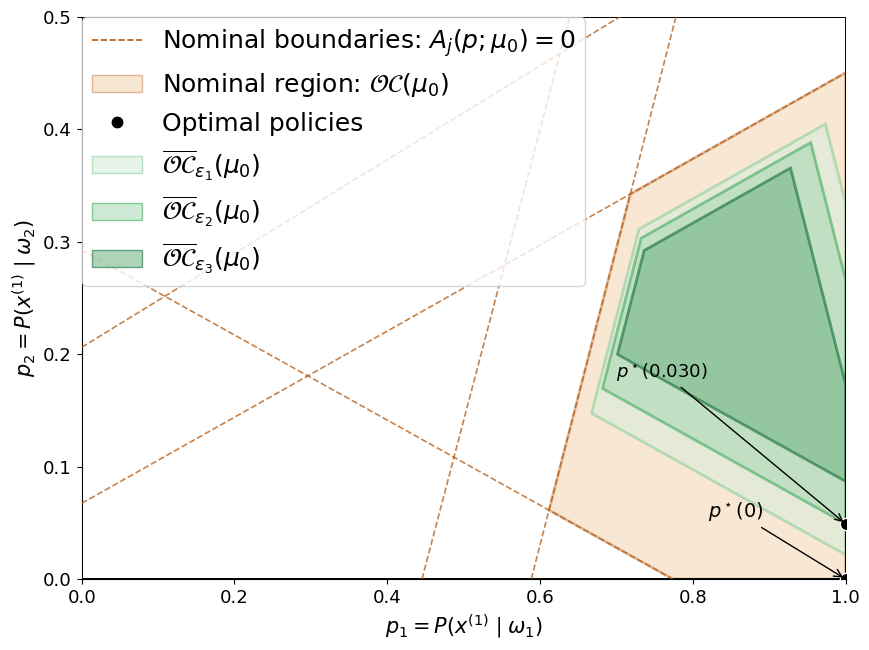
Figure 1: Obedience boundaries (orange dashed), the nominal feasible region OC(μ0), and shrinking feasible regions (green) as robustness radius μ0 increases; the optimizer transitions as robustness increases.
Sensitivity Analysis and Value Function Behavior
The robust value function μ1, which captures the optimal social cost under robust obedience, is shown to be monotone nondecreasing in the robustness radius μ2: stricter robustness necessitates weaker obedience guarantees and hence higher (or equal) minimum cost. The differentiable structure of μ3 is elucidated by connecting its local slope to the active constraint set in the robust obedience formulation. Specifically, at regular (LICQ) points, the local value sensitivity can be tightly upper-bounded in terms of the Lagrange multipliers associated with active constraints, their cost scales, and the conditioning of the tangent constraint gradients (Theorem: slope bound).
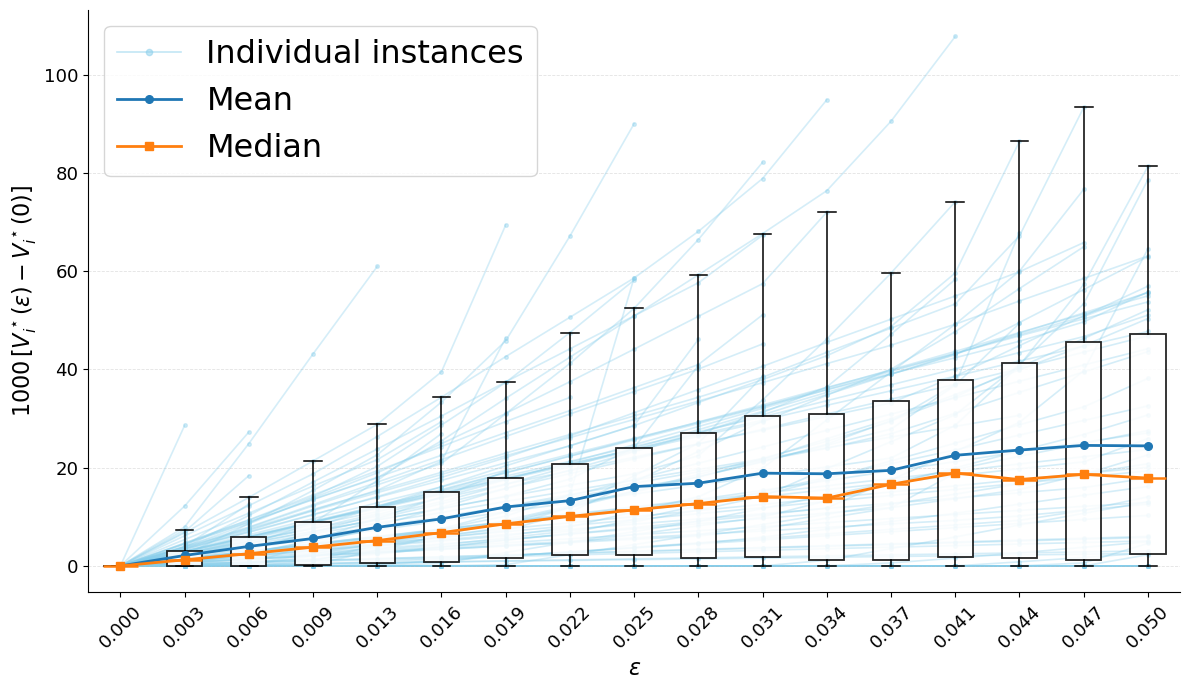
Numerical simulations reinforce these sensitivity effects. As μ4 grows, feasible regions shrink and—beyond a critical threshold—policies previously optimal for the nominal prior become infeasible. The optimal population cost under robust obedience exhibits both a rising central tendency and increasing variance across instances as robustness requirements tighten.
Figure 2: Excess robust cost μ5 (scaled by μ6) across feasible instances; as μ7 increases, cost and dispersion grow, and infeasibility emerges for many instances.
Practical and Theoretical Implications
The analysis advances the theoretical understanding of robust mechanism and information design in large-scale routing applications, notably by pinpointing the geometric and combinatorial factors that determine the fragility or resilience of obedience to user heterogeneity. Key implications include:
Policy Certification: Practical mechanisms can be equipped with certified robustness guarantees, bounding the heterogeneous beliefs they can tolerate while still ensuring implementability.
Cost-Robustness Tradeoff: There is an explicit, quantifiable tradeoff between achievable system-optimality and the breadth of belief heterogeneity for which obedience remains guaranteed.
Algorithmic Reduction: The reduction to support pattern LPs provides an efficient computational path for certifying and optimizing robust signaling policies in finite Bayesian congestion models.
Extensibility: While focused on parallel networks with affine costs, the methods are amenable to extension to broader network topologies, more intricate latency structures, and different uncertainty models.
Prospects for Future Research
Immediate future directions include extension to general network (non-parallel) topologies, developing more precise upper bounds or exact characterizations of max-robustness radii, and incorporating learning-based or online elements to the designer’s model to address situations where the population belief distribution evolves or is only partially observed. Further investigation into the interplay between robustness and other behavioral models (e.g., bounded rationality or limited attention) could yield additional insights relevant for critical infrastructure control and platform information dissemination.
Conclusion
This paper formulates and solves the robust information design problem for Bayesian congestion games under explicit belief heterogeneity, providing quantitative and structural results on the conditions for robust obedience, the value-performance tradeoff under robustness, and computational methods for policy synthesis. The work elucidates how the geometry of obedience constraints, the nature of the recommendation set, and the scaling of cost differences interact to determine the feasibility and efficiency of robust signaling policies in decentralized traffic and network systems.