- The paper introduces a tripartite hyperevent model combining authors, references, and keywords to capture the multifaceted dynamics of scientific collaboration.
- It employs Relational Hyperevent Models (RHEM) and Geometrically Weighted Subset Repetition to quantify both closure and repetition effects across different node types.
- Empirical evaluation on a dataset of Italian academic statisticians validates the model's fit, revealing significant interdependencies and evolving thematic trends.
Modeling Tripartite Hyperevents in Scientific Collaboration Networks
Conceptual Foundation: Tripartite Hyperevents and Limitations of Conventional Network Analyses
The paper addresses core methodological gaps in the study of collective scientific production by proposing a tripartite hypergraph formalism for modeling the intricate interplay among authors, references, and keywords. Traditional one-mode and bipartite network representations suffer from significant information loss and inability to simultaneously capture the co-evolving relational mechanisms intrinsic to scientific collaboration, citation, and topic development. Crucially, analyses based on projections or externally-imposed partitions preclude rigorous testing of competing hypotheses regarding the drivers of collective production dynamics.
The tripartite hyperevent structure extends duality frameworks (e.g., Breiger's duality of persons and groups) and folksonomy paradigms into the field of scientific collaboration, emphasizing that authors, references, and keywords co-participate in high-order events (publications) in ways that induce nontrivial interdependencies both within and across sets. This conceptualization accommodates the multiplex, polyadic, and temporally dynamic nature of contemporary scholarly datasets.
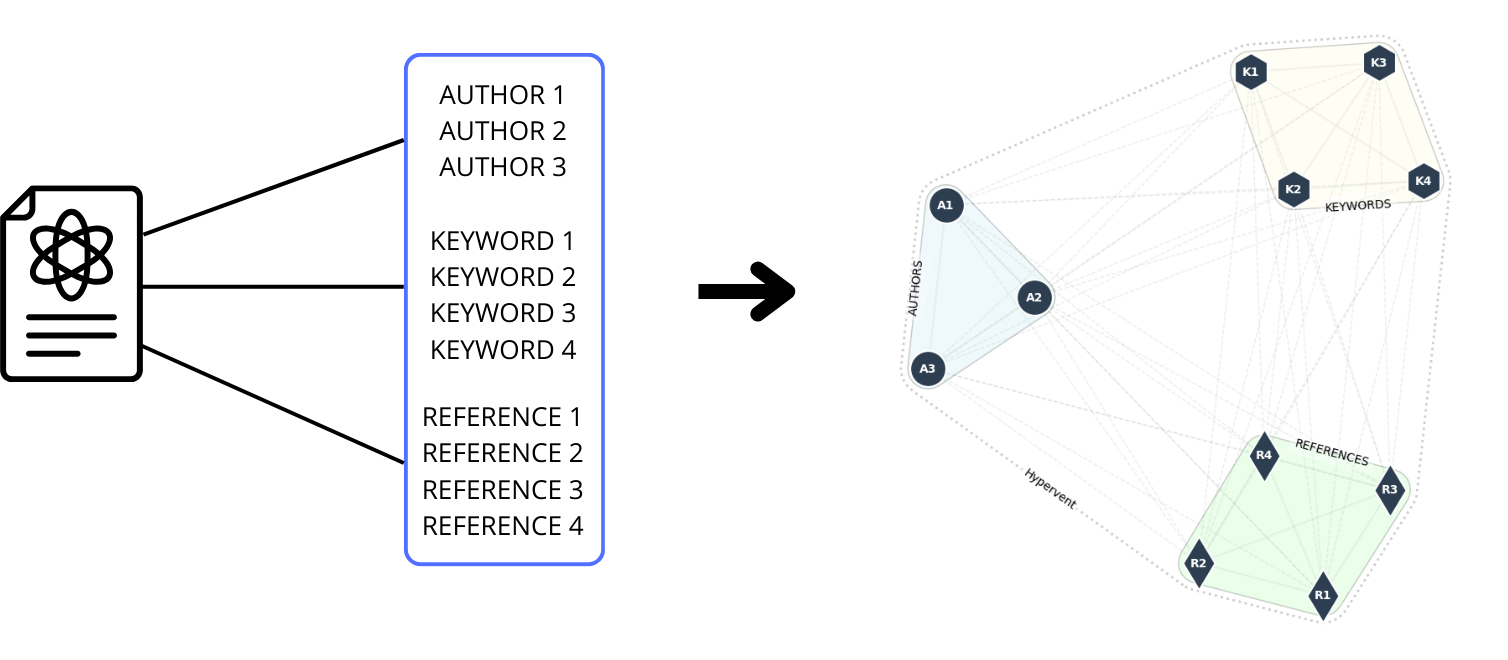
Figure 1: Illustration of a tripartite hyperevent capturing simultaneous interactions among authors, keywords, and references, including intra- and inter-set relations.
The paper formally models publication events as tripartite hyperevents where each hyperedge comprises a set of authors, references, and keywords, temporally indexed. The RHEM framework, rooted in point-process theory, operationalizes the conditional probability (hazard rate) of a hyperevent based on the history of past events and high-order statistics calculated over dynamically evolving tripartite hypergraphs.
Key network statistics implemented include:
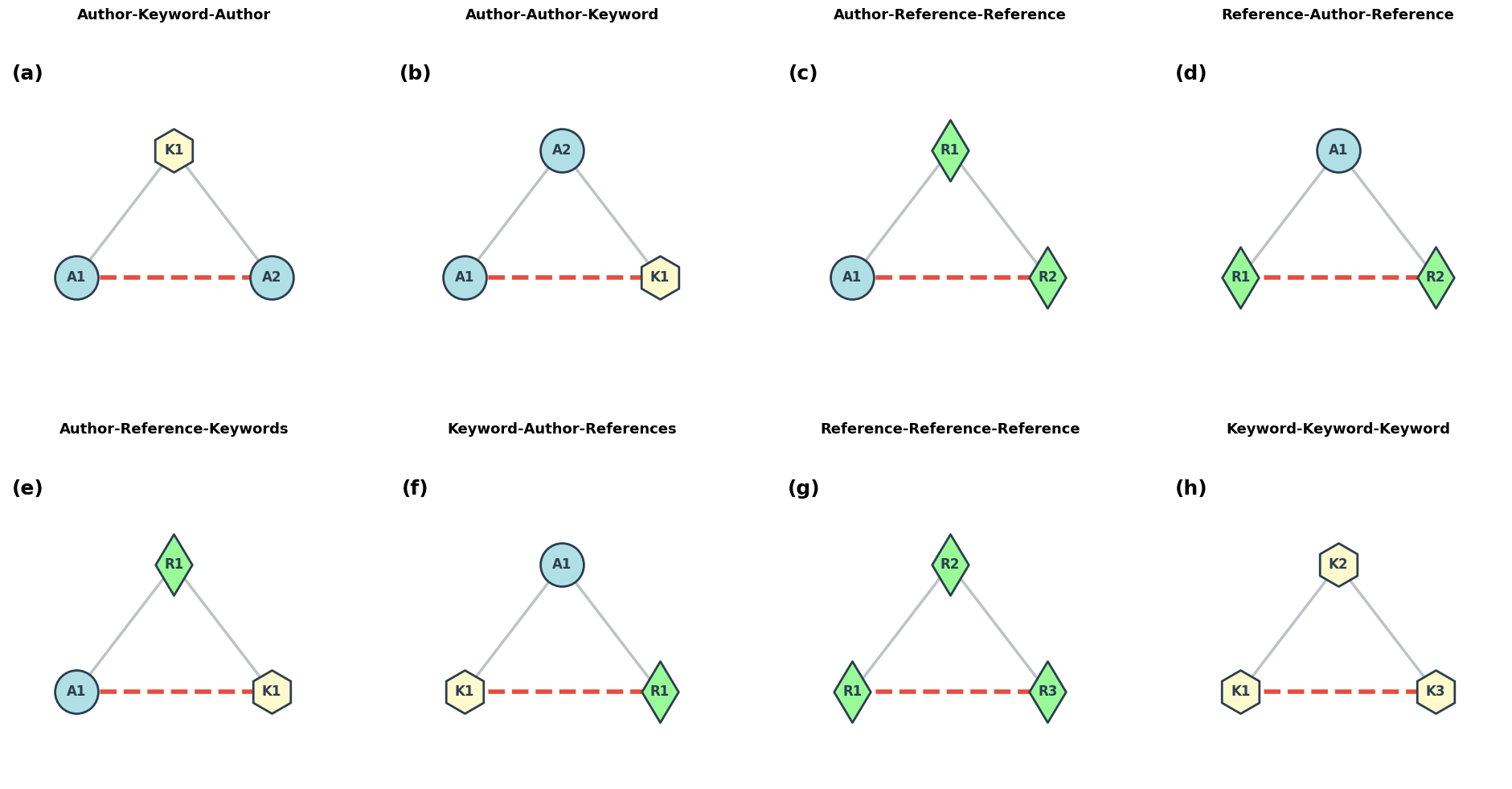
- Closure effects: Quantifying the likelihood that pairs of entities, indirectly related via two-paths involving any combination of the three sets, will co-occur in hyperevents, reflecting both social and cognitive mechanisms such as triadic closure, semantic proximity, and collective knowledge consolidation.
- Subset repetition statistics: Counting repeated co-attendance within and between sets, enabling the study of persistence, homophily, and memory effects in authoring, referencing, and keyword usage.
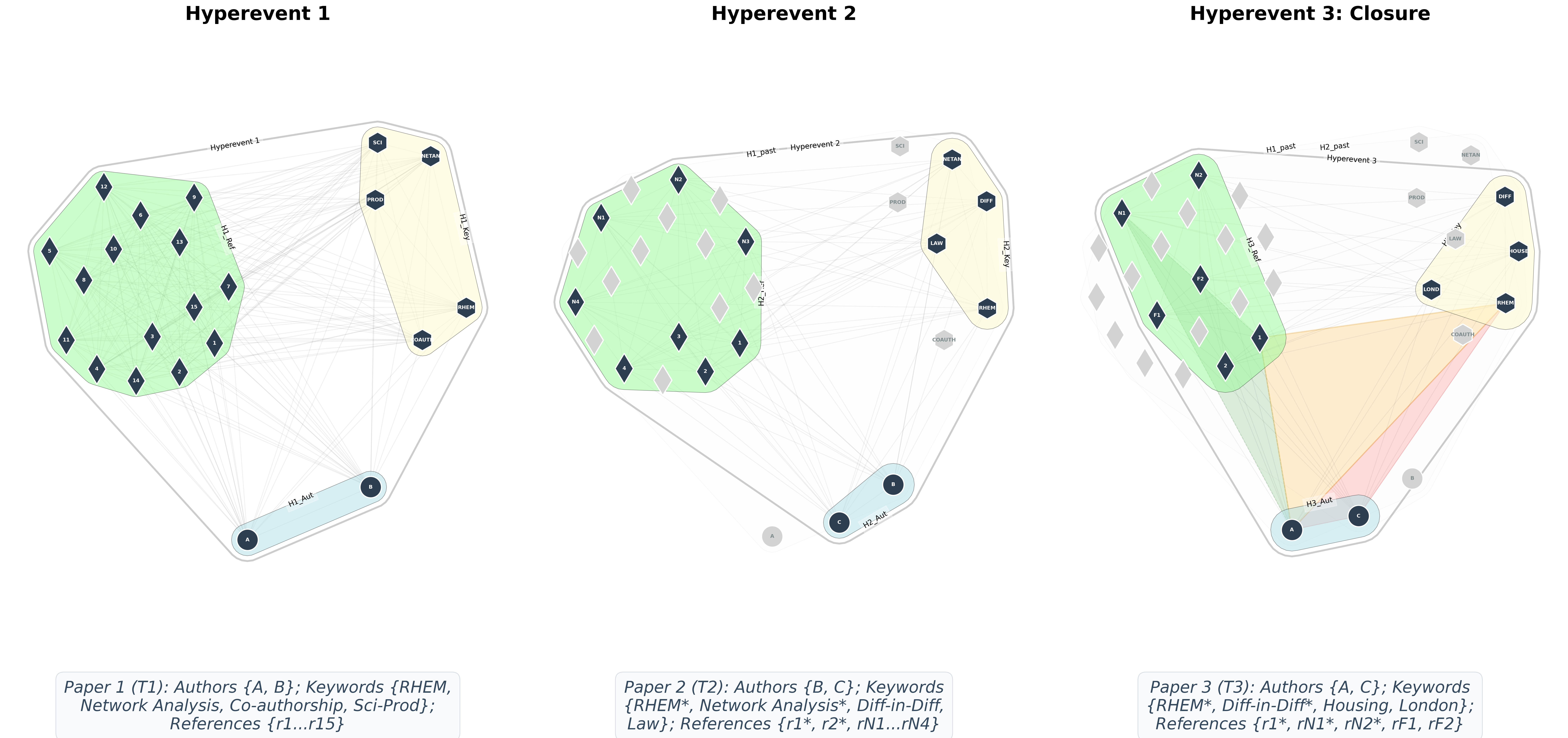
Figure 2: Temporal sequence of relational hyperevents, depicting partial overlaps and closed triads among authors, keywords, and references.
The extension of RHEM for tripartite hyperevents enables the testing of hypotheses regarding the joint evolution of team formation, knowledge inheritance, and topical focus, surpassing prior models limited to dyadic or bipartite dependencies.
Technical Innovation: Geometrically Weighted Subset Repetition (GWSR)
A central methodological contribution is the definition and integration of Geometrically Weighted Subset Repetition (GWSR) statistics. GWSR generalizes subset repetition counts using geometric weighting, controlling for hyperedge overlap and mitigating issues of combinatorial explosion and degeneracy commonly encountered in exponential family models. Parameters κ and λ regulate the sensitivity to repeated co-attendance in source and target sets, offering scalable and numerically stable statistics for modeling overlapping subgroups and co-citation patterns.
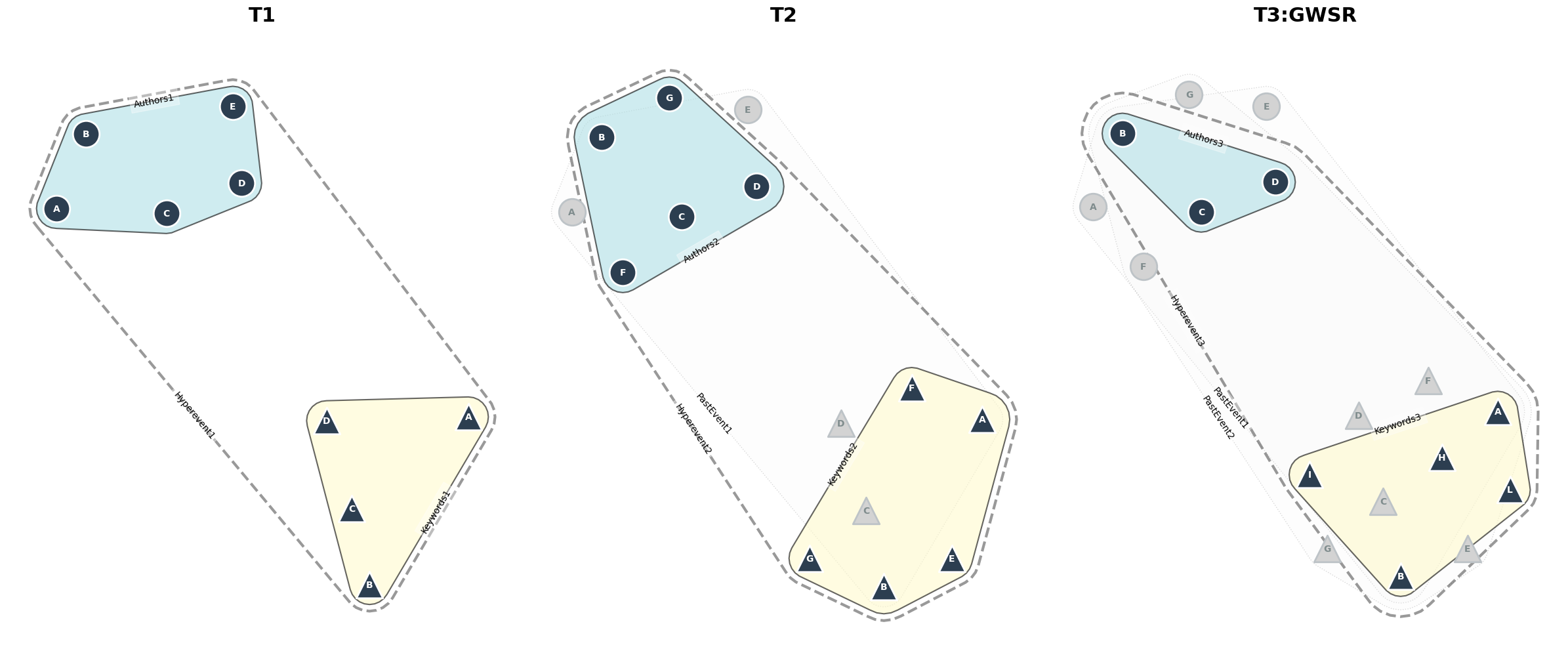
Figure 3: Visualization of overlapping author-keyword subsets across sequential hyperevents, illustrating GWSR weighting.
This approach enables modeling both within-type persistence (e.g., repeated co-authorship) and cross-type persistence (e.g., authors repeatedly co-citing the same set of references or using stable keyword clusters), adapts to variable hyperedge sizes, and isolates baseline effects for individual nodes.
Empirical Evaluation: Italian Academic Statisticians Case Study
The model is empirically instantiated on a comprehensive dataset of publications (14,332 papers, 2014–2024) authored by Italian academic statisticians. The tripartite hypergraph includes complete mappings of authors, references, and keywords, with temporal granularity sufficient for event history modeling. Analyses track structural and topical developments, such as shifts in author collaboration sizes and the emergence of key terms (“COVID-19”, “Machine learning”), and document increasing reference density over time.
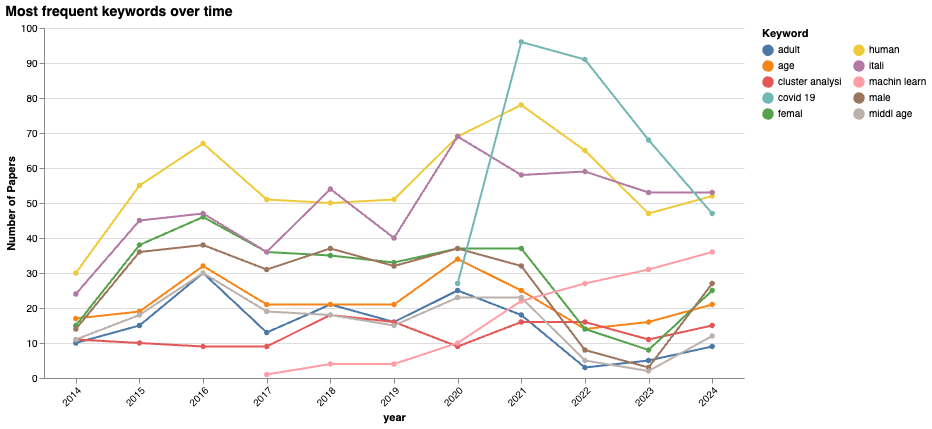
Figure 4: Frequency dynamics of dominant keywords (“human”, “COVID-19”, etc.) across years.
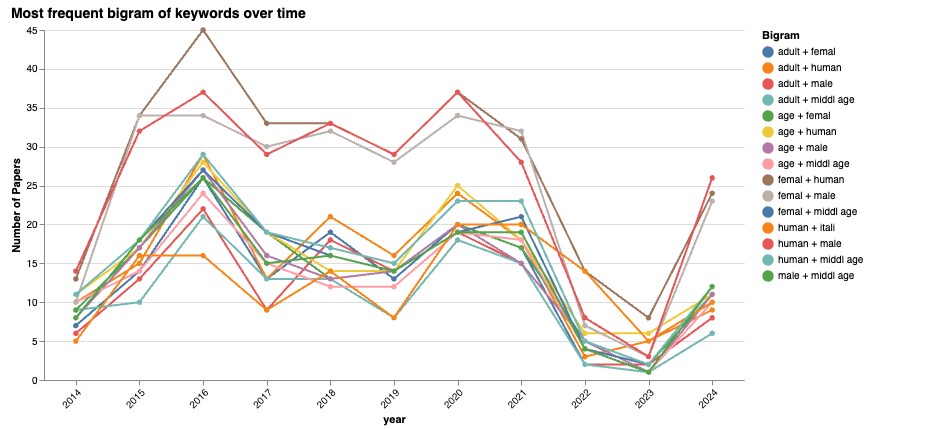
Figure 5: Temporal evolution of prevalent keyword bigrams, with “Machine learning” rising in prominence.
Results: Statistical Evidence and Model Fit
Parameter estimates from full and partial models reveal:
- Nearly all of the 24 modeled effects are highly significant in the full tripartite model (p < 0.001).
- Omission of any single node type (authors, references, keywords) leads to substantial deterioration in model fit (AIC increases by up to 9500), demonstrating that all three are indispensable for capturing the collaborative dynamics and topical evolution of scientific production.
- Most influential effects contributing to model fit are reference-related subset repetition and closure (e.g., preferential attachment, co-citation closure), with author collaboration closure and keyword closure also contributing but to a lesser extent.
- Several effects change sign or significance upon omitting a node type, indicating complex interdependencies that cannot be deduced from lower-mode models.
The structural evolution is characterized by:
Theoretical and Practical Implications
This work theoretically advances network modeling in science studies by operationalizing high-order joint dynamics, moving beyond dyadic projection limitations. The statistical framework provides rigorous tools for dissecting the micro-mechanisms responsible for global structural emergence in collaboration, citation, and topic networks. Practically, the methodology scales to large datasets and facilitates nuanced hypothesis testing about the drivers of collective action, knowledge inheritance, and thematic shifts in science.
Going forward, similar tripartite (or even higher-order multipartite) RHEM formulations could be leveraged for analyzing patent networks, grant collaborative consortia, or cross-disciplinary meta-networks, where overlapping and co-evolving entity sets define emergent phenomena. Combining RHEM statistics with motif analyses or incorporating node-level metadata could further enhance interpretability and predictive accuracy.
Conclusion
The tripartite relational hyperevent model introduced in this paper achieves simultaneous modeling of author, reference, and keyword dynamics, successfully quantifying both within-type and cross-type closure and repetition effects. Empirical evidence decisively shows that exclusive reliance on dyadic or bipartite structures substantially misrepresents the complexity of scientific collaboration. The GWSR innovation ensures statistical stability and scalability. The framework sets new standards for the rigorous analysis of polyadic event networks, and its adoption will inform future work in computational social science, scientometrics, and network-based AI modeling.