- The paper introduces a regime-adaptive ISAC framework that reuses HLCS Ka-band relay transmissions as radar pulses for debris detection around the Lunar Gateway.
- It employs dual-mode processing with standard 2D-FFT and Keystone transform to overcome OFDM ICI challenges induced by high orbital velocities in NRHO.
- The methodology retrofits debris detection onto existing communication hardware, achieving a 36 dB SNR advantage and doubling throughput without dedicated radar systems.
CisLunarSense: Opportunistic ISAC for Debris Detection at the Lunar Gateway
Introduction and Motivation
CisLunarSense introduces a regime-adaptive integrated sensing and communication (ISAC) framework for the detection of space debris around the Lunar Gateway. The main innovation is the reuse of the Gateway's High-Rate Ka-band Communication System (HLCS) relay transmissions as opportunistic monostatic radar pulses, obviating the need for dedicated radar hardware in cislunar space—an operational domain currently devoid of any in-situ space situational awareness (SSA) infrastructure. The system is motivated by the unique dynamical and RF environment of the Gateway's near-rectilinear halo orbit (NRHO), where debris created by Gateway operations or injected by external actors can remain in proximity for tens of days, traversing velocities spanning two orders of magnitude.
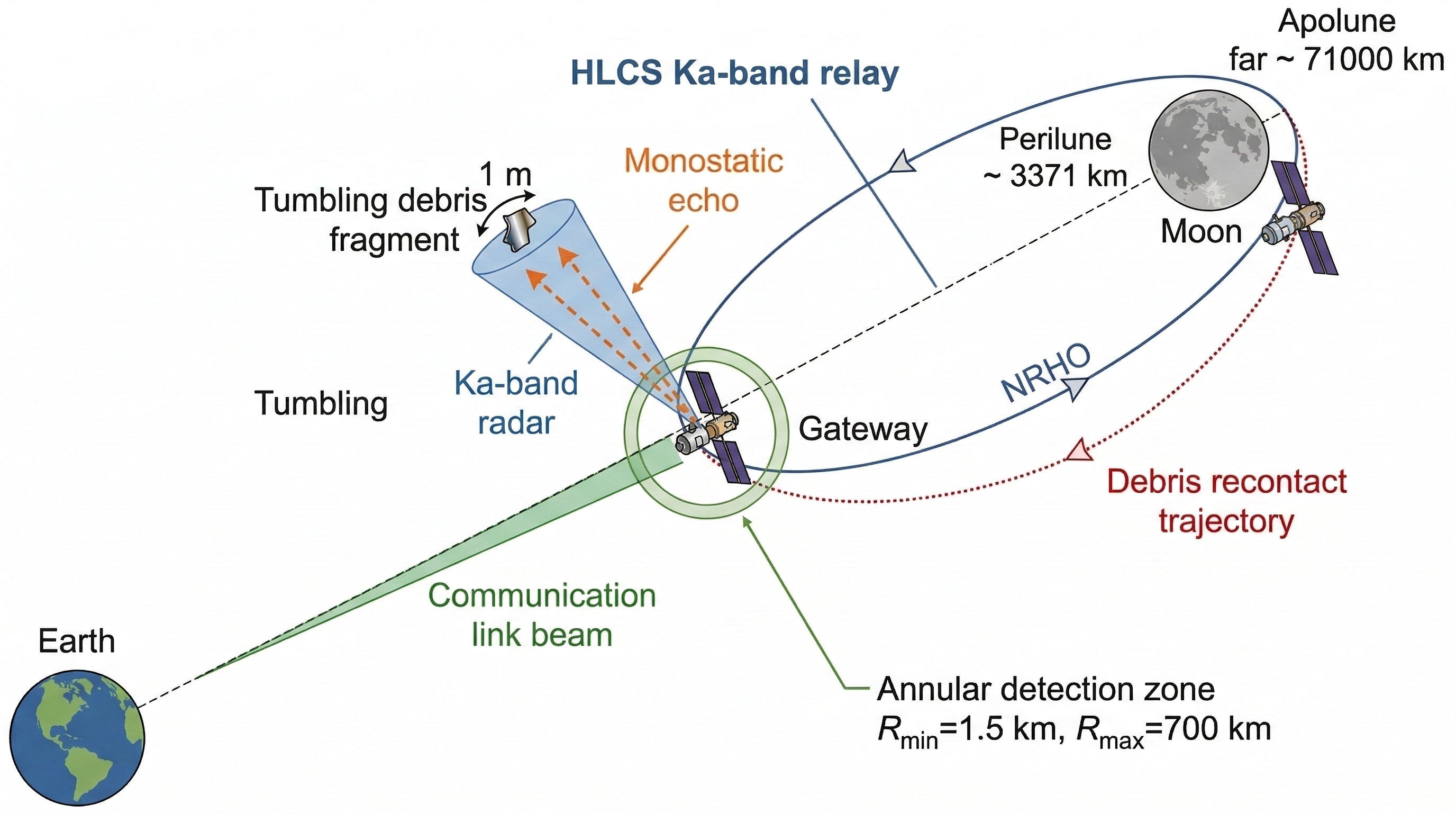
Figure 1: CisLunarSense system overview. HLCS Ka-band relay beam (green) for Earth uplink; echoes (orange) from debris within Rmin=1.5~km to Rmax=700~km (1~m target) are processed for monostatic detection. Red dotted: CR3BP-predicted recontact trajectory.
CisLunarSense is contextualized within the broader ISAC literature by focusing on the cislunar application layer, with Ka-band monostatic sensing and communication carried via the HLCS relay, exploiting the free-space channel's low noise floor and absence of terrestrial/LEO clutter. This differs from previous ISAC work, which predominantly targets terrestrial, LEO, and GEO orbits and neglects the peculiarities of NRHO dynamics and debris kinematics.
System Model and Sensing Architecture
The system model leverages the HLCS Ka-band relay, proposed for upgrade to a multicarrier (OFDM) transceiver, to achieve simultaneous high-throughput communication and debris sensing. Uplink OFDM waveforms at 27 GHz and 100 MHz bandwidth are repurposed for monostatic radar, where the co-located receiver exploits knowledge of transmitted symbols for coherent matched-filtering and velocity estimation across a configurable coherent processing interval (CPI).
Beam geometry, power levels, Doppler shift, and delay are modeled in accordance with NRHO kinematics and a CR3BP trajectory generator, with analytic expressions derived for signal, noise, and path loss (including R−4 monostatic radar scaling).
A significant innovation is the identification of velocity-coupled inter-carrier interference (ICI) arising from NRHO's e=0.91 eccentricity, which causes the Gateway's instantaneous velocity to sweep over more than 100× per orbit, a regime where OFDM ICI becomes a severe, orbit-phase-dependent limitation for coherent integration and detection.
Fundamental Limits: SNR, Detection, and Cramér–Rao Bounds
A comprehensive analysis of sensing SNR, estimation Fisher information, and Cramér–Rao bounds (CRB) is conducted as functions of orbit phase and target kinematics. The analytic SNR model integrates transmitter EIRP, antenna gain, target RCS, bandwidth, noise temperature, and an ICI-aware processing efficiency factor G(vrel) that sharply penalizes high relative velocities at perilune and during external-object encounters.
A major quantitative claim is that cislunar opportunistic sensing at the Gateway accrues a strong 36 dB environmental SNR advantage over ground-based Ka-band radar, attributable to zero atmospheric/ionospheric attenuation, low system temperature (Tsys≈200 K), and the absence of any background clutter.
The orbit-phase distribution of vrel, validated against propagated CR3BP trajectories for routine (Δv∼1−5 m/s) Gateway debris and parametric external threats, quantifies the SNR-accessible detection regime (Figures 3, 4). The CRB analysis establishes that for operational debris (vrel<50 m/s), detection within 700 km is possible with more than 30 minutes' warning at all orbital phases. For high-velocity external threats, detection range degrades only by 35% near perilune due to increased ICI (down to ∼400 km for a 1 m object).
Regime-Adaptive Processing: Dual-Mode Architecture and Resource Scheduling
The detection pipeline is realized in a dual-mode architecture that switches between standard 2D-FFT (Mode A) for low-velocity (ICI-absent) encounters and a Keystone transform plus adaptive subcarrier decimation (Mode B) for high-velocity, ICI-limited targets. The mode-switch threshold is analytically derived (Rmax=7002 m/s for HLCS parameters), and the net result is near-optimal SNR recovery for all relevant debris regimes Figure 2.
Resource scheduling is treated through an orbit-phase-adaptive allocation of the sensing duty cycle Rmax=7003. The optimization maximizes minimum detection range subject to a relay throughput constraint, yielding a closed-form phase-dependent solution that exploits the Gateway's residence time near apolune and the anti-correlation of relay demand and debris encounter density.
Notably, the adaptive regime reduces average sensing duty cycle from 60% to 19%, more than doubling the achievable communication throughput from 44 Mbps to 90 Mbps, with no loss of detection coverage.
Outage Analysis and Detection Reliability
Detection reliability under Swerling I (exponential) fluctuation of target RCS is analyzed for both snapshot and session-optimized regimes. A closed-form for the Rmax=7004-CPI noncoherent integration sensing outage probability is derived and validated by Monte Carlo. Crucially, at operational Rmax=7005 (corresponding to realistic 60 s integration windows and typical beam dwell), the Rmax=7006 outage regime extends to 91% of the deterministic detection range, and the penalty from RCS fluctuation becomes subdominant.
Practical and Theoretical Implications
CisLunarSense demonstrates that meaningful cislunar SSA can be retrofitted onto existing and planned Ka-band relay architectures simply by adopting multicarrier-capable hardware and regime-adaptive software. No dedicated radar mass/power/spectrum is required, and the analytic bounds confirm high coverage with strong operational margins for both Gateway-born debris and exogenous threats.
The work also exposes the sensitivity of opportunistic OFDM-ISAC to orbit-specific dynamics: the tight coupling of the available CPI duration, processing SNR, and phase-velocity profile in NRHO is unique compared to nearly constant-velocity LEO/GEO environments. This recommends orbit-aware scheduling and processing for any ISAC application in highly eccentric cislunar orbits.
Potential extensions include the integration of multistatic sensors, more detailed debris population models including solar radiation pressure for high area-to-mass ratio objects, advanced waveforms (e.g., OTFS, FMCW) for improved Doppler tolerance, and fusion with cross-domain (optical/IR) measurements.
Conclusion
CisLunarSense provides a theoretically grounded and practically attainable ISAC framework for cislunar debris detection around the Lunar Gateway, delivering strong SNR, reliable detection, and efficient resource utilization through velocity-adaptive, phase-aware design. Its analytic performance claims are backed by detailed Monte Carlo validation and closed-form bounds, and its architectural requirements align with forward-compatible evolutions of the HLCS. The framework sets a foundation for scalable opportunistic SSA in the rapidly evolving multi-actor cislunar operational regime (2604.10807).