- The paper shows that interfacing a ferromagnetic monolayer with a topological insulator induces an exchange gap on the top surface, resulting in a half-quantized Hall plateau (±e²/2h).
- The paper employs density functional theory and tight-binding Hamiltonians to compute Berry curvature and layer-resolved Chern numbers, confirming the topological origin of the half-quantized response.
- The paper identifies unique sidewall transport in TI/FM nanoribbons that supports the parity anomaly and offers a platform for probing axionic topological magnetoelectric effects.
Half-Quantized Anomalous Hall Conductance in Topological Insulator/Ferromagnet van der Waals Heterostructures
Introduction and Theoretical Context
This study investigates the emergence of half-quantized anomalous Hall conductance (AHC) in van der Waals (vdW) heterostructures combining topological insulators (TIs) with ferromagnetic (FM) monolayers. The work leverages first-principles calculations and tight-binding models to reveal the microscopic mechanisms by which proximity-induced magnetization at a single TI surface breaks time-reversal symmetry, resulting in a parity anomaly and the manifestation of σxy=±e2/2h Hall plateaus. This physical realization is tied fundamentally to the unique axionic electromagnetic response of 3D TIs and provides a condensed-matter platform for probing the ($2+1$)D parity anomaly.
A critical advance is the analysis of experimental accessible TI/FM systems where only the top surface is exchange-gapped while the bottom one remains gapless—precluding an integer QAHE, but permitting observation of half-quantized conductance. This structure addresses the parity anomaly conundrum arising from the Nielsen-Ninomiya theorem, since the top and bottom Dirac cones, though paired in the film geometry, can be energetically isolated by selective interfacing. The paper also contextualizes its findings with prior experimental observations where half-quantized Hall conductance has been seen in Cr-doped or FM-clad Bi2Se3 thin films.
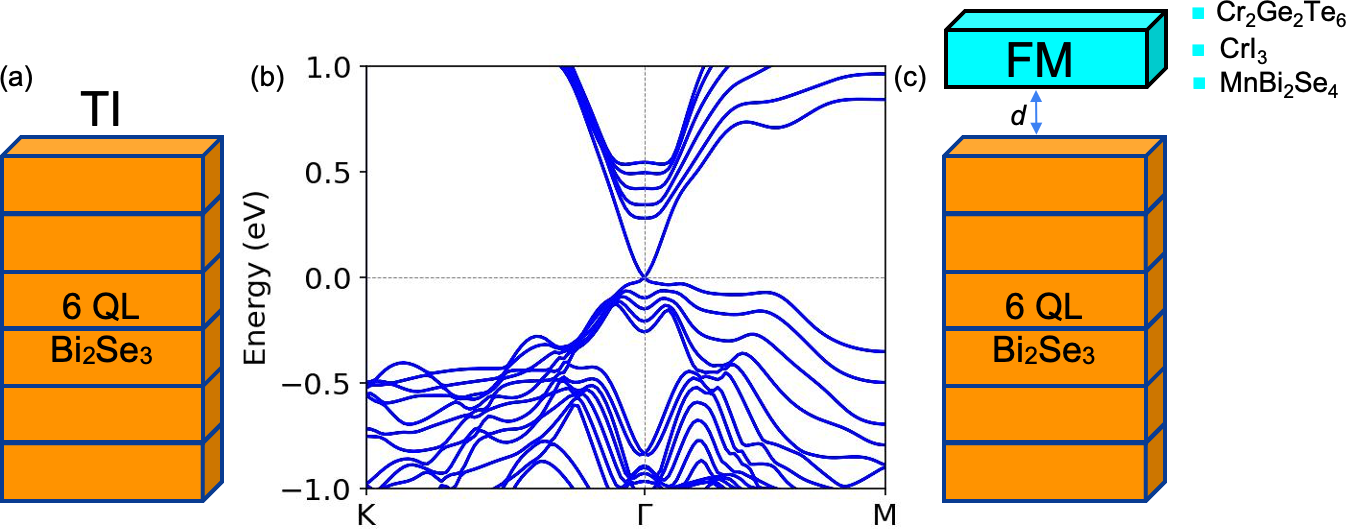
Figure 1: Schematic and band structure of a 6-QL Bi2Se3 TI thin film showing Dirac surface states, and the generic FM/TI vdW heterostructure geometry considered.
Computational Methods
Density functional theory (DFT) with van der Waals corrections was used to resolve structural, magnetic, and electronic properties of the TI/FM interface. Exchange-correlation effects were addressed via GGA and Hubbard U treatments for the FM layers. Maximally localized Wannier functions (MLWFs) provided a basis for constructing real-space tight-binding Hamiltonians, enabling calculation of Berry curvature and AHC with WannierBerri, and layer-resolved Chern numbers with pcn.
TI/FM Heterostructure Design: Candidate Systems
The study focuses on three heterostructures: Cr2Ge2Te6/Bi2Se$2+1$0, MnBi$2+1$1Se$2+1$2/Bi$2+1$3Se$2+1$4, and CrI$2+1$5/Bi$2+1$6Se$2+1$7, all featuring a 6-quintuple-layer Bi$2+1$8Se$2+1$9 thin film as the TI base. In all systems, the FM monolayer is interfaced atop the TI to locally break time-reversal symmetry and gap the Dirac state of the top surface, while preserving a gapless bottom surface.
Electronic Structure and Topological Properties
Cr20Ge21Te22/Bi23Se24 Heterostructure
First-principles calculations demonstrate a pronounced exchange-induced gap (45 meV) at the top surface, with the bottom surface exhibiting gapless, Dirac-like dispersion. The partial isolation of gapped and gapless Dirac cones manifests as a nontrivial topological regime:
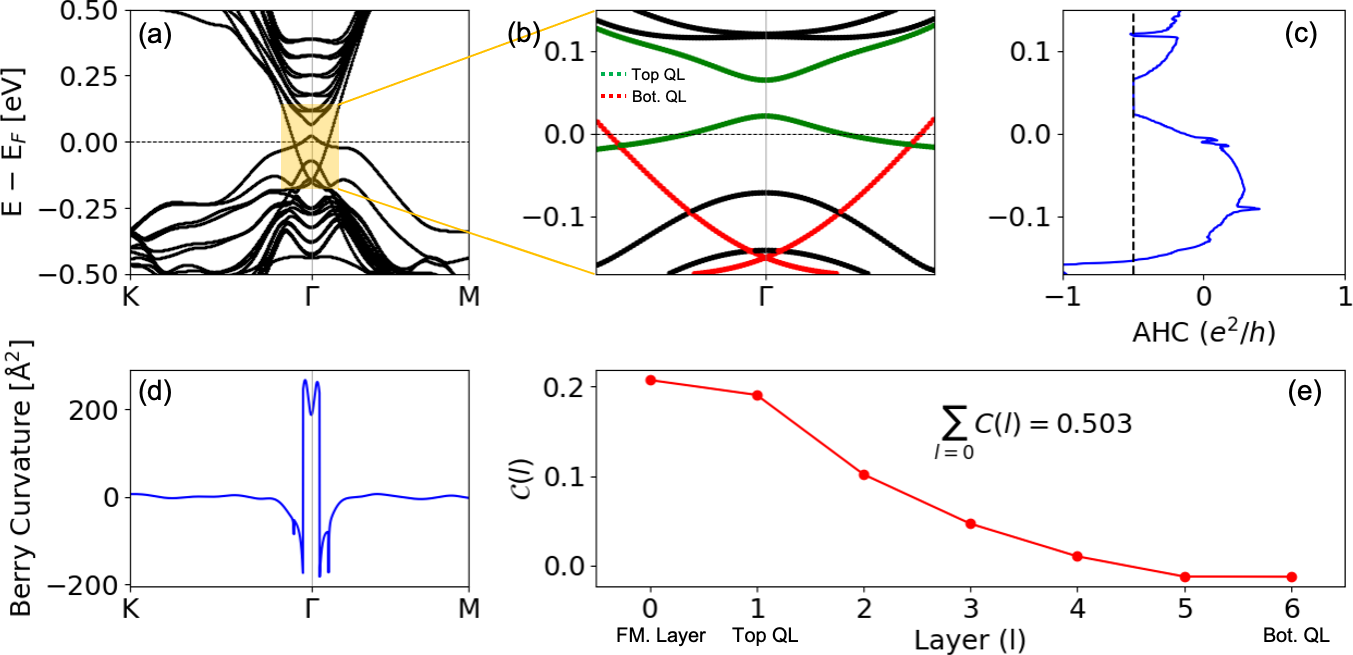
Figure 2: Evidence for half-quantized Hall conductance in CGT/Bi25Se26. The top surface is gapped while the bottom is gapless (panel b); AHC plateau at 27 (panel c); Berry curvature sharply localized near 28 (panel d); Chern contributions localized at the FM/TI interface (panel e).
The AHC exhibits an exact plateau at 29 as the Fermi energy traverses the induced gap. Berry curvature is sharply localized in k-space, confirming its topological origin is linked to the gapped surface Dirac cone. Layer-resolved Chern analysis shows the half-quantized response is localized at the FM/TI interface, decaying rapidly into the TI interior.
MnBi30Se31/Bi32Se33 and CrI34/Bi35Se36 Heterostructures
Both MnBi37Se38 and CrI39 as the FM layer similarly induce an exchange gap only at the proximate TI surface. The electronic structure remains metallic overall due to persistent gapless states at the bottom surface—the ‘parity partner’ required by TI film geometry. Nonetheless, AHC remains very close to 20, with the layer-projected Chern number similarly localized at the interface.
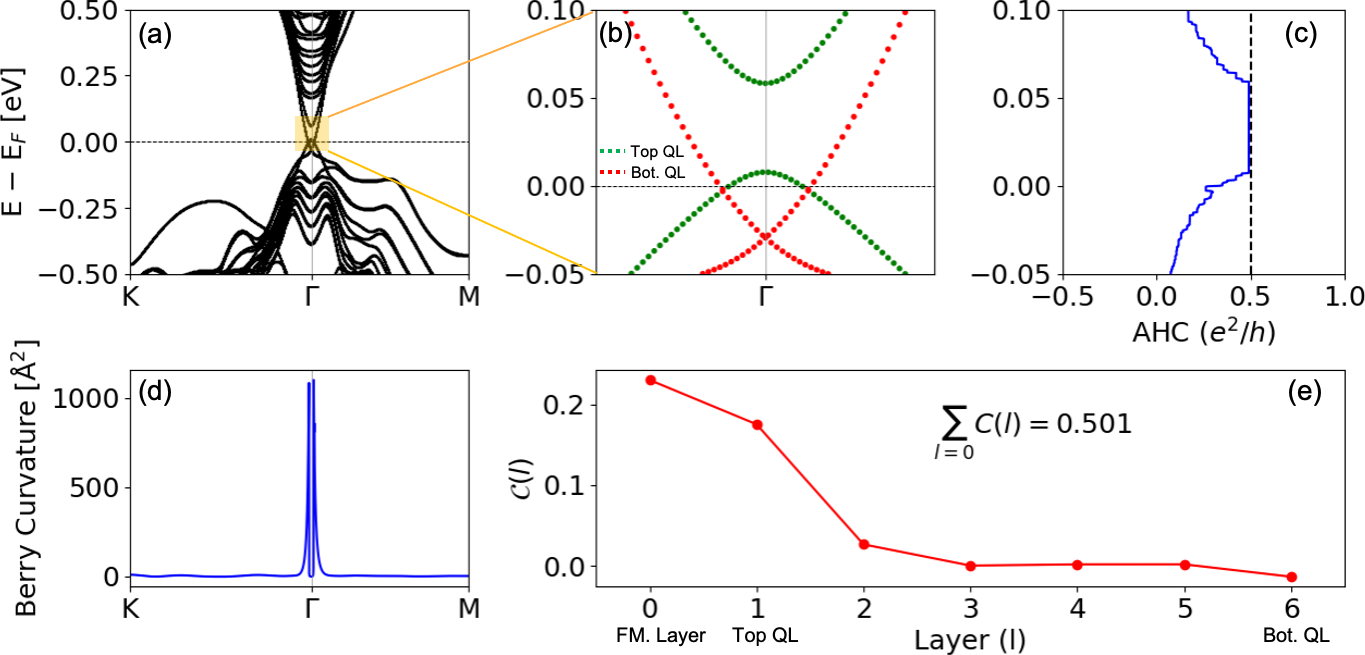
Figure 3: In the MBSe/Bi21Se22 heterostructure, the top surface is gapped while the bottom is gapless, leading to half-quantized AHC; Berry curvature is highly localized (panel d); the Chern response is interface-localized (panel e).
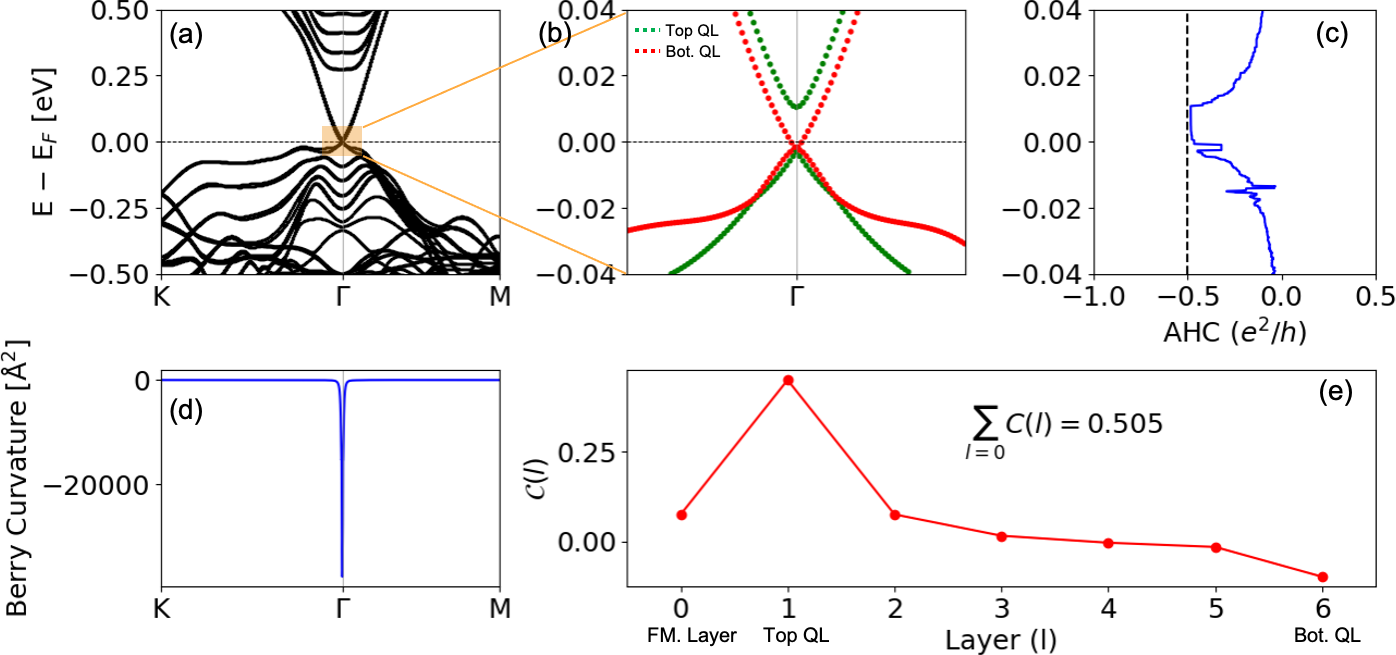
Figure 4: For CrI23/TI, the same pattern is observed: a gapped top Dirac cone, half-quantized AHC plateau, and an interface-localized Chern response with weak low-energy avoided crossings.
The sign of the Hall conductance is determined by the FM magnetization orientation, as expected in parity-breaking systems with a single chiral channel.
Sidewall States and Edge Transport in Finite Nanoribbons
A key open theoretical issue is the nature of current-carrying modes near the interface and system edges. The work addresses this by analyzing a 20 nm-wide nanoribbon of the CrI24/Bi25Se26 heterostructure. The Fermi level is set inside the top surface gap but intersects conducting states of the bottom surface Dirac cone.
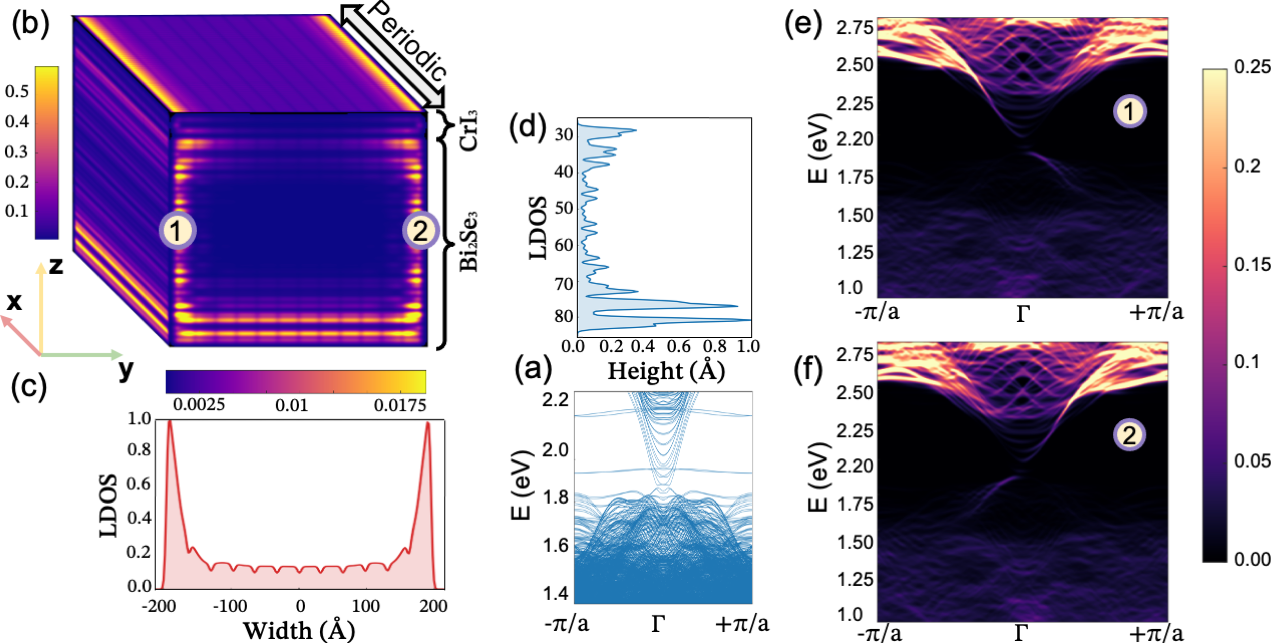
Figure 5: (a) Band structure of a quasi-1D CrI27/Bi28Se29 nanoribbon; (b-d) spatial projections of the LDOS, showing topologically trivial and nontrivial states distributed across the ribbon; (e,f) sidewall-state dispersions on the left and right edges, exhibiting spin-polarized, weakly chiral edge channels.
Chiral sidewall modes are observed near the interface, exhibiting slow spatial decay into the interior—a power-law profile rather than the exponential localization typical in integer-QAHE Chern insulators. While metallic bottom surface states persist, the sidewall channels define the quantum regime supporting the half-quantized conductance. Their spatial profile and spin-polarized chirality are directly connected to the presence of the parity anomaly.
Implications and Outlook
This rigorous computational analysis establishes that TI/FM vdW heterostructures with selective interfacial magnetization robustly yield half-quantized AHC, with the quantization topologically protected as long as only one Dirac cone is gapped. The metallic bottom surface results in nonzero longitudinal conductivity, but does not destroy Hall quantization as long as disorder, thermal excitation, or chemical potential tuning do not mix the surfaces strongly.
The results provide theoretical support for experimental reports of half-quantized Hall plateaus in TI/FM systems [Mogi2022, Ralph2024, hu2026half] and clarify the significance of sidewall states, which differ qualitatively from chiral edge states in integer-QAHE systems. The work also indicates that the observation of 1/2-QAHE is feasible well above dilution refrigerator temperatures, as the exchange gap scales with the quality of FM proximity and interface engineering, rather than the intrinsic Curie temperature of the FM layer.
Further progress will require experimental control of Fermi level positioning, improvement in interface quality, and advanced spectroscopies to directly probe the spatial structure of sidewall states. Theoretical developments might address the interplay between disorder, dephasing, and the robustness of the quantized response [Zhou_2022_PhysRevLett.129.096601]. Extensions to axion insulator phases, light-driven (Floquet) half-quantized Hall systems [Qin_2023_PhysRevB.108.075435], and engineered Chern/magnetic topological heterostructures are clear future directions.
Conclusion
This work demonstrates, via first-principles and tight-binding calculations, that van der Waals TI/FM heterostructures with a single magnetized interface robustly host the parity anomaly phase with half-quantized anomalous Hall conductance, 30. Detailed band structure, Berry curvature, and real-space Chern analysis confirm that this response is localized to the gapped surface region and persists even in the presence of finite longitudinal conductivity due to parallel gapless bottom surface channels. Nanoribbon calculations reveal the unique sidewall transport regime supporting the parity anomaly, distinct from conventional QAHE edge states. These results provide a solid theoretical foundation for the experimental pursuit of 1/2-QAHE and the investigation of axionic topological magnetoelectric phenomena in TI-based quantum materials.

