- The paper demonstrates that engineered Peierls phase modulation in two-leg ladders induces Anderson localization without requiring onsite disorder.
- It employs static (IPR, PR, NPR) and dynamical (MSD) diagnostics to quantitatively capture transitions between extended, mixed, and localized eigenstate regimes.
- A semiclassical analysis establishes a link between classical trajectories and quantum localization, offering insights for experimental realizations in ultracold atom systems.
Anderson Localization via Peierls Phase Modulation in Two-Leg Ladders
Introduction
The paper "Anderson localization via Peierls phase modulation" (2604.10731) systematically investigates the emergence and control of localization in a two-leg ladder system of non-interacting fermions subject to various spatial magnetic flux patterns, engineered through Peierls phase modulation. Unlike paradigmatic disorder-driven Anderson localization, all mechanisms considered here preserve onsite disorder freedom and instead couple to transport via the structure of hopping matrix elements. The central result is the demonstration that quasiperiodic or random Peierls phase patterns can drive localization-delocalization transitions, including extended, localized, and intermediate mixed phases, while a uniform Peierls phase leaves the spectrum fully extended. The analysis quantitatively resolves the system’s static and dynamic localization signatures and relates them to a phase diagram in the space of quasiperiodicity parameters.
Model and Setup
The lattice under study is a two-leg ladder (Fig. 1), each leg of length N, described by a tight-binding Hamiltonian with all hopping amplitudes of unit strength. The essential ingredient is the Peierls substitution, in which the presence of a site-dependent vector potential A(x) results in complex phase factors eiθn assigned to hopping terms along the upper leg (denoted B), with θn encoding the effective flux per plaquette. No disorder is introduced in onsite potentials or hopping magnitudes.
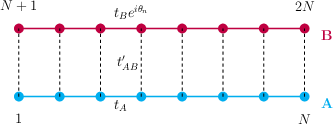
Figure 1: Schematic diagram of the two-leg ladder with Peierls phase modulated hopping along the upper leg, as defined by Eq.~\ref{ham_eqn}.
The Peierls phase admits three principal configurations:
- Uniform flux: θn=θ (all n).
- Random flux: each θn independently drawn from [0,2π).
- Quasiperiodic flux: θn follows a two-parameter generalization with amplitude V and modulation A(x)0,
A(x)1
with A(x)2 an incommensurate frequency.
The system’s phase diagram is mapped in the A(x)3 plane (Fig. 2), capturing the emergence of delocalized, localized, and mixed (coexisting) regimes. Notably, in strict 1D open chains, gauge freedom removes any effect of the Peierls phase. The ladder geometry is minimal for observing nontrivial localization.
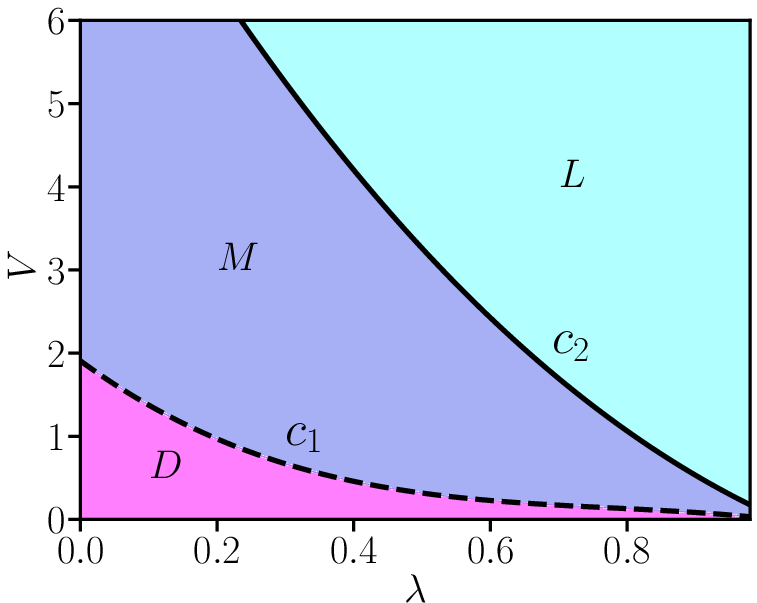
Figure 2: Schematic phase diagram for quasiperiodic magnetic flux: delocalized (A(x)4), localized (A(x)5), and mixed (A(x)6) phases with crossover lines A(x)7 and A(x)8 separating them.
Localization is quantified by a suite of metrics:
- Inverse Participation Ratio (IPR): Measures spatial concentration of eigenstates. For state A(x)9, eiθn0 distinguishes localized (order 1) and extended (eiθn1) states.
- Participation Ratio (PR): eiθn2; the average PR captures system scaling.
- Normalized PR (NPR): eiθn3; vanishes in localized or multifractal regimes.
- Lyapunov Exponent: Inverse of localization length, computed via transfer matrix methods.
Dynamics is probed by initializing a particle at the center of leg A and tracking the time-dependence of the mean square displacement (MSD) eiθn4. Long-term scaling eiθn5 distinguishes:
- Ballistic (eiθn6), diffusive (eiθn7), sub/super-diffusive (eiθn8), and localized (eiθn9) dynamics.
For homogeneous Peierls phase (θn0), both static and dynamical diagnostics confirm the persistence of the extended phase for all values of θn1. The θn2 and θn3 scaling (Fig. 3), along with ballistic dynamics (θn4) (Fig. 4), establish the absence of localization.
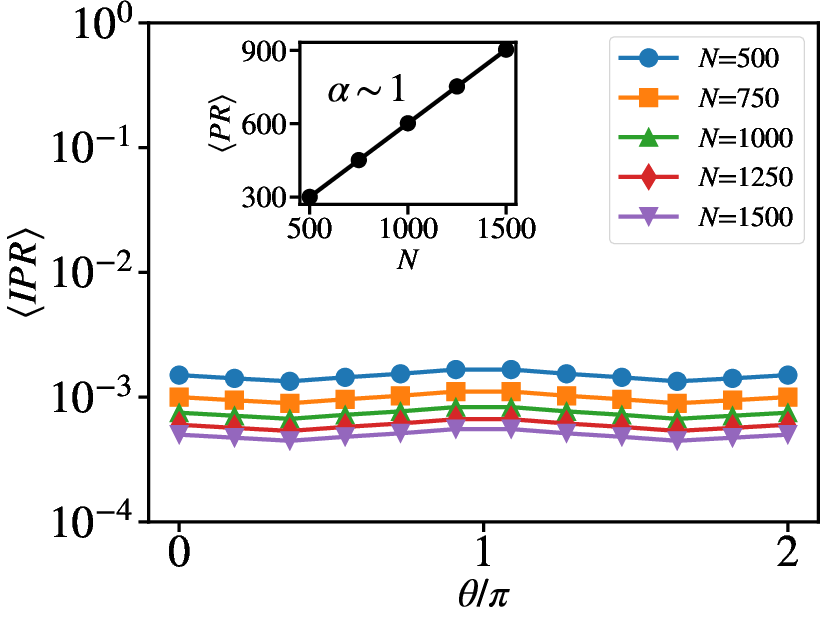
Figure 3: Uniform flux: system-size scaling of average IPR versus θn5 underscores delocalization.
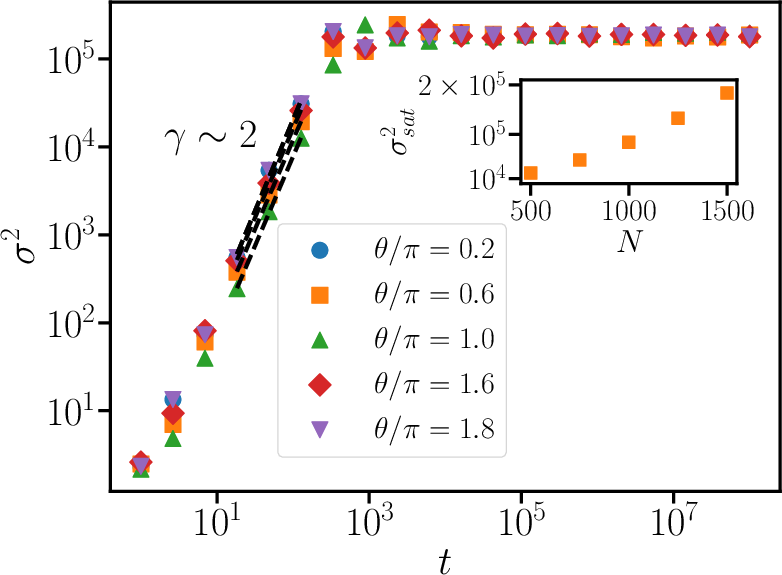
Figure 4: Uniform flux: MSD θn6 scales ballistically with time for all θn7.
Random Flux
In contrast, random Peierls phases (θn8 uniformly random) enforce strong localization across the spectrum. Disorder-averaged θn9 is independent of system size (Fig. 5), and the time evolution shows rapid saturation of MSD (Fig. 6) indicative of Anderson localized states (θn=θ0 at long times).
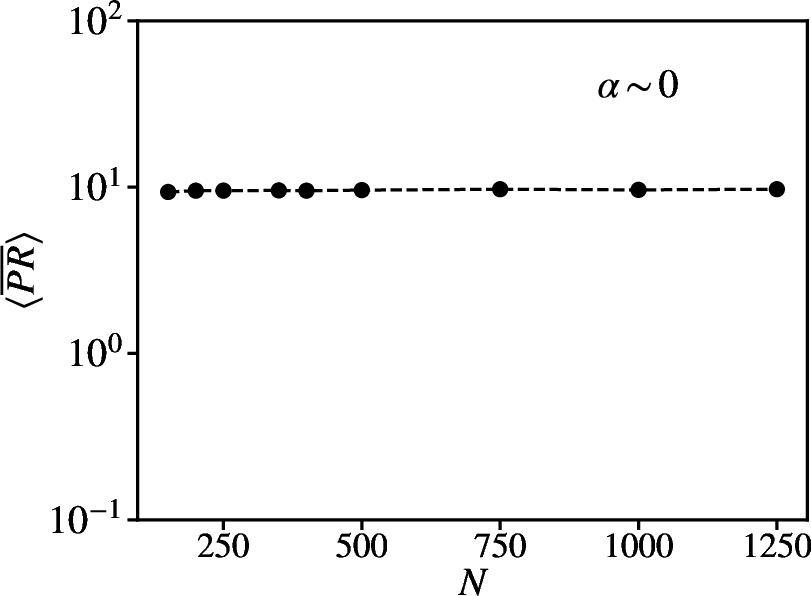
Figure 5: Random flux: disorder-averaged PR versus system size confirms localized eigenstates.
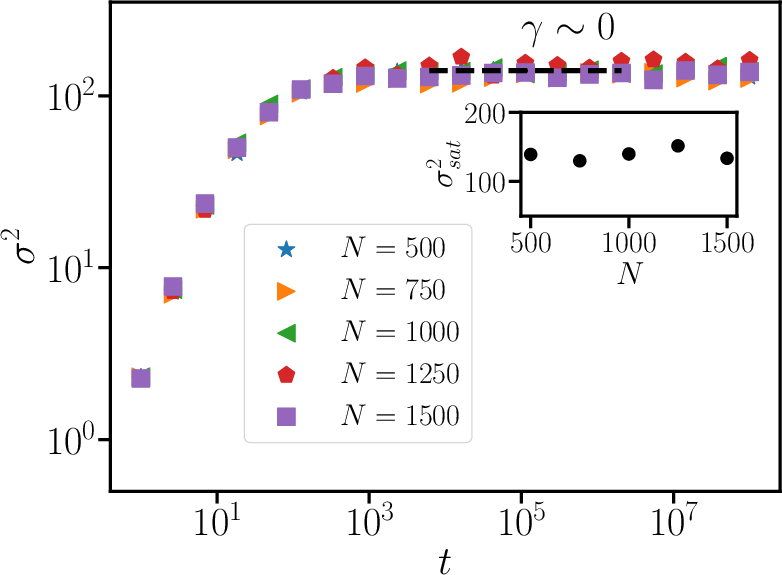
Figure 6: Random flux: MSD saturates and is system-size independent, a hallmark of localization.
The core advance is a complete characterization of the phase diagram as the Peierls phase is set to a generalized Aubry-André-type quasiperiodic function.
Static Localization Properties
For θn=θ1, the eigenstate-resolved NPR contour (Fig. 7) reveals three principle regimes as θn=θ2 is increased:
- Low θn=θ3 (θn=θ4): all states delocalized.
- Intermediate θn=θ5 (θn=θ6): coexistence—mixed spectrum with some localized and some extended states.
- High θn=θ7 (θn=θ8): all states localized.
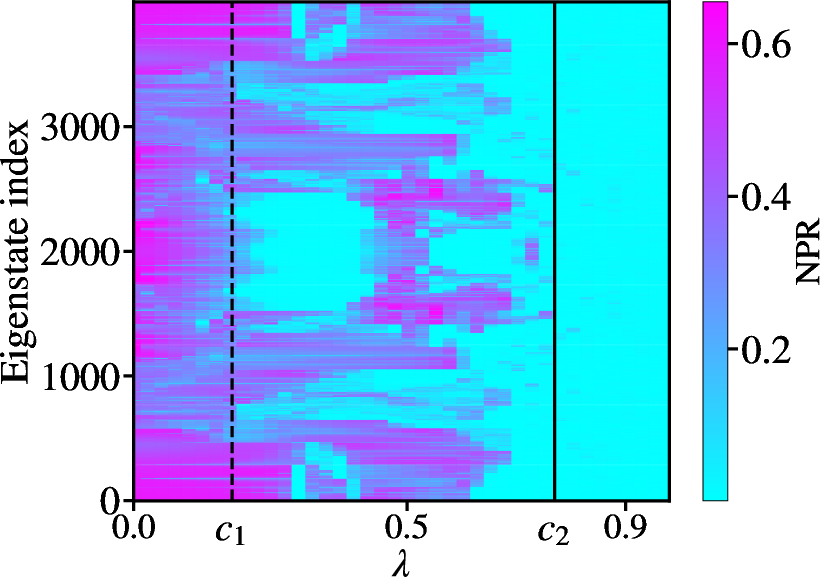
Figure 7: Contour plot of NPR vs. θn=θ9 and state index for n0 illustrates regions of mixed, delocalized, and localized spectra.
Finite-size scaling of PR (Fig. 8) and Lyapunov exponent-derived localization length converge on identical boundaries. Thermodynamic extrapolation (Fig. 9) shows simultaneous finiteness of both n1 and n2 in the mixed regime—a condition unattainable in canonical Anderson or AA transitions.
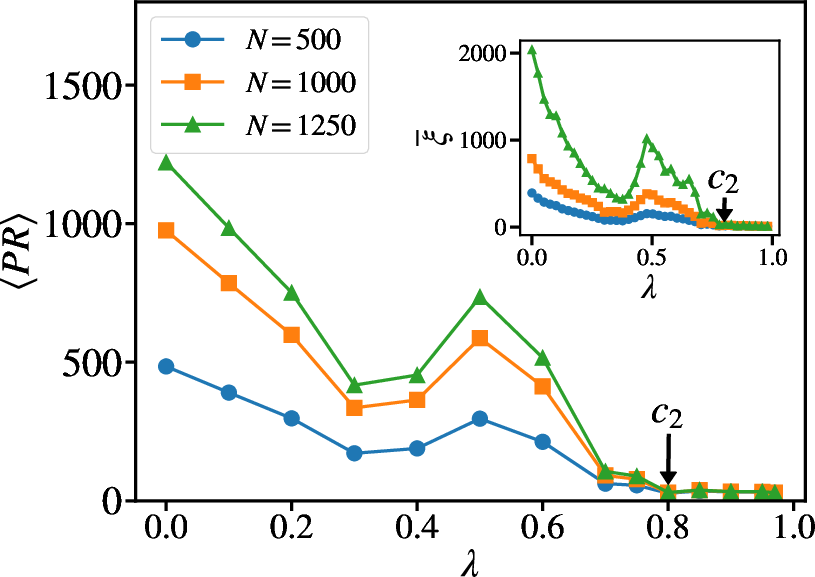
Figure 8: n3: Averaged PR and localization length as functions of n4.
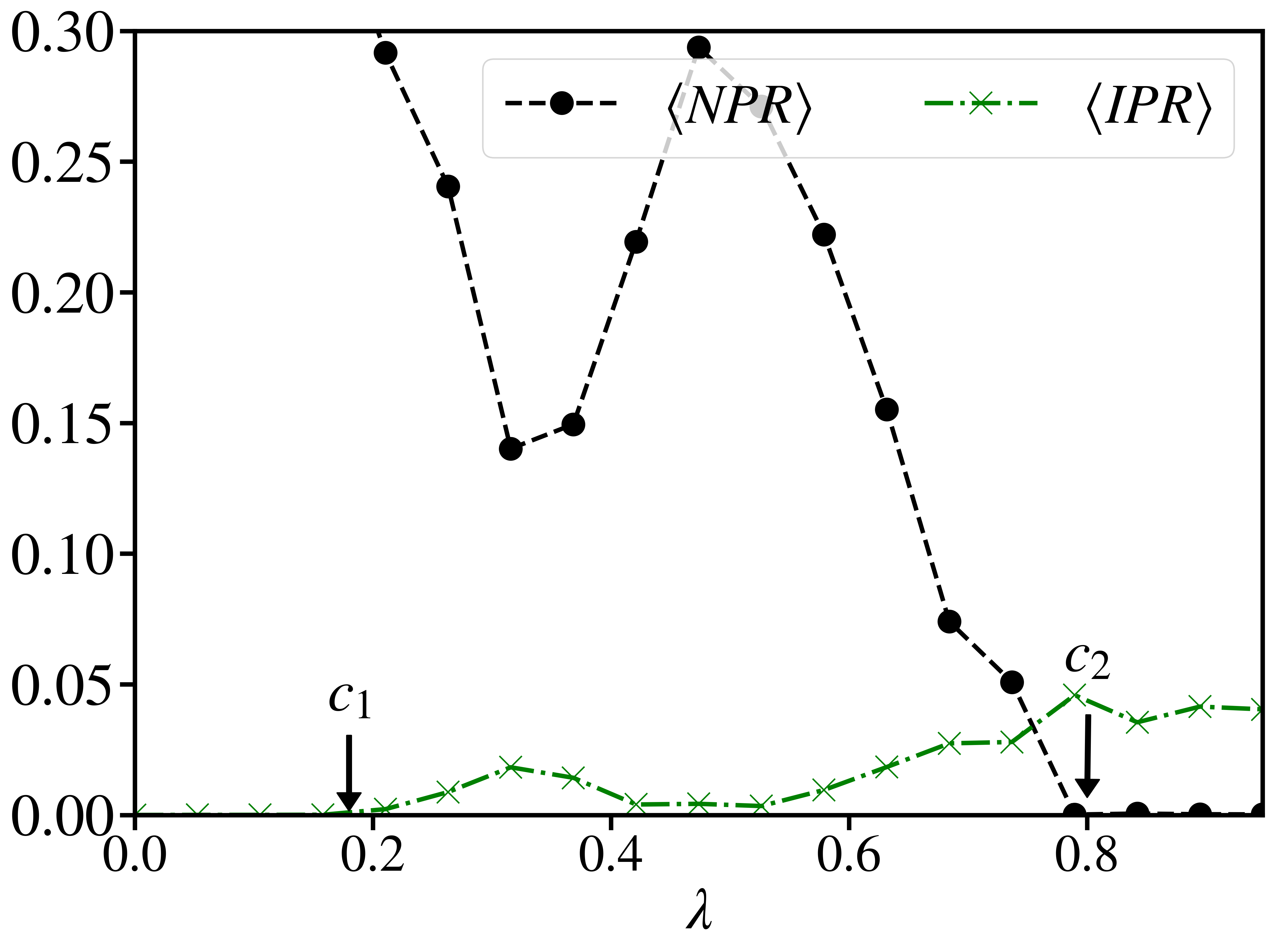
Figure 9: n5: Thermodynamic limit of average IPR and NPR versus n6; mixed phase exists for intermediate n7.
Real-Time Dynamics and Memory Effects
Wavepacket dynamics illustrate the freezing of propagation in the localized phase, unimpeded expansion in the extended regime, and partial memory retention in the intermediate regime (Fig. 10). MSD analysis quantifies the dynamical exponent n8 (Fig. 11): ballistic dynamics persist only in the fully delocalized phase, while n9 diminishes monotonically across the mixed and localized phases.
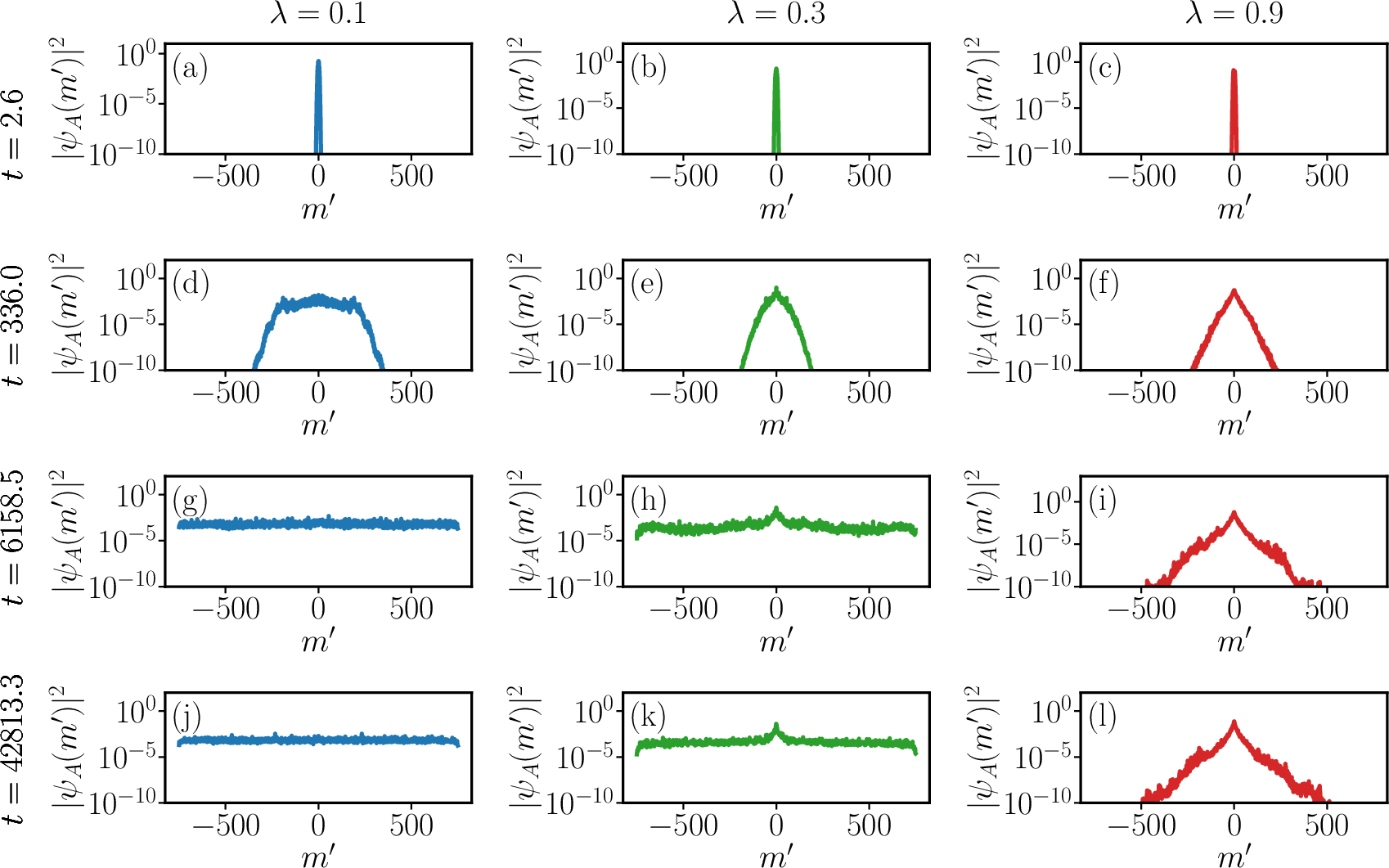
Figure 10: Time snapshots of the projected probability distribution θn0 for representative θn1 highlight the spread, partial memory, and localization effects.
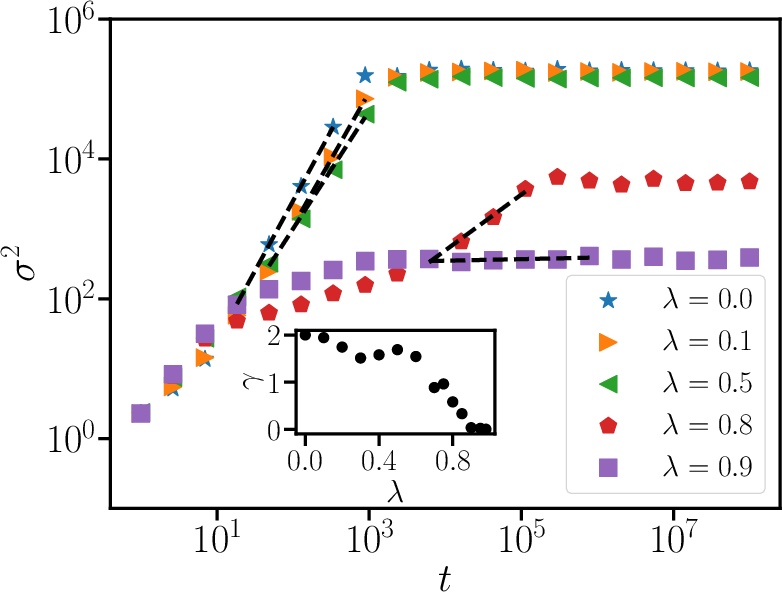
Figure 11: θn2: MSD dynamics—growth exponent θn3 interpolates between 2 (ballistic) and 0 (localized) as θn4 increases.
The scaling of the saturation value of the MSD, θn5, confirms localization only in the high-θn6 regime, with strict system-size independence (Fig. 12).
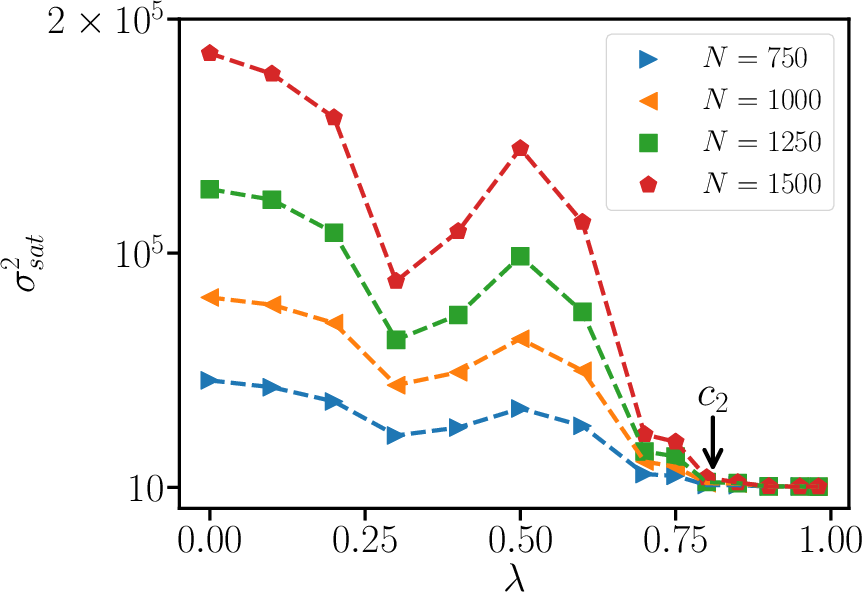
Figure 12: θn7: MSD saturation θn8 reveals localization onset as function of θn9.
[0,2π)0 Line: Suppression of Delocalized Phase
For larger modulation amplitude ([0,2π)1), the phase space is dominated by the mixed and localized phases, with the delocalized phase absent. Static (Fig. 13) and dynamic (Fig. 14) quantities corroborate these results. The phase boundary shifts to lower [0,2π)2.
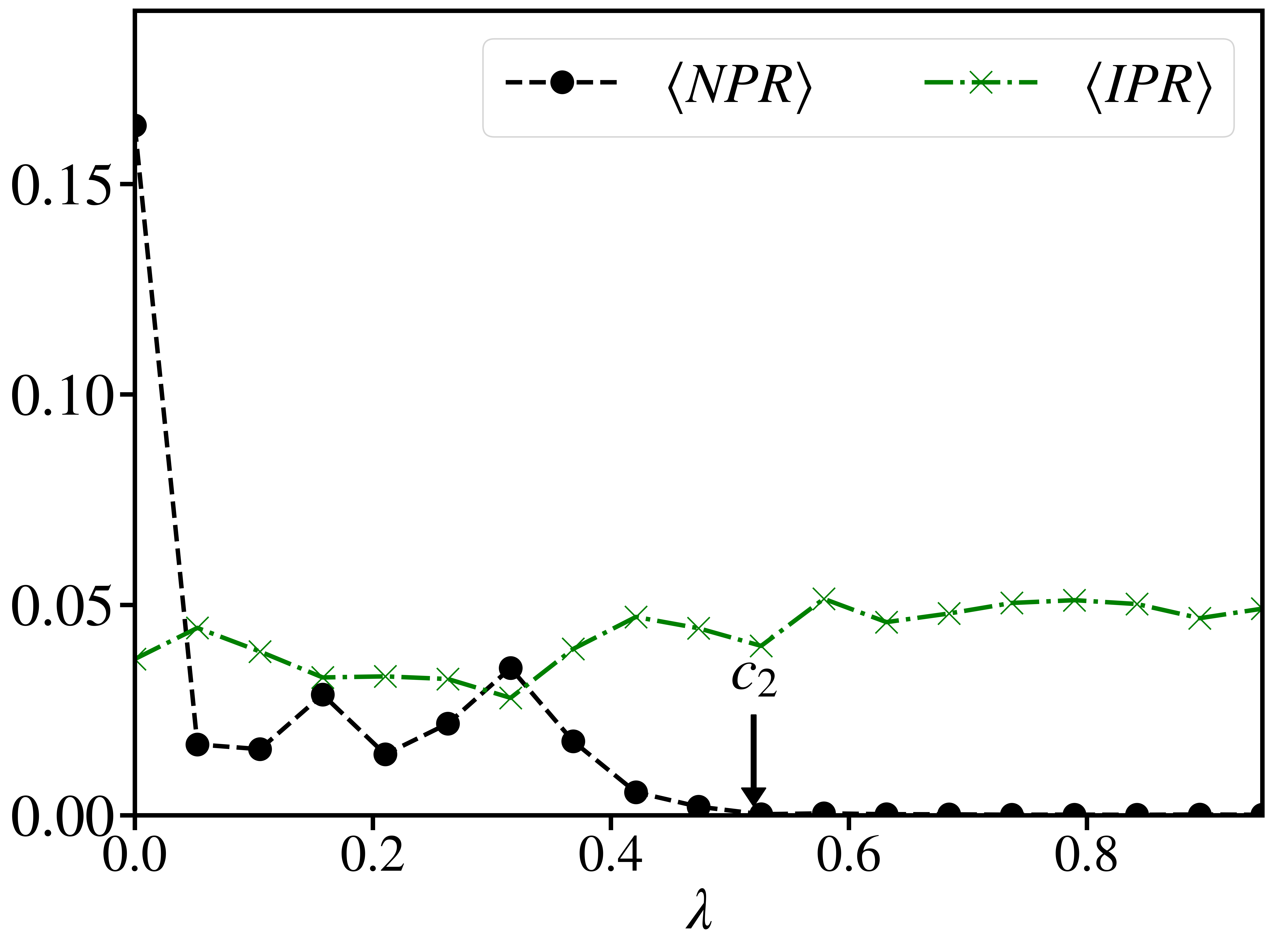
Figure 13: [0,2π)3: Average IPR and NPR—no fully delocalized regime is observed.
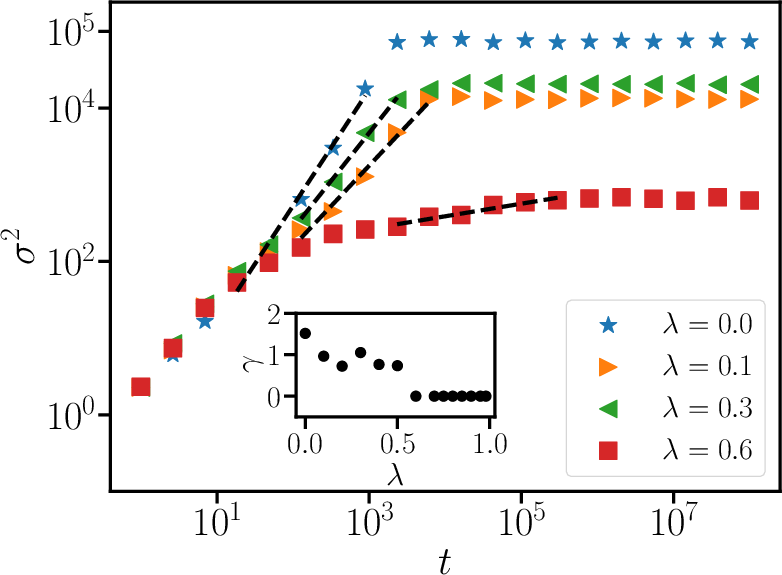
Figure 14: [0,2π)4: MSD time series and exponent [0,2π)5 show sub-ballistic expansion in the mixed phase and localization for large [0,2π)6.
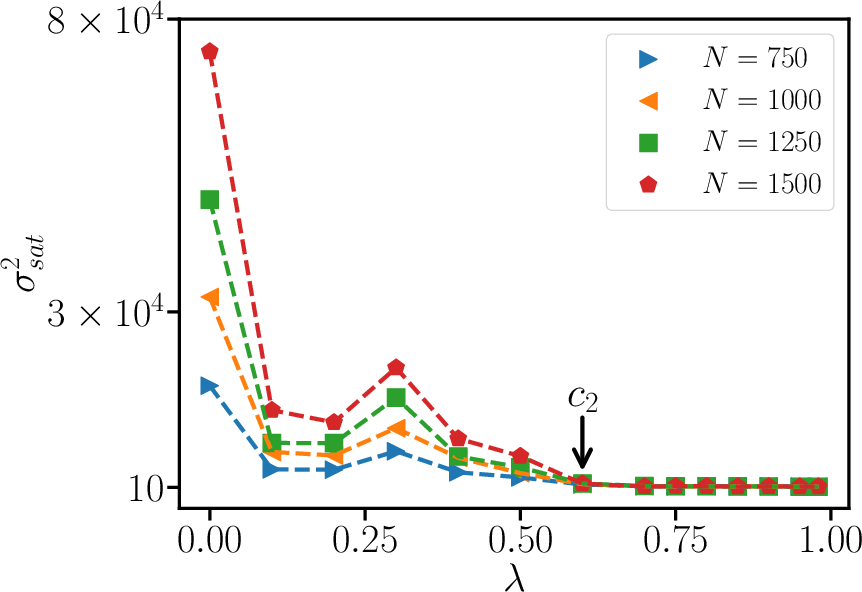
Figure 15: [0,2π)7: MSD saturation, system-size independence in the localized regime.
Semiclassical Analysis
A semiclassical treatment elucidates the correspondence between classical trajectories and quantum localization. Mapping the ladder Hamiltonian with quasiperiodic Peierls phase onto a classical Hamiltonian, stability analysis of fixed points in [0,2π)8 phase space reproduces the qualitative behavior observed in the quantum model (Fig. 16). For small [0,2π)9, extended classical orbits persist; as θn0 grows, separatrices merge fixed points, eliminating unbounded trajectories and signaling the onset of localization. A classical critical value θn1 is derived, with the θn2–θn3 relation qualitatively mirroring the quantum phase diagram.
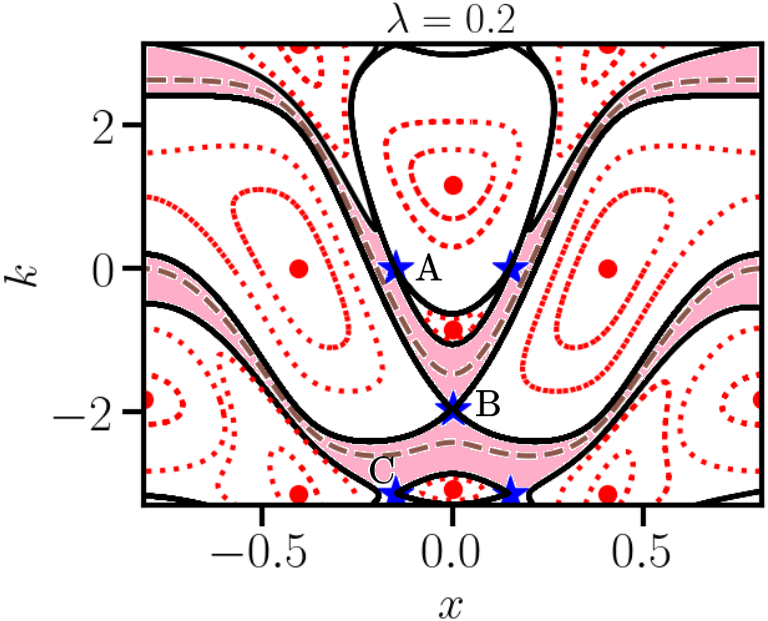
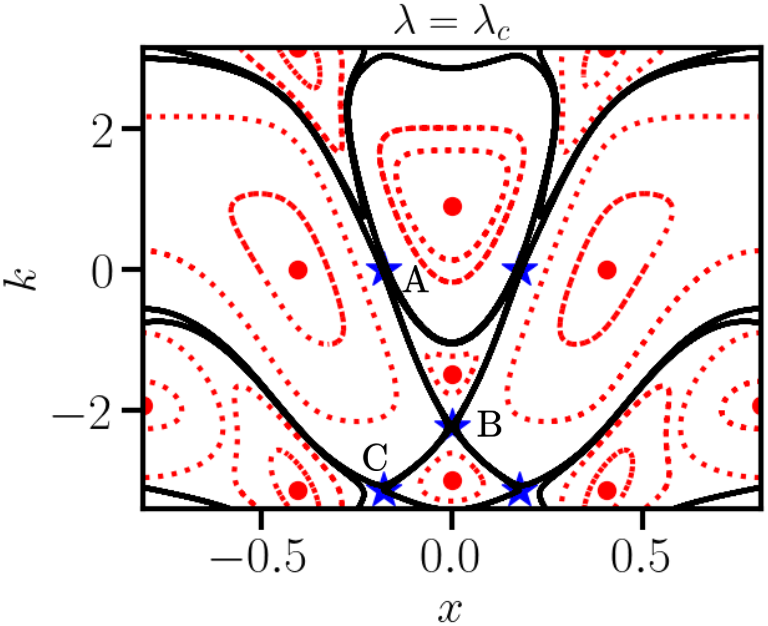
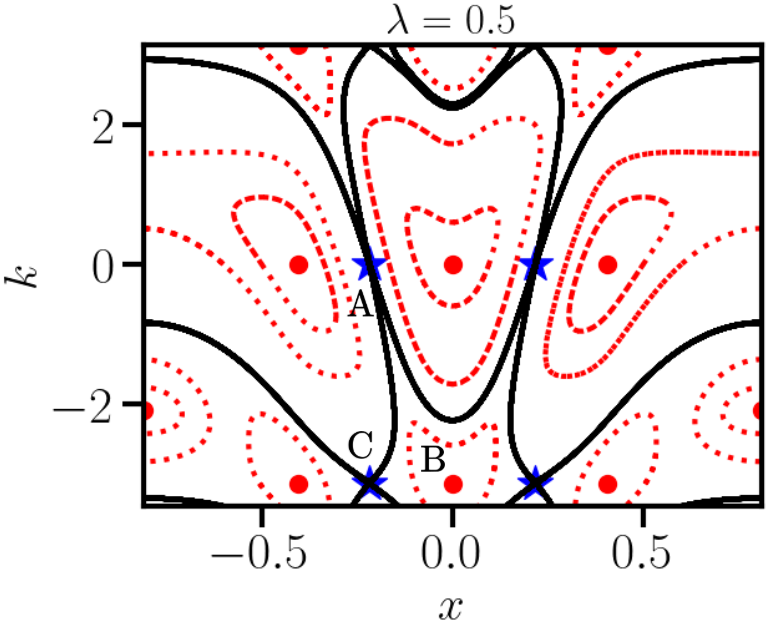
Figure 16: Classical phase-space flow for varying θn4; transition from unbounded to bounded trajectories characterizes the localization transition semiclassically.
Implications and Prospects
The rigorous identification of mobility edge physics, including a robust intermediate ("mixed") phase in a minimal ladders system subject to Peierls phase engineering, demonstrates a new route to tunable localization-delocalization transitions beyond onsite disorder paradigms. The explicit control via external (quasiperiodic) fields realizes a broad range of dynamical exponents and localization regimes.
Theoretically, the existence of a mixed phase—characterized by coexistence of localized and delocalized eigenstates—is a salient feature previously observed in higher-dimensional and some correlated 1D systems, but is directly engineered here via hopping modulation. The semiclassical analysis further accentuates the quantum-to-classical correspondence and enables analytical tracking of transition points.
Experimentally, ultracold atom platforms with optical ladders and synthetic gauge fields are natural candidates for realization, particularly since no disorder or challenging long-range potentials are required. The structure can be generalized to explore many-body localization or sub-diffusive transport regimes in interacting systems.
Conclusion
The work definitively shows that Peierls phase engineering—without onsite disorder—enables full control of single-particle localization in minimal quantum ladder geometries. The systematic analysis foregrounds the roles of flux disorder, quasiperiodicity, and structure-induced magnetic interference. The emergence of a mixed phase with sub-ballistic transport and its semiclassical correspondence suggest rich avenues for future investigation, including interaction effects, topology, and many-body ergodicity breaking.

