- The paper derives explicit analytic expressions showing that both the order parameter and the fraction of locked oscillators experience a discontinuous jump at a critical coupling strength.
- It employs a parametric self-consistency framework to map out bifurcation structures across various phase shifts, highlighting the impact of uniform frequency distributions.
- The study underscores practical implications for engineered synchronization protocols in systems with bounded frequency heterogeneity.
Introduction
The Kuramoto-Sakaguchi (KS) model describes collective behavior of globally coupled phase oscillators, parameterized by both coupling strength and a phase shift parameter α. Whereas the nature (first- vs. second-order) of the disorder-to-synchrony transition in the Kuramoto model is governed predominantly by the distribution of intrinsic (natural) frequencies, the introduction of a phase shift in the Sakaguchi extension introduces additional complexity. Uniform distributions, in contrast to the standard Cauchy or Gaussian types, induce a fundamentally discontinuous (yet reversible) transition to synchrony, a phenomenon established in the Kuramoto limit. This paper extends analytic results to the full KS model, mapping out the behavior of macroscopic order parameters and the fraction of locked oscillators for arbitrary phase shifts, and elucidates the corresponding bifurcations and their dependencies.
Model Framework
The considered model is:
θ˙k=ωk+εRsin(Ψ−θk−α)
where ωk are i.i.d. from a uniform distribution g(ω), ReiΨ=N−1∑jeiθj, and parameters are the coupling strength ε and phase shift α.
Macroscopic observables are:
- Order parameter R: measures collective synchrony.
- Fraction of locked oscillators Q: quantifies macroscopic phase locking.
A key analytical advance rests on deriving, in the thermodynamic limit, explicit integral equations for R and θ˙k=ωk+εRsin(Ψ−θk−α)0, yielding parametric representations of synchronization transitions for general θ˙k=ωk+εRsin(Ψ−θk−α)1 and uniform θ˙k=ωk+εRsin(Ψ−θk−α)2.
Discontinuous Transition and Order Parameter Behavior
For uniform θ˙k=ωk+εRsin(Ψ−θk−α)3, the θ˙k=ωk+εRsin(Ψ−θk−α)4 curve exhibits a discontinuous onset at a critical coupling θ˙k=ωk+εRsin(Ψ−θk−α)5; this extends to the KS model for all attractive coupling regimes (θ˙k=ωk+εRsin(Ψ−θk−α)6). At θ˙k=ωk+εRsin(Ψ−θk−α)7, both θ˙k=ωk+εRsin(Ψ−θk−α)8 and θ˙k=ωk+εRsin(Ψ−θk−α)9 jump from zero to finite values ωk0 and ωk1, respectively, establishing a unique first-order transition without hysteresis. For stronger coupling, ωk2 continues to increase smoothly, and ωk3 saturates to 1 at a second threshold ωk4, marking complete synchrony.
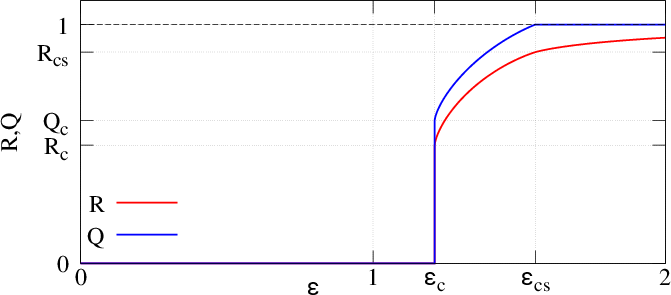
Figure 1: Dependence of the order parameter ωk5 and the fraction of locked oscillators ωk6 on the coupling strength ωk7 for ωk8, showing a discontinuous transition at ωk9 and full synchrony at g(ω)0.
The behavior of g(ω)1 and g(ω)2 as functions of g(ω)3 demonstrates that the critical coupling for synchrony decreases monotonically as g(ω)4, inverting the trend observed for Lorentzian (Cauchy) frequency distributions. Notably, for g(ω)5 (pure Kuramoto limit), g(ω)6, retrieving the classic result.
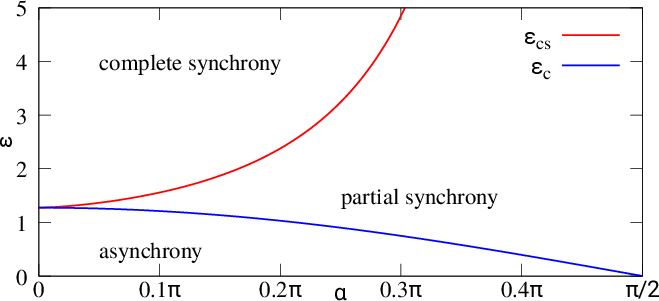
Figure 2: Critical coupling strengths g(ω)7 (onset of partial synchrony) and g(ω)8 (onset of complete synchrony) as functions of phase shift g(ω)9.
The analytic expressions for the jump heights ReiΨ=N−1∑jeiθj0 and ReiΨ=N−1∑jeiθj1 at ReiΨ=N−1∑jeiθj2 further reveal a strong suppression of synchrony for large ReiΨ=N−1∑jeiθj3; as ReiΨ=N−1∑jeiθj4, the jumps decay exponentially but remain nonzero, confirming finite discontinuity up to the conservative limit.
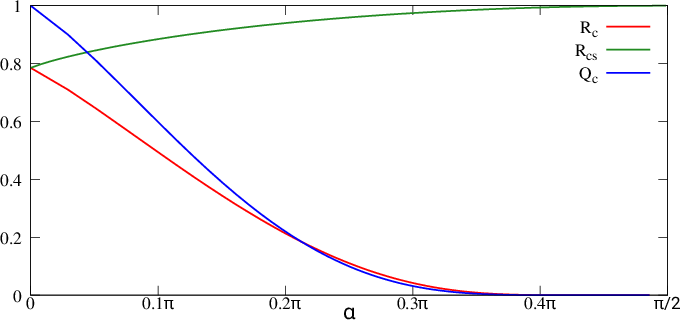
Figure 3: Height of discontinuous steps ReiΨ=N−1∑jeiθj5 and ReiΨ=N−1∑jeiθj6, and the value ReiΨ=N−1∑jeiθj7 at the full synchrony transition, as functions of phase shift ReiΨ=N−1∑jeiθj8.
Analytic Structure of the Synchronous State
The core of the analysis is a parametric self-consistency framework that extends the classical mean-field approach to embrace the KS phase shift. This yields:
- An analytic expression for the order parameter as ReiΨ=N−1∑jeiθj9 with auxiliary functions encoding both the coupling and distribution.
- Explicit formulas for ε0 as an integral over locked frequency intervals.
- Closed-form expressions for all step heights and thresholds, using auxiliary functions tailored to the uniform ε1.
Crucial results include the detailed ε2-dependence:
ε3
which sharply contrasts with ε4 in Cauchy ensembles, and step size expressions revealing the exponential suppression near critical phase shift.
Complete Synchrony and Critical Scaling
The full synchrony threshold ε5 always exceeds ε6 for ε7; as ε8, ε9 diverges, with the range of partial synchrony expanding reciprocally. This indicates that, whereas infinitely narrow frequency support (Gaussian/Lorentzian) prevents complete phase locking except at infinite coupling, the finite support of the uniform distribution allows such transitions at finite coupling, with marked dependence on the phase shift.
Implications and Directions
This research decisively characterizes the non-universal, distribution-specific nature of synchronization bifurcations in mean-field oscillator models once the coupling is generalized via a phase shift. The analytical tractability achieved points to:
- Strong theoretical implications for the classification of phase transitions in high-dimensional coupled oscillator systems, where finite-support statistics are relevant.
- Protocol design for engineered synchronization in populations with bounded frequency heterogeneity, given the possibilities of tuning phase lags and coupling.
Future research can probe the persistence of this phenomenology in other bounded-support distributions (e.g., beta or triangular α0), or explore stability/bifurcation diagrams beyond the mean-field or thermodynamic limits.
Conclusion
This paper provides a comprehensive analytic treatment of synchronization transitions in the Kuramoto-Sakaguchi model with a uniform frequency distribution. The results include explicit expressions for critical couplings, order parameter jumps, and regimes of partial and full synchrony as functions of the coupling phase shift. The findings clarify and quantify the unique, discontinuous nature of the uniform-distribution-induced transition, as distinct from the continuous or hysteretic transitions seen in other frequency ensembles. The framework delivers both analytic precision and practical insight for future synchronization studies and applications.
(2604.10711)

