- The paper introduces a spillover-aware decomposition that handles multiple unordered mediators, enabling full effect partitioning in cluster-randomized trials.
- It presents robust semiparametric one-step estimators with double and triple robustness, supported by explicit influence function derivations.
- Simulation studies and the PPACT CRT application demonstrate accurate estimation and finite-sample stability under complex interference and clustering.
Introduction and Context
The manuscript "Causal mediation in cluster-randomized trials with multiple mediators: spillover-aware decomposition, identification, and semiparametric efficient inference" (2604.10710) presents a comprehensive inferential and methodological framework for causal mediation analysis in CRTs with an arbitrary number of post-treatment mediators under unknown causal ordering. The motivating setting involves hierarchical clustering, intracluster correlation, within-cluster (partial) interference, and multiple potential mediating pathways—features that, when considered jointly, break most standard assumptions underlying classical mediation methods in biostatistics and social science.
Key motivating examples include cluster-based interventions (e.g., provider-level, school-based, or group-level randomization) such as the PPACT CRT for chronic pain, where multiple mediators are measured but their ordering and causal relationships are unspecified. This paper bridges several substantial gaps, especially in the presence of multiple mediators and intervention-induced interference, by: (i) giving a permutation-invariant, spillover-aware algebraic decomposition of causal effects; (ii) deriving new structural assumptions sufficient for nonparametric identification in these settings; (iii) establishing semiparametric efficiency theory and robust estimation procedures for the resulting high-dimensional functionals, operationalized via elliptical copula marginal regression models for complex nuisance density estimation.
Theoretical Framework and Estimand Construction
The authors propose an extension of mediation analysis in CRTs from the two-mediator scenario to an arbitrary number K of causally unordered mediators. They develop a unified class of estimands, including:
- Symmetric Interaction Indirect Mediation Effects: capturing all higher-order interaction terms between subsets of mediators, and ensuring permutation invariance.
- Spillover and Individual Interaction Mediation Effects (SIME/IIME): quantifying the portions of the effect decomposition due to (i) spillover effects (intermediate variable in one subject affecting others in the cluster) and (ii) individual (direct) mediation effects.
They provide an explicit combinatorial algebra, leveraging the inclusion-exclusion principle and connections to factorial trial designs, that allows full decomposition of the natural indirect effect (NIE) into all possible interactions (up to order K) and assignment of spillover components.
The identification of these estimands requires carefully defined cross-world structural assumptions—specifically, forms of conditional ignorability and independence for observed and potential mediators under different intervention assignments—extensions and generalizations of prior ART assumptions for single or ordered mediators.
Nonparametric Identification and Efficient Estimation
The identification results are formalized as nested theorem statements under increasingly strong sets of assumptions (from "Set I" for TE/NIE/NDE, up to "Set III" for the finest SIME/IIME decompositions). The identification proofs are constructive, using nested applications of the law of total expectation, conditioning on observed (and potential) mediator values.
For efficient estimation and inference, the authors:
- Derive influence functions and develop semiparametric one-step estimators for all effect functionals.
- Establish double and triple robustness of their procedures: The semiparametric one-step estimator for NIE/NDE is doubly robust (consistent if either the outcome or mediator joint density model is correct), while the estimator for higher-order interaction functionals is triply robust.
- Introduce elliptical copula marginal regression (ECMR) as a general method for flexible, semiparametric modeling of complex, clustered joint mediator distributions (accommodating both continuous and discrete mediators and heavy-tails).
- Allow machine learning-based, debiased estimation for nuisance components (outcome regression, copula parameters), and provide finite-sample stabilization guidelines to mitigate high-dimensional weighting instability.
Simulation Studies
Comprehensive simulation studies are conducted, using scenarios that vary which component models are correctly specified (mediator/outcome/covariate/generator). Results demonstrate:
- When all models are correctly specified, all estimators are unbiased with nominal coverage.
- The g-computation estimator is substantially sensitive to model misspecification (particularly outcome regression); in contrast, one-step estimators display the predicted robustness properties.
- The stabilized, debiased machine learning estimator (EIF.DML.S) performs well even when all models are misspecified with respect to the covariate design, with median efficiency gains (larger for interaction effect estimation).
- Misspecification of the copula generator has minimal effect for the robust one-step estimators, while impacting g-computation.
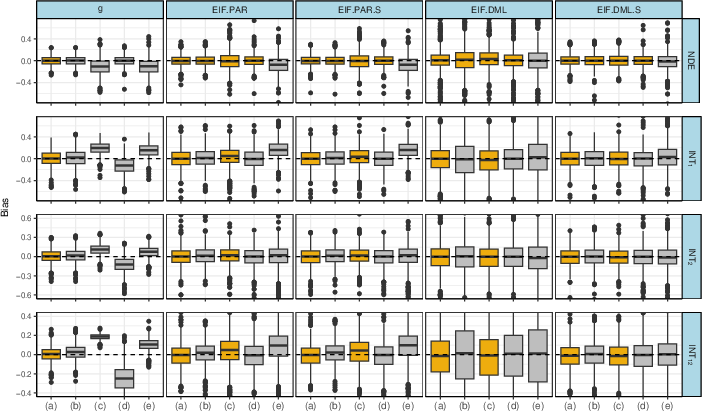
Figure 1: Simulation results for the bias of the natural indirect effect and interaction effects for various nuisance model misspecification scenarios.
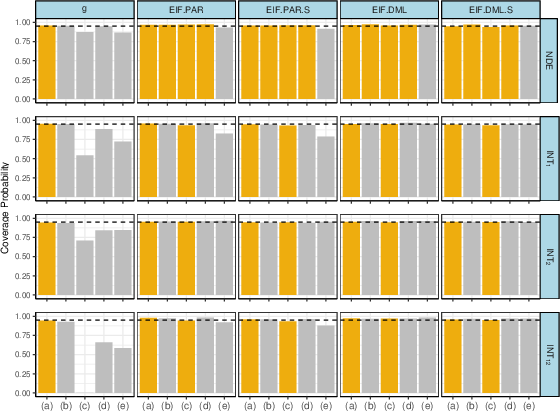
Figure 2: Empirical coverage probabilities of the estimators for the natural indirect effect and interaction effects across nuisance model misspecification scenarios.
The simulation evidence supports the theoretical robustness and finite-sample efficiency claims of the new methodology, and highlights the instability and bias of traditional g-computation under complex mediator and outcome structures.
Real-World Application: PPACT CRT Analysis
The methodology is applied to the PPACT CRT study, which evaluates a CBT intervention to reduce pain in chronic opioid users (clusters = providers, K=3 mediators: RMDQ, satisfaction, opioid dose). All analysis scenarios adjust for individual- and cluster-level covariates, and allow for cluster spillover via cross-individual mediator means.
Highlights from the substantive results include:
- The NIE constitutes a large proportion of the total effect (41%–37% depending on the estimator).
- The indirect effect mediated by RMDQ is dominant; the other mediators and interactions are negligible in magnitude.
- Most higher-order (especially three-way) interactions or spillover effects are small, supporting an approximate independence of pathways.
- Estimates are robust to choice of parametric (EIF.PAR, EIF.PAR.S) or debiased machine learning (EIF.DML, EIF.DML.S) methods, though stabilization improves finite-sample behavior.
Novel Technical Contributions
- Permutation-Equivariant Spillover-Aware Decomposition: The algebraic symmetry and full spillover accounting enable the definition of causal estimands with clear, intervention-relevant interpretations in multilevel and multi-mediator settings.
- Semiparametric Efficiency and Robustness: The formalization of one-step estimators, explicit influence function derivation, and demonstration of double/triple robustness represent state-of-the-art developments for mediation analysis in CRTs with complex nuisance structures.
- Elliptical Copula Marginal Regression: ECMR generalizes Gaussian copula regression, allows for both model flexibility (heavy tails, mixed-type mediators) and interpretable correlation parameters (ICCs for within and between individual/mediator dependence), and is applicable beyond mediation analysis contexts.
- Ratio-Scale Effect Decomposition: The algebra is extended for ratio or odds ratio scale estimands by applying logarithmic transformation, supporting inference even for binary outcomes.
Implications and Future Directions
The methodological advances in this work set a new benchmark for mediation analysis in CRTs, enabling analyses that are both theoretically rigorous and practically suitable for applications where mediators are measured contemporaneously and interference is plausible. The approach obviates the need for strong ordering assumptions and admits arbitrary numbers of mediators.
Three explicit future directions are suggested:
- Incorporation of causal ordering when longitudinal mediator measurement is possible, allowing even more refined decomposition.
- Further development of fully data-adaptive copula generator estimation for large clusters/high K.
- Development of formal sensitivity analysis tools for cross-world structural assumption violations.
The elliptical copula density modeling approach has broader implications, offering a template for high-dimensional dependence modeling in clustered or hierarchical causal inference beyond mediation.
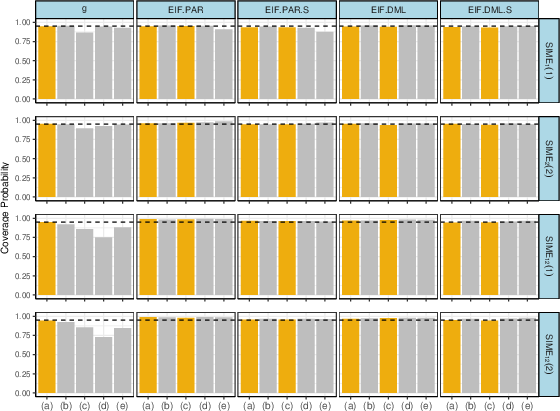
Figure 3: Bias performance for spillover interaction mediation effects under various model misspecification scenarios.
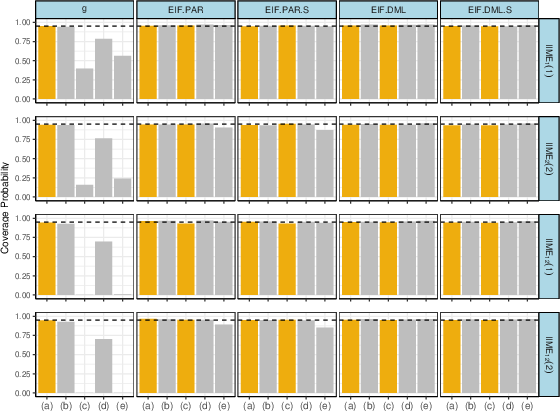
Figure 4: Bias performance for individual interaction mediation effects, emphasizing the impact of different nuisance specification errors.
Conclusion
This paper provides a comprehensive theoretical and computational blueprint for estimation and inference of causal mediation effects in cluster-randomized designs with arbitrary numbers of unordered mediators and cluster-level interference. The proposed estimands, identification conditions, and estimators fill a critical gap in mediation methodology for complex clustered interventions. The work is directly relevant for practical analysis of real-world CRTs in public health and beyond, providing principled procedures for mechanism elucidation under realistic hierarchical designs. The elliptical copula framework and robust one-step estimator construction extend the robust semiparametric toolkit for causal inference under general interference and high-dimensional nuisance conditions.

