- The paper proposes a one-step score-based density ratio estimation that bypasses iterative numerical integration for efficient inference.
- It employs a spatiotemporal decomposition with analytic RBFs, providing explicit error bounds and reliable performance in challenging settings.
- Empirical results demonstrate up to 68× faster inference while maintaining sharp density estimation and robust mutual information evaluation.
Introduction
This paper introduces "One-Step Score-Based Density Ratio Estimation" (OS-DRE) (2604.10672), a novel framework in the density ratio estimation (DRE) landscape. OS-DRE targets the tension between estimation quality and inference efficiency that plagues existing DRE methodologies. Classical direct estimators—while inference-efficient—are unreliable in high-discrepancy or low-overlap regimes. In contrast, score-based methods offer superior accuracy but at prohibitive inference costs due to their reliance on repeated function evaluations and numerical integration over interpolating distributions.
The OS-DRE framework eliminates this bottleneck via a spatiotemporal decomposition of the log-density ratio path integral, enabling its computation through a single analytic step with precomputed temporal weights. By constructing a frame system based on analytic radial basis functions (RBFs), OS-DRE unifies core advantages from both direct and score-based approaches and theoretically grounds the resulting estimator with explicit error bounds for finite- and infinitely-smooth kernels.
Theoretical Framework
The method rests on the score-based rewriting of the log-density ratio,
logr(x)=logp0(x)p1(x)=∫01∂tlogpt(x)dt,
where {pt}t∈[0,1] defines an interpolating path between p0 and p1. While numerical solvers (e.g., ODE/ODE-based quadrature) are traditionally required, OS-DRE reframes the integral in a manner that entirely bypasses this need.
A key insight is to express the time-score field as a spatiotemporal expansion: ∂tlogpt(x)≈k=1∑Khk(x)gk(t),
where gk are analytic temporal atoms (RBFs) and hk(x) are learned spatial coefficients. Integrating over time, the log-density ratio becomes
logr(x)≈∑k=1Khk(x)gˉk,
with gˉk=∫01gk(t)dt as precomputable weights.
The use of non-orthogonal, analytic frames resolves the degeneracy that arises with orthogonal bases (e.g., Fourier, polynomial), where most temporal integrals collapse, discarding useful frequency information. Theoretical development is rigorous, including:
- Justification that the time-score field resides in a suitable Hilbert space, allowing frame-based expansions.
- Explicit construction of analytic RBF families (e.g., Gaussian, IMQ, rational quadratic, Matérn) with closed-form integrals and derivatives for both infinite and finite smoothness regimes.
- Error bounds for finite-term approximations, demonstrating algebraic (Sobolev) or exponential (infinitely smooth kernel) decay as K increases, thereby quantifying the quality-efficiency trade-off.
Practical Implementation
The spatial coefficients are parameterized by neural networks. For a given input, a single network evaluation yields the vector {pt}t∈[0,1]0, with the final ratio estimate computed as a dot product against the precomputed vector of temporal integrals: {pt}t∈[0,1]1
This formulation yields inference with {pt}t∈[0,1]2, independent of the interpolating path complexity.
Training leverages score matching losses, with the analytic form of both integrals and time derivatives enabling first-order optimization and eliminating the need for higher-order automatic differentiation. Empirical studies utilize PyTorch-based models and standard datasets.
Empirical Analysis
Density Estimation and Out-of-Distribution (OOD) Detection
The effectiveness of OS-DRE is validated on synthetic and real-world tabular datasets for density estimation tasks. OS-DRE matches or outperforms computationally-intensive baselines while reducing inference time by up to 68×. The density estimates maintain sharpness and topological correctness even under multimodal, disconnected, or manifold-structured distributions.
A trade-off curve between negative log-likelihood (NLL) and number of function evaluations (NFE) illustrates the quality-efficiency frontier:
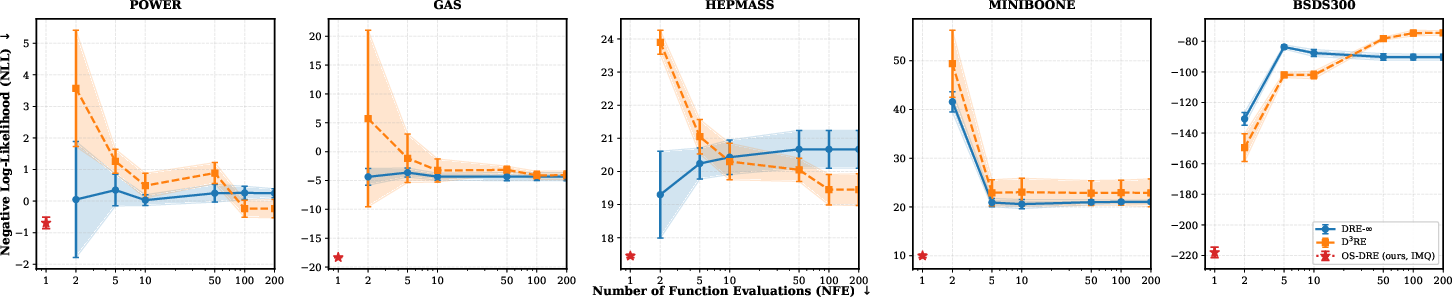
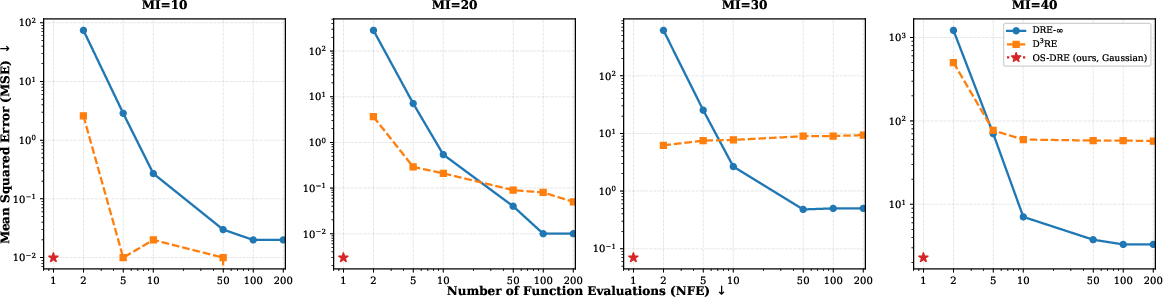
Figure 2: NLL versus NFE for density estimation tasks on five tabular datasets, demonstrating OS-DRE's superiority at minimal inference cost.
In OOD detection (CIFAR-100, Near/Far OOD), OS-DRE exhibits clearer separation between ID and OOD score distributions than both neural direct and solver-based score methods:
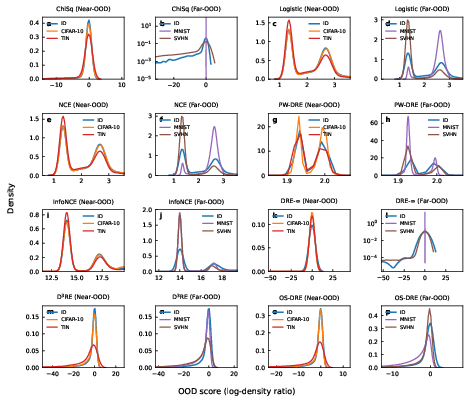
Figure 4: Densities of OOD scores for ID CIFAR-100 vs. Near-/Far-OOD datasets; OS-DRE and D³RE demonstrate enhanced separation.
Robustness is further established in MI estimation on geometrically pathological benchmarks, where OS-DRE achieves systematically lower mean squared error compared to quadrature-reliant score-based baselines:
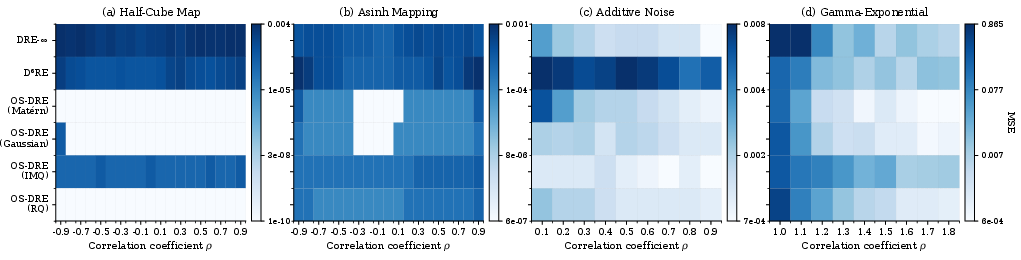
Figure 6: MI estimation error (MSE {pt}t∈[0,1]3) on four pathological distributions, indicating OS-DRE's efficiency and resilience against complex geometry.
The method also maintains strong sample complexity and inference performance in high-discrepancy scenarios, confirming mitigation of the density-chasm problem even when MI values exceed 20 nats—settings where direct DRE approaches are known to fail.
Kernel and Basis Ablation
Ablative studies explore the effect of basis cardinality ({pt}t∈[0,1]4) and kernel choice. Results indicate improvement up to a saturation point, after which overfitting can reduce generalization. IMQ and rational quadratic kernels provide strong general-purpose performance, while Matérn kernels excel for non-smooth temporal fields.
Theoretical and Practical Implications
OS-DRE closes a major methodological gap by enabling score-based DRE with computational efficiency rivaling direct one-pass estimators but without their catastrophic breakdown under sharp, high-dimensional, or non-overlapping regime discrepancies. The closed-form, analytic temporal integration obviates quadrature bias and provides deterministic, stable estimators.
The theoretical framework—embedding spatiotemporal fields into a separable Hilbert space and leveraging frame-based expansions—suggests broader applicability to other path-integral inference problems where the integrand can be learned and admits analytic basis decompositions. The explicit analytic tractability facilitated by RBFs removes a general barrier for practical deployment of score-based methods in real-time or resource-constrained settings.
Conclusion
"One-Step Score-Based Density Ratio Estimation" rigorously establishes a solver-free, analytic pipeline for reliable DRE across diverse modern inference scenarios. By separating the time score into learnable spatial coefficients and analytic temporal frames, OS-DRE provides a practical, theoretically-grounded estimator that is both precise under challenging distributional mismatch and extremely efficient during inference. This development invites future investigation of analytic frame-based approaches within the broader space of path-integral machine learning estimators, including potential extensions to other probabilistic inference and generative modeling tasks.