- The paper establishes explicit criteria for locating singularities of complete diagonals via the Landau variety derived from Newton polyhedra and discriminants.
- It employs a multidimensional residue framework and unimodular transformations to derive integral representations clarifying analytic continuation in parameter space.
- The work unifies techniques from combinatorics, algebraic geometry, and analysis to classify singular behaviors in generating functions.
Singularities of Diagonals of Laurent Series for Rational Functions
Overview and Context
The paper "Singularities of diagonals of Laurent series for rational functions" (2604.10605) rigorously addresses the analytic continuation of complete diagonals of Laurent series expansions associated to rational functions in several variables. It provides geometric and algebraic criteria for the singularity structure—specifically, it locates the set of singularities (Landau variety) in terms of discriminants tied to combinatorial faces of the Newton polyhedron of the denominator.
The construction unifies perspectives from several domains, including analytic combinatorics, difference equations, and algebraic geometry, and it is germane to the understanding of the algebraicity/transcendence of diagonals and the nature of their singular locus.
Laurent Series, Diagonals, and Nondegeneracy
Let F(z) denote the Laurent expansion of g(z)/f(z) about the origin in (C×)n, with g and f coprime Laurent polynomials and f nondegenerate with respect to its Newton polyhedron Δf. The notion of nondegeneracy is in the sense of Kouchnirenko: for any face δ of Δf, the critical points of the truncation fδ are non-degenerate.
Domains of convergence of such expansions correspond precisely to the convex components g(z)/f(z)0 of the complement of the amoeba g(z)/f(z)1, a well-studied object in algebraic geometry that maps the zero set of g(z)/f(z)2 under the log-absolute value map.
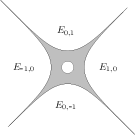
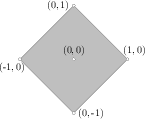
Figure 1: Amoeba (gray, left), its complement components (the bounded component without label is g(z)/f(z)3), and the Newton polytope (right) of the Laurent polynomial g(z)/f(z)4.
For an g(z)/f(z)5-tuple of integer vectors g(z)/f(z)6 generating a saturated sublattice, the complete g(z)/f(z)7-diagonal of rank g(z)/f(z)8 is defined by selecting coefficients indexed by the g(z)/f(z)9-sublattice and re-expanding in new variables (C×)n0. This operation produces functions ubiquitous in enumerative combinatorics and mathematical physics, including hypergeometric functions.
Main Theorem: Analytic Continuation and Landau Variety
The principal result is the precise formulation of the set (C×)n1 (Landau variety), outside which the diagonal admits analytic continuation. The Landau variety is determined as a union of images of discriminants (and their associated loci of degenerate Jacobian) for (C×)n2 and all its face truncations under the monomial mappings determined by (C×)n3. For every face (C×)n4 of the Newton polyhedron, singular loci in parameter space are given by the drop in rank of an associated logarithmic Gauss-Jacobian matrix at torus points mapped to parameter tori.
The theorem asserts that, for nondegenerate (C×)n5, the complete diagonal can be analytically continued along any path in the parameter torus that does not intersect (C×)n6.
Explicit Integral Representation
The diagonal is realized as a multivariate residue, or equivalently an integral over an (C×)n7-cycle in the complement of the zero locus of the denominator and binomial constraints corresponding to parameters (C×)n8. After a change of variables (via a unimodular transformation associated to the lattice structure), the diagonal can be written as an (C×)n9-dimensional torus integral (where g0), with cycle determined by the component of the amoeba's complement associated to a chosen Laurent expansion.
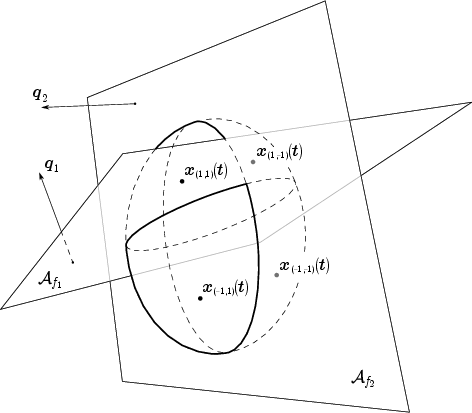
Figure 2: Partition of the component g1 by the amoebas g2 and the choice of points g3.
This explicit form makes the analytic dependence on parameters transparent and ties the singularities of the integral (as a function of parameters) precisely to the projected critical set structure (Landau variety).
Geometric and Topological Framework
The detection of the singular locus is reduced to analyzing the Landau variety of a suitable stratification in a toric compactification of parameter space. The arrangement of hypersurfaces coming from the faces of the Newton polyhedron and the binomial constraints is shown to satisfy transversality and to admit proper stratifications, so the Landau variety can be rigorously computed as the image under the parameter projection g4 of the locus of degenerate differentials (generalizing the classical theory of discriminants and critical loci).
The locally trivial fibration structure leads to a systematic analytic continuation, governed by Picard-Lefschetz and isotopy methods, along any path avoiding g5.
Examples
Two detailed examples are provided: the first shows the generalized hypergeometric function as a diagonal of a rational Laurent series and locates its unique singularity via the Landau variety computation; the second discusses the two-variable Appell function g6 and derives its singular variety as an explicit (complex) algebraic curve in parameter space, consistent with classical results. The Newton polytope, amoeba structure, and resulting singular sets are made explicit.
Implications and Further Directions
The present framework generalizes analytic continuation results for diagonals of rational functions beyond the classical case (g7), accommodating full Laurent expansions and arbitrary lattice projections. The association with Newton polyhedra and discriminant loci connects the analytic structure of the diagonal to deep aspects of toric geometry and the combinatorics of amoebas.
Theoretical implications include progress towards the algebraicity/transcendence dichotomy for higher-dimensional diagonals, while, practically, the method enables the classification of singular behavior for generating functions arising in combinatorics, mathematical physics, and computational applications. The general method of computing Landau varieties in terms of Newton polyhedra and their faces provides an effective computational route.
Future developments could include a systematic description of monodromy and Stokes phenomena for such multivariate diagonals, refinements for degenerate cases, and explicit asymptotic expansions for coefficients in various geometric regimes. Applications to the study of G-functions and period integrals in arithmetic geometry are immediate.
Conclusion
This work establishes a general, explicit, and rigorous criterion for the location and nature of singularities of complete diagonals of Laurent series for rational functions, phrased in terms of Newton polyhedra, amoeba geometry, and Landau varieties. The blend of analytic, algebraic, and topological arguments yields a powerful and flexible toolset for researchers investigating the analytic and algebraic complexity of multivariate generating functions and their applications.