- The paper introduces the FCC as a model-free coefficient that measures the directional explained variation for heterogeneous non-Euclidean objects.
- The paper develops a partition-based estimator that adapts to the geometry of data in complex metric spaces and remains consistent under mild regularity conditions.
- The paper establishes robust theoretical guarantees that generalize classical R², enabling hypothesis testing and effect size estimation in high-dimensional and multimodal settings.
The Fréchet Correlation Coefficient: A Model-Free Directional Measure of Explained Variation for Heterogeneous Random Objects
Introduction
The proliferation of multimodal and heterogeneous data in contemporary statistics and machine learning necessitates association measures beyond classical Euclidean paradigms. The Fréchet correlation coefficient (FCC) addresses this imperative by providing a unifying, model-free, and directional quantification of explained variation applicable when both predictors and responses reside in general metric spaces—including non-Euclidean and heterogeneous structures. Departing from symmetric dependence and non-directional summaries, FCC characterizes how much of the Fréchet variance of a response is attributable to a predictor, thereby enabling coherent comparison of non-Euclidean predictors by explanatory strength.
Limitations of Standard Dependence Measures
Traditional dependence coefficients such as Pearson’s correlation, R2, Spearman’s ρ, and newer rank-based or kernel-based measures (e.g., distance covariance, Ball covariance) are fundamentally Euclidean or, at best, adapted to spaces equipped with an algebraic structure. When response and/or predictors are elements of non-Euclidean spaces—such as distributions in Wasserstein spaces, circular data, or symmetric positive definite (SPD) matrices—these measures are ill-defined or lose necessary interpretability, particularly in quantifying the proportion of variance “explained” in response-specific, geometric terms.
Definition and Properties of FCC
For Y valued in (Y,dY) and X valued in (X,dX) (both complete, separable metric spaces), the FCC is
ρ=1−VFE[V(X)],
where VF is the global Fréchet variance of Y and V(X) is the conditional Fréchet variance given ρ0. This construction generalizes ρ1 to settings where neither predictor nor response need any algebraic structure.
Key properties include:
- Directionality: ρ2 is not symmetric in ρ3, reflecting the regression/inferential direction.
- Model-Free: FCC does not require parametric regression model specification or linearity assumptions.
- Scale-Free and Bounded: ρ4, with ρ5 iff ρ6 is almost surely a deterministic function of ρ7, and ρ8 iff conditioning on ρ9 does not change the Fréchet mean of Y0.
- Geometry Adaptivity: The explanatory strength measured by FCC is dependent on the choice of response and predictor geometry, consistent with modern statistical object analysis.
This metric allows for analysis in settings such as Wasserstein distributions, SPD matrices, and manifolds, where scientifically meaningful notions of explained variation cannot be captured by scalar summaries.
Estimation and Partition-Based Algorithm
Direct estimation of conditional Fréchet means is infeasible in high-dimensional or general metric spaces. The authors introduce a partition-based estimator:
- Partition the predictor space Y1 into Y2 cells using geometry-respecting schemes (e.g., Voronoi cells, prototype-based clustering, or quantile binning for Euclidean variables).
- Estimate within-cell and global Fréchet means and variances.
- Aggregate cell-weighted variances and compute the empirical FCC.
The estimator is robust to partition choice and is shown to be consistent under mild regularity conditions ensuring that partition cells have sufficient sample mass and shrink appropriately as sample size increases. Importantly, partition construction is conducted strictly on the predictor side, preserving model-free inference for the response.
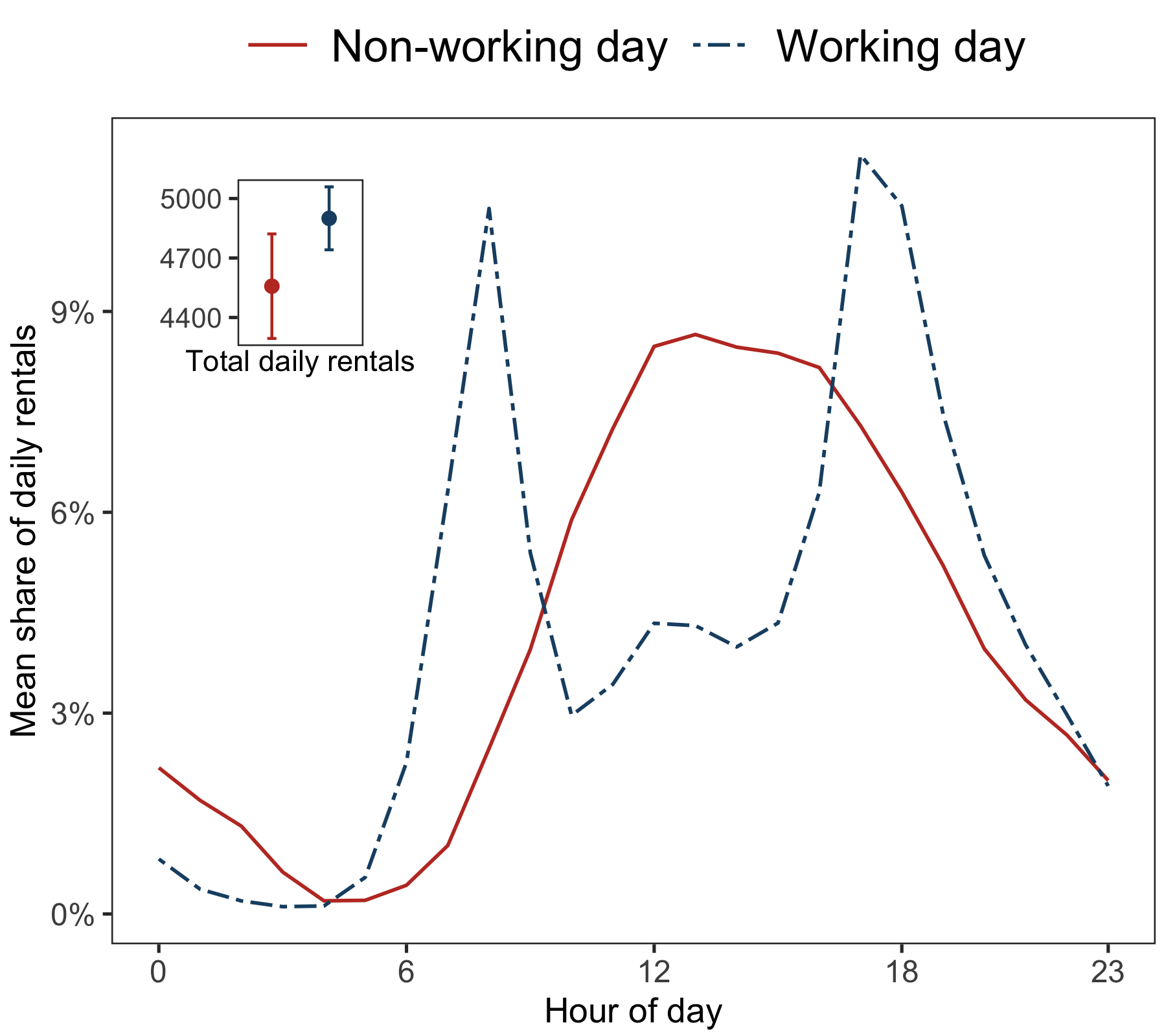
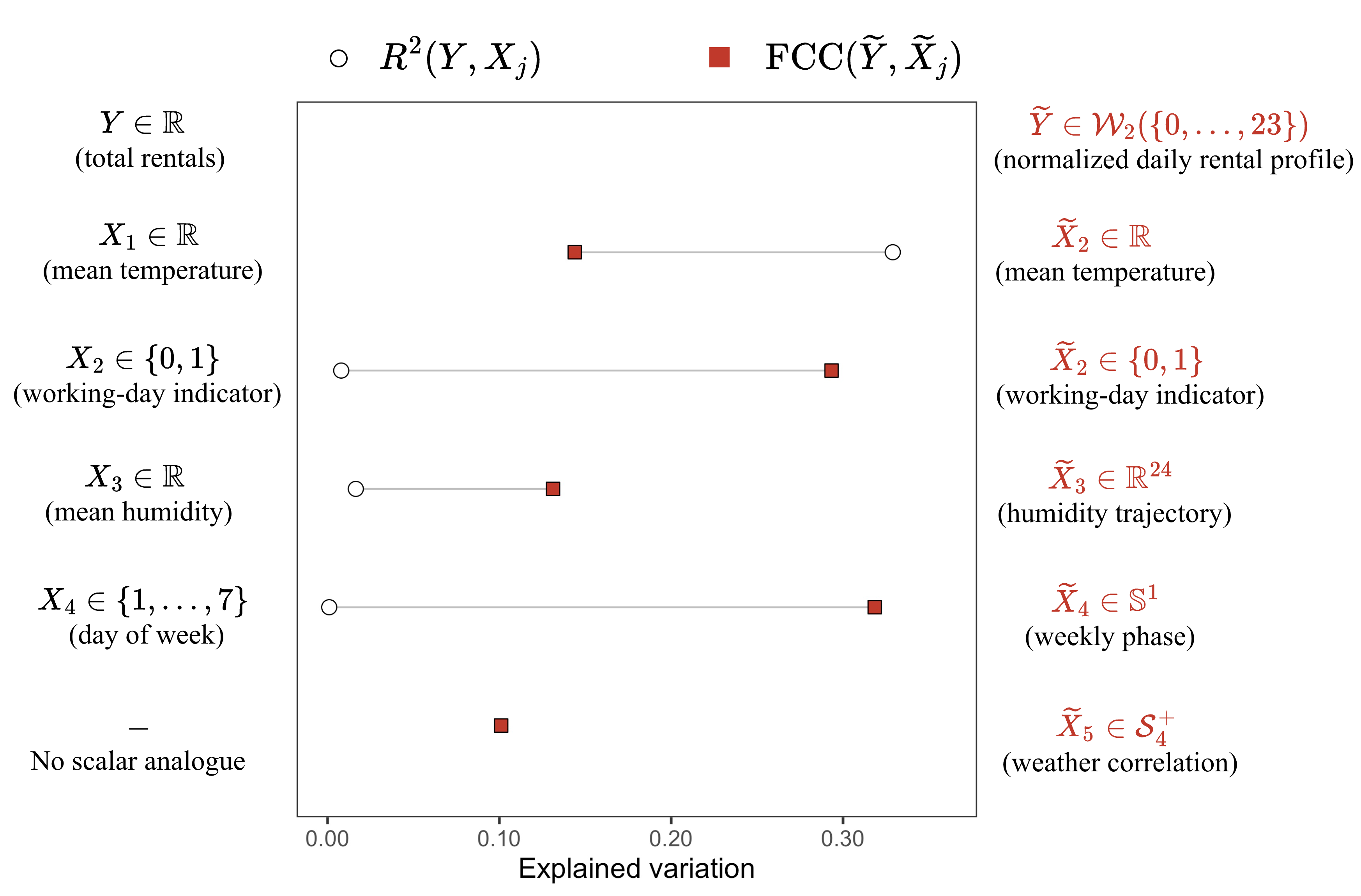
Figure 1: Normalized rental demand profiles (non-Euclidean response in Y3) and total-demand insets (Euclidean response) for working and non-working days, illustrating the interpretive necessity of geometry-aware explained variation.
Boundary Cases, Theoretical Analysis, and Asymptotics
The population FCC admits sharp boundary characterizations:
- Y4 iff Y5 is almost surely functionally determined by Y6.
- Y7 iff the conditional Fréchet mean of Y8 equals its global Fréchet mean almost surely in Y9 (including but not restricted to independence).
The partition-based estimator is shown to be strongly consistent. Under the null hypothesis (Y,dY)0: (Y,dY)1 (i.e., no Fréchet mean dependence), finite-sample and asymptotic null distributions are derived under fixed and growing partition regimes, essential for hypothesis testing and power calculation. For instance, the null limit law on finite-dimensional manifolds generalizes the classical ANOVA into a (potentially infinite-dimensional) weighted chi-square or Gaussian chaos, depending on the partition growth and metric structure.
Relation to Existing Methods
FCC generalizes the explained variation framework of (Y,dY)2 to metric spaces and contrasts with symmetric dependence measures (e.g., distance covariance, kernel-based association). It further orthogonalizes itself from recently proposed metrics such as Ball covariance and profile association, which detect general dependence but do not provide directional, response-specific decompositions of variance.
The FCC is strictly more general than several well-known special cases:
- Reduces to generalized correlation for real-valued (Y,dY)3 [zheng2012generalized].
- Strictly exceeds Fréchet (Y,dY)4 from parametric object regression [petersen2019frechet] when the regression model is misspecified.
Empirical Demonstration and Simulation Studies
Extensive simulation analysis covers scalar, vector, spherical, SPD, and Wasserstein response-predictor pairs, specifically considering scenarios where only nonlinear or geometric dependence persists. Under various configurations, FCC exhibits high power and competitive or superior sensitivity to dependence compared to energy statistics and Ball covariance, especially in non-Euclidean settings where localized or shape-oriented variation dominates.
Illustrative Example: Mode-Specific Explained Variation
Applying FCC to real-world multi-modal data, such as the Washington bike-sharing dataset, reveals divergent explanatory patterns when using Euclidean versus metric-space based response representations. For instance, working-day status shows negligible classical (Y,dY)5 for total rentals but a substantially larger FCC for daily rental profiles, indicating that such predictors primarily account for when rather than how much rentals occur—information that would be omitted in scalar reductions.
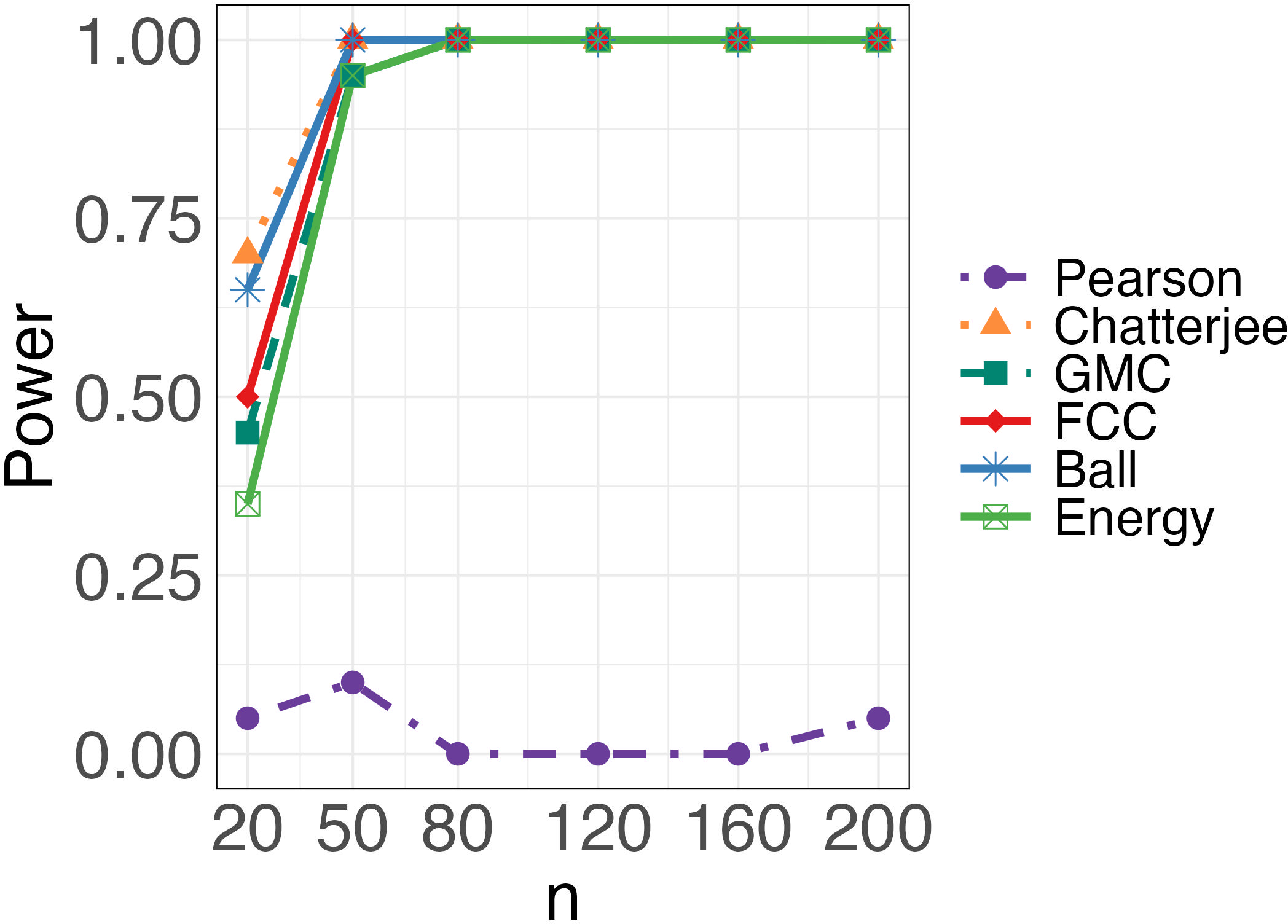
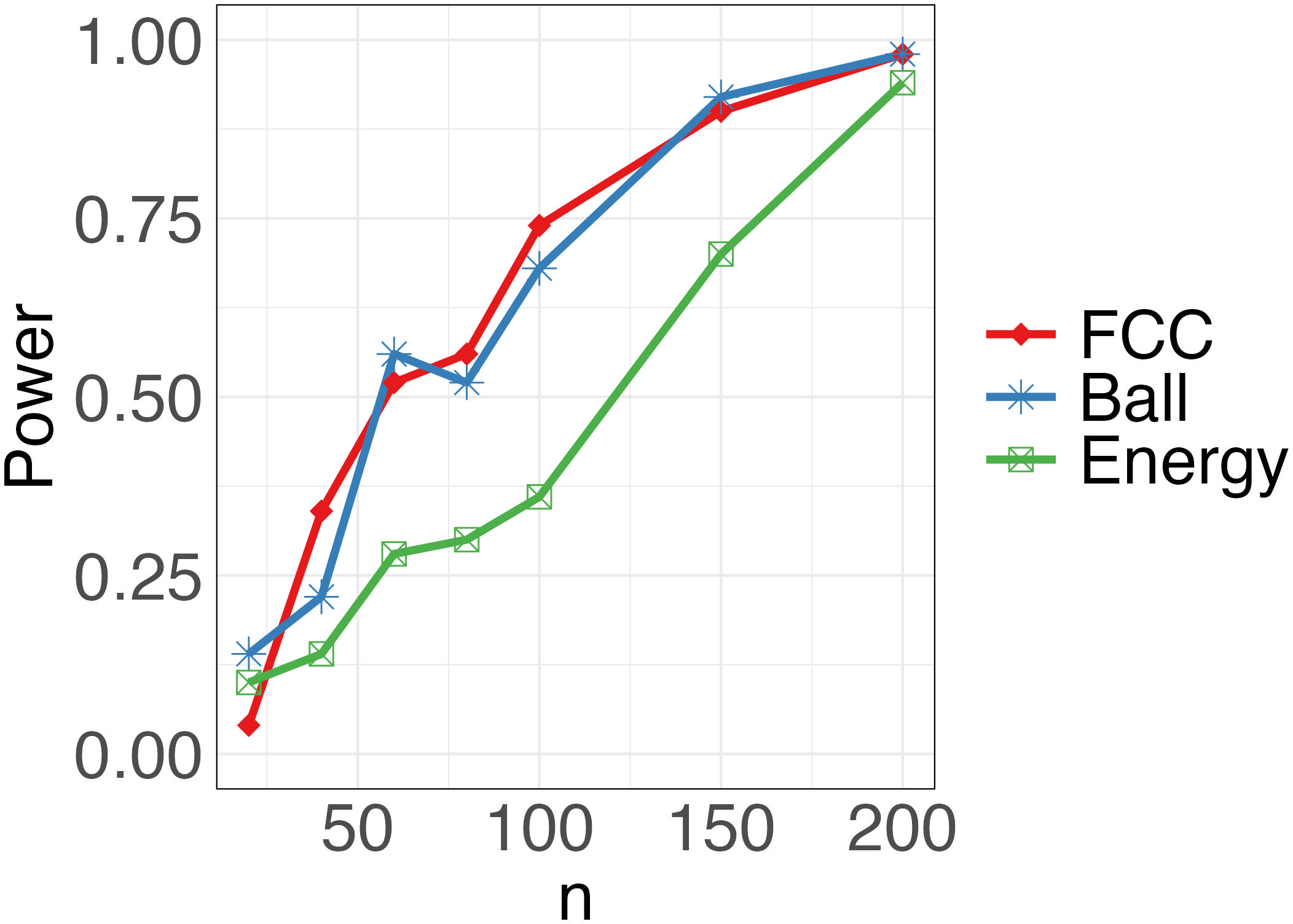
Figure 2: Plot illustrating the response-supporting space (Y,dY)6 for Euclidean total rentals versus geometric domain representations.
Behavior under Structured Noise Models
In one-dimensional Wasserstein and SPD manifold models, FCC shows measurable monotonicity to noise strength—explained variation measured by FCC decays with increasing stochasticity in the data-generating model. This behavior substantiates the FCC as a robust and interpretable effect-size statistic in complex, heterogeneous data structures.
Practical and Theoretical Implications
FCC enables rigorous, geometry-adaptive effect size quantification in multimodal data analysis, supporting both model selection and hypothesis testing. Its asymptotic theory ensures validity of inference in both fixed and high-complexity (growing partition) scenarios—critical for modern statistical workflows.
The framework is particularly impactful for:
- Comparative analysis of heterogeneous predictors where responses are probability measures, functions, SPD matrices, or manifold-valued traits.
- Object data regression, as in neuroimaging (e.g., connectomics), compositional data analysis, or imaging applications where the response is a non-Euclidean entity.
- Multimodal association discovery, such as between physiological signals and cognitive assessments, where scalar summarization is inadequate.
Future Directions
Immediate extensions include the development of data-adaptive partition selection methods, boosting both efficiency and interpretability, and integrating FCC more deeply with Fréchet regression to support joint effect size and regression surface estimation in general metric spaces. Additionally, methods for small-sample calibration—possibly via resampling—remain to be thoroughly examined.
Conclusion
The Fréchet correlation coefficient provides a principled, computationally tractable, and theoretically robust tool for measuring explained variation in regression and association studies with heterogeneous, non-Euclidean random objects. Its introduction constitutes a substantive advancement for high-dimensional, multimodal, and geometric data analysis, equipping practitioners to conduct inference and effect size estimation in settings well beyond the scope of classical correlation and (Y,dY)7-based metrics.
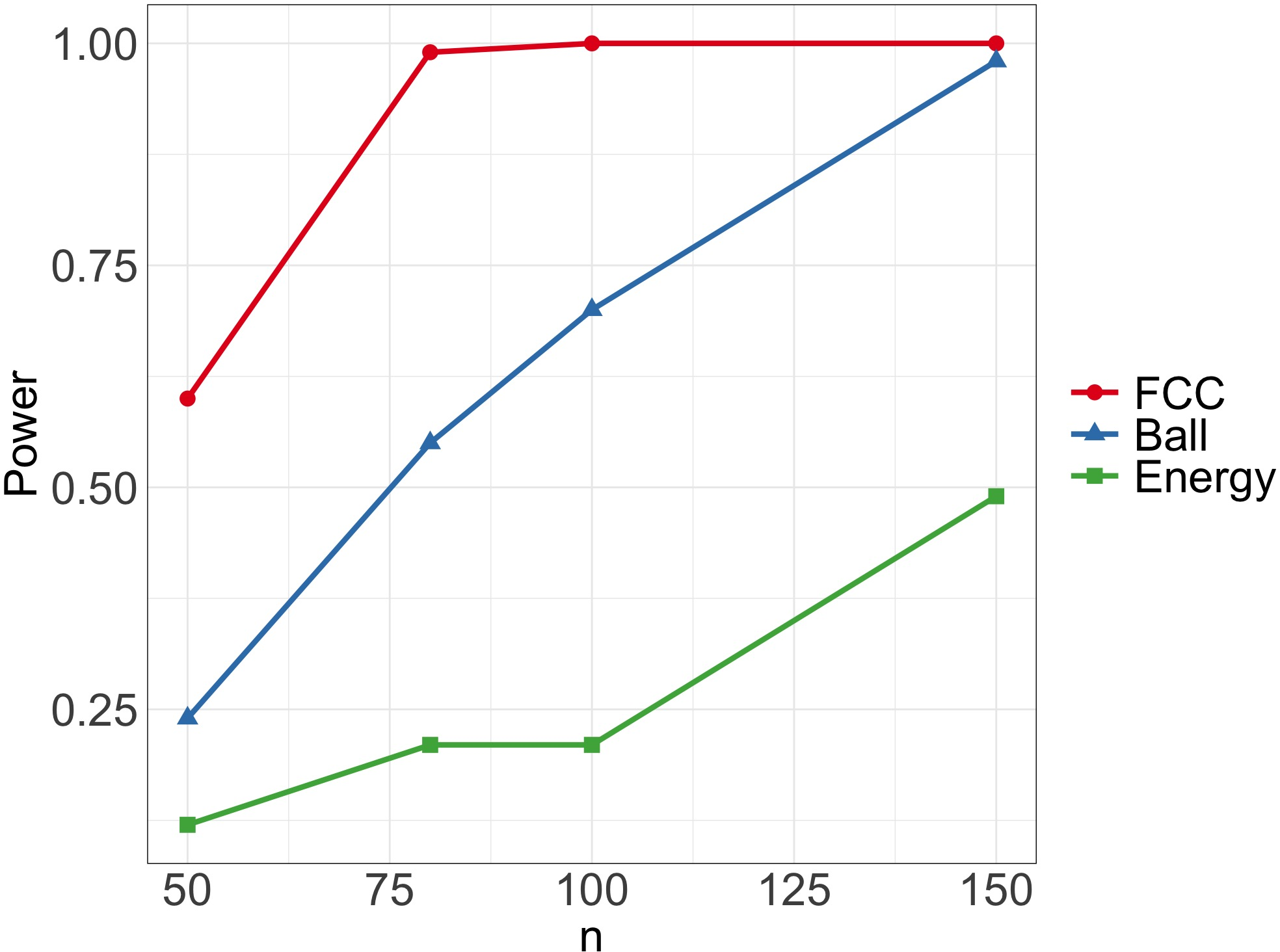
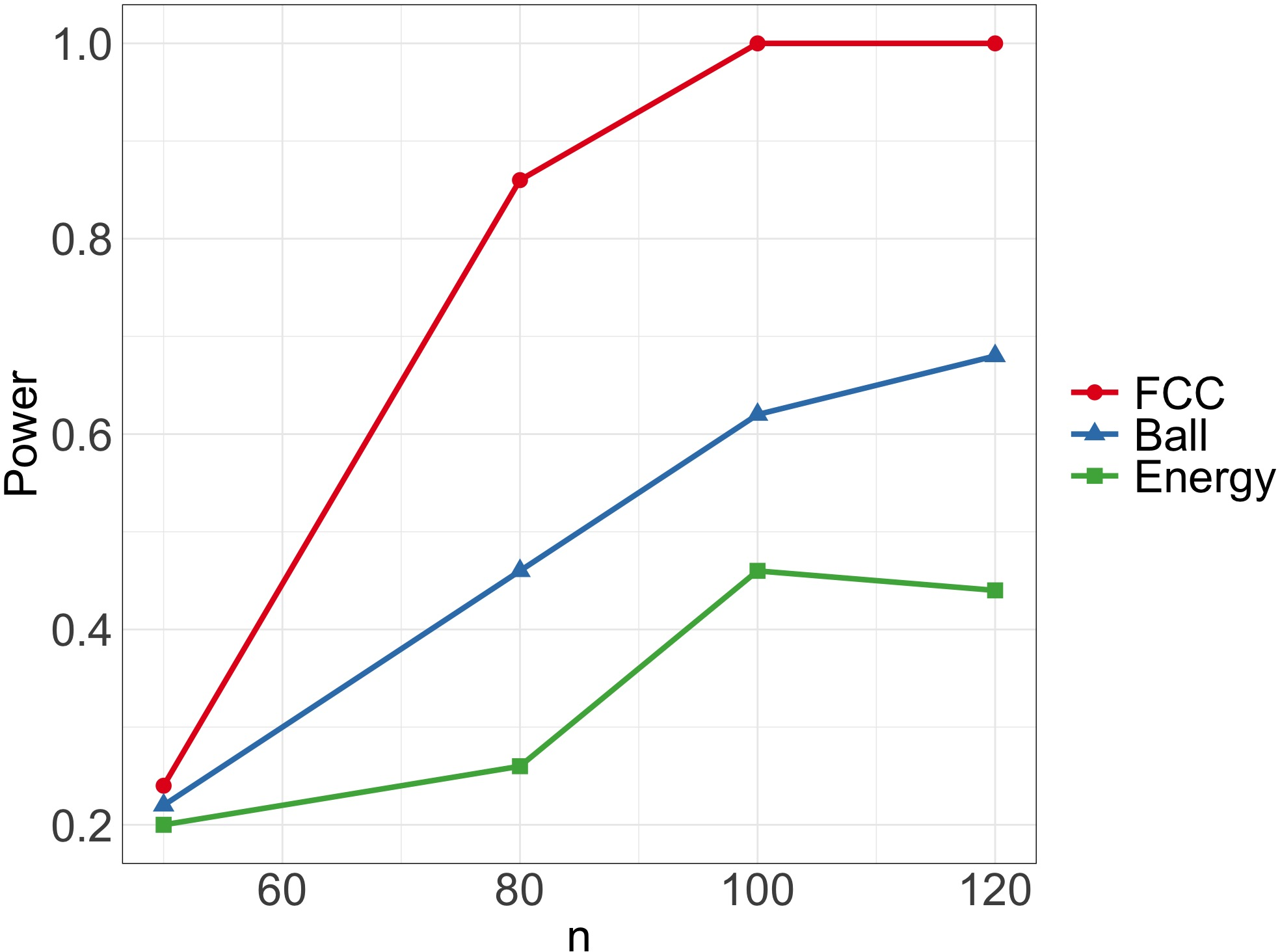
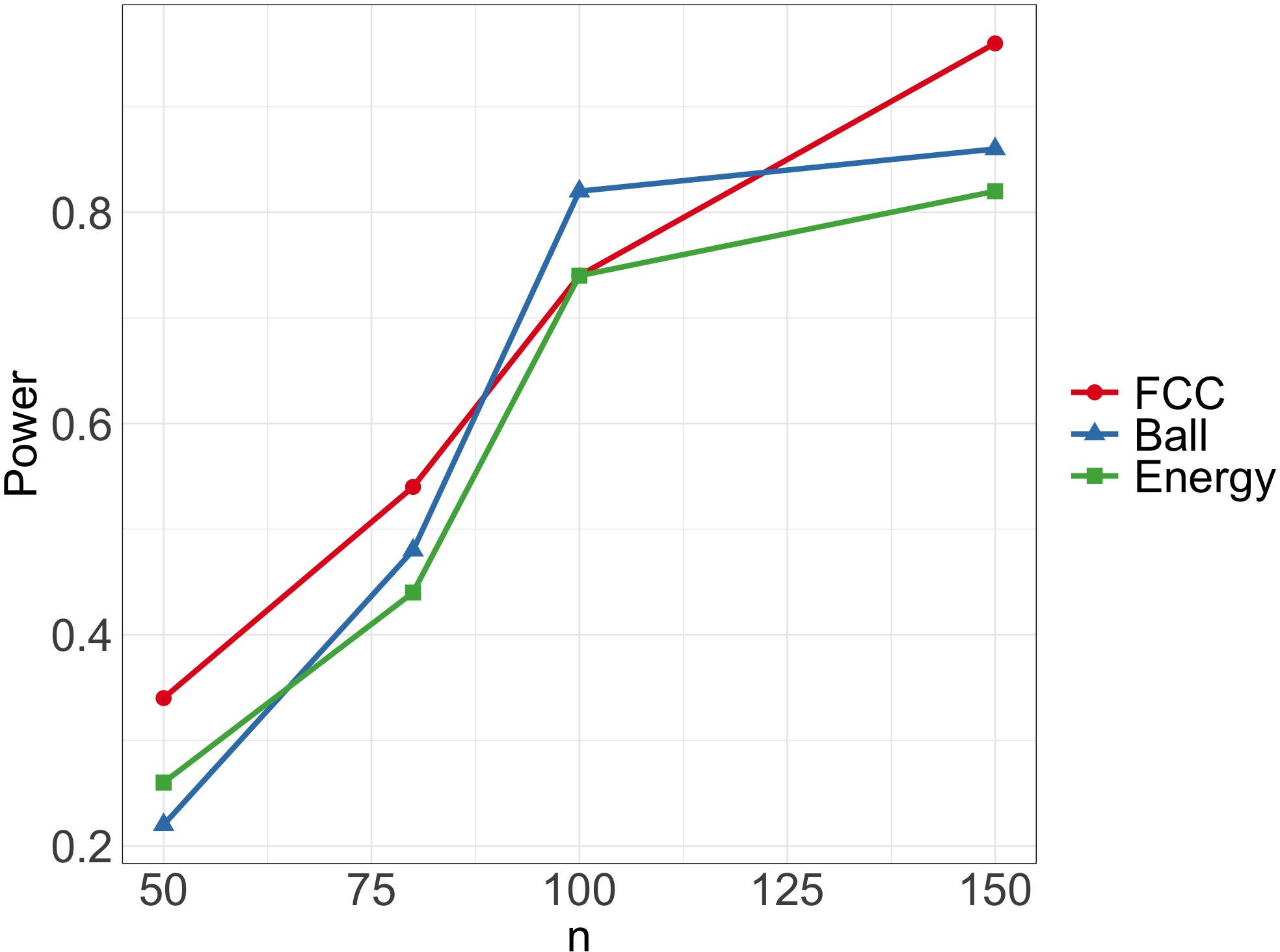
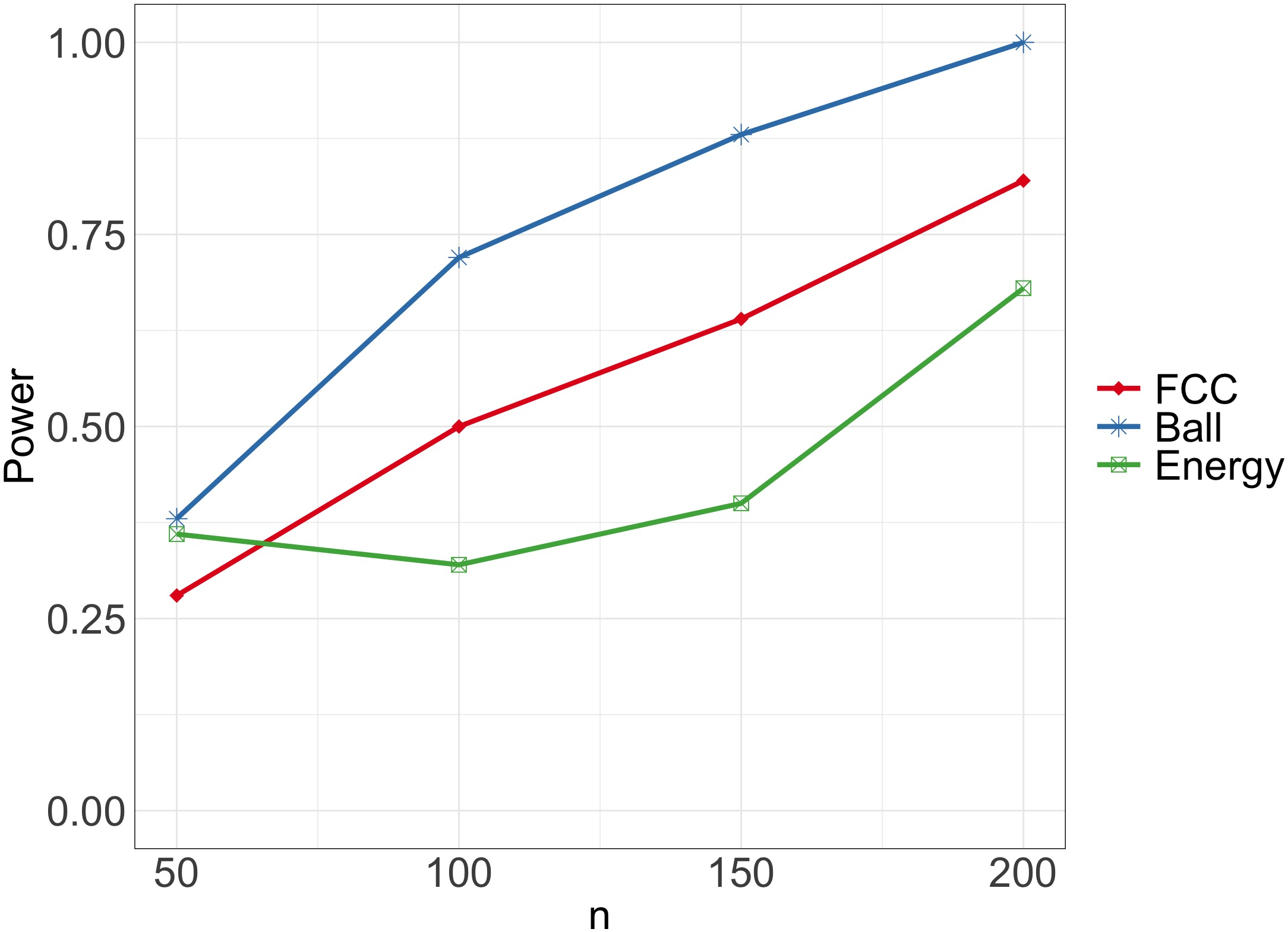
Figure 3: Schematic illustrating the response domain (Y,dY)8 for spherical manifold-resident object data, further exemplifying the necessity of geometric awareness in explained variation measures.