- The paper demonstrates that persistent self-propulsion reshapes CRR morphology, leading to non-monotonic facilitation behavior.
- It employs spatial and statistical analyses to decompose CRRs into core and shell regions, revealing distinct mobility and shape characteristics.
- The study identifies a universal diffusive scaling of facilitation length that persists despite activity-induced anisotropy and nonlinearity.
Introduction
This work presents a rigorous computational analysis of dynamical facilitation mechanisms in active glass formers under the influence of persistent self-propulsion, using the two-dimensional athermal Ornstein-Uhlenbeck particle (AOUP) model as the minimal active matter framework. The investigation systematically explores how activity—quantified by the persistence time τp and effective temperature Teff—modulates the morphology, spatial transport, and statistical properties of cooperatively rearranging regions (CRRs). Unlike passive glass formers where dynamical facilitation (DF) is nearly isotropic and density governed, the study explicitly tests the operational validity of DF theory in the active, nonequilibrium regime and analyzes the role of geometric and temporal reorganization of mobility excitations.
Model and Methods
The AOUP protocol features overdamped dynamics for a binary mixture in two dimensions, where persistent, exponentially correlated noise generates activity without explicit aligning interactions. Clusters of mobile particles, defined via DBSCAN at thresholded particle displacements, are decomposed into core and shell regions using median distance from the cluster center. Morphological analysis is done via the eigenvalue spectrum of the cluster gyration tensor, with asphericity and acylindricity serving as primary shape descriptors.
Excitation statistics are complemented by detailed analysis of radial displacement distributions, polarization, vorticity, and higher-order moments (skewness, kurtosis). Facilitation lengths ξfac are extracted by fitting the spatial decay of the mobility transfer function, which quantifies the temporal correlation and spatial extent of excitation propagation. Domain morphology is mapped in the (Teff,τp) plane, constructing distinctive phase diagrams for both core and shell regions.
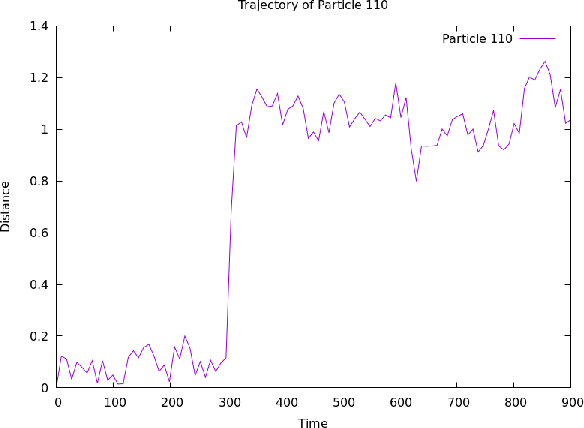
Figure 1: Typical particle trajectory associated with an excitation, demonstrating core mobility within the cluster.
Core–Shell Decomposition and Internal CRR Dynamics
The median-based core–shell partitioning reveals strong, activity-dependent dichotomy: the core is the locus of localized plastic rearrangement, while the shell acts as the mechanically responsive periphery transmitting mobility (Figure 2, Figure 3).
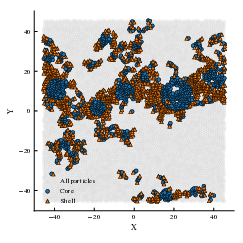
Figure 2: Representative core-shell partitioning of excitation clusters for a≥0.3 at fixed Teff shows distinct spatial hierarchy between core and shell.
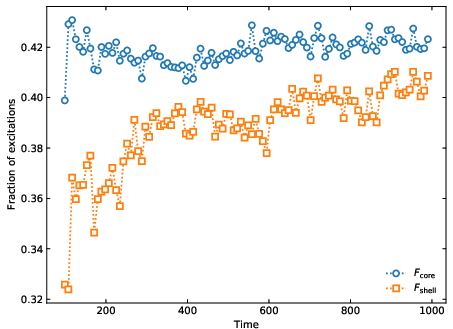
Figure 3: Time evolution of core and shell population fractions, establishing the dynamic exchange between localized and transmitted excitations.
Radial displacement distributions P(dm) indicate that modal displacement dpeak exhibits a non-monotonic dependence on τp at low to intermediate Teff—peaking where activity and noise optimally cooperate, but suppressed at large Teff0 due to coherence or trapping. Significantly, this non-monotonicity is temperature dependent, with monotonic increases only realized for moderate values of Teff1.
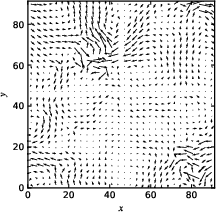
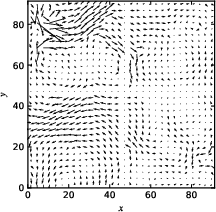
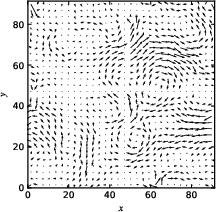
Figure 4: Different regimes of cooperative motion at large Teff2, highlighting transitions from coherent advection to vortex-like trapping structures dependent on noise level.
Polarization and vorticity analyses confirm that, while persistent activity aligns particle motion, it also diminishes internal rotational fluctuations. High polarization regimes correspond to coherent advective or vortex-trapped CRRs, as revealed by suppressed Teff3 and vorticity at large Teff4.
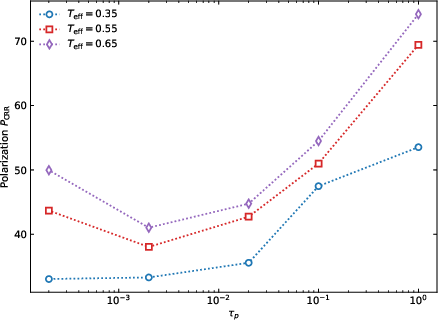
Figure 5: Average CRR polarization increases monotonically with Teff5, mapping the emergence of directional coherence.
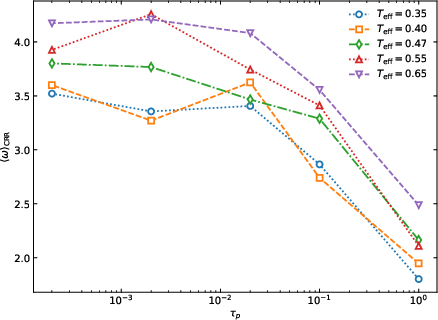
Figure 6: Average vorticity within CRRs, showing strong suppression at large persistence due to coherence or trapping.
Statistical Signatures of Cooperative Motion
The work identifies significant, nontrivial structure in the higher-order statistics of displacement distributions (kurtosis Teff6, skewness Teff7) as functions of Teff8. Both Teff9 and ξfac0 exhibit strong peaks at intermediate ξfac1 for low ξfac2, signaling increased tail weight and distribution asymmetry—statistical evidence for maximal dynamic facilitation driven by rare, collective rearrangements rather than smooth diffusion.
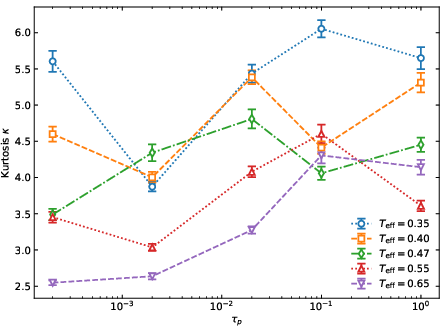
Figure 7: Kurtosis of ξfac3 versus ξfac4, indicating abundance of rare, large-scale events at optimal persistence.
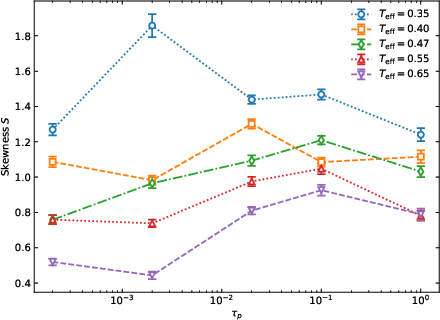
Figure 8: Skewness maximizes at intermediate ξfac5, corresponding to increasingly asymmetric, advective distributions.
Radial Structure and Shell Occupation
Radial distribution functions for core and shell show that, while the core geometry is robust to persistence changes, the shell population is strongly and non-monotonically modulated by ξfac6 and ξfac7. The shell occupation probability ξfac8 is maximized at intermediate persistence for low–intermediate ξfac9 but generally suppressed at high noise, establishing the structural basis for facilitation maxima.
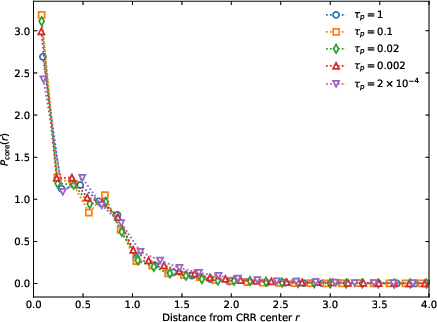
Figure 9: Core radial distribution is stable across Teff,τp0, underscoring persistence-insensitive core structure.
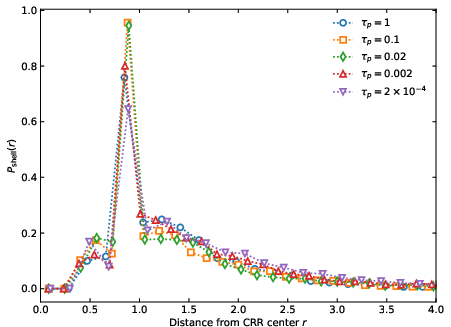
Figure 10: Shell radial distribution shows strong amplitude modulation with Teff,τp1, reflecting preferential shell occupation.
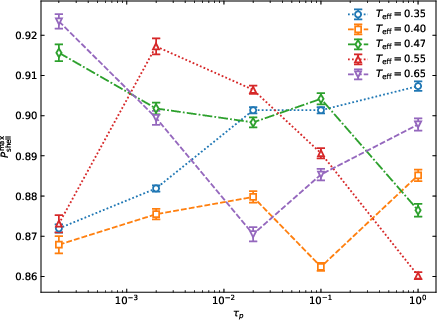
Figure 11: Maximum shell occupation probability, demonstrating non-monotonicity with respect to Teff,τp2 for different temperatures.
Facilitation Length and Universal Scaling
The facilitation length Teff,τp3—the key quantitative DF metric—is found to depend non-monotonically on Teff,τp4 for all Teff,τp5, with a principal maximum at intermediate persistence and secondary enhancement at the largest Teff,τp6. Crucially, when rescaled by the microscopic persistence length Teff,τp7, all data collapse onto a single master curve when plotted versus Teff,τp8, with the scaling law Teff,τp9.
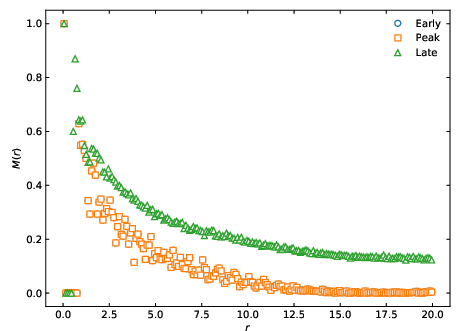
Figure 12: Mobility transfer function at various times, providing the empirical basis for extracting a≥0.30.
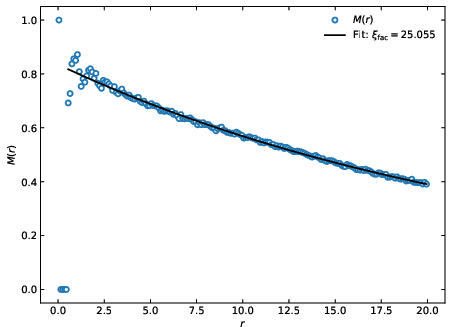
Figure 13: Exponential fit of the facilitation function enables precise extraction of a≥0.31.
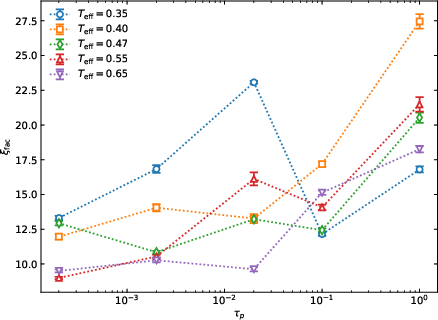
Figure 14: Facilitation length as a function of a≥0.32, exhibiting clear non-monotonicity across noise amplitudes.
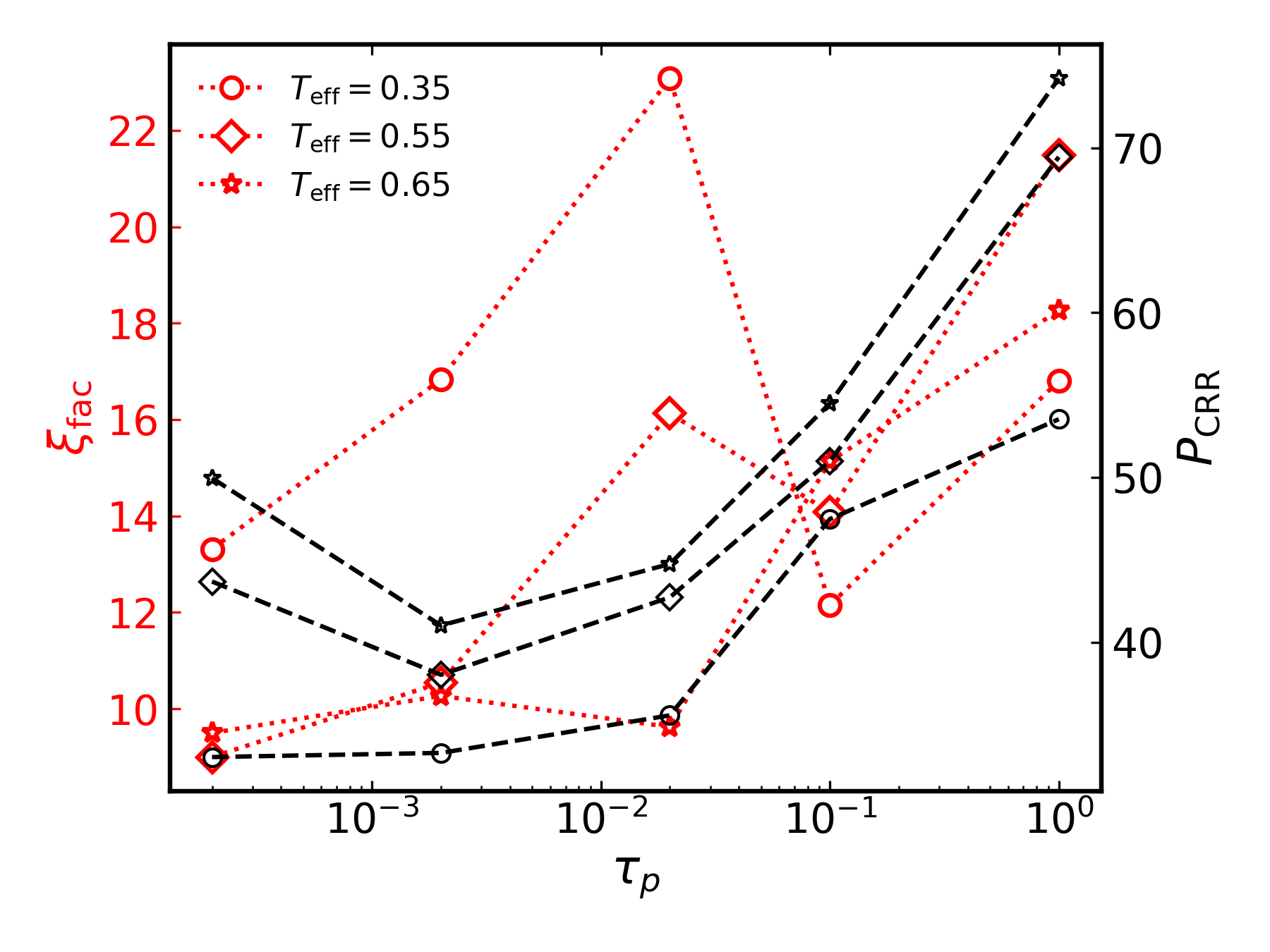
Figure 15: Scaling collapse of a≥0.33 vs. a≥0.34. Universality is recovered upon rescaling by a≥0.35.
This scaling demonstrates that, despite dramatic activity-induced reshaping of excitation morphology, the large-scale transport of mobility excitations retains a diffusive (dynamic exponent a≥0.36) character. The facilitation length spans up to two orders of magnitude larger than a≥0.37, supporting the robustness of DF theory under nonequilibrium drive.
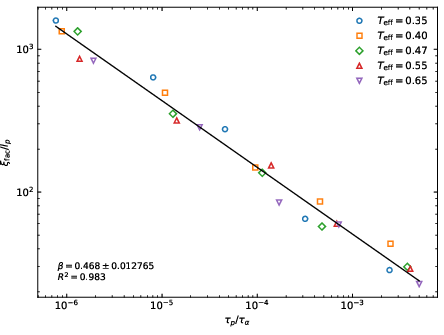
Figure 16: Reference 'glass' length a≥0.38 shows parallel scaling with a≥0.39, supporting passive–active universality.
Morphology and Shape Transitions of CRRs
Cluster-shape analysis using asphericity and acylindricity reveals that core morphology is highly sensitive to Teff0—evolving from compact (low asphericity) to mixed rod-and-sphere (bimodal) to elongated configurations as Teff1 increases. The shell, by contrast, primarily reflects acylindricity changes with more moderate dependence on Teff2, indicating its role as an accommodating, mechanically stable facilitator.
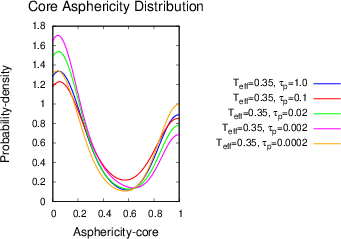
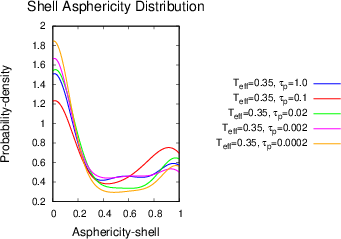
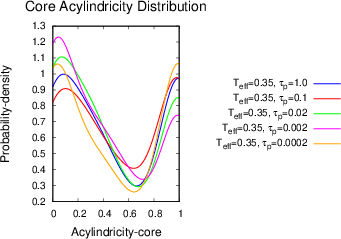
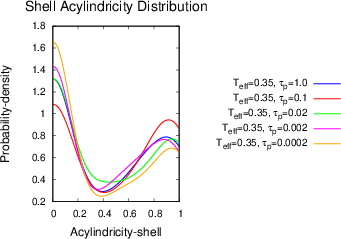
Figure 17: Core asphericity as a function of Teff3 and Teff4, mapping a clear trajectory from isotropic to stretched morphologies.
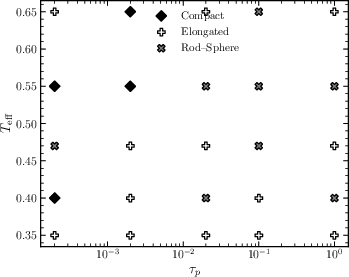
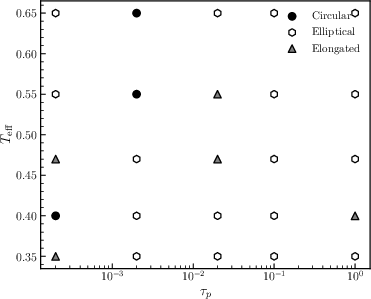
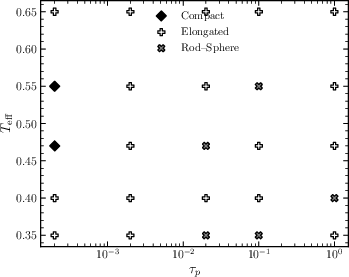
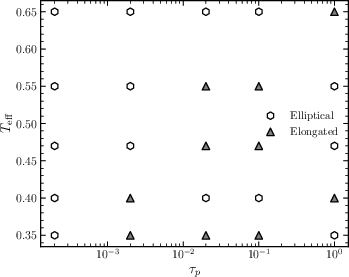
Figure 18: Phase diagram of core asphericity shows transitions from compact to fully elongated clusters; rod-like states dominate at high Teff5.
The percentile-based phase diagram reinforces this morphological hierarchy: core asphericity responds strongly and non-monotonically to persistence, while shell acylindricity captures cylindrical stretching at higher Teff6. This structural organization correlates closely with the optimized facilitation length and shell occupation probability.
Theoretical and Practical Implications
The unambiguous demonstration that dynamical facilitation persists in the active, non-equilibrium regime—albeit with reshaped, anisotropic pathways and non-monotonic control by persistence—constitutes a significant advance for both theory and modeling of glassy active matter. The findings indicate that dynamic universality classes (diffusive versus super-Arrhenius scaling) are robust against strong nonequilibrium perturbation, provided excitation concentration remains the governing variable. Functional separation between core and shell, and their differential responses to persistence, introduce a physically grounded mechanistic picture for the facilitation process in active systems.
Practically, these results imply that morphological and transport heterogeneity in real active materials (e.g., self-propelled colloids, biological tissues, or cytoskeletal assemblies) can be tuned by engineering the persistence of self-propulsive dynamics, with maximal mobility propagation possible at optimal combinations of persistence and noise. The activity-governed reshaping of CRRs suggests experimental metrics for inferring the presence and efficiency of facilitation in synthetic and living active glasses.
Conclusion
This work establishes that, within two-dimensional AOUP active glass formers, persistent activity reorganizes the geometry and statistics of dynamic facilitation through core–shell morphological restructuring. Facilitation length and shell occupation probability exhibit pronounced non-monotonic dependence on persistence, maximizing cooperative mobility at intermediate Teff7. Despite this, the fundamental transport law remains diffusive at large length and time scales, as shown by universal scaling collapse when rescaled by persistence length. Morphological analysis reveals that the core is the primary locus of activity-induced anisotropy, while the shell serves as a robust facilitator, and their interplay dictates the efficiency and spatial organization of excitation propagation. These insights refine the dynamical facilitation framework for active glasses and provide clear theoretical and methodological foundations for future studies of nonequilibrium glassy systems.
Future directions include extension to three-dimensional systems, coupling with external fields or disorder, and exploration of the DF regime near motility-induced phase separation, where new collective length scales may dominate, potentially breaking the observed diffusive universality.
Reference: "Dynamical Facilitation in Active Glass Formers: Role of Morphology and Persistence" (2604.10468)