- The paper develops a unified Lagrangian framework that connects GNY, NJLY, and Wess-Zumino models through arbitrary scalar and fermion flavor counts.
- It employs a modified Clifford algebra and rigorous dimensional regularization to ensure quantum consistency and eliminate unwanted flavor anomalies.
- Emergent SUSY conditions are pinpointed at critical flavor points, leading to optimized computations for operator anomalous dimensions.
Unified Supersymmetry and Non-Supersymmetric Theories: Gross-Neveu-Yukawa Framework
Overview of Unified Lagrangian Construction
The paper develops a generalized Lagrangian that encapsulates the Gross-Neveu-Yukawa (GNY), Nambu-Jona-Lasinio-Yukawa (NJLY), and Wess-Zumino (WZ) models within a single theoretical construction. This unified Lagrangian is parameterized by arbitrary flavor counts of scalars (ns) and fermions (nf), with full flavor symmetry and generalized interaction terms. The formulation leverages the modified Clifford algebra for flavor elements, ensuring the absence of evanescent terms in loop expansions.
The construction reveals deep structural connections between non-supersymmetric and supersymmetric field theories. By embedding models with different flavor content, it systematically exposes conditions under which emergent supersymmetry occurs, notably at special values of (ns,nf) corresponding to critical points in the GNY and NJLY universality classes.
Modified Clifford Algebra and Flavor Structure
The central mathematical tool is the modified Clifford algebra for flavor matrices ZI and ZˉI, which ensures locality and preserves the quantum structure essential for consistent renormalization:
ZIZˉJ+ZJZˉI=2δIJ
This algebraic structure is proven necessary and sufficient for non-evanescent behavior of primitive diagrams, guaranteeing the absence of flavor-induced anomalies or inconsistencies at any loop level. The flavor quartic interaction tensor MIJKL is correspondingly fixed, enabling universal trace relations and spinor contractions across model types.
Dimensional Regularization and Trace Identities
Dimensional regularization is discussed with care due to the potential presence of evanescent operators and the technicalities of γ5 in higher loops. Trace identities generalize to arbitrary spacetime dimension D and flavor structure, including careful treatment of odd and even traces via block-matrix ΓI constructions.
At four loops (and below), nf0-induced anomalies do not arise due to the topology of Feynman diagrams; explicit analysis shows contributions vanish until five-loop order, aligning with known constraints from previous studies. The paper provides prescriptions for handling flavor traces in both even and odd dimensions, ensuring consistently regularized calculations.
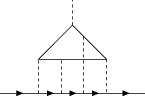
Figure 1: Diagrams in three-dimensional regularization illustrating non-vanishing odd trace contributions, relevant for emergent SUSY at nf1.
Renormalization and Emergent SUSY Conditions
The paper systematically works out renormalization, anomalous dimensions, and β-functions for the generalized theory, expressing counterterms in terms of loop order expansions. All propagators and vertices are composed as sums of flavor factors times loop integrals, facilitating efficient computational automation.
To identify emergent SUSY, the authors analyze the equality of anomalous dimensions for scalar and fermion fields:
nf2
At each loop order, transcendental coefficients and flavor structures yield algebraic curves in nf3 space; supersymmetric points correspond to intersections where all constraints are simultaneously satisfied.
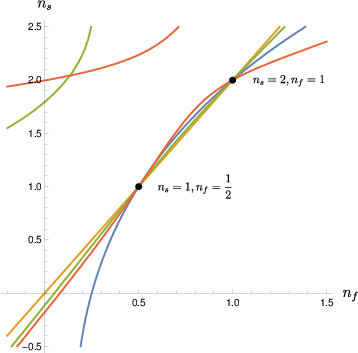
Figure 2: Intersection of loop order SUSY Ward identity curves in nf4 space; two emergent SUSY points serve as critical solutions.
A strong numerical result is that all analyzed SUSY Ward identity constraints up to four loops intersect at exactly two points: nf5—matching nf6 four-dimensional Wess-Zumino model field content, and nf7—corresponding to three-dimensional emergent SUSY. Calculations confirm that non-renormalization theorems (holomorphic superpotential, nf8) hold only at the four-dimensional SUSY point.
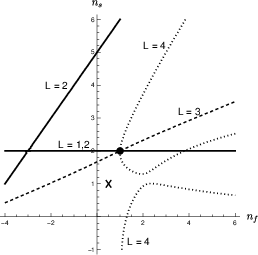
Figure 3: Curves for non-renormalization of the superpotential; only the four-dimensional SUSY point nf9 satisfies all conditions.
Application: Operator Renormalization Optimization
The unified Lagrangian is leveraged to optimize the computation of anomalous dimensions for twist-two operators in GNY-type theories. Operator matrix elements (OMEs) are expressed as flavor-symmetric correlators, and emergent SUSY is used to generate additional Ward identities, which remove redundant integrals from loop expansions.
The approach is formalized via systematic projection to the WZ model at the SUSY point, enabling light-cone formulation and elimination of auxiliary (non-physical) operator contributions. At two and three loops, the optimization reduces computation time for high-spin Mellin moments by roughly 25%, illustrating practical benefit even in non-supersymmetric settings.
Numerical results confirm that SUSY-inspired Ward identities hold for operator anomalous dimensions at all even moments and loop orders, after appropriate treatment of odd Clifford traces for three-dimensional cases.
Implications and Future Directions
The theoretical implications are substantial: the unification and algebraic constraints elucidate the deep relationship between non-SUSY and SUSY models, confirming the unique nature of emergent SUSY conditions at critical points. Practically, the approach offers a scalable means to optimize renormalization calculations in field theories, including for high-loop and high-moment computations relevant in QCD.
Potential future developments include:
- Extension of optimization techniques to QCD, especially flavor-singlet sector computations at high loop order.
- Analyses in supersymmetric gauge theories (e.g., (ns,nf)0 SYM), where flavor tensor algebra can resolve ambiguities in dimensional regularization.
- Systematic mapping of all-loop SUSY results (e.g., NSVZ β-function constraints) onto non-SUSY models for further computational and phenomenological improvements.
Conclusion
This work establishes a rigorous, unified Lagrangian framework connecting supersymmetric and non-supersymmetric quantum field theories, elucidates emergent SUSY at critical flavor points, and demonstrates practical computational gains via SUSY-inspired optimization of operator renormalization. The flavor-modified Clifford algebra is shown to be both an organizational and constraining principle for quantum consistency and calculation efficiency, opening new vistas for precision field theory and higher-loop perturbative computations.