- The paper introduces new complexity classes—U-complete, D-complete, and H-complete—grounding each in Cantorian diagonalization and Turing's computational framework.
- It demonstrates how the cardinality mismatch between countable algorithmic procedures and uncountable problem spaces establishes inherent undecidability.
- It extends classical Turing machine concepts to super-Turing and hypercomputational models, proposing practical implications for AI and advanced algorithmic theory.
Historical Foundations and Theoretical Context
The paper "Turing or Cantor: That is the Question" (2604.10418) provides a rigorous examination of the interplay between Alan Turing’s formalism of computation and Georg Cantor’s foundational work in set theory and infinities, emphasizing Cantor’s underrecognized but crucial impact on computational theory. While Turing's models are universally regarded as the basis of classical computability and digital algorithmics, the argument presented is that Cantor’s insights into cardinalities and diagonalization are indispensable prerequisites for Turing's results, especially with regard to the unsolvability of Hilbert’s Entscheidungsproblem.
Both the historical and mathematical trajectory of computability hinges on the recognition that Turing’s enumeration of algorithmic procedures corresponds to the countable set of integers, while the space of potential problem instances—particularly languages—corresponds to the uncountable set of real numbers as established by Cantor. The cardinality mismatch, formalized through diagonalization, yields intrinsic undecidability and incompleteness.
Turing Machines: Standard Model and Extensions
The paper delineates the canonical Turing machine (TM) as the archetype for recursive algorithms. TMs admit languages by accepting input strings either via halting in a final state or by exhaustion of defined transitions. The machinery involves finite control, an infinite tape, and deterministic transitions.
Extensions and equivalence classes are addressed: nondeterministic TMs, multi-tape TMs, Chomsky grammars, recursive functions, Markov algorithms—all form computationally equivalent models to TM. Less expressive automata include finite and pushdown automata; more expressive, super-Turing models encompass choice machines, oracle machines, and unorganized machines (as per Turing), as well as modern constructs such as infinite time TMs, accelerating TMs, neural networks on real numbers, and evolutionary computational models. Principles like interaction, evolution, or infinity are identified as the key drivers of higher computational expressivity.
Cantor’s central results—one-to-one correspondences, uncountability of the real numbers, power set cardinality, and the diagonal argument—are not merely background but integral to proving the limitations of algorithmic computation. Turing’s proof strategy for the Entscheidungsproblem is fundamentally rooted in Cantorian diagonalization, allowing for the construction of non-enumerable sets of languages and thus the existence of problems not solvable by any TM.
Entscheidungsproblem: Dual Proof Strategies and Beyond
The unsolvability of the Entscheidungsproblem is established here both through Turing’s original method (encoding logical statements as real numbers and demonstrating the existence of uncomputable numbers) and through a shorter Cantor-based proof articulated in the paper: putting the Universal TM as its own input yields an analysis over all subsets of possible encodings, an uncountable set per Cantor, thus precluding decision algorithms.
Further, the paper extends Turing’s work on oracle machines and systems of logic parametrized by ordinals (inspired by Cantor’s infinite hierarchy of cardinalities) as the prototypical super-Turing constructs. Turing envisioned an infinite hierarchy of increasingly complete logics, mirroring Cantor’s infinite ordinals.
Hierarchies of Undecidability and Complexity: Novel Classification
A significant original contribution of the paper is the introduction of three new complexity classes for TM undecidable problems:
- U-complete (Universal-complete): Semi-decidable class, analogous to NP-completeness, where solutions can be verified but not necessarily found; includes Universal TM language, PCP, Busy Beaver Problem, ambiguity of CFGs—members are characterized by recursive enumerability without recursive decidability.
- D-complete (Diagonalization-complete): Non-recursively enumerable class, characterized by problems defined via diagonalization that cannot be recognized by any TM; includes languages like the diagonalization language, empty TM language, and their complements.
- H-complete (Hypercomputation-complete): Hyper-undecidable class, admitting neither recursive nor recursively enumerable characterization; canonical representative is the hyper-diagonalization language, and members require reductions potentially via a-decidable or i-decidable mechanisms.
These classes imply not only a partitioning of undecidable problems but also a potential infinite hierarchy, hypothesized in the paper, inspired by Cantor’s multiple levels of infinity and Turing’s stratified logics.
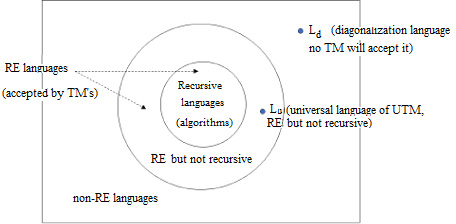
Figure 1: Visualizes the relationships between recursive, recursively enumerable, and non-recursively enumerable languages, emphasizing the hierarchical structure underpinning undecidable problems.
Strong claims are made regarding the structure of undecidability: recursive languages are strictly separate from recursively enumerable languages for U-complete problems, and non-RE classes subsume D- and H-complete problems. The measure of undecidability is formalized by the proportion of input instances that are undecidable, their probability distribution, and the degree of unsolvability—a novel approach that enables a stratified analysis of algorithmic limits, rather than a binary decidable/undecidable dichotomy.
Practical and Theoretical Implications
The systematic expansion of Turing’s framework to super-Turing and hypercomputational models is argued to be increasingly relevant, given trends in non-terminating computation, continuous computation, and natural computation. The recognition that more problems are undecidable than decidable, and that decidability is only a subset within an infinite hierarchy of computational hardness, compels a shift in focus from polynomial algorithmic tractability to broader classes of asymptotic, infinite, and probabilistically decidable computations.
The formal introduction of U-complete, D-complete, and H-complete offers a structured lens for classifying undecidable problems—analogous to NP-completeness and its intractable problem class—enabling systematic reduction arguments and mapping between hardness classes, paralleling the advances made in classical complexity theory.
Implications in AI and machine learning center on approximation and probabilistic decision strategies for undecidable or intractable problems, as well as the pursuit of new computational paradigms, echoing Turing’s own advocacy for models beyond a-machines. The intersection of infinite computational hierarchies and emerging architectures (neural networks, evolutionary paradigms) suggests new fundamental research directions.
Conclusion
The paper delivers a formal, technical synthesis of Turing’s and Cantor’s foundational roles in computational theory, extending Turing’s legacy to a broader, more nuanced classification of undecidable problems. The explicit construction of U-complete, D-complete, and H-complete classes fills a gap in the theory of computation, offering rigorous analogs to classical completeness notions and proposing an infinite hierarchy inspired by set theory. This stratification has broad implications for theoretical computer science, complexity theory, and speculative computational models in AI. The integration of probability distributions for undecidability measures and the extension to hypercomputation signal fertile ground for further developments—both in practical algorithmics and foundational logic.

