- The paper presents two novel probabilistic constructions, SG-GC and EP-GC, that closely match the worst-case error performance of optimal BIBD codes.
- The SG-GC method employs a sparse Gaussian approach to significantly expand feasible parameter regimes while maintaining key statistical properties.
- The EP-GC technique leverages spectral control and degree-preserving sparsification to enhance robustness against adversarial stragglers in distributed systems.
Probabilistic Gradient Coding via Structure-Preserving Sparsification: Technical Essay
Introduction
The paper "Probabilistic Gradient Coding via Structure-Preserving Sparsification" (2604.10374) addresses the challenge of mitigating straggler effects in distributed gradient computation by exploiting advanced constructions of gradient codes. Classical methods, such as combinatorial BIBD gradient codes, offer optimal adversarial straggler resilience but are available only for restricted parameter regimes due to stringent combinatorial constraints. This work proposes two new probabilistic gradient code constructions — the Sparse Gaussian (SG) and the Expansion-Preserving (EP) gradient codes — that significantly expand the parameter space and closely approach the optimal worst-case error performance of BIBD codes while enabling practical polynomial-time construction.
Gradient Coding: Preliminaries and Existing Codes
In distributed learning, the server partitions the dataset into K pieces, allocates weighted combinations to N workers, and aims to reconstruct the entire gradient sum with minimal error even when S workers are stragglers. An encoding matrix E∈RK×N governs the assignment, and gradient codes are measured by the normalized worst-case squared error over all possible subsets of non-straggling workers.
Classical codes include:
- Fractional Repetition Code (FRC): Vulnerable to adversarial straggling, with stepwise error surges as S increases.
- Bernoulli Gradient Code (BGC) and regularized BGC (rBGC): Employ i.i.d. random assignment, allowing greater parameter flexibility but suffer from higher error.
- BEG-GC (Bipartite-Expander-Based): Uses expander graphs for robustness; error is tightly linked to the graph's spectral gap but realizable only for narrow degree distributions.
- BIBD Gradient Code: Offers optimal error resilience due to its regular structure, but BIBD incidence matrices exist only for select (N,K,L,R,λ) parameter sets.
Soft BIBD codes use a probabilistic approach to partially alleviate existence issues, but remain constrained by binary matrix requirements.
Sparse Gaussian Gradient Code (SG-GC)
Construction and Properties
The SG-GC encodes assignments with sparsity and weighted randomness, emulating the marginal statistics of BIBD codes while utilizing real-valued matrices. Each entry of the K×N encoding matrix is formed by masking a correlated Gaussian random variable with an independent Bernoulli variable, ensuring in-expectation agreement with BIBD per-row/column sum and pairwise intersection properties. The approach is parameterized by (N,K,L,R,λ,γ) with precise criteria (Theorem~1 in the paper) to ensure the positivity of variance and feasibility.
This probabilistic design dramatically expands the set of permissible parameterizations over BIBD and soft-BIBD codes, as illustrated in Figure 1.
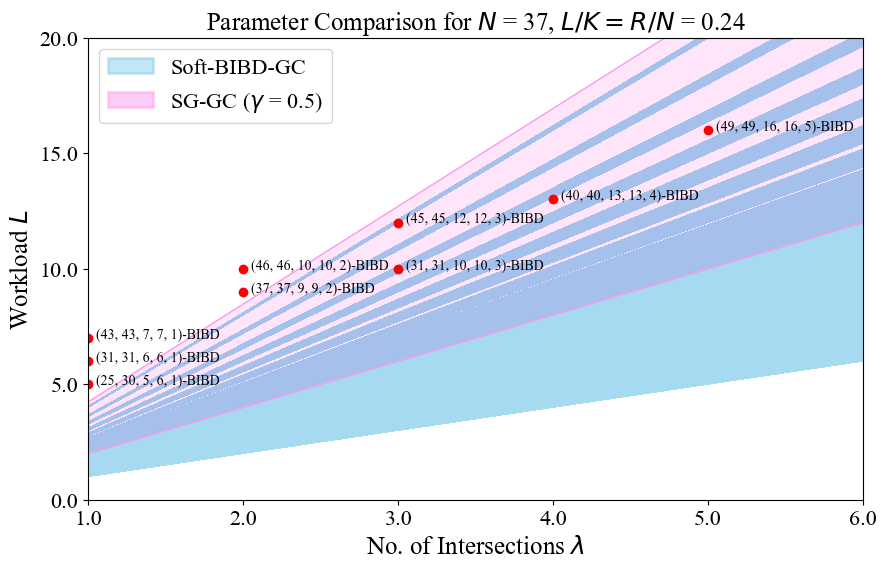
Figure 1: The parameter region (pink) for SG-GC codes, significantly outstripping the soft-BIBD (blue) and combinatorial BIBD (red dots) regions for fixed N and density.
Error Guarantees and Regime Expansion
A key theoretical guarantee (Theorem~2) asserts that, for large N and under the conditions N0, SG-GC achieves worst-case error with high probability that is within an N1 additive factor of the optimal BIBD code with matching parameters. The error's concentration properties stem from sub-exponential tail control and tight matching of first- and second-order statistics to BIBD constructions.
Thus, SG-GC enables gradient codes for workloads where combinatorial BIBDs or their binary relaxations do not exist, with negligible error penalty.
Expansion-Preserving Gradient Code (EP-GC)
Construction via Spectral Control
EP-GC is constructed to achieve optimal robustness by maintaining spectral properties (specifically, the second-highest eigenvalue) critical for adversarial error control in expander-based codes. It begins with a symmetric random half-normal N2 core, augments to N3 to enforce uniform row/column sums N4, and applies the DegreePreservingSparsify algorithm to create a sparse graph while exactly preserving degree and, crucially, controlling eigenvalue distortion.
The parametric regime for EP-GC is controlled independently by N5 (row/column sum) and N6 (sparsification accuracy), leading to enormous flexibility relative to combinatorial BEG-GC with rigid degree constraints Figure 2.
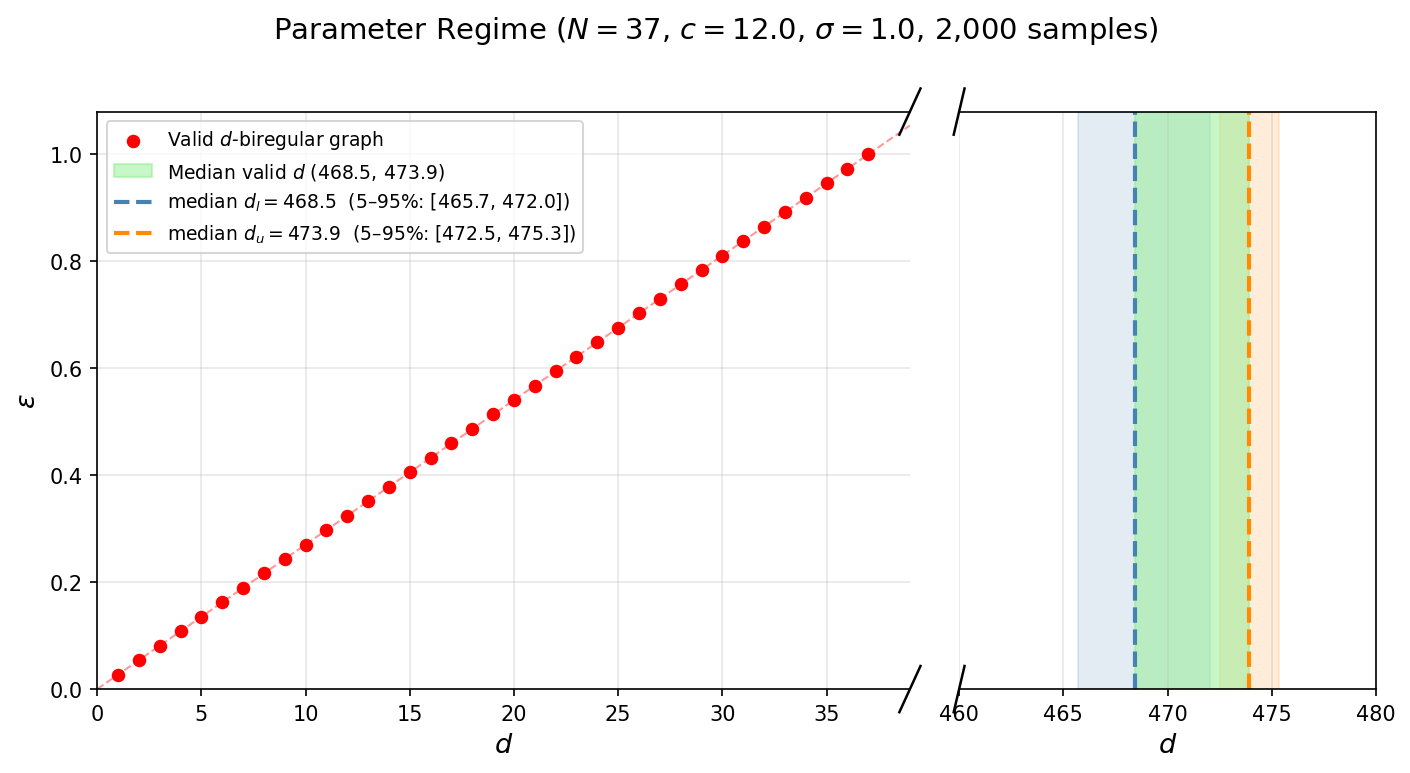
Figure 2: EP-GC’s feasible N7 region (green) vastly exceeds the parameter points for BEG-GC (red), and allows independent sparsity control via N8.
Theoretical Error Analysis
EP-GC obtains explicit spectral-norm bounds between pre- and post-sparsification Laplacians. The main result (Theorem~3) bounds the worst-case reconstruction error as:
N9
where S0 is the second-largest eigenvalue of the original assignment matrix. This bound shows that error can be made arbitrarily close to expander/BIBD performance by tuning S1 and enforcing sufficient spectral gap, with flexibility for moderate density/sparsity.
Empirical Evaluation
An empirical comparison across the spectrum of classical and proposed codes demonstrates strong relative performance for SG-GC and EP-GC. Notably:
- Near-optimal error: Both SG-GC and EP-GC closely match BIBD-GC’s error profile, especially for low-to-moderate straggler ratios.
- Error trends: In the regime of many stragglers, EP-GC remains nearly indistinguishable from BIBD-GC, validating the efficacy of spectral preservation. SG-GC incurs slightly higher error but remains highly competitive.
- Other codes: rBGC and BGC codes are dominated in all settings, and FRC shows poor adversarial resilience.
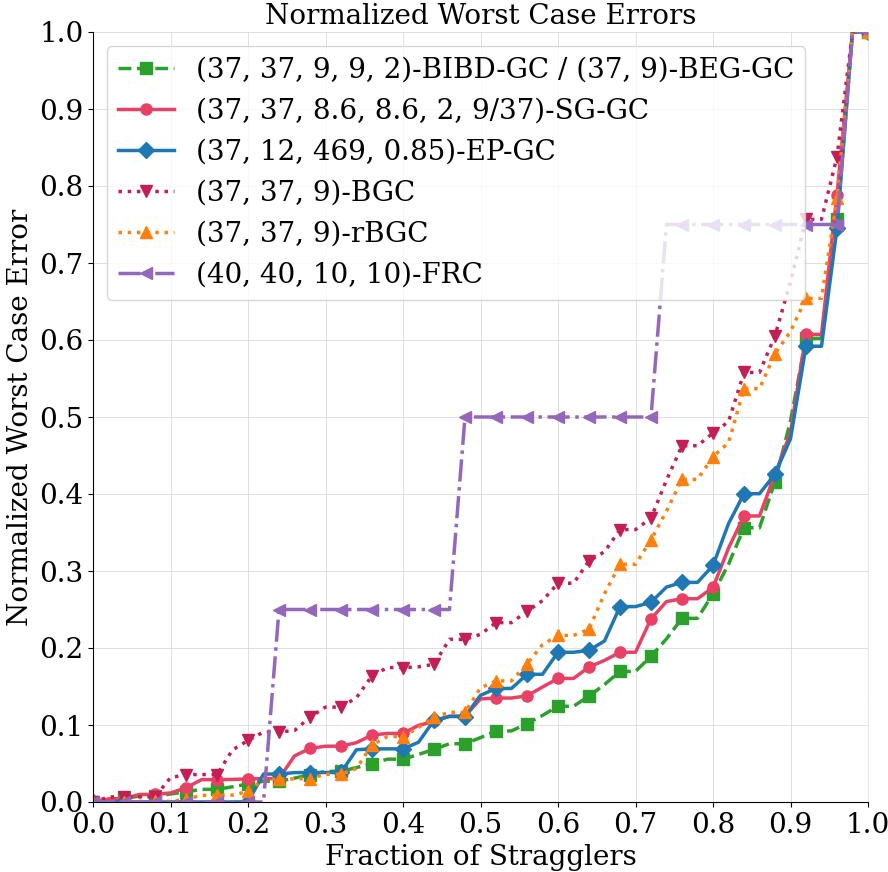
Figure 3: Normalized worst-case error vs. straggler fraction for SG-GC, EP-GC, BIBD-GC, and other codes, matched for column densities (SG-GC: 0.24, EP-GC: 0.25).
Implications and Future Directions
The structural decoupling of coding parameter regimes from combinatorial design constraints represents a substantial advance for practical straggler-robust distributed computation in large-scale ML systems. Both SG-GC and EP-GC provide deterministic error control, and their real-valued matrices are especially well-suited to modern hardware and floating-point implementations. The flexible tradeoff between redundancy, workload per worker, and error tolerance can benefit hyper-scale systems where classical designs fail to yield feasible codebooks.
Potential extensions include dynamic/adaptive sparsification responsive to heterogeneous worker performance, jointly optimizing communication, and extending to generalized adversarial/failure models. Theoretical developments in random graph design and matrix concentration could further tighten error bounds and yield new code variants optimized for deep learning pipelines.
Conclusion
This work demonstrates that probabilistic, structure-preserving sparsification enables the construction of gradient codes on real-valued matrices that significantly generalize combinatorial BIBD error performance to vastly wider system parameters. Both SG-GC and EP-GC achieve near-optimal worst-case error, unlock practical code design for distributed ML workloads, and point toward new intersections of coding theory, spectral graph theory, and large-scale optimization.

