- The paper introduces the QPINN framework, integrating Nyström-approximated quantum feature mapping with physics-informed neural networks for improved battery SOH estimation.
- It employs a quantum-inspired kernel to map sensor time series data into a high-dimensional Hilbert space, achieving an average SOH accuracy of 99.46% with significant error reductions.
- Empirical evaluations across multiple battery chemistries demonstrate strong cross-domain adaptability, with up to 65% MAPE and 62% RMSE reductions compared to traditional methods.
Introduction
Battery State of Health (SOH) estimation remains a central technical challenge for scalable and reliable battery energy storage systems, especially when deployed in diverse chemistries and under heterogeneous operating regimes. Traditional empirical and purely data-driven approaches face limitations in model generalizability, interpretability, and robustness. Physics-Informed Neural Networks (PINNs) represent a substantial step by embedding physical degradation constraints, but suffer from inadequate feature expressiveness, particularly for high-dimensional, nonlinear battery dynamics.
The "Battery health prognosis using Physics-informed neural network with Quantum Feature mapping" (2604.10362) paper addresses these limitations by introducing QPINN, a hybrid framework fusing Nyström-approximated quantum feature embeddings with physics-constrained neural networks. The core innovation is a quantum-inspired kernel layer that projects raw sensor time series into a high-dimensional Hilbert space, augmenting the information accessible to the downstream PINN architecture (Figure 1). This approach is demonstrated to yield strong gains in accuracy, robustness, and cross-chemistry adaptability for SOH estimation.
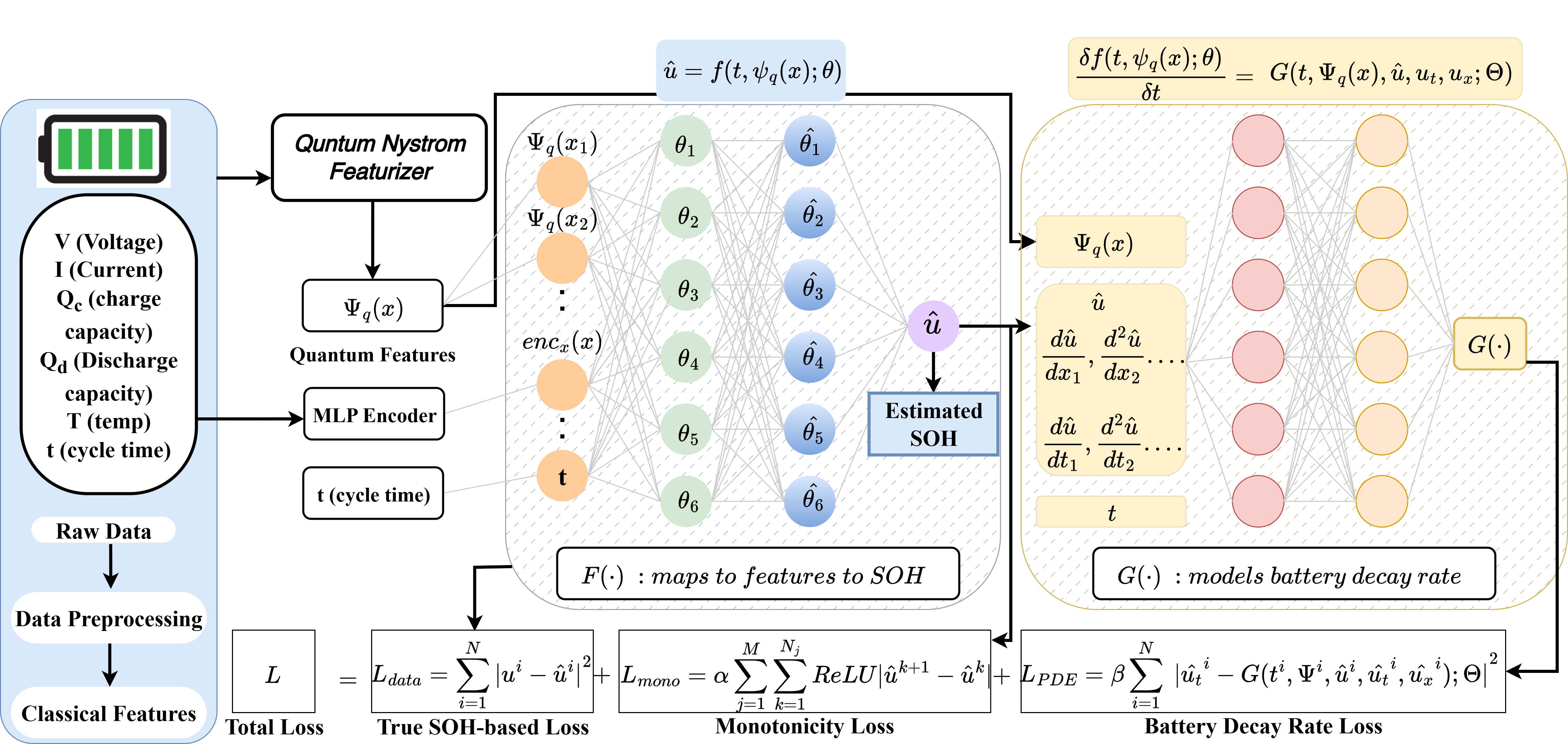
Figure 1: Model Architecture for Physics-informed Neural Network with quantum feature mapping (Nyström-approximated).
Methodological Advances
Limitations of Previous SOH Estimation Approaches
Classic model-based approaches, like Extended Kalman Filtering with equivalent circuit models, suffer from sensitivity to initialization, poor adaptation to regime changes, and computational overhead due to frequent offline recalibration. Mainstream deep learning models (MLP, LSTM, GRU, BRNN) fit benchmark datasets accurately but exhibit overfitting, poor adaptability across chemistry or cycling protocol, and lack physical interpretability. PINNs incorporate prior knowledge via partial differential equation (PDE) constraints, but still depend on coarse statistical features which miss higher-order interactions and raise issues of overfitting and lack of robustness.
Quantum Feature Mapping Mechanism
QPINN augments the standard PINN pipeline by introducing a quantum feature mapping (QFM) stage. Classical descriptors (cycle-wise voltage, current, temperature statistics) are embedded into an n-qubit Hilbert space via a parameterized unitary Uϕ(x), yielding a quantum state representation per input, i.e., ∣ψ(x)⟩=Uϕ(x)∣0⟩⊗n. An associated kernel K(xi,xj)=∣⟨ψ(xi)∣ψ(xj)⟩∣2 characterizes high-order similarities through geometric overlap in Hilbert space.
To avoid the computational overhead of quantum simulation, QPINN adopts a Nyström approximation: the quantum kernel matrix over a selected set of landmarks is orthonormalized, and all incoming features are projected into this data-driven, fixed basis, producing a stable, high-dimensional input geometry. The use of data re-uploading and controlled depth ensures expressivity while maintaining tractable conditioning.
The downstream PINN enforces a continuous SOH field whose temporal evolution must satisfy PDE constraints derived from empirical battery degradation models. The loss function combines a data consistency term, a physics residual enforcing the PDE, and a regularizer to maintain monotonic SoH decrease over cycles. The hybrid feature input z(t,x) merges both quantum embeddings and a trainable shallow encoder, simplifying optimization and improving the decoupling of representation and degradation dynamics.
QPINN achieves both feature-level and model-level information fusion: heterogeneous cycle descriptors are projected into a stable high-dimensional quantum-augmented space, while the physics-informed loss functional ties predictions to mechanistically meaningful SOH evolution. Model training employs state-of-the-art optimizers and gradient clipping for stability. In cross-domain adaptation, only the solution-encoding layers are fine-tuned, while the physical dynamics network and quantum features remain fixed, enhancing transferability.
Empirical Evaluation
Datasets and Protocol
The framework is benchmarked on four public datasets—covering LFP, LCO, NCA, and NMC chemistries—for a total of more than 310,000 charge-discharge cycles from 387 commercial cells. All provide synchronized voltage, current, temperature, and ground-truth SOH labels. The TJU dataset, for instance, showcases significant heterogeneity in protocol and degradation curves (Figure 2), while characteristic voltage decay patterns for multiple chemistries are detailed in Figure 3.
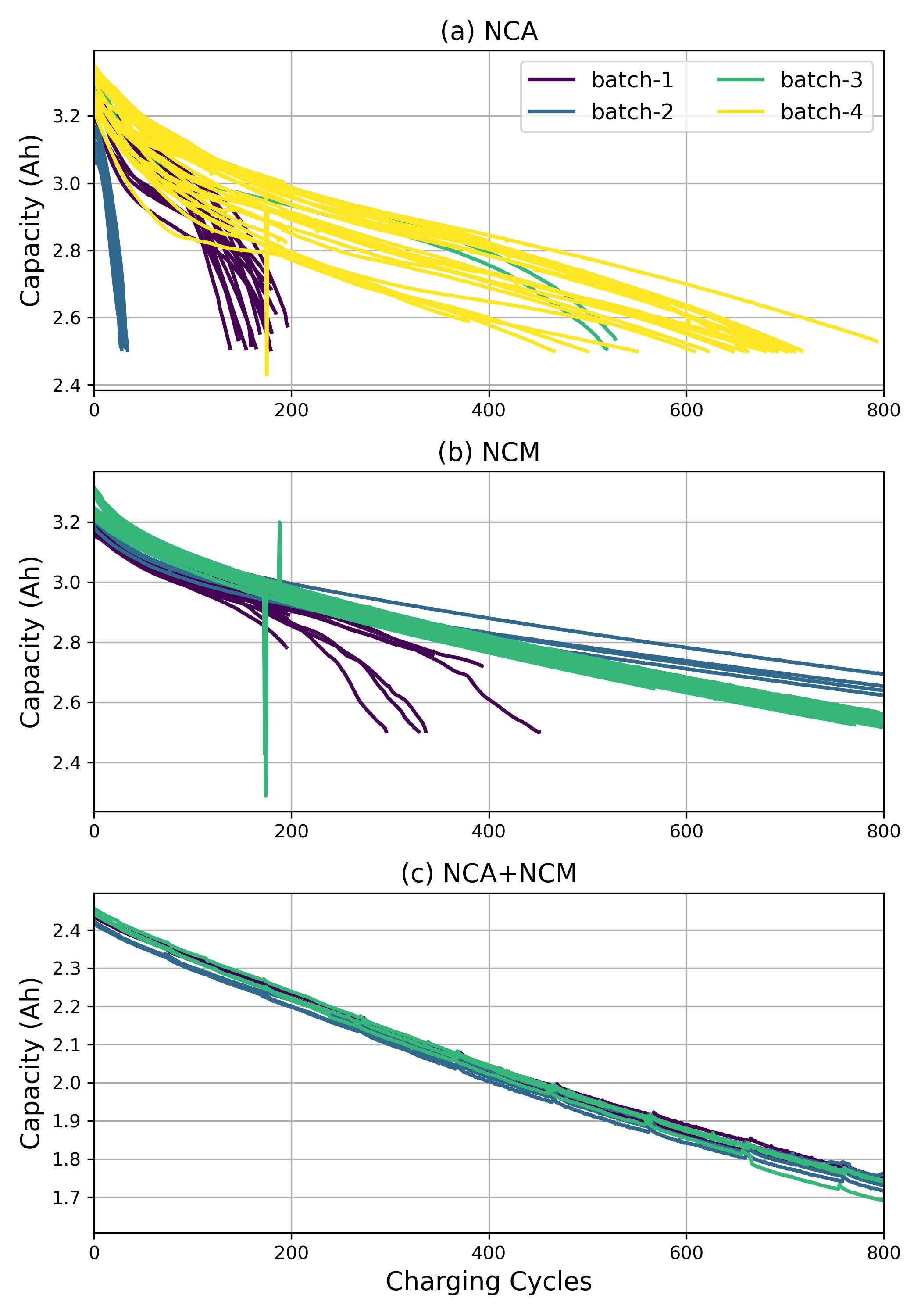
Figure 2: Degradation patterns in the TJU battery dataset across four batches and three chemistries, with varying charge/discharge protocols.
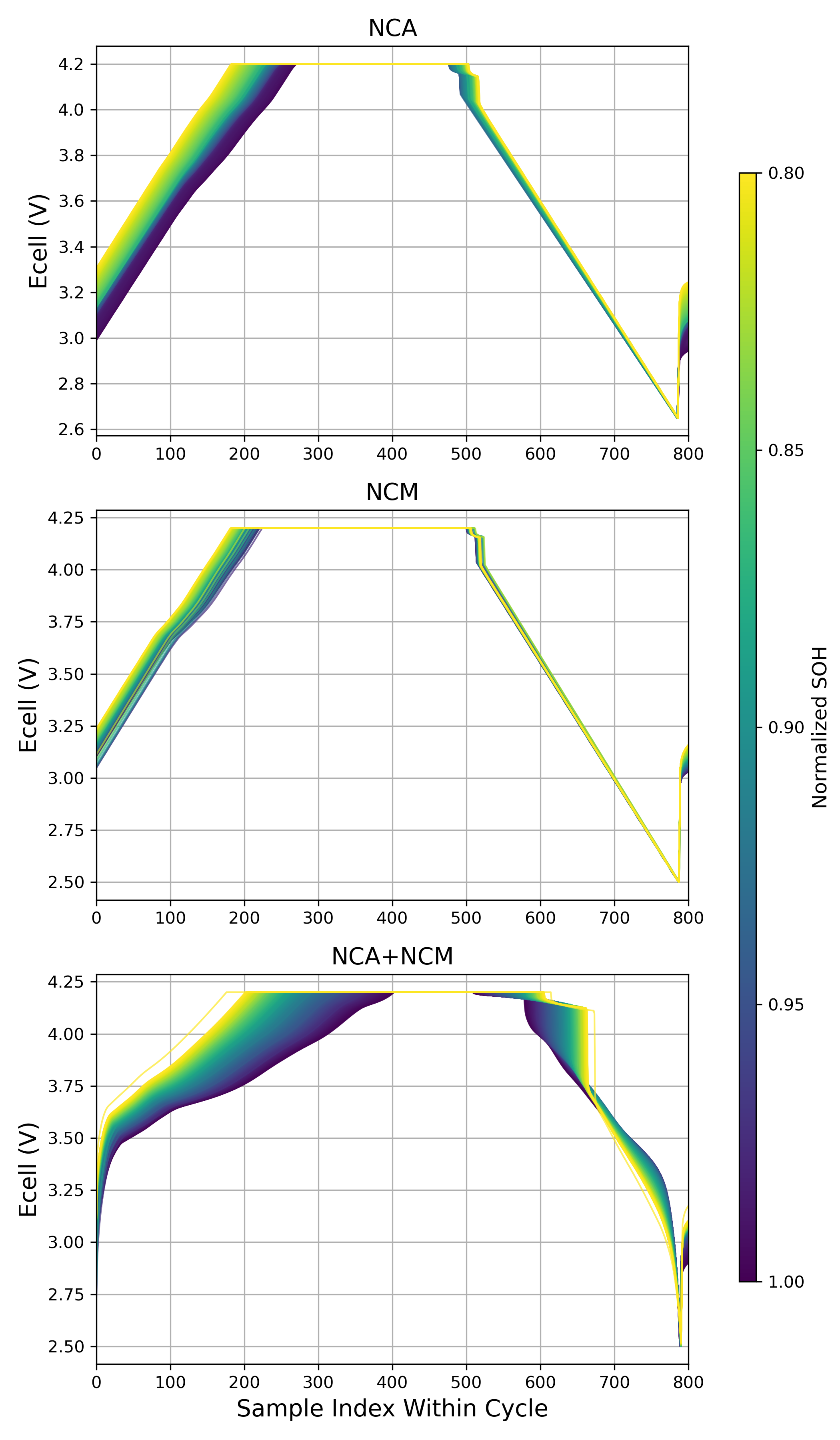
Figure 3: Normalized Voltage Aging Profiles of NCA, NCM, and NCM+NCA commercial cells from the TJU dataset, illustrating chemistry-dependent shifts.
QPINN delivers state-of-the-art accuracy on all benchmark datasets, with an average SOH estimation accuracy of 99.46%. Notable reductions in error metrics are observed:
- Up to 65% reduction in MAPE and 62% reduction in RMSE compared to the best baseline models (PINN, MLP, CNN, SPIKAN).
- QPINN outperforms all baselines in both in-sample and cross-chemistry transfer settings.
- On datasets with nonuniform protocols or rapid capacity fade (notably HUST), QPINN's improvements are most pronounced.
The strong cross-dataset adaptability is achieved without access to target-domain SOH labels during initial transfer—only a small amount of fine-tuning is required for optimal accuracy, underscoring the stability and universality imparted by the quantum feature kernel.
Ablation and Cross-Domain Transfer
When models pre-trained on one dataset are adapted to another, QPINN achieves order-of-magnitude reductions in RMSE following a brief fine-tuning phase with frozen dynamics network and encoder-side adaptation. The results indicate that the model captures transferable degradation structure, with immediate utility for battery chemistries and protocols not present during source training.
Implications and Future Directions
The QPINN framework advances the field along several axes:
- Generalizability: Through high-dimensional quantum kernels and physics-based constraints, QPINN is less sensitive to domain shifts, mitigating overfitting and improving robustness to real-world nonuniformity.
- Practicality: SOH can be accurately predicted for arbitrary chemistries and protocols, with minimal target-domain data and no need for re-identification of physical models or handcrafted statistical features.
- Theoretical impact: This work demonstrates that compositional information fusion (quantum-inspired kernels + PINN) yields a favorable bias-variance tradeoff, providing an inductive bias that is both data-efficient and mechanistically meaningful.
Future work is anticipated along several fronts: real-time, streaming deployment; further quantum-inspired feature engineering; investigation of explainability and interpretability of quantum kernel features; and exploration of domain adaptation with limited labels or fully unsupervised adaptation mechanisms. Additional research into the scaling of the quantum feature dimension, kernel structure, and circuit depth will be crucial for optimizing both accuracy and efficiency in edge-deployed BMS applications.
Conclusion
The QPINN methodology provides a demonstrably superior approach to battery health prognosis by unifying quantum feature mapping with robust physics-informed neural architectures. It achieves strong numerical gains in SOH estimation accuracy, delivers cross-chemistry and cross-dataset adaptability, and offers pathways toward chemistry-agnostic, scalable battery management solutions. This line of research suggests that integrating advanced feature mapping paradigms with domain-specific physical constraints is a productive route for next-generation AI-driven diagnostics in energy storage.

