- The paper introduces an efficient algorithm that extends the enumeration of finite O-sequences from d≤60 to d≤1100 by transforming an iterative formula into a memory-efficient method.
- The paper empirically calibrates refined upper and lower bounds for log(Oₙ), achieving maximum errors of approximately 5.27 and 0.52 units respectively, which confirms sub-Fibonacci growth behavior.
- The paper resolves longstanding questions by demonstrating that the ratio Oₙ/Oₙ₋₁ converges to 1, indicating that the growth of finite O-sequences is consistently below the classical Fibonacci rate.
Sub-Fibonacci Behavior and Growth Estimates in Counting Finite O-Sequences
Introduction
The paper "Counting finite O-sequences: sub-Fibonacci behaviour and growth estimates" (2604.10354) presents a comprehensive quantitative study of finite O-sequences—specifically, the enumeration of such sequences as a function of a fixed multiplicity d. O-sequences arise as Hilbert functions of standard graded Artinian K-algebras, with combinatorics governed by growth constraints reflecting the structure of lex-segment ideals and related objects in commutative algebra. The enumeration of finite O-sequences, denoted by Od for given multiplicity d, has implications for understanding structural properties and asymptotics in Hilbert function theory.
Background and Problem Statement
Finite O-sequences of multiplicity d correspond bijectively to order ideals (under division) of given size, with extremal cases arising from lex-segment ideals. A core challenge lies in quantifying Od, due to the intricate dependencies imposed by the Macaulay growth conditions. Previous foundational work established that (Od)d forms a sub-Fibonacci sequence, admitting elementary bounds on growth rates but leaving significant room for sharper estimates and improved computational reach. The related sequence (Ad)d, where Ad enumerates those O-sequences whose last nonzero entry exceeds one, is also relevant for fine-grained enumeration.
Algorithmic Advances and Sub-Fibonacci Structure
A major technical contribution is the transformation of an existing iterative formula for Od into a practical, memory-efficient algorithm that extends explicit computation from K0 (previous art) to K1. The technique leverages generating functions to encode the recursive cardinality structure, updating only two consecutive computational layers at a given time, leading to significantly improved resource consumption. This computation supplies a previously unavailable dataset for empirical analysis of K2 and its growth properties.
The sub-Fibonacci property is extended to the sequence K3, proven via careful exploitation of the recursive relationships between O-sequences of various types. Specifically, it is established that K4 satisfies K5 for all K6. As a corollary, this constrains the relative growth rate of the number of these O-sequences.
Empirical Calibration of Asymptotic Bounds
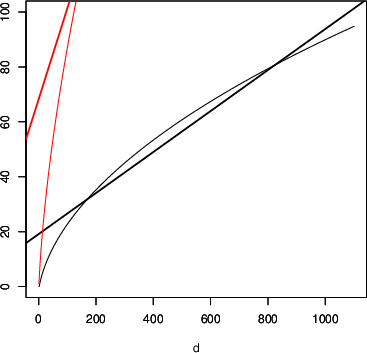
With the computational extension to K7, the authors systematically evaluate the accuracy of the Stanley-Zanello bounds:
The refined upper bound is captured by a transformed function Od8, which shifts and scales Od9 to serve as an actual upper bound for all calculated values, reducing the maximum error from over d0 units to roughly d1 units in the observed interval.
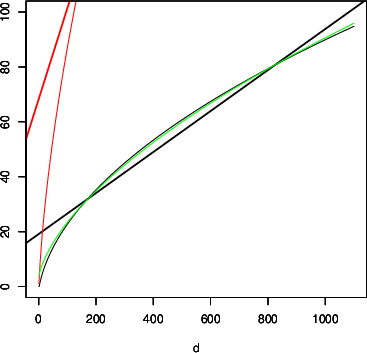
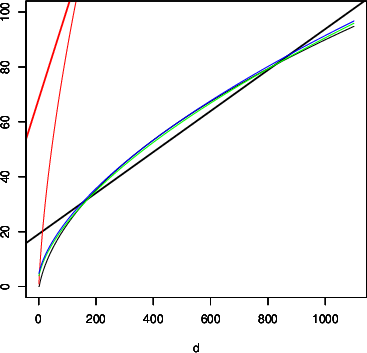
Figure 2: Beyond the prior lines, the green curve shows the rescaled empirical bound d2, closer to d3, and the blue curve d4, the minimal transformed upper bound, for d5.
Similarly, the lower bound d6 (derived analogously from the Hardy–Ramanujan partition formula) also receives an affine empirical calibration, again significantly tightening the gap to the observed values.
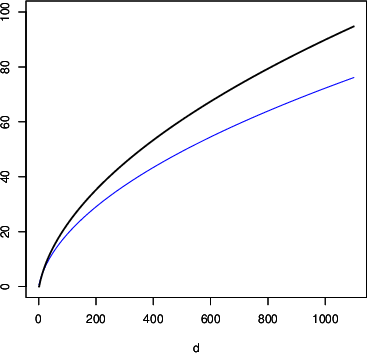
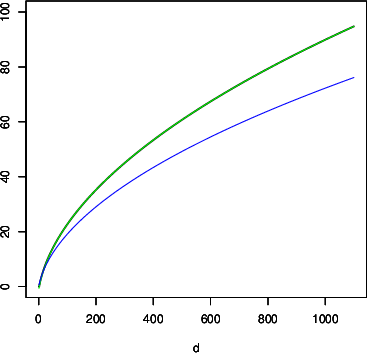
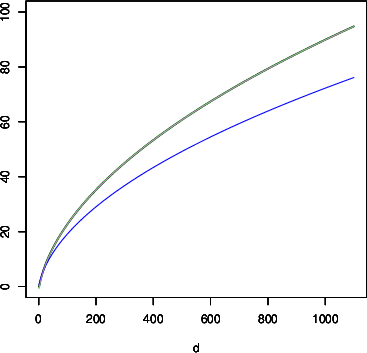
Figure 3: The blue plot is d7, with overplots of d8 (black), the rescaled lower bound d9 (green), and the shifted minimal lower bound d0 (magenta), for d1.
Discrepancy analyses indicate that the maximum error for d2 is less than d3 units, a substantial improvement over the uncalibrated lower bound's maximum error of about d4 units.
Prediction and Extrapolation
Using partial fits to the range d5 or d6, the paper constructs prediction estimates for d7 at larger d8, assessing the robustness of the calibration strategy as data volume increases.
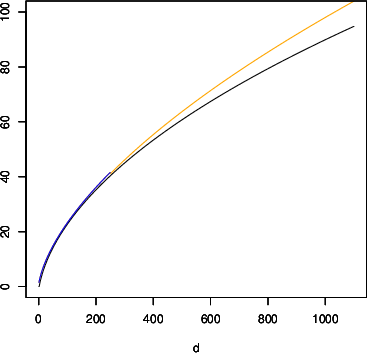
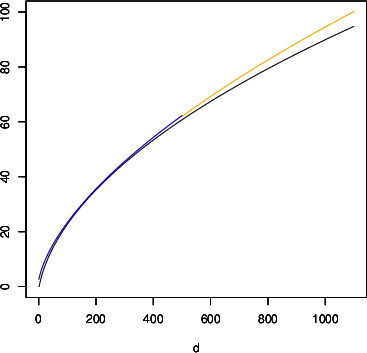
Figure 4: Prediction estimates for the upper bound. Left: calibration to d9, extrapolated to Od0. Right: calibration to Od1, extrapolated up to Od2.
Further, both upper and lower bounds are extrapolated to Od3, forming a prediction zone whose maximum width (the gap between calibrated upper and lower bounds) is less than Od4 units.
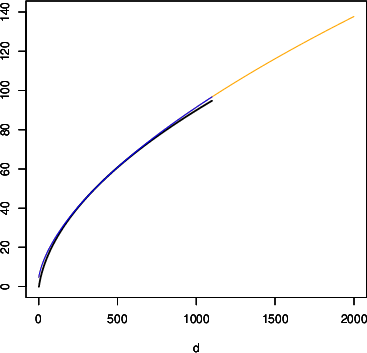
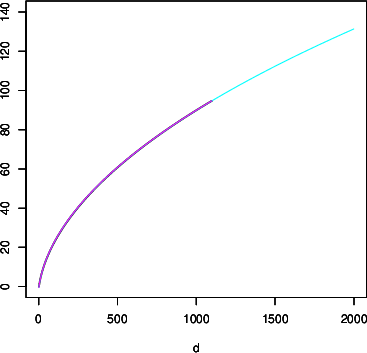
Figure 5: Prediction estimates for upper and lower bounds from Od5 to Od6, with calibration from Od7.
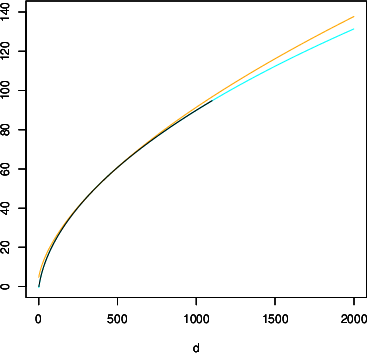
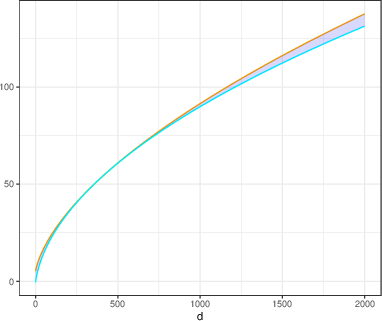
Figure 6: Prediction zone up to Od8, bounded by the extrapolated upper (orange) and lower (cyan) calibrated bounds.
The stability of the prediction zone's width under increasing calibration window size suggests that this empirical methodology yields reliable future estimates for Od9 growth, at least for the observed range.
Theoretical Implications
The use of improved empirical bounds allows for the resolution of a longstanding problem posed by L. G. Roberts (1992), regarding the asymptotic behavior of the ratio (Od)d0. The calibrated Stanley-Zanello upper bound implies, under mild convergence hypotheses, that this ratio tends to (Od)d1 as (Od)d2, thereby delivering a negative answer to Roberts' question concerning possible growth beyond unit ratio.
The distinction between sub-Fibonacci behavior and classical Fibonacci growth is significant theoretically; the results confirm that the proliferation of O-sequences is consistently suppressed below the Fibonacci curve.
Computational Complexity and Practical Considerations
The introduced algorithm has worst-case computational complexity (Od)d3 (with classic convolution), and memory usage (Od)d4. However, observed sparsity in intermediate generating functions can lead to practical improvements.
The computed sequence (Od)d5 up to (Od)d6 is made available by the authors, expanding the toolbox for future experimental and theoretical investigation of Hilbert function enumeration and related enumerative combinatorial structures.
Conclusion
The paper synthesizes algorithmic, combinatorial, and empirical analytic approaches to substantially advance understanding of the counting and growth rates of finite O-sequences. By extending explicit enumeration to (Od)d7, empirically calibrating upper and lower asymptotic bounds, and confirming sub-Fibonacci behavior for distinct sequence subclasses, the study delivers sharp quantitative insights, resolves open questions about growth rates, and provides evidence for the stabilization of bound estimates in the calculable range.
These methodological innovations set the stage for further theoretical exploration of Hilbert function enumeration, sharper asymptotic analysis, and continued improvement of computational techniques for related combinatorial and algebraic problems.