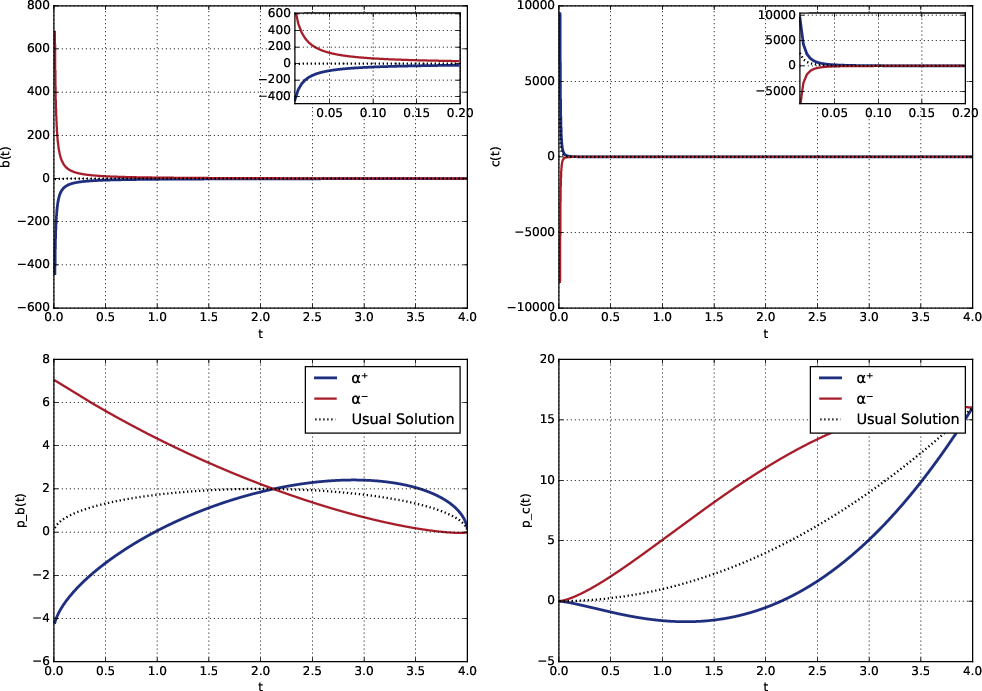
- The paper introduces entropy-deformed Hamiltonian dynamics that incorporate superstatistical quantum gravity corrections to regularize Schwarzschild singularities.
- By employing Ashtekar–Barbero variables and distinct entropy measures S₊ and S₋, the study analytically integrates modified equations yielding a finite anisotropic core.
- The research links statistical mechanics with quantum gravity phenomenology, offering insights into black hole thermodynamics and potential observational signatures.
Overview and Motivation
The study addresses the dynamical evolution of the Schwarzschild black hole interior within the framework of entropy-deformed Hamiltonian dynamics, leveraging superstatistical generalizations of entropy. Quantum gravity-induced corrections are incorporated into the Hamiltonian via entropy measures S+ and S−, derived from the superstatistical formalism of Beck and Cohen. Notably, the analysis uses Ashtekar–Barbero variables to formulate these modified dynamics, capturing loop quantum gravity (LQG) phenomenology and resolving classical singularities without polymer quantization.
Superstatistical Generalized Entropies and Effective Hamiltonians
The superstatistics approach treats intensive thermodynamic variables, particularly inverse temperature, as fluctuating, leading to generalized entropy formulas. The entropies S+ (with α+<0) and S− (with α−>0) encapsulate different quantum corrections corresponding to dual deformation regimes:
- S+ regime (α+<0): Represents a maximal momentum, yielding a repulsive deformation that enforces a maximum on conjugate momentum.
- S− regime (α−>0): Implements a minimal length scale, corresponding to an attractive deformation allowing for a lower bound on position uncertainty.
Through expansion and manipulation of the Boltzmann factors, the modified effective Hamiltonians S−0 manifest as quadratic corrections to the conventional Hamiltonian, with quantum gravity effects encoded entirely in the sign and magnitude of S−1.
The modified Hamiltonian yields dynamical equations for the Ashtekar–Barbero canonical variables (S−2, S−3, S−4, S−5). Analytical integration reveals:
A critical distinction between the two regimes emerges:
- S+8 case: Curvature invariants (e.g., the Kretschmann scalar S+9) remain finite everywhere, yielding a regular black hole interior.
- α+<00 case: The geometry features a localized high-curvature region at α+<01, the solution to α+<02, corresponding to a finite nonzero radius, surrounded by a cigar-like core. Here, α+<03 diverges locally, demarcating a transition layer instead of a true singularity.
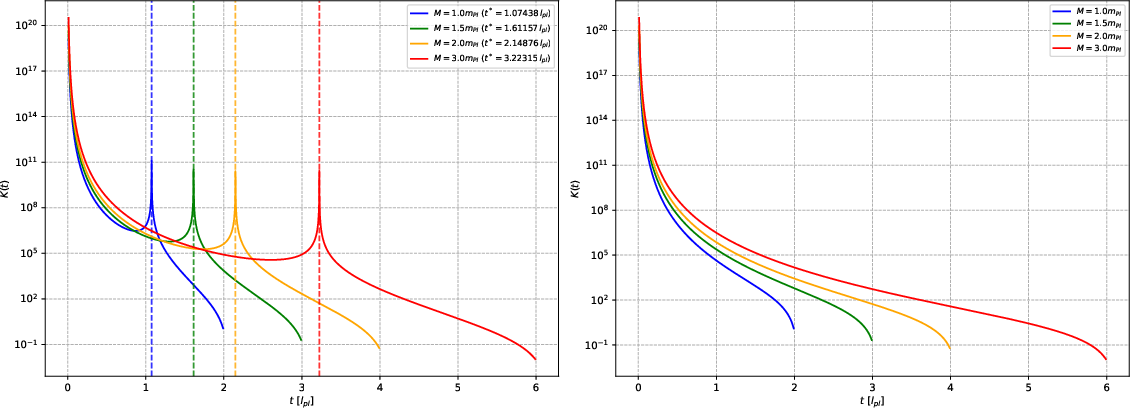
Figure 2: The left panel shows the curvature α+<04 for the entropy measure α+<05 with divergence at α+<06; the right panel shows α+<07 for α+<08, which remains finite, for different black hole masses in Planck units.
Geometric and Causal Structure
The emergent phase-space trajectories are bounded both from above and below in the presence of entropy corrections, further manifesting as bounded areas for the α+<09 and S−0 cross sections. Notably, the areal radius of the 2-sphere (S−1) vanishes at the core, but cigar-like radial cross sections persist, providing an explicit example of anisotropy induced by quantum gravity corrections.
Importantly, the solutions present a signature change near the core, with S−2 and S−3 interchanging their sign roles, indicative of a smooth extension of spacetime across the classical singularity—echoing predictions from loop quantum gravity black hole models.
Numerical Implications and Comparison with Classical Gravity
For both entropy measures, the quantum-corrected geometry remains indistinguishable from the classical Schwarzschild solution for macroscopic black holes due to the Planck-scale nature of S−4. However, at scales near S−5, the effective description provided by S−6 yields conspicuous departures:
- The regularization occurs at S−7, generically close to the Planck length.
- The mass and the correction parameter S−8 directly control the extension of the quantum-regularized region.
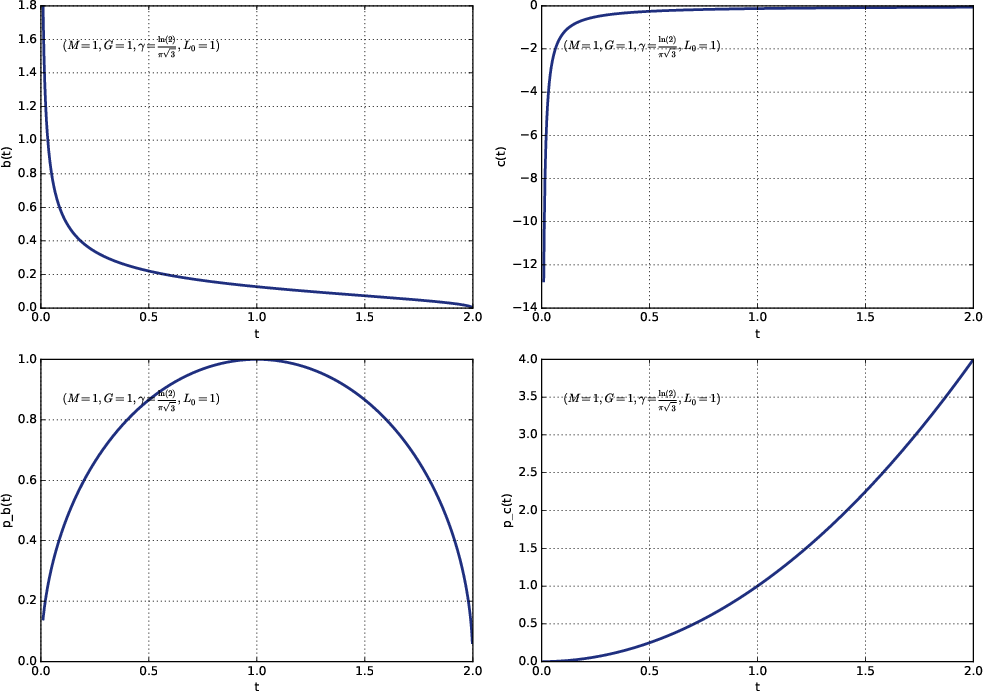
Figure 3: Graphical behavior of the internal solutions (S−9, α−>00, α−>01, α−>02) for the black hole as a function of Schwarzschild time, showing the quantum-corrected deviations near the singularity.
Theoretical and Practical Implications
This work demonstrates that quantum gravity effects—when derived from non-extensive, superstatistical entropies—naturally yield singularity-resolving, anisotropic black hole interiors. The replication of loop quantum gravity features (bounded curvature, signature change, finite anisotropic core) without explicit polymer quantization suggests a deep connection between statistical mechanics (information-theoretic principles) and quantum gravitational phenomena.
From a theoretical standpoint, this presents a robust method for deriving GUPs and effective gravitational constraints from foundational entropy principles. The results point toward a statistical mechanics underpinning of quantum geometry, with practical consequences for black hole thermodynamics, information paradox analyses, and possible signatures in primordial black hole physics—should deviations from classicality occur at observable scales for lighter black holes.
Future Directions
Potential extensions include:
- Analysis of rotating or charged black holes using these entropy-induced Hamiltonians.
- Investigation into the compatibility of these corrections with holographic entropy bounds and their effect on black hole evaporation scenarios.
- Exploration of observable consequences for gravitational wave echoes or possible Planckian remnants, leveraging the geometric regularization near the would-be singularity.
Conclusion
Entropy-deformed Hamiltonian dynamics, grounded in superstatistical generalizations, provides a statistically motivated pathway to quantum gravity corrections for the Schwarzschild black hole interior. The resulting effective theory describes a regular, anisotropic core with bounded curvature and novel causal extensions, reproducing and generalizing key results of LQG-inspired models while obviating the need for discrete polymerization. This work reinforces the emerging link between generalized information measures and the foundational dynamics of spacetime at the Planck scale, with broad implications for quantum gravity phenomenology and black hole physics.