- The paper introduces a single operational protocol that, via distinct post-processing, produces two inequivalent quantum time distributions (TF and QS).
- It employs free-evolution projective sampling to capture dynamic transitions versus occupancy, elucidating differences between rate-of-change and presence measures.
- The study clarifies controversies such as the Hartman effect and offers practical tools for analyzing quantum tunneling and time uncertainty in various systems.
Complementary Quantum Time Distributions from a Single Operational Protocol
Introduction and Context
Quantum mechanics famously lacks a self-adjoint time observable, making the operational definition and measurement of quantum times—such as durations for detection events or tunneling processes—a persistent conceptual and technical challenge. Most attempts at quantum time distributions depend on specific measurement frameworks, producing contextual, protocol-dependent results rather than a universal temporal probability. In "Complementary Quantum Time Distributions from a Single Operational Protocol" (2604.10339), Mathieu Beau critically advances this discourse by showing that inequivalent quantum time distributions can be obtained from the same measurement protocol through distinct post-processing strategies. This work systematizes and operationalizes two major classes of temporal distributions—activity-based time-of-flow (TF) and presence-based quantum stroboscopic (QS)—elucidating their conceptual split and pragmatic roles.
Operational Protocol and Dual Time Distributions
The foundational protocol introduced is the free-evolution projective sampling (feps): an ensemble of identically prepared systems evolves freely, and a projective measurement M^ is applied to each system at varying times. This reconstructs the time-dependent signal p(t)=Tr(M^ρ^t) while evading quantum Zeno inhibition.
From the same p(t) trajectory, two post-processing schemes give rise to two distinct time distributions:
- TF Distribution: Sensitive to the rate of change (activity), πTF(t)∝∣p˙(t)∣. This probes the timing of transitions (e.g., arrivals or departures) in the observable of interest.
- QS Distribution: Sensitive to the instantaneous value (presence), πQS(t)∝p(t). This assesses the occupation probability or residence time.
A conceptual architecture (Figure 1) distinguishes three layers: the operational protocol (feps), the distributional outputs (TF, QS via post-processing), and their quantum-dynamical interpretations (transition vs. occupation times).
(Figure 1)
Figure 1: Three-layered structure—operational protocol, distributional bifurcation, and conceptual interpretation—demonstrating how distinct quantum time observables (TF and QS) emerge from the same measurement record.
Discrete Quantum Systems: The Rabi Model Illustration
The distinction is made sharp in a two-level Rabi model. For a system evolving under H=(ℏω0/2)σ^x, with projective measurements onto a target state:
- The TF distribution isolates the periods of maximal transition activity: for arrivals, this is targeted at TR/4 (with TR the Rabi period), aligned with flux-type interpretations and transition events.
- The QS distribution instead reflects maximal occupation (presence) in the target state at TR/2, blurring the arrival/departure distinction and integrating over longer periods of “staying”.
In stationary cases, TF vanishes (no activity, i.e., transitions), while QS persists uniformly, indicating continuous presence but zero dynamical transition density.
Tunneling and the Hartman Effect: Operational Analysis
Applying these distributions to tunneling provides a nuanced operational perspective on the long-disputed Hartman effect—where the mean traversal time across a quantum barrier appears independent of barrier width. Using the feps protocol:
- TF Distribution: For a wavepacket impinging upon a rectangular barrier, the TF mean initially decreases as the barrier thickens (the “Hartman regime”), then increases when the transmitted spectrum becomes dominated by above-barrier energy components. This is governed by exponential spectral filtering, which selects faster momentum components and shifts the temporal centroid, as explicated by detailed spectral averaging and stationary phase arguments.
- QS Distribution: Measures the temporal “presence” within the barrier region. Its mean saturates with increasing barrier width, documenting the early penetration and limited probability density actually residing inside the barrier, in contrast with classical expectations.
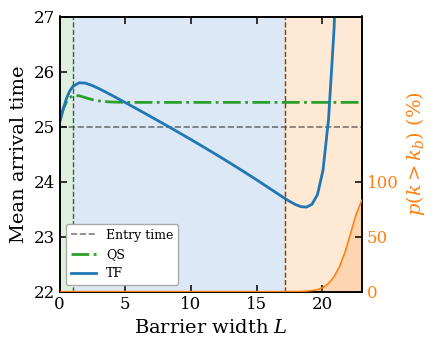
Figure 2: Mean times derived from TF (solid) and QS (dash-dotted) as a function of barrier width L for a tunneling problem. TF first decreases (Hartman regime) then grows, while QS rapidly saturates, demonstrating their operational and conceptual divergence.
The operational import is that QS and TF offer distinct, non-reducible narratives for quantum traversal; the former quantifies how much probability lingers inside the barrier, while the latter determines how fast flow actually emerges on the exit side. The TF distribution captures the impact of spectral filtering (shifting the effective velocity), while the QS mean remains unaffected by spectral reshaping in the opaque regime.
Quantum Time Uncertainties
Both mean and spread (uncertainty) of these distributions exhibit divergent scalings:
- TF Spread: Narrows under spectral filtering as the barrier becomes thicker, until above-barrier transmission dominates and the spread grows again.
- QS Spread: Remains determined by the incident wavepacket bandwidth, largely independent of barrier width for thick barriers.
This reflects the basic dichotomy: TF probes exit-flow timing dependent on transmission specifics, while QS interrogates cumulative in-barrier occupation, insensitive to the post-barrier dynamics.
Conceptual and Theoretical Implications
The primary assertion is that quantum time observables are not unique probabilities extracted directly from quantum mechanics but rather contextual distributions generated by the interplay of measurement procedures and post-processing. The distinction between QS and TF:
- Invalidates the uniqueness of a quantum "tunneling time"; instead, it supports a pluralism of operational definitions, each with measurable consequences.
- Clarifies controversies such as the Hartman effect, showing that claims of "superluminal" traversal or paradoxical time advances depend on the operational question—presence or flow—being asked.
- Provides a rigorous framework for extending time measurement theory to discrete state systems, spin chains, and general non-position observables, not just position-space tunneling.
Practically, this dual framework furnishes experimentalists with concrete tools to select and interpret specific operational notions of time relevant to their setups: transition timing for switching, detection, or transport analysis (TF), and presence timing for residency or occupancy studies (QS).
Outlook and Future Developments
Future research directions include:
- Generalizing the protocol to systems with continuous monitoring, integrating weak measurement regimes, and analyzing the quantum speed limit implications for each class of distribution.
- Investigating trade-offs in quantum time uncertainty and their interplay with time-energy uncertainty relations in contexts such as quantum control and information propagation.
- Exploring the roles of these distributions in open quantum systems and their relevance for environment-induced decoherence in quantum measurement of temporal events.
Conclusion
This work delineates a rigorous operational framework for quantum time measurements, identifying two fundamentally distinct yet complementary time distributions (TF, QS) obtainable from a common measurement protocol. These distributions answer conceptually different questions—about transition activity and presence—and provide a comprehensive perspective on quantum temporal dynamics, exemplified by their contrasting behavior in tunneling and discrete-state systems. This duality not only clarifies foundational paradoxes but also enhances the design and interpretation of quantum time-resolved experiments and theoretical models.
Reference:
Mathieu Beau. "Complementary Quantum Time Distributions from a Single Operational Protocol" (2604.10339)

