Crystalline topological invariants in quantum many-body systems
Published 11 Apr 2026 in cond-mat.str-el, cond-mat.mes-hall, hep-th, math-ph, and quant-ph | (2604.10338v1)
Abstract: Crystalline symmetries give rise to topological invariants that can distinguish quantum phases of matter. Understanding these in strongly interacting systems is an ongoing research direction requiring non-perturbative methods. Recent developments have demonstrated that even classic models, like the Harper-Hofstadter model of free fermions on a lattice in a magnetic field, yield a host of crystalline symmetry protected topological invariants. Here we review some of these developments, focusing mainly on how to characterize, classify, and detect invariants arising from lattice translation and rotation symmetries along with charge conservation in two-dimensional systems, including integer and fractional Chern insulators.
The paper introduces a comprehensive framework for classifying and characterizing crystalline topological invariants in 2D quantum many-body systems.
It employs advanced techniques including group cohomology, cobordism, and TQFT to link abstract invariants with measurable numerical observables via partial symmetry operations.
The work demonstrates the practical relevance of crystalline invariants through the Harper-Hofstadter model and discusses implications for engineered quantum materials.
Crystalline Topological Invariants in Quantum Many-Body Systems
Introduction and Scope
The paper "Crystalline topological invariants in quantum many-body systems" (2604.10338) provides a comprehensive review of the theoretical framework and characterization methods for topological invariants protected by crystalline symmetry in strongly interacting quantum many-body systems. The analysis encompasses both invertible phases (such as SPTs and Chern insulators) and non-invertible, topologically ordered phases (notably, fractional Chern insulators), with a particular focus on two-dimensional systems possessing U(1) charge conservation and square lattice symmetries. The work synthesizes advances from group cohomology, cobordism, TQFT, and G-crossed braided tensor categories, and demonstrates how classic single-particle models harbor previously unappreciated many-body crystalline invariants. The review underscores both classification and characterization approaches, including practical numerical probes for invariants in paradigmatic models such as the Harper-Hofstadter lattice.
Frameworks for Classification and Characterization
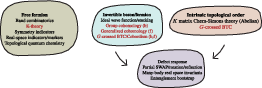
Extensive progress in the classification of crystalline topological phases leverages mathematical technologies ranging from K-theory in the non-interacting regime to more general group cohomology, cobordism, and categorical approaches for interacting systems. For free fermions, band representation combinatorics, symmetry indicators, and topological quantum chemistry establish classification schemes, but these approaches fail to capture interaction-induced phenomena. Many-body systems with strong correlations necessitate non-perturbative frameworks—most notably, invertible TQFT, group cohomology for SPTs, and G-crossed BTCs for SETs and topologically ordered states.
Figure 1: Summary of approaches to classify and characterize crystalline topological states, highlighting the interplay between band-theoretic and many-body categorical/TQFT methods.
Classification schemes are complemented by operational characterization protocols, notably the usage of lattice defects (disclinations/dislocations), partial symmetry expectation values, and recently developed techniques to extract invariants directly from ground state data on the torus or other manifolds, with and without explicit defect insertions.
Crystalline Invariants in Invertible Phases
Classification of Invariants
For 2D systems with Gf=U(1)f×ϕp4 symmetry, such as the Hofstadter model, the crystalline symmetry enables the existence of invariants beyond the electronic Chern number C. These include:
So: quantized "discrete shift" associated with rotation centers;
Po: quantized many-body electric polarization;
ℓo: angular momentum response detected via partial rotations;
κ: quantifies filling constraints at high symmetry points,
G0: partial symmetry invariants extracted from expectation values of symmetry-restricted operators.
The topological response is captured by an effective TQFT action incorporating both internal and crystalline gauge fields, allowing the derivation of quantization conditions and observable signatures for all invariants.
Hofstadter Model as a Paradigm
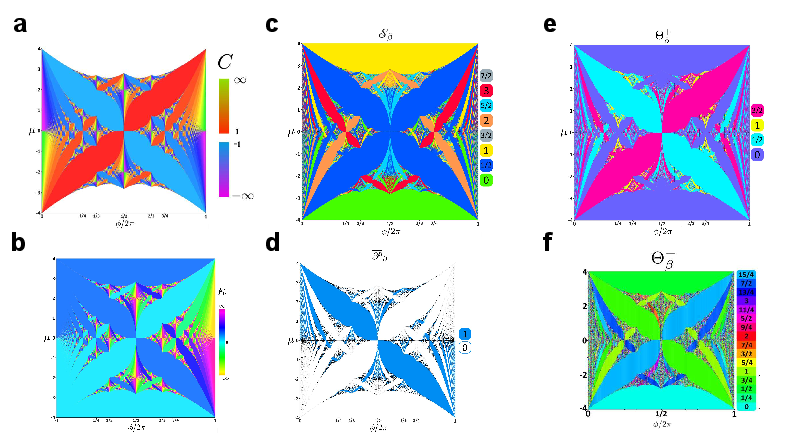
The Harper-Hofstadter model on the square lattice serves as a canonical example for crystalline invariants. Different ground states (lobes in the so-called Hofstadter butterfly) exhibit distinct combinations of integer invariants (G1, G2) and newly identified crystalline ones (G3, G4, G5). The review demonstrates that even this prototypical non-interacting model manifests a rich structure of many-body invariants, further generalizable in interacting settings.
Figure 2: Hofstadter butterflies for the invariants (a) G6 (Chern number), (b) G7 (filling-related), (c) G8 (discrete shift), (d) G9 (electric polarization), and (e),(f) partial rotation invariants K0.
Numerical Detection and Measurement Protocols
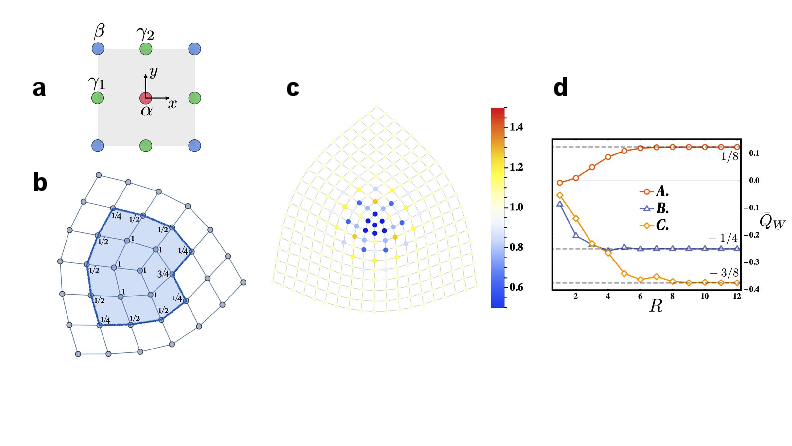
Charge responses to lattice disclinations and dislocations are directly computable from ground state observables. The excess charge in a region encircling a disclination is quantized in units determined by the discrete shift K1:
K2
High-precision numerics confirm the quantization and invariant extraction as K3—the region radius—increases.
Figure 3: (a) Real-space K4 unit cell, (b) charge measurement weights, (c) numerical plot of K5, (d) quantization of K6 as K7 increases in distinctive Hofstadter ground states.
Partial symmetry operations, such as partial rotations, provide direct access to the invariants K8, which can distinguish between crystalline phases that are otherwise indistinguishable via Chern number or filling alone. These ground state expectation values are robust to local perturbations and serve as operationally accessible order parameters.
Crystalline Invariants in Fractional Chern Insulators
The review extends the analysis to topologically ordered states, focusing on symmetry-enriched Abelian topological orders (e.g., 1/2-Laughlin FCI). The classification of symmetry fractionalization is governed by the charge vector K9, spin vector G0, and discrete torsion vector G1, in addition to the standard Hall conductance quantization:
G2
Here, G3 encodes the analog of the discrete shift, determining both charge and fractional angular momentum bound to defects, while G4 governs fractionally quantized electric polarization.
The numerical validation is performed via variational Monte Carlo for projected parton wave functions, with precise agreement between predicted and observed quantization of all invariants.
Implications and Theoretical Advances
The identification and operational detection of these crystalline invariants establish several notable consequences:
Electric Polarization in Chern Insulators: The paper demonstrates a many-body definition of electric polarization in states with nontrivial G5, overcoming prior limitations of single-particle approaches and connecting to real-space edge and corner charge observables [zhang2022pol, zhang2025pol].
Complete Characterization via Partial Symmetries: The full set of crystalline invariants, including those not accessible via band theory, can be detected via partial rotations and defect charge measurements, even for interacting systems. This enables a nearly one-to-one mapping between mathematical classification (e.g., TQFT invariants) and practical observables [zhang2023complete].
Experimental Relevance: The theoretical framework is applicable to engineered systems such as moiré materials, ultracold atomic lattices, photonic heterostructures, and quantum simulators [cai2023fci, aidelsburger2013, hafezi2013]. The invariants provide concrete targets for experimental probes such as local charge detection, edge/corner state measurement, and controlled defect insertion.
Open Directions and Outlook
Several open problems are posed:
Determining the invariants realized in experimentally accessed FCIs and higher-rank crystalline groups.
Extending characterization to systems with time-reversal, reflection, and higher-order (non-Abelian) symmetries, particularly with G6-crossed category methods.
Developing complete classification and measurement protocols for gapless systems.
Exploring the role of disorder and non-perturbative anomalies in the stability and measurability of crystalline invariants.
Conclusion
This review systematizes the classification, measurement, and interpretation of crystalline symmetry-protected invariants in both invertible and topologically ordered quantum many-body systems, establishing direct connections between abstract algebraic structures and bulk/defect observables. The explicit protocols for extracting invariants in lattice models, the extension to interacting settings, and the synthesis of categorical and field-theoretic perspectives collectively advance the precision and operationalization of crystalline topological order (2604.10338). The presented theory provides a universal language for the analysis of complex quantum phases in both natural and artificial materials, with ramifications for condensed matter physics, topological quantum computation, and fundamental symmetry studies.