Beyond Whittle: exact finite-time multispectral statistics from a single Brownian trajectory in a harmonic trap
Published 11 Apr 2026 in cond-mat.stat-mech | (2604.10323v1)
Abstract: Power spectral densities are often interpreted through ensemble averages and long-time asymptotics. In many experiments, however, only a single finite record is available, so spectral estimators remain broadly distributed and the usual independence assumptions across frequencies need not hold. Here we develop an exact finite-$T$ multispectral theory for an overdamped Brownian particle in a harmonic trap. For a collection of frequencies ${ω_i}$, we obtain an exact characterization of the joint law of the finite-time estimators ${S(ω_i,T)}$, together with a covariance-explicit Gaussian representation for the associated Fourier projections. This representation makes the observation-window-induced inter-frequency correlations explicit and shows how they vanish as $T\to\infty$, thereby recovering the asymptotic Whittle picture. We then use this structure to formulate a hierarchy of spectral likelihoods for inference from a single trajectory, ranging from the factorized Whittle approximation to blockwise covariance-aware approximations in frequency space. Monte Carlo simulations validate the finite-time theory and quantify the effect of neglected cross-frequency correlations on single-trajectory estimates of the trap parameters. Our results provide a controlled finite-time benchmark for spectral inference beyond the asymptotic regime.
The paper calculates exact finite-time power spectral density (PSD) statistics for a single trajectory of an OU process, revealing inherent broad fluctuations.
It derives closed-form expressions for mean, variance, and probability distributions, highlighting non-exponential, Bessel-function behavior at finite observation times.
The work introduces a likelihood hierarchy that accounts for inter-frequency correlations, enhancing parameter inference over traditional Whittle approaches.
Exact Finite-Time Multispectral Statistics for Brownian Motion in a Harmonic Trap
Overview
The paper "Beyond Whittle: exact finite-time multispectral statistics from a single Brownian trajectory in a harmonic trap" (2604.10323) rigorously analyzes the spectral statistics of overdamped Brownian motion within a harmonic potential, modeling the system as an Ornstein–Uhlenbeck (OU) process. It directly addresses a fundamental limitation prevalent in many real-world time series experiments: in contrast to classical ensemble or long-time averaging, practitioners frequently contend with a single finite-length observation. The work departs from standard Whittle-type frequency-domain likelihoods by deriving exact, window-size-dependent joint laws for power spectral estimators at multiple frequencies, providing a comprehensive benchmark for spectral inference beyond the asymptotic, frequency-wise factorized regime.
Single-Frequency Statistics and Finite-Time Effects
The authors first concretely address the distribution of the power spectral density (PSD) estimator:
S(ω,T)=T1∫0TdteiωtX(t)2
for a single finite-length record of X(t). Due to the Gaussianity of the OU process, all finite-time spectral statistics can be derived via the moment generating function (MGF) of S(ω,T), which is shown to possess an explicit, closed-form representation in terms of frequency, diffusion coefficient, relaxation time, and observation window length through kernel integrals.
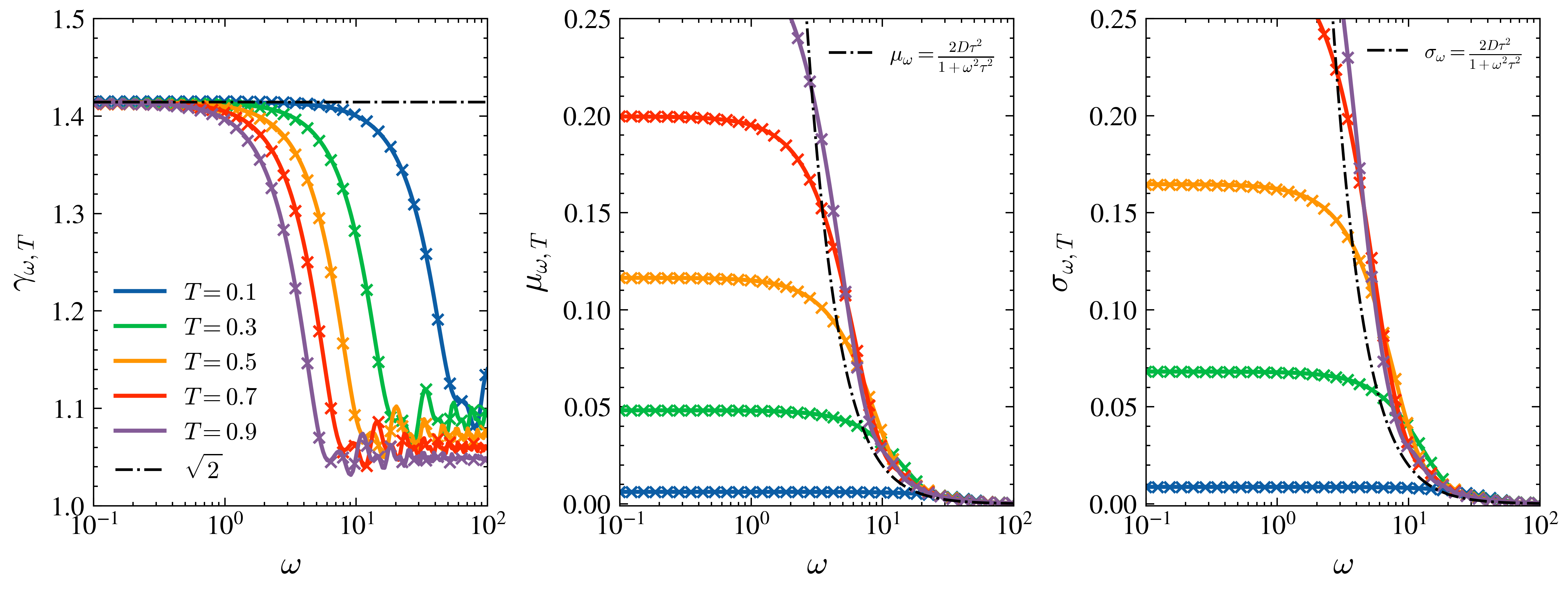
The most salient result is the explicit calculation of the mean, variance, and coefficient of variation of S(ω,T) as a function of frequency for different finite observation windows, supported by extensive Monte Carlo simulations. The analysis reveals that single-trajectory PSD estimators exhibit inherently broad fluctuations (coefficient of variation γω,T∈[1,2]) at all finite T. Only in the infinite-time limit is the estimator’s distribution exponential, corresponding to perfect decorrelation and the traditional Whittle assumption.
Figure 1: The coefficient of variation γω,T, mean μω,T, and standard deviation σω,T for S(ω,T) elucidate strong finite-time fluctuations and their evolution with X(t)0.
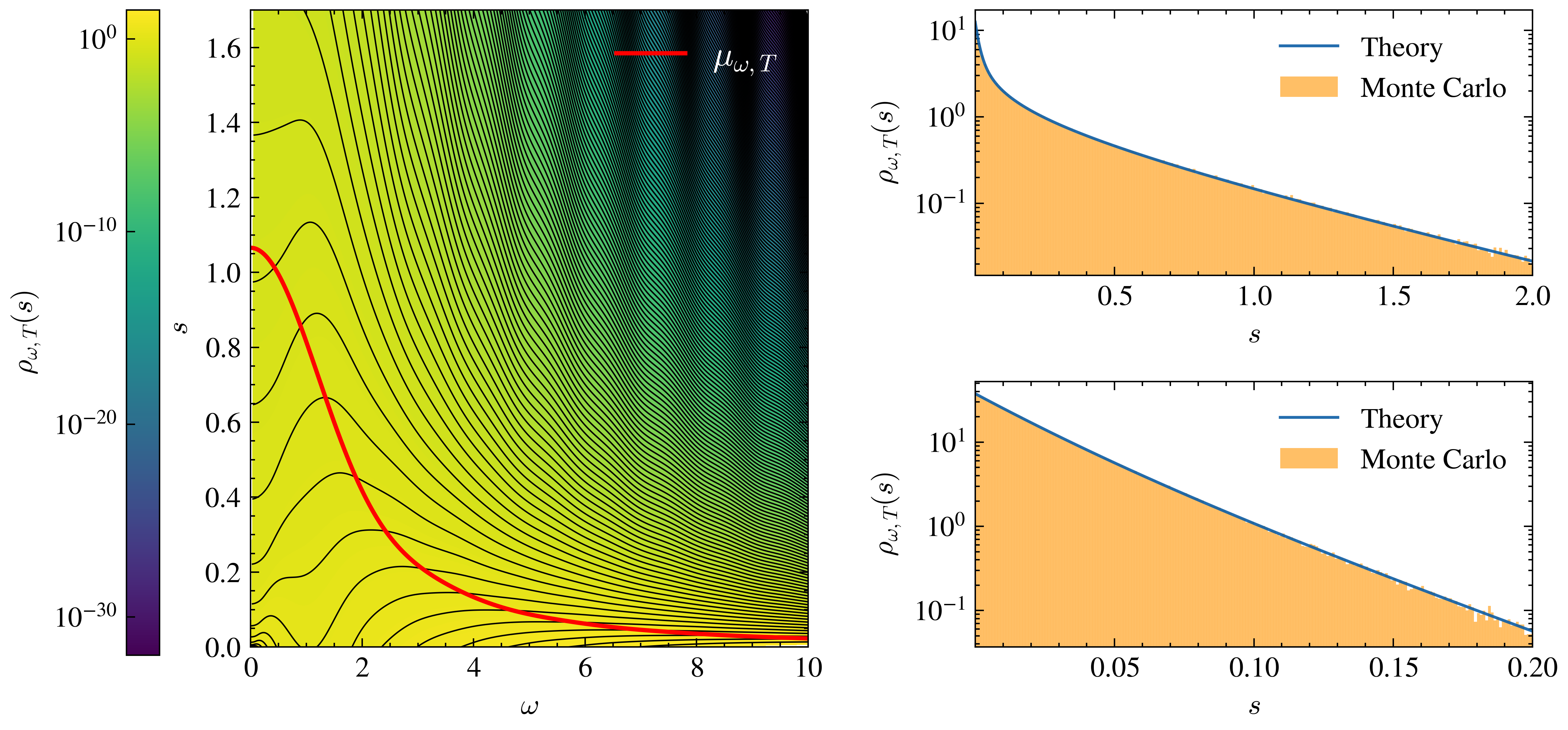
They further analyze the full probability density function of X(t)1, revealing a scaled Bessel function form at finite X(t)2. This law generalizes to different diffusive regimes (e.g., free Brownian motion) and provides exact calibration tools for experimental and inferential applications.
Figure 2: The density X(t)3 versus X(t)4 and X(t)5, and comparison between theory and Monte Carlo data, showing non-exponentiality at finite X(t)6.
Multispectral Joint Law and Frequency Correlation Structure
A central advance of the paper is the derivation of the exact finite-time joint law for spectral estimators X(t)7 at a set of frequencies X(t)8. The formalism constructs the vector of finite-window Fourier sine and cosine projections, which collectively follow a multivariate normal law with explicit covariance matrix X(t)9 determined by the observation window and process parameters.
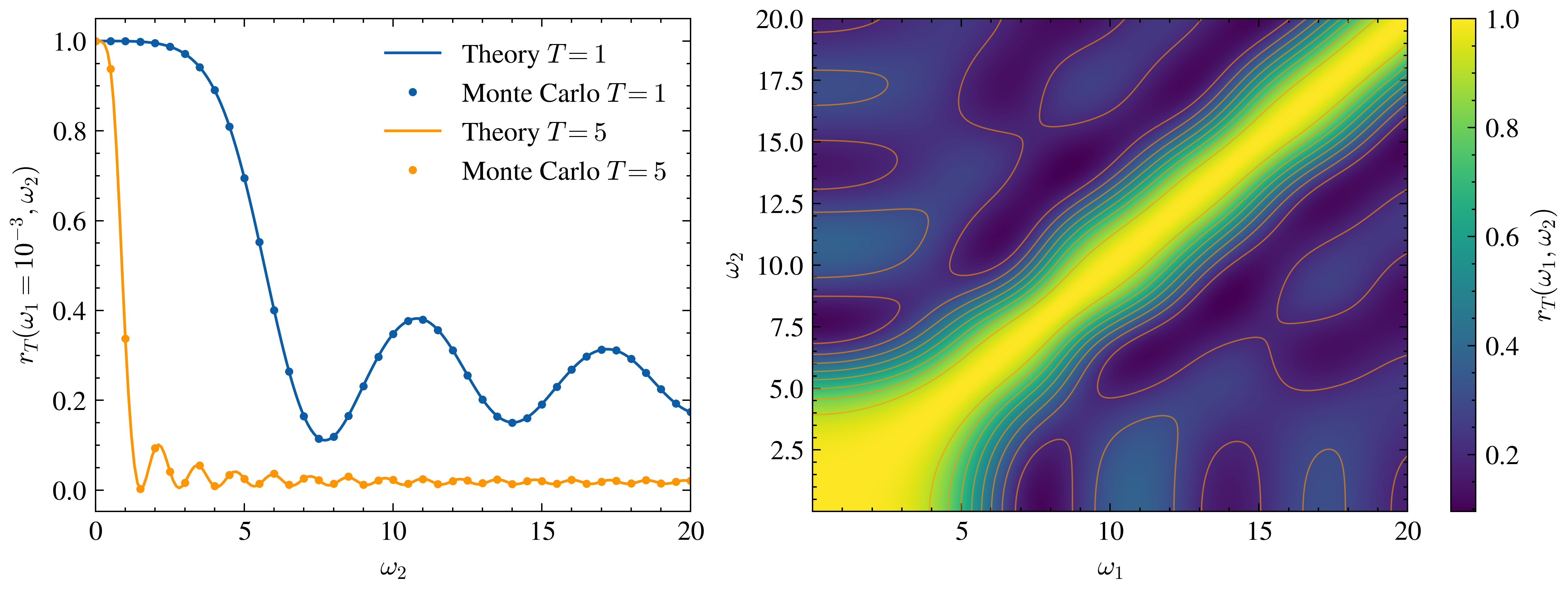
The covariance between power spectral estimates at distinct frequencies, S(ω,T)0, is found to be non-negligible—especially for frequencies separated by intervals S(ω,T)1—and only decays in the asymptotic limit (S(ω,T)2). The magnitude and localization of these correlations are rigorously quantified.
Figure 3: Empirically validated finite-time correlation coefficient S(ω,T)3 between spectral estimates at S(ω,T)4 and S(ω,T)5, highlighting the decay of correlations with frequency separation and increasing S(ω,T)6.
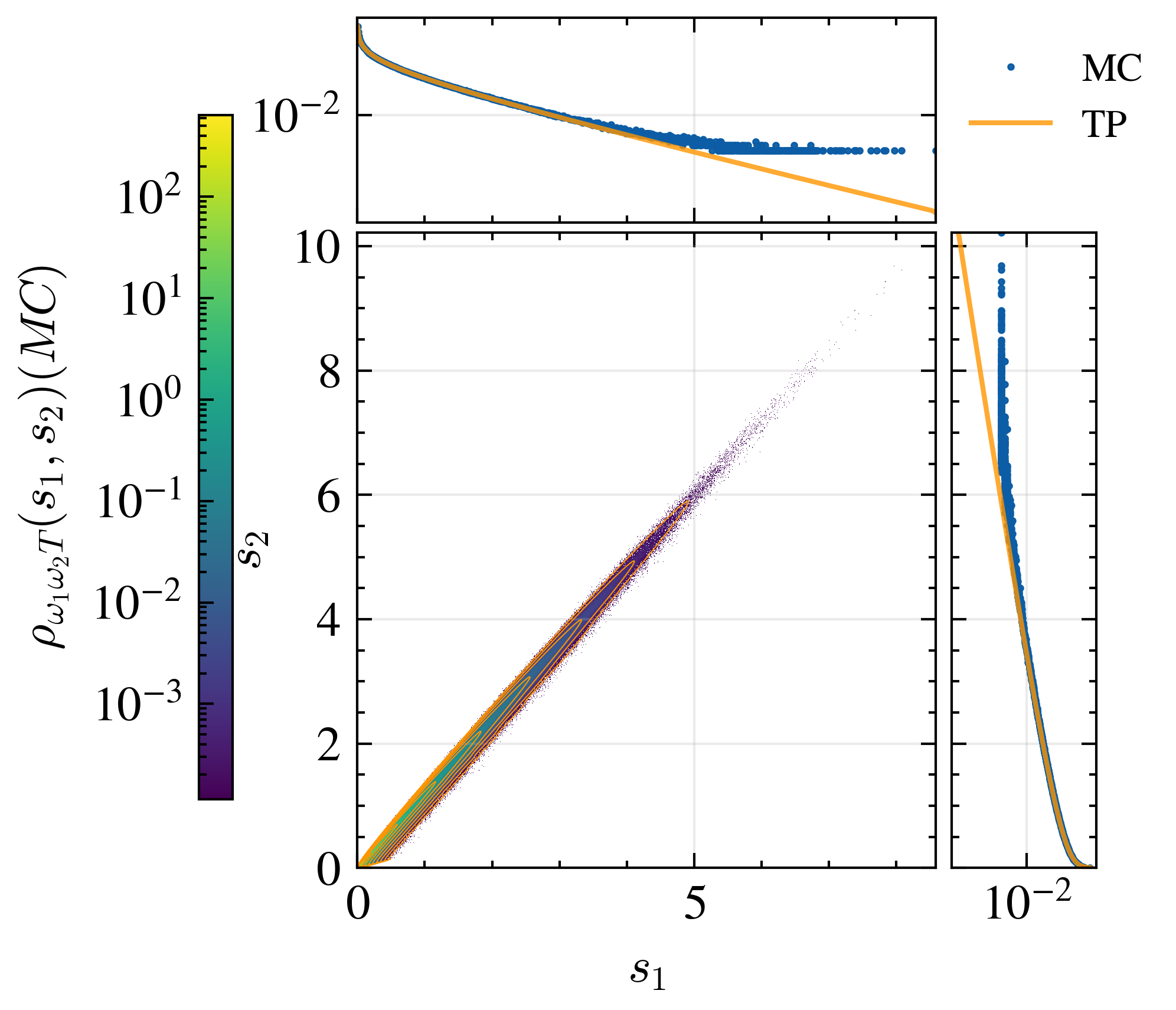
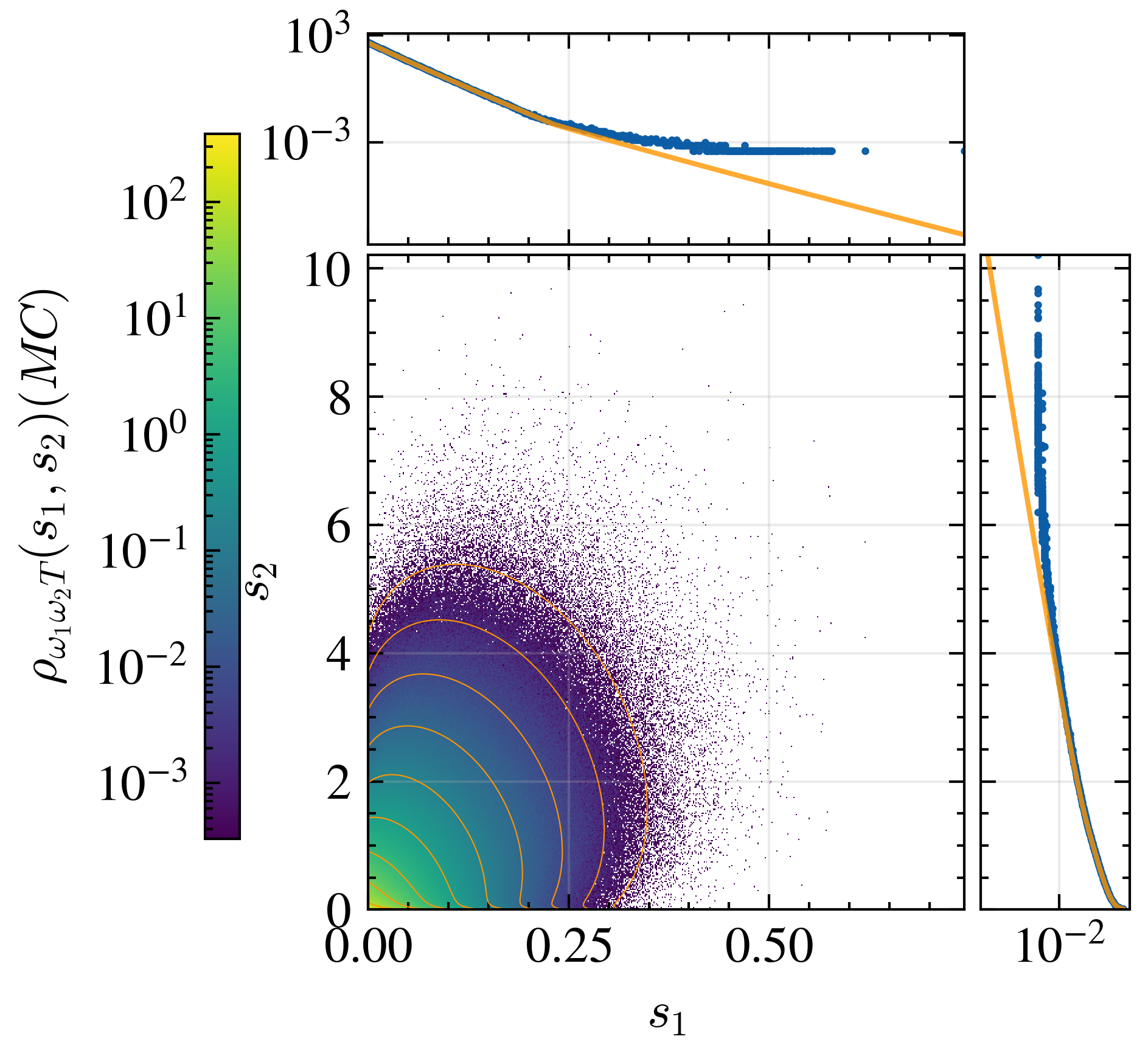
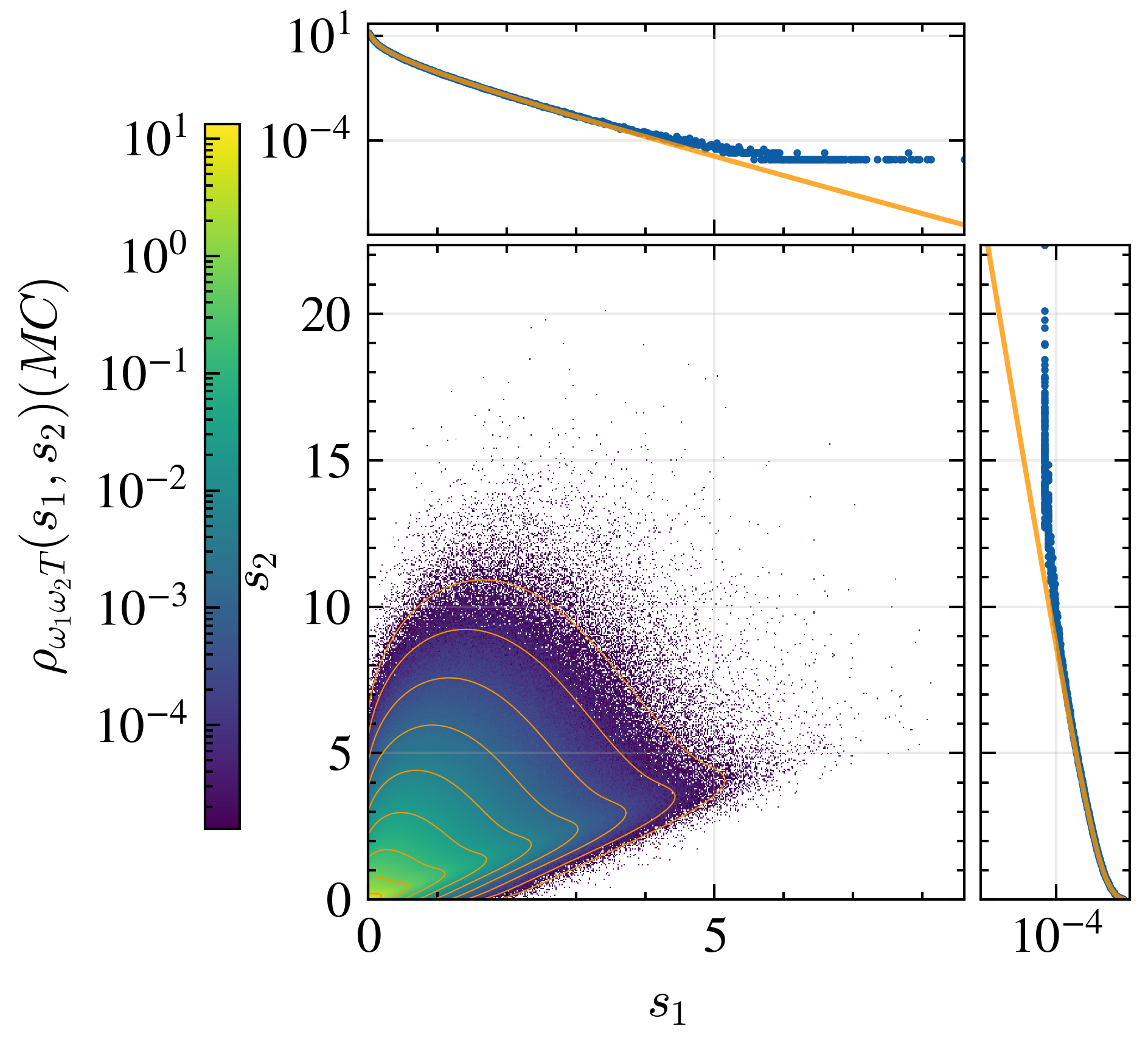
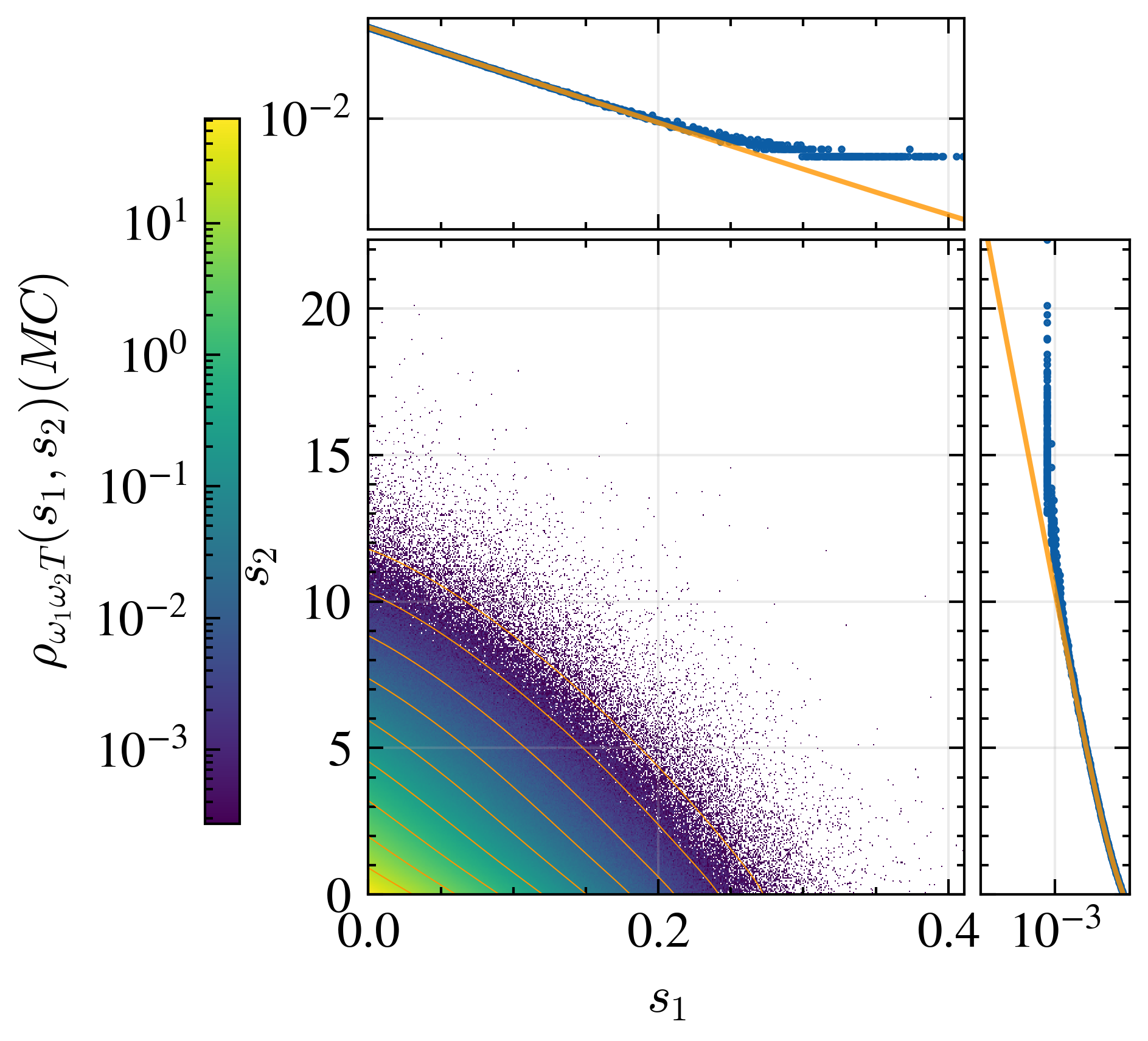
The joint probability density function S(ω,T)7 is derived in both oscillatory (Bessel-Gaussian) and manifestly positive forms. Monte Carlo data confirm the accuracy of the analytical expressions, which display clear inter-frequency couplings in the finite-window regime.
Figure 4: Joint PDF S(ω,T)8 for pairs of frequencies, comparing theory and simulations, and illustrating frequency-correlation-induced distortions from a factorized law.
Inference Hierarchy: Likelihoods Beyond the Whittle Approximation
The exact multispectral law enables construction of a hierarchy of frequency-domain pseudo-likelihoods for inferring the OU process parameters S(ω,T)9 (diffusion constant) and S(ω,T)0 (relaxation time) from single-trajectory data:
Whittle Likelihood: Assumes independent exponential (asymptotic) statistics for each frequency bin, neglecting all finite-time corrections and inter-frequency correlations.
Finite-S(ω,T)1 Factorized Likelihood: Incorporates the exact finite-time single-frequency law at each frequency but still assumes frequency-wise independence.
Blockwise Covariance-Aware Likelihoods: Interpolates between the fully factorized and fully correlated regime by retaining the covariance among contiguous frequency blocks of increasing size, as encoded in the exact covariance matrix.
The paper demonstrates, via simulated inference tasks and robust numerical diagnostics, that:
Neglect of cross-frequency correlations leads to systematic mis-specification and, particularly for S(ω,T)2, can produce substantial biases and underestimation of uncertainty.
Restoring even partial cross-frequency covariance (using modest block sizes) substantially reduces both the large error rate in S(ω,T)3 and the calibration gap relative to the true time-domain model.
These results provide a controlled, quantitative framework for benchmarking real-world spectral inference pipelines and represent a significant extension beyond classical factorized periodogram fitting.
Implications and Future Directions
The paper’s results reframe classical frequency-domain analysis of stochastic processes, rigorously quantifying the role of finite observation time and the resulting inter-frequency correlations overlooked by traditional Whittle-type approaches. This framework is directly relevant for practical applications where only a single, finite-length time series is available—such as in optical trapping, fluctuation-based calibration, and biology.
On the theoretical side, the explicit Gaussian lifted representation (where window-induced covariance is made manifest) enables the design of principled, covariance-aware spectral pseudo-likelihoods and offers a calibrated benchmark for structured matrix sparsification, blockwise, or machine-learned spectral models. Inference based on the exact finite-S(ω,T)4 joint law is shown to possess superior calibration and reliability in parameter estimation, especially for short records or in low-frequency-dominated regimes where window-induced couplings are strongest.
This analytic benchmark sets the stage for natural extensions:
Generalization to multivariate processes, where both cross-frequency and cross-component coupling are present.
Incorporation of more complex (non-Gaussian, non-stationary) dynamics and experimental windowing.
Rigorous evaluation of machine learning approaches which attempt to model frequency-domain structure, as highlighted by the comparison to Whittle Network methods.
Conclusion
This work rigorously characterizes the full finite-time, multispectral statistics of the OU process, providing exact analytical tools and precise calibration benchmarks for single-trajectory spectral inference. It makes explicit the inter-frequency dependencies neglected by Whittle-type approaches and formalizes a flexible likelihood hierarchy that interpolates between factorized and fully correlated regimes. These contributions are immediately relevant for experimental and inference settings requiring precise finite-sample uncertainty quantification, and open new theoretical and methodological directions in the spectral analysis of stochastic processes.