- The paper demonstrates that, under UGC assumptions, Max-Cut remains NP-hard to approximate at the αGW ratio in 3-colorable graphs.
- It introduces a novel SDP-based rounding scheme that surpasses the αGW barrier when independent sets exceed a critical edge-volume threshold.
- Sharp threshold phenomena and multipartite noise stability are established, linking advanced isoperimetric analysis with valued PCSP frameworks.
Approximability of Max-Cut on 3-Colorable Graphs and Graphs with Large Independent Sets
Introduction and Motivation
The Max-Cut problem is a canonical graph partitioning problem fundamental to combinatorial optimization and theoretical computer science. While the standard Goemans-Williamson SDP approach achieves a tight αGW≈0.87856-approximation ratio for general graphs, finer analysis is required to understand the role of structural promises on the approximability of Max-Cut.
This paper addresses whether Max-Cut is easier to approximate on two classes of graphs that are conjecturally more tractable: 3-colorable graphs, and graphs containing large independent sets (measured by edge volume). Unlike the well-understood bipartite (2-colorable) case, polynomial-time algorithms with improved guarantees are not known for these settings, and the state of the art did not resolve whether the Goemans-Williamson barrier can be surpassed under these restrictions.
Main Results
The authors establish both tight hardness and algorithmic results, resolving the status of Max-Cut approximability under the stated structural promises:
- UGC-Hardness at αGW for 3-Colorable Graphs: Even when the 3-coloring is known, Max-Cut remains NP-hard to approximate within the αGW factor, assuming the Unique Games Conjecture (UGC).
- Independence Set Thresholds: They identify a critical threshold α∗≈0.81597 for the relative edge volume of an independent set such that:
- If the independent set's volume is at most α∗ (and possibly hidden), the αGW-approximation barrier cannot be surpassed (UGC-hardness persists).
- If the independent set's volume strictly exceeds α∗ (even when not revealed), a polynomial-time algorithm achieves better-than-αGW approximations; these improved guarantees are accompanied by a novel SDP-based rounding scheme.
- Sharp Threshold Phenomenon: For the case when the independent set is given, a smaller threshold at s∗/2≈0.371 exists (where s∗=(arccosρ∗)/π). Above this, direct cuts yield better than αGW0.
- Tripartite Majority-Is-Stablest: Core technical contributions include a new isoperimetric result for the tripartite noisy cube, showing that, for sufficiently negative correlation, the majority function remains extremal even in the multipartite setting—contrasted by degenerate cuts at higher correlations.
Techniques and Analytical Framework
The hardness proofs leverage PCP gadget reductions, synthesizing dictatorship tests adapted to the promised structures (tripartite and bipartite noisy cubes, and tensor products involving gadgets that 'hide' independent sets). A pivotal technical innovation is the extension of invariance principles and stability theorems (Majority-Is-Stablest) to multipartite settings, enabling sharp analysis in the presence of coloring constraints and planted independent sets.
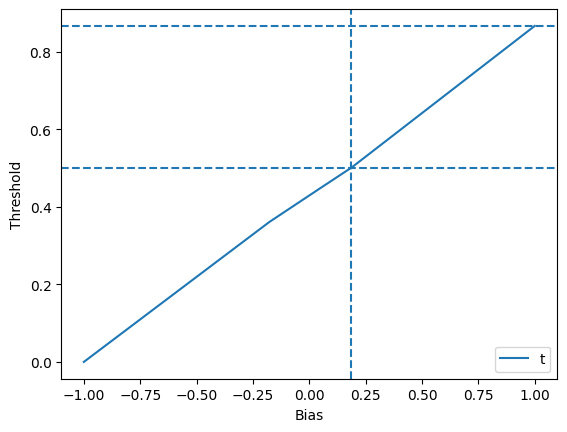
Figure 2: Plot of the threshold function αGW1 against the bias parameter αGW2 used in the SDP rounding, illustrating the nonlinearity and the fine-tuned control required for optimality near the threshold αGW3
The algorithmic side introduces an SDP relaxation tailored to maximize cuts aligned with large independent sets, augmented by a carefully calibrated αGW4-thresholded rounding scheme (from the LZ family). This approach balances the Goemans-Williamson style hyperplane rounding with additional constraints enforcing orthogonality (akin to Lovász theta), enabling finer guarantees when structural promises hold.
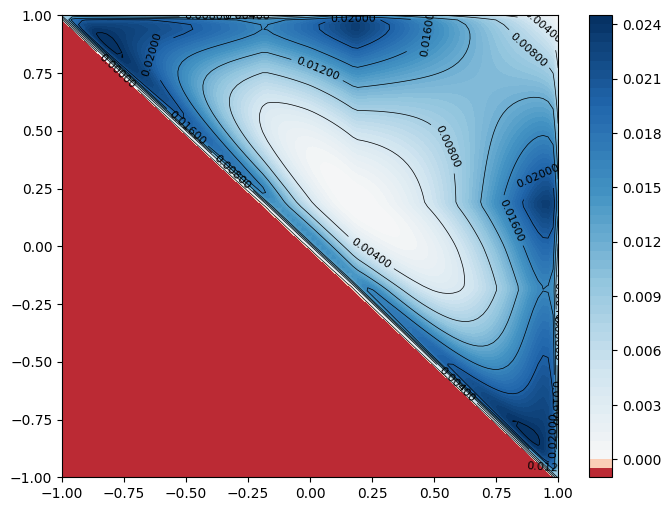
Figure 4: Contour plot of αGW5, validating the soundness of the rounding scheme across the feasible bias region via interval arithmetic.
Verification employs interval arithmetic with rigorous computational checks to ensure the desired affine dominance property of soundness over the relevant parameter space. This avoids closed-form analytical bottlenecks and allows for tight, computer-assisted proofs.
Implications and Theoretical Significance
The results reveal the apparent recalcitrance of Max-Cut with respect to structural graph promises:
- 3-Colorability Does Not Help: Unlike 2-colorability, even knowing a 3-coloring does not permit improved approximation, indicating a sharp computational phase transition.
- Large Independent Set Threshold: There exists a narrow window (between αGW6 and αGW7 in edge volume) where structural improvements cease; only when the independent set comprises a sufficiently large edge-volume fraction does the cut become tractable for improved approximation.
- Role for Valued PCSPs: The reduction design and isoperimetric analysis align naturally with the framework of valued promise constraint satisfaction problems (PCSPs), highlighting connections to recent algebraic complexity paradigms.
The techniques developed shed light on multipartite noise stability, opening avenues for related inapproximability questions in Max-αGW8-Cut and beyond. The tightness of the analysis—both in the hardness and the matching algorithmic threshold—suggests that these phenomena are robust, not artifacts of current proof technology.
Future Directions
- Algorithmic Optimality Above Threshold: The polynomial-time method given here requires decreasing the SDP value for analysis; it remains open whether the algorithm can be made genuinely optimal for all αGW9 (as conjectured).
- Generalizations to Higher Chromatic Number and Other CSPs: The techniques point toward broader exploration of noise stability and dictatorship testing for structurally restricted combinatorial optimization, with potential applications in other valued PCSP contexts.
- Efficiency of Verification via Interval Arithmetic: The computational aspects of verifying rounding scheme soundness at scale might inform future algorithmic hardness results in the presence of nuanced structural promises.
Conclusion
This paper establishes definitive UGC-hardness of αGW0-approximation for Max-Cut on 3-colorable graphs and on graphs with independent sets up to a critical edge-volume threshold, and simultaneously delineates the tractable regime above this threshold using novel SDP rounding. The main technical contributions—particularly the multipartite isoperimetric analysis—substantially advance both the theory of hardness of approximation and the algorithmics of semidefinite rounding, with direct implications for complexity-theoretic characterizations of CSPs under structural promises.