- The paper introduces iterated Geronimus transformations and demonstrates their role in generating Sobolev-type orthogonal polynomials with combined function evaluations and derivatives.
- It establishes explicit multi-term recurrence relations and connection formulas linking classical orthogonal polynomials with their Sobolev-type counterparts.
- It presents robust asymptotic analysis for Jacobi Sobolev polynomials, confirming the stability and invariance of key spectral attributes under perturbation.
Introduction and Context
This work develops a detailed spectral and algebraic framework unifying Geronimus transformations—rational spectral modifications at points outside the support of the original orthogonality measure—and Sobolev-type orthogonal polynomials whose inner products include both point evaluations and their derivatives. The focus is on the relationship between classical orthogonal polynomial families (e.g., Jacobi polynomials), their double Geronimus-transformed analogues, and sequences orthogonal in non-diagonal inner products involving derivatives, revealing deep algebraic structures and concrete asymptotic behaviors. The exploration is particularly rigorous, constructing explicit connection formulas and multi-term recurrence relations, and culminating in robust asymptotic results.
The Geronimus transformation, denoted generically as a measure modification dμg(x)=x−a1dμ(x)+Mδ(x−a) with a∈/supp(μ), is an archetypal rational spectral transformation that preserves much of the original orthogonality but introduces subtle structure via a point mass. Iterating this transformation at the same point a, known as a double Geronimus transformation, systematically injects higher-order singularities into the measure, ultimately yielding an orthogonality relation which involves both function values and derivatives at a.
The resulting Sobolev-type inner product is
⟨p,q⟩S=∫Ep(x)q(x)dμ(x)+Mp(a)q(a)+Np′(a)q′(a),
where a∈/supp(μ) and M,N>0, a prototypical example of a non-diagonal inner product that underpins the Sobolev orthogonality regime.
Recurrence Relations and Algebraic Structure
The main object of study is the sequence {Pngg(x)} of double Geronimus polynomials associated to the transformation. It is rigorously shown that these polynomials obey a modified three-term recurrence of the form:
Pn+1gg(x)=(x−a−σn,ngg)Pngg(x)−σn,n−1ggPn−1gg(x),
with recurrence coefficients parameterized explicitly in terms of the original recurrence coefficients and structural constants Bn,Cn relating a∈/supp(μ)0 to the original orthogonal polynomials a∈/supp(μ)1.
The polynomial structure is further elucidated through a five-term recurrence for a∈/supp(μ)2:
a∈/supp(μ)3
with all coefficients given in closed form. This higher-order recurrence encapsulates the non-diagonal (Sobolev) perturbation's algebraic impact, manifesting as non-trivial recurrence closure.
Central to the results are precise connection formulas between the Sobolev-type polynomials a∈/supp(μ)4 and both the original and double Geronimus-transformed polynomials. Utilizing the Christoffel-Darboux kernel a∈/supp(μ)5, the authors establish:
a∈/supp(μ)6
where the evaluations a∈/supp(μ)7 and a∈/supp(μ)8 are provided via linear systems involving derivatives of the kernel. The explicit determinantal representations for a∈/supp(μ)9, including for the special case of Jacobi polynomials at a0, enable precise reductions to classical forms and facilitate subsequent asymptotic analysis.
Asymptotic Analysis for Jacobi Sobolev Polynomials
A comprehensive asymptotic regime is developed for the Jacobi case, with the focus on the scaled monic polynomials a1 and their Sobolev counterparts. Employing detailed expansions involving the Gamma function and advanced manipulation of Christoffel-Darboux kernel derivatives, the study demonstrates:
- Derivative Ratio Asymptotic: For fixed a2,
a3
which is independent of the perturbation parameters a4.
a5
This result substantiates the stabilization of the Sobolev norm in the high-degree limit, tying the spectral transformation's effect directly to its algebraic manifestation.
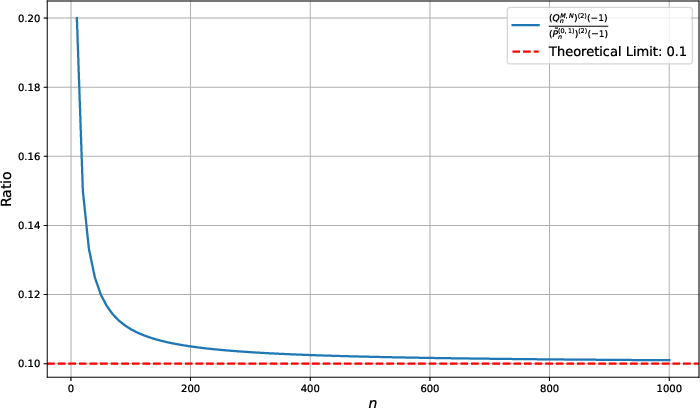
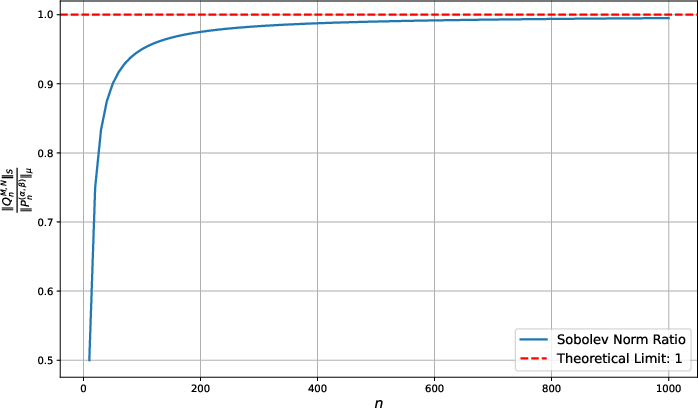
Figure 1: The convergence of a6 demonstrates alignment with the predicted theoretical limit for a7, a8, a9.
(Figure 2)
Figure 2: The norm ratio a0 approaches unity as a1 increases, confirming the Sobolev norm asymptotic.
Implications and Future Directions
The paper establishes substantive theoretical connections between spectral transformations (specifically, double Geronimus modifications) and Sobolev-type orthogonal polynomials, unifying seemingly disparate strands of spectral theory, algebraic combinatorics, and approximation theory. Key implications include:
- Unified Spectral Framework: The explicit equivalence between iterated Geronimus transformations and Sobolev-type inner products affirms the deep algebraic connection between spectral measure modifications and derivative-perturbed orthogonality structures. This result informs further development in spectral perturbation theory and the construction of Krall-type systems.
- Stable Asymptotic Behavior: The independence of certain asymptotic limits from mass parameters a2 underscores robust structural features for high-degree Sobolev polynomials, essential for spectral methods in approximation and numerical analysis.
- Algorithmic Opportunities: The concrete recurrence and connection formulas open avenues for efficient computation (including via matrix algorithms) of Sobolev-type orthogonal systems arising from spectral transformations—relevant for adaptive quadrature, spectral collocation, and integrable systems.
- Extensions to Matrix Polynomials and Beyond: The methodology and results appear extensible to matrix-valued orthogonal polynomials, multi-point spectral transformations, and nonclassical measures, potentially facilitating analysis of operator algebras related to bispectral problems and integrable hierarchies.
Conclusion
This rigorous examination of the interplay between Geronimus spectral transformations and Sobolev-type orthogonal polynomials advances both the algebraic understanding and practical computation of orthogonal systems under non-standard inner products. Through explicit connection formulas, multidimensional recurrence relations, and detailed asymptotic analysis—supported by numerical evidence—the work provides a comprehensive reference framework for researchers studying spectral perturbation, orthogonal polynomials, and their applications in computational mathematics and mathematical physics. The invariance of certain asymptotic quantities further signals strong structural features that are likely to influence future theory and algorithmic development in the domain of generalized spectral orthogonality.
(2604.10276)