- The paper establishes that phase displacements under weak nudging directly encode gradients with respect to each oscillator's natural frequency.
- It demonstrates that frequency-only learning in sparse Kuramoto architectures outperforms coupling weight learning, confirmed by multiple numerical approaches.
- It introduces spectral seeding to overcome convergence failures caused by loss landscape multistability, ensuring robust training outcomes.
Analytical Overview of "The Phase Is the Gradient: Equilibrium Propagation for Frequency Learning in Kuramoto Networks"
Introduction and Motivation
This work establishes that, for coupled Kuramoto oscillator networks, the equilibrium phase displacement under weak output nudging exactly encodes the gradient of the loss with respect to each oscillator’s natural frequency, formalizing and verifying a precise phase-gradient identity. Unlike prior equilibrium propagation (EP) studies on oscillatory substrates, which focused mainly on learning coupling weights and neglected frequency as a learnable parameter, this paper demonstrates—both theoretically and empirically—that frequency learning conditioned on convergence outperforms weight learning on sparse layered architectures. Furthermore, the commonly observed convergence failures are attributable to loss landscape multistability rather than gradient estimation error, and are eliminated by a principled, topology-aware spectral seeding scheme for initializer design.
Kuramoto networks are prototypical models of synchronization, with phase θi governed by intrinsic frequency ωi and weighted sinusoidal coupling Kij. While the cost of gradient computation in digital deep learning remains a major challenge, the authors demonstrate that, at the physical level, these oscillator networks manifest gradients directly in their phase response, obviating the explicit backward pass and its memory costs.
Phase-Gradient Identity
The central theoretical result is a closed-form relationship between phase displacements and gradients with respect to the mean-centered natural frequency vector ωc of the network. Given the stable equilibrium θ∗, a weak nudging force −β(θi−θitgt) applied at the output nodes yields a perturbed equilibrium θβ. The per-node displacement (θkβ−θk∗)/β converges to −∂L/∂ωkc as β→0, for quadratic output loss.
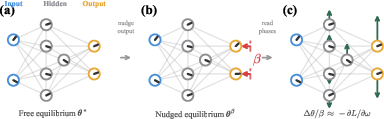
Figure 1: The two-phase gradient readout protocol; phase displacement under nudging gives the exact gradient with respect to oscillator frequency, in the ωi0 limit.
This identity is derived using the implicit function theorem, exploiting the Jacobian structure of the equilibrium system, which is shown to be the negative Laplacian of the coupling graph (i.e., ωi1 with ωi2 the coupling-weighted graph Laplacian). In the symmetric coupling regime, the gradient propagation matches diffusion on the graph mediated by ωi3. This closed-form relationship underpins a physical learning rule that holds for any system with odd coupling functions and symmetric weights, provided equilibrium exists and is stable.
Numerical Verification
The identity is rigorously validated across a broad range of network sizes (ωi4 to 200) and with multiple computational approaches: (1) the two-phase nudged/free equilibrium difference, (2) explicit Laplacian-based analytical computation, (3) finite-difference methods, and (4) a fully independent PyTorch autograd-based solver using implicit differentiation. All methods yield cosines of 1.000000 between their estimated gradients to machine precision, confirming the theoretical result and computational robustness.
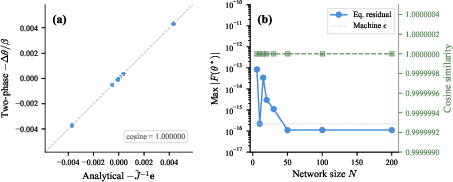
Figure 2: Per-node scatter of the two-phase gradient vs. the analytical gradient at ωi5 and ωi6; all points fall on ωi7.
Frequency vs. Coupling Weight Learning: Empirical Evaluation
Systematic ablation studies reveal that, on sparse layered Kuramoto architectures, frequency-only learning (ωi8-only) provides a marked accuracy advantage over coupling weight (ωi9-only) learning among converged seeds: for the binary vowel task, 94.3% vs. 82.3% test accuracy at matched parameter count (Kij0). Increasing the parameter budget for Kij1 does not close the gap.
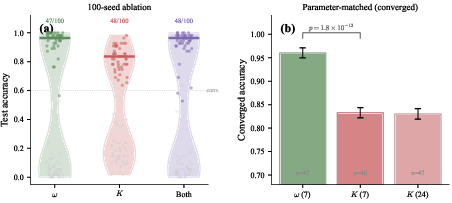
Figure 3: Violin plot of converged seeds in the ablation study: Kij2-only achieves higher test accuracy than Kij3-only, despite similar convergence rates.
Learning is performed with online SGD on a Kij4-input, Kij5-hidden, Kij6-output network, and results generalize across architectures and tasks. The frequency advantage is significant in the sparse regime (13.7 percentage points at Kij7), narrowing as architectures become denser.
Convergence Failure and Spectral Seeding
A salient empirical observation is a ~50% convergence failure rate across random seeds; this is shown not to stem from gradient estimation but rather from loss landscape multistability—repeat runs with the same seed but across different configurations yield identical convergence outcomes. Diagnoses based on Jacobian condition number, equilibrium solver diagnostics, and training trajectories corroborate this conclusion.
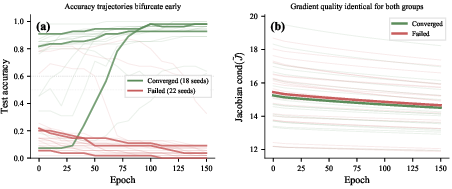
Figure 4: Example trajectories of converged and failed seeds; both have identical Jacobian condition numbers and no skipped samples, confirming the landscape-based origin of convergence failures.
To overcome this, the authors introduce spectral seeding, initializing Kij8 using eigenvectors of the reduced Laplacian weighted by their spectral output separation and inverse eigenvalue. This approach guarantees all seeds (100/100) converge with >90% test accuracy; random initialization gives only 46/100, with zero seeds lost in the transition.
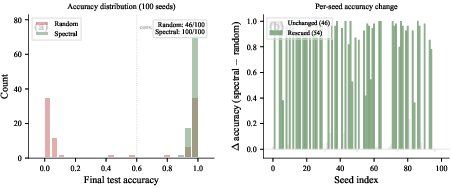
Figure 5: Spectral seeding eliminates random-initialization-induced basin failures, achieving 100/100 successful seeds versus 46/100 with random initialization.
The method generalizes to different tasks, training regimens (including Kij9-only), and larger architectures.
Theoretical and Practical Implications
The proven phase-gradient identity connects learning in physical oscillatory substrates to mathematical diffusion processes on the underlying coupling graph. It enables local, physically implemented gradient readout directly via phase measurement, bypassing traditional backward computation. The role of ωc0 as the primary effective parameter on sparse graphs, and the utility of spectral seeding, may inform both theoretical analyses of learning landscapes in physical neural networks and practical strategies for hardware-based learning machines.
Physically realizable implementations may include voltage-controlled oscillators, microring resonators, or other platforms where phase is a native variable and coupling is symmetric. The universality of the approach suggests direct extensions to other oscillator models with odd coupling and symmetric topologies.
Practically, while Kuramoto networks with limited parameterization do not compete with digital baselines on structured tasks, the methodology defines a canonical learning rule and initialization protocol grounded in physical and mathematical rigor. The energy-efficiency implications—while projected to be large—remain to be validated experimentally at scale.
Conclusion
This work rigorously establishes that phase displacements in Kuramoto networks under output nudging encode exact gradients with respect to oscillator frequency. Spectral properties of the coupling topology mediate both gradient propagation and the elimination of training basin failures. Frequency learning is conditionally superior for sparse architectures, contrasting with the consensus in prior literature. These results open new directions for physically grounded learning in oscillator architectures and offer algorithmic tools (spectral seeding, phase-based gradient acquisition) for future neuromorphic hardware development.