- The paper introduces an agent-based model combining social influence (α) and internal coherence (β) to reveal how belief networks evolve toward internal consistency.
- It demonstrates that arbitrary neutral associations become polarized, with simulations showing maximal group divergence in both opinion and affect.
- The study identifies critical parameter thresholds that trigger polarization, offering a baseline for evaluating interventions in sociocognitive dynamics.
Emergence of Stereotypes and Affective Polarization from Belief Network Dynamics
Modeling Framework and Theoretical Underpinnings
The study introduces an agent-based model wherein each individual in a social network constructs a personal belief network, comprising nodes for salient social concepts (e.g., self, peers, group identities, and neutral objects) connected by weighted, signed edges representing belief strength and valence. The core dynamics harness two principal mechanisms: social interaction—belief transmission and updating upon interaction with others—and an endogenous coherence drive via Social Balance Theory, ensuring that belief networks evolve toward internal consistency by minimizing cognitive dissonance.
Upon each simulated interaction, an individual (receiver) updates a focal belief by partially adopting the corresponding belief from a chosen neighbor (sender), with update magnitude controlled by a social influence parameter (α). Subsequently, the receiver performs an endogenous update to another belief in their network, selected via a two-step weighted random walk, in the direction that most efficiently reduces internal dissonance. The coherence-adjustment is modulated by a parameter (β), regulating the degree of preference for internal consistency.
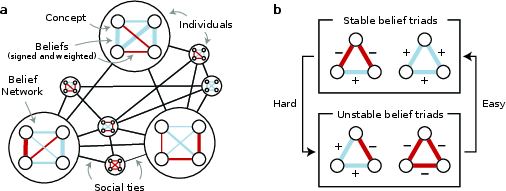
Figure 1: Schematic of belief network structure and the dynamic update rule integrating social and internal-coherence pressures.
This framework captures the psychological embedding of beliefs within an interconnected system, explicitly representing balancing constraints at the triad level, and operationalizes individual-level tendencies to harmonize belief sets following both direct interpersonal influence and indirect cognitive pressures.
Emergence of Stereotypes from Neutral Associations
The model demonstrates that even when groups are assigned arbitrarily and neutral concepts (e.g., "latte") have no initial group-association, stereotypes can emerge purely as an epiphenomenon of social communication and coherence seeking. Simulations initialize all beliefs (apart from strong, fixed group identifications) to near-zero, unbiased values. Yet, as the update dynamics proceed, beliefs regarding the association between neutral concepts and group identities become polarized without any exogenous differences or realities underlying them.
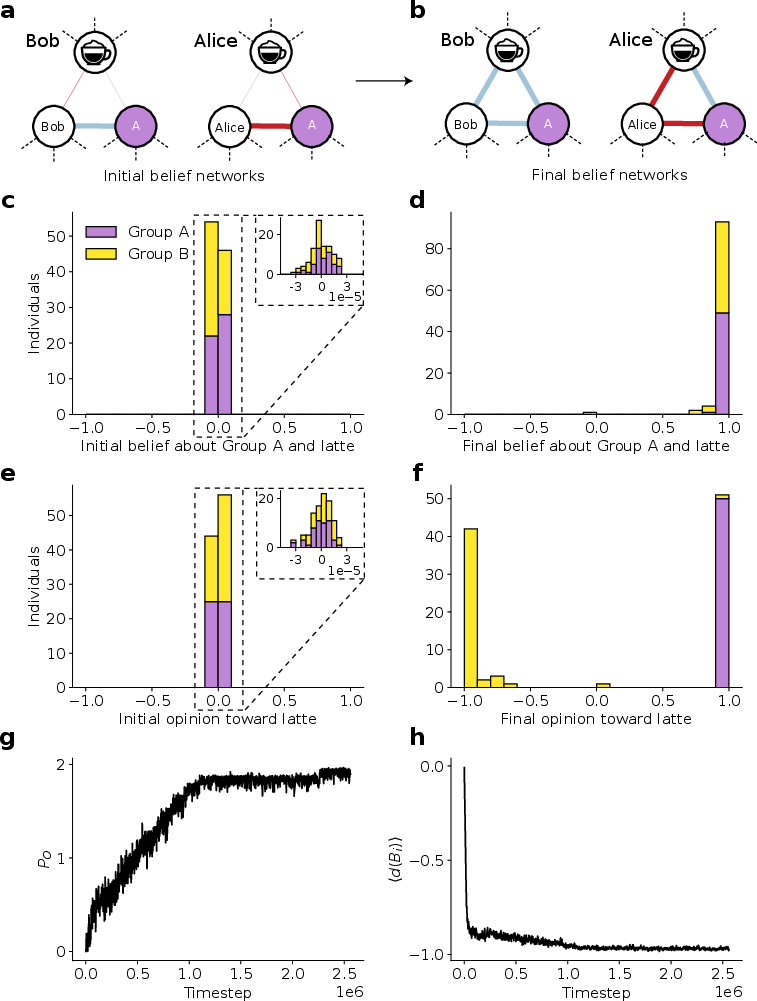
Figure 2: Temporal evolution of beliefs revealing that stereotypes associating neutral concepts to group identities are instantiated solely via social-coherence dynamics, absent baseline differences.
Key numerical results indicate that by the terminal state, group association with the neutral concept is maximal and sharply divergent across groups. Individual preferences ("latte-liking") similarly polarize along group lines, and the opinion polarization metric, PO, approaches its maximal bound of $2$. Intriguingly, the process is accompanied by a monotonic decrease in average network dissonance, underlining a convergence toward highly internally consistent (and stable) belief structures.
Dynamics and Metrics of Affective Polarization
The model further elucidates the endogenous genesis of affective polarization—the emergence of positive valence toward ingroup members and negative valence toward outgroups—even in the absence of any substantive ideological conflict. As individuals are exposed to the behavior of others, they infer likely group memberships and recursively update their social beliefs to maintain coherence, ultimately yielding population-wide affective separation.
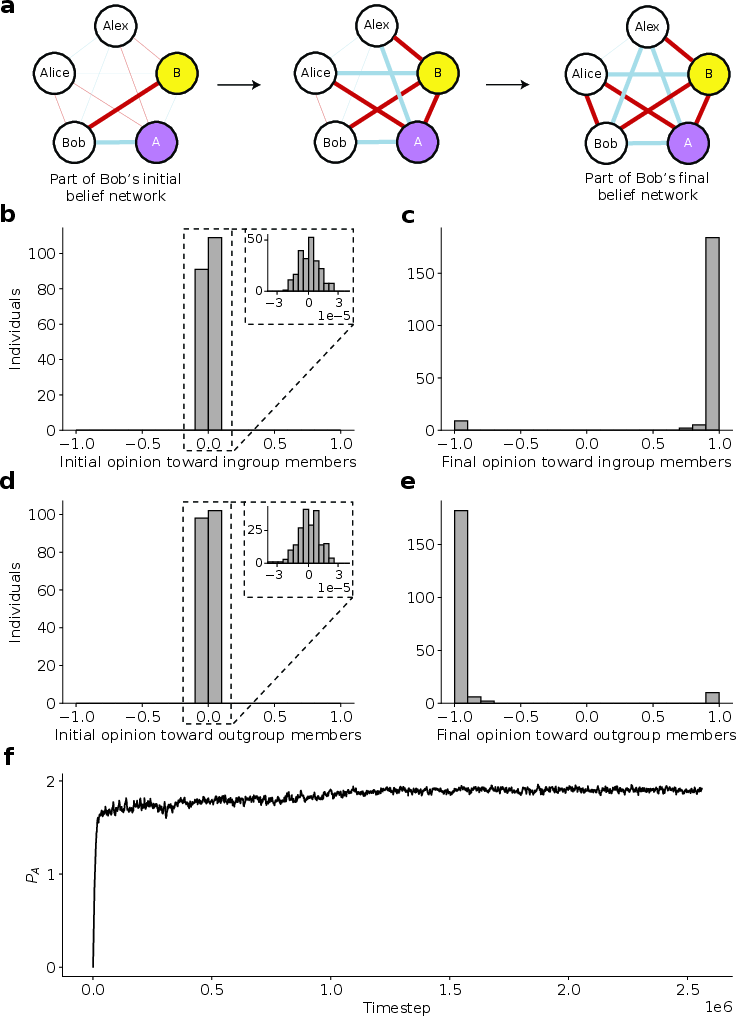
Figure 3: Trajectories of individual and collective beliefs depicting the consolidation of ingroup favoritism and outgroup derogation via iterative social and belief network mechanisms.
Empirically, the simulation registers affective polarization PA rising from $0$ (unbiased) to nearly $2$ (maximum affective divide) by the system's end-state. Notably, the process does not depend on prior knowledge of others' group affiliations or any structural constraints; initial condition symmetry and a fully mixed interaction protocol suffice. The minority of individuals who develop nonconforming (outgroup-favorable) beliefs are explained by false inferences arising from projection and the drive for network coherence, offering a formalization of empirical cognitive biases such as the false consensus effect.
Parameter Regimes Governing Polarization and Stereotype Emergence
A systematic parameter sweep demonstrates that only when both social influence (α) and the drive for internal coherence (β) are nontrivial does the model reliably generate pronounced population polarization and group-level stereotypes. For α>0.5 and β0, polarization metrics saturate, with belief distributions tightly clustering at extreme values segregated by group. High β1 values, holding β2 fixed, suppress polarization due to premature crystallization of beliefs before adequate social learning occurs.
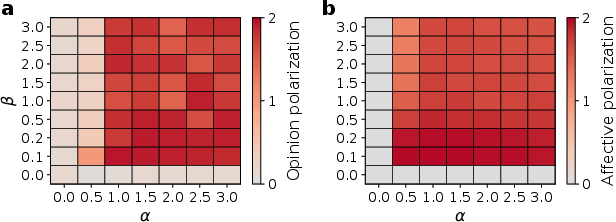
Figure 4: Joint dependency of opinion and affective polarization metrics on social influence (β3) and internal coherence (β4) parameters.
These findings specify critical thresholds for the interaction of cognitive and social factors in generative models of stereotype formation and polarization, and they delimit the parameter regimes in which group-aligned patterns are most likely to emerge.
Implications for Theory and Computational Social Science
The primary implication hinges on the theoretical minimality required for group-based stereotypes and affective polarization to manifest. The model provides a rigorous mechanistic account demonstrating that neither homophily, community structure, nor real group differences are needed; polarization can arise in well-mixed, undifferentiated systems via basic psychological and social processes alone. This demystifies real-world phenomena where polarization emerges around initially apolitical or inconsequential symbols, and rationalizes the rapid entrenchment of arbitrary or even erroneous group associations.
The theoretical advancement includes shifting the modeling focus from independent attitude updates to belief networks, where each belief is mutually constrained with others and changes may propagate nonlocally through coherence-seeking adjustments. This perspective maps closely to recent empirical findings in attitude networks and advances cognitive theories of belief system organization.
Practically, the model's generality recommends its use as a baseline or null model against which more complex sociocognitive dynamics—such as leadership, media influence, selective exposure, and identity salience—can be evaluated. It further cautions that interventions aimed at depolarization must address both social communication structures and the cognitive architecture that gives rise to coherence-seeking.
Extensions discussed include: incorporating network structure/homophily; increasing group or concept dimensionality; modeling dynamic group identity assignment; distinguishing direct from meta-beliefs/theory of mind; and calibrating to empirical observation and experimental data.
Conclusion
By formalizing the interplay between social influence and internal coherence within belief networks, this study demonstrates the spontaneous generation of stereotypes and affective polarization in the absence of real group differences or external drivers. The results underscore the sufficiency of basic cognitive and social mechanisms for the onset of group-aligned belief patterns and provide a foundation for future explorations of polarization phenomena using network-based cognitive-social models.
(2604.10251)

