- The paper introduces AL-ATCI, which leverages active learning to pinpoint key determinants in finite-Hamiltonian impurity solvers.
- It employs a random-forest classifier to pre-screen and rank determinants, significantly reducing the Hamiltonian diagonalization workload.
- The approach achieves reliable ED-level accuracy with fewer determinants, enabling efficient large-bath and multi-orbital DMFT simulations.
Introduction
The exponential scaling of Hilbert space remains the primary bottleneck for finite-Hamiltonian impurity solvers—those that diagonalize explicit, finite Anderson models within DMFT frameworks—especially as the number of bath or orbital degrees of freedom increases. This paper introduces an active learning extension of adaptive-truncation configuration interaction (AL-ATCI), addressing this challenge by employing machine learning techniques to identify the physically relevant subspace of high-importance Slater determinants. The primary findings are: (1) the computational complexity of AL-ATCI grows only weakly with bath or orbital dimension, and (2) Nquery provides a direct, systematically improvable handle on solution accuracy in the absence of external benchmarks.
AL-ATCI Algorithm Overview
AL-ATCI builds upon the adaptive-truncation configuration interaction (ATCI) solver, itself an iterative selected CI method that employs reference configurations and particle-hole substitutions in conjunction with natural orbital transformations. In AL-ATCI, a random-forest classifier is trained during the iterative solver cycle using previously accumulated data to predict the importance of candidate determinants, which are then ranked and the top Nquery retained for Hamiltonian construction and diagonalization. This pre-screening step sharply reduces the dimension of the matrix diagonalization task, the dominant computational cost in the ED/CI context.
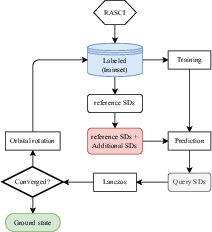
Figure 2: AL-ATCI flowchart, indicating the classifier training, determinant ranking, and selective querying loop.
The classifier operates on binary occupation representations, and importance labels are determined by wavefunction coefficients exceeding a prescribed threshold. Careful dataset management, symmetry partner construction, and class-imbalance corrections ensure stability and generalization within DMFT cycles.
Systematic Control and Convergence
The query size Nquery constitutes a direct and fine-grained convergence knob for AL-ATCI, enabling systematic approach to ED-level accuracy across both static and dynamical observables. For the one-dimensional half-filled Hubbard model, clear monotonic convergence of total energy, occupancies, and (matrix-valued) self-energy is observed as Nquery increases, with best agreement achieved for orders-of-magnitude fewer determinants than the full Hilbert space.
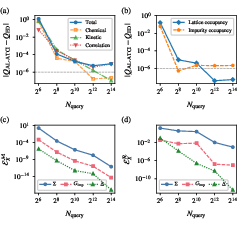
Figure 3: Convergence of various observables (energy, occupancy, self-energy) with increasing Nquery in a cluster DMFT setup.
This behavior is robust to physical regime—convergence in insulators (large U/t) is achieved at lower Nquery than in metals, consistent with the smaller entanglement and more compact determinant manifolds in insulating ground states.
Scaling and Computational Cost
A pronounced advantage of AL-ATCI is its weak scaling with bath size Nb. Unlike ATCI and conventional ED—which see exponential increases in determinant counts and wall-clock time as bath orbitals are added—AL-ATCI exhibits markedly slower growth, essentially decoupling the cost of Hamiltonian enlargement from the nominal orbital count. The physically relevant manifold, as discovered by active learning, expands far more slowly than the total determinant space.
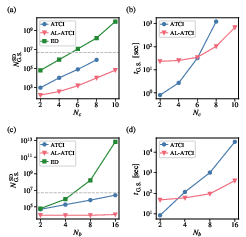
Figure 4: Scaling of selected determinant count and computational cost with cluster (Nc) and bath size (Nb) for ATCI and AL-ATCI.
This enables regime access (e.g., large Nquery0 cellular DMFT, large Nquery1 for hybridization-fit convergence, or inclusion of spectroscopically relevant noninteracting orbitals) that is otherwise prohibitive for standard CI methods.
Timing analyses indicate the speedup emerges from the reduction in ground-state diagonalization size. Overheads incurred from classifier training and prediction are negligible by comparison.
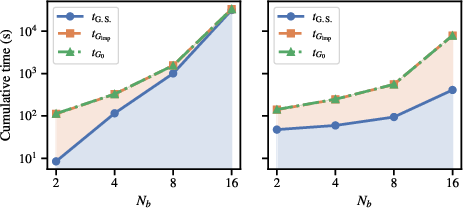
Figure 6: Breakdown of cumulative wall-clock time as a function of bath size, illustrating the dominance and suppression of diagonalization time with AL-ATCI.
Physical Benchmarks: Cluster and Multi-Orbital Calculations
One-Dimensional Hubbard Model
Applying AL-ATCI to the 1D Hubbard model within cluster DMFT, the solver achieves ED-equivalent spectral functions for clusters as large as Nquery2, with significantly reduced computational effort and memory.
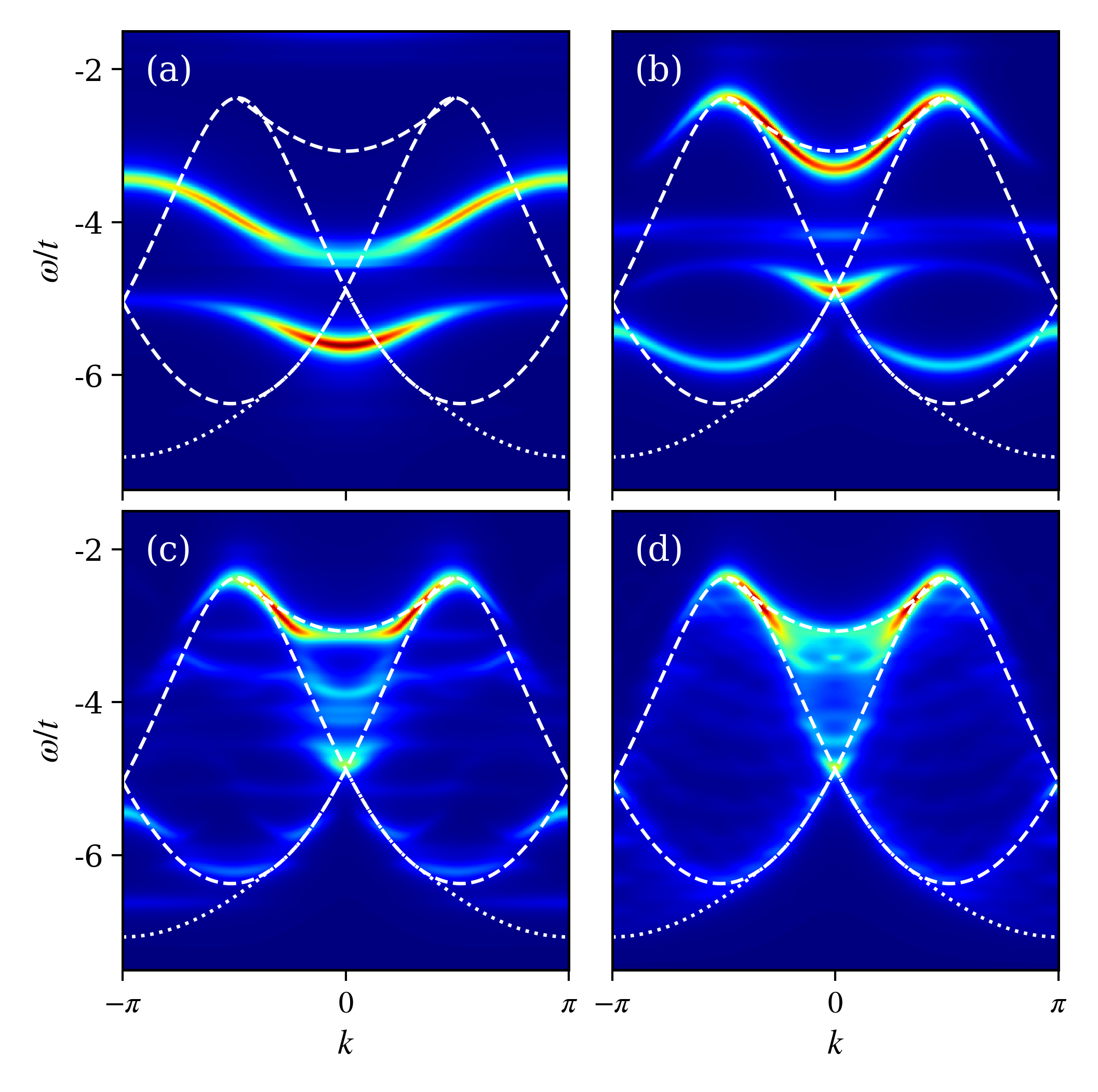
Figure 1: Spectral function evolution with increasing cluster size, showing improved short-range correlation capture and approach to Bethe-ansatz spinon/holon bands as Nquery3 increases.
Momentum-resolved spectra illustrate systematic convergence and accurate reproduction of Mott gaps, particle-hole symmetry, and fine structure absent at low cluster sizes.
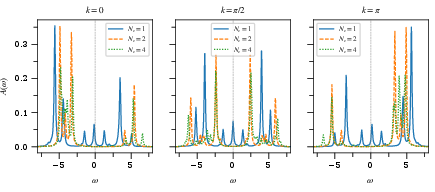
Figure 8: Momentum-resolved spectral function Nquery4 for small clusters, documenting approach to correct spectral symmetry and gap.
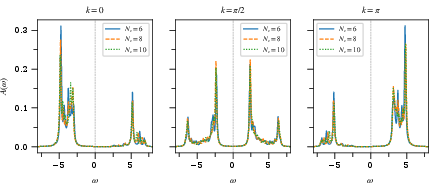
Figure 10: Convergence of Nquery5 at larger clusters Nquery6, showing near-indistinguishable spectra with increasing Nquery7.
SrNquery8RuONquery9 Three-Orbital Problem
AL-ATCI is also applied to SrNquery0RuONquery1 with a fully rotationally invariant three-orbital impurity model—a regime intractable for ED at moderate bath size. The rapid decay of CI coefficient weights across all Nquery2 demonstrates the compressibility of the many-body wavefunction and justifies truncated Hilbert space techniques. Convergence of self-energy and spectral functions with bath size is achieved up to Nquery3.
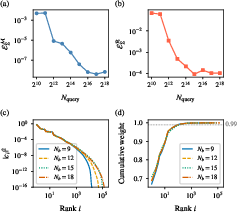
Figure 11: Self-energy convergence with query size and CI coefficient weight decay for increasing Nquery4 in the three-orbital impurity problem.
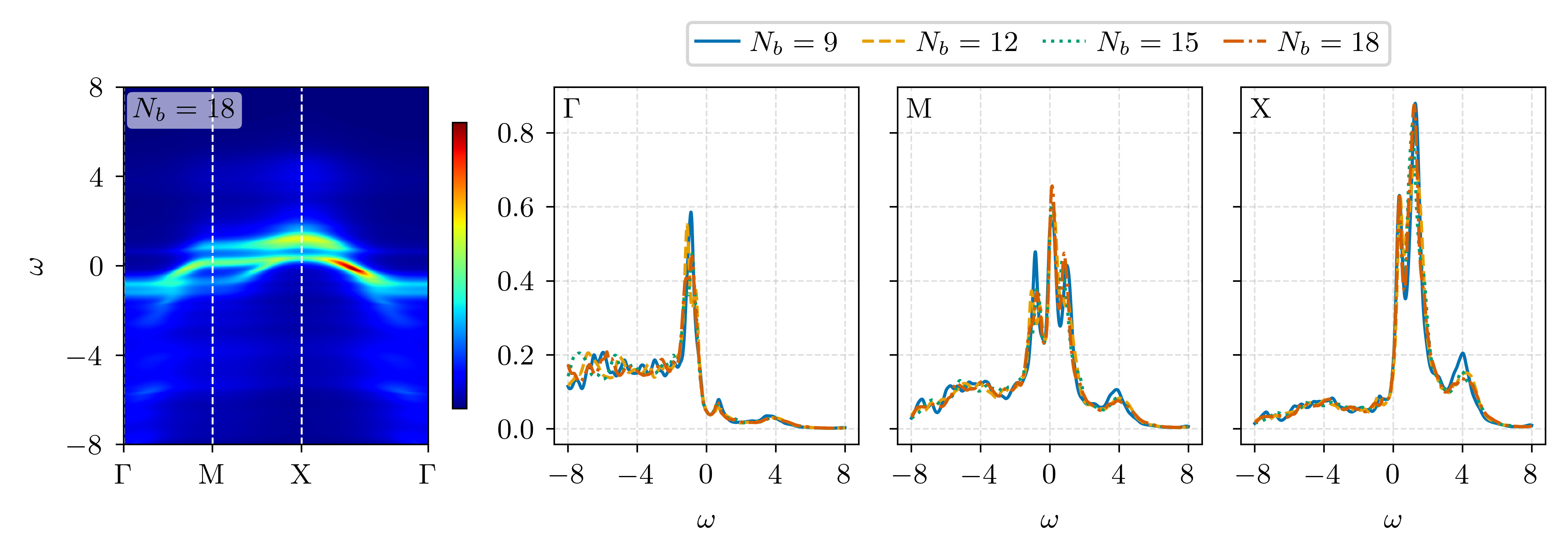
Figure 5: SrNquery5RuONquery6 spectral function for Nquery7 to Nquery8, showing systematic convergence and robustness to bath discretization.
Implications and Future Directions
The paper establishes that the physically relevant determinant manifold for correlated impurity solvers does not scale exponentially with one-particle orbital dimension in physically meaningful regimes, instead being dictated by underlying correlation structure and entanglement. For cluster extensions/truncation-based solvers, this is a decisive shift: large-bath, enlarged orbital, or multi-orbital calculations become accessible while retaining the real-frequency, sign-problem-free advantages of finite-Hamiltonian approaches.
The Nquery9 parameter provides not merely computational control, but a practical error bar and internal convergence metric in the absence of external benchmarks—essential for realistic material calculations where exact solutions are lacking.
Beyond quantum impurity models, this paradigm of actively discovering and compressing the physically relevant many-body space with machine learning can be extended to more general correlated lattice problems, quantum chemistry, and spectroscopic simulations (e.g., large-orbital RIXS/XAS).
Conclusion
AL-ATCI marks a significant advance in the tractability of configuration-interaction-based impurity solvers for DMFT and related quantum embedding frameworks. By introducing an active learning loop that systematically targets the subspace of relevant Slater determinants, the method decouples computational complexity from nominal orbital count and renders large-bath and multi-orbital DMFT calculations feasible without loss of real-frequency precision. This scalability, supported by extensive numerical validation across single- and multi-band regimes, positions AL-ATCI as an essential tool for advancing the frontier of numerically exact many-body quantum solvers.

